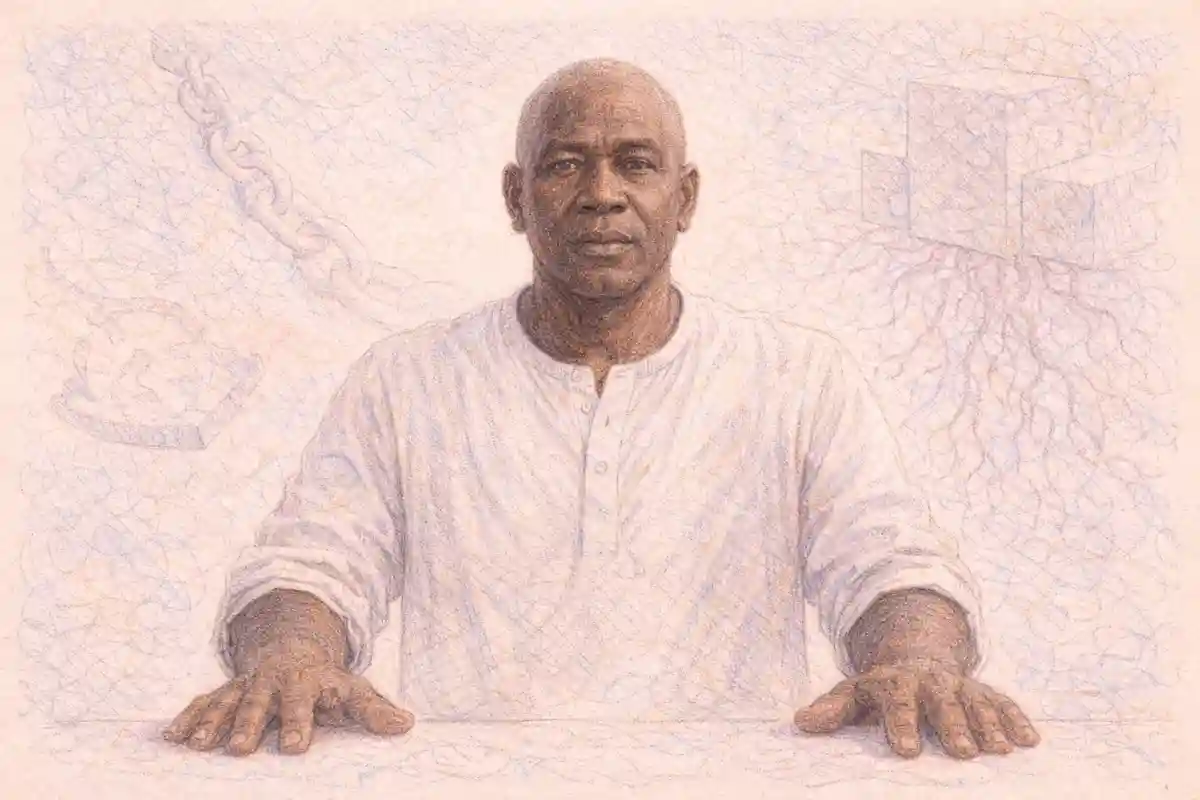
On the afternoon of January 22, 1973, a former president collapsed in the bedroom of his Texas ranch house, dialed the security detail for help that arrived too late, and died of a heart attack at age 64. He had been out of office four years and five days. He was, by every measure available in that moment, a man whose historical reputation had cratered. The Gallup approval rating he carried out of the White House in January 1969 was 49 percent, a recovery from worse, but his standing among the educated classes who read books and wrote them was lower still. The peace agreement his successor would sign in Paris five days after his funeral was the war he had escalated and could not end. The newsreels of his presidency that ran on the evening broadcasts that night were not the Voting Rights Act signing ceremony from March 1965. They were the cities burning in 1967 and 1968, the body counts from MACV briefings, the protesters chanting outside the White House.

Robert Caro was thirty-seven years old that January and had not yet begun the project that would reshape what was thinkable about this dead president. The first volume of The Years of Lyndon Johnson would not appear until 1982, nine years after the funeral. The Path to Power would run 882 pages and would change nothing immediately about the public estimation of the man it covered, because the man was already a punchline in the spring of 1973, a Texas figure receding into the rearview mirror of a country trying to forget Vietnam. What Caro had begun, however, would over four decades and four volumes produce one of the strangest historiographic events in American political biography. It would lift Lyndon Johnson into the top fifteen presidential rankings while leaving the war catastrophe untouched. It would generate a split verdict that no subsequent reassessment has reconciled. That split verdict, durable, productive, and analytically unstable, is the subject of this article.
The Shape of a Split Verdict
The phrase “split verdict” sounds like a hedge. It is not one. A split verdict is a specific finding: the evidence on one set of questions points decisively in one direction, the evidence on another set of questions points decisively in the opposite direction, and the two judgments do not cancel each other out into a moderate composite. They sit beside each other, unreconciled, because the underlying historical record will not let them be reconciled.
LBJ’s case is the cleanest example in the modern presidency. On civil rights and social policy, the record is near-elite: the Civil Rights Act of 1964 broken out of the Senate by the cloture vote that ended the longest filibuster in American history, the Voting Rights Act of 1965 signed five months after Selma, Medicare and Medicaid creating the largest federal entitlement expansion since Social Security, the Immigration and Nationality Act of 1965 dismantling the national-origin quota system that had been law since 1924, the Higher Education Act of 1965 creating federal student aid, and the Fair Housing Act of 1968 signed seven days after the assassination of Martin Luther King. On foreign policy and war-decision-making, the record is bottom-tier: the Gulf of Tonkin Resolution of August 1964 obtained on the basis of an attack that did not happen as described, the escalation decisions of July 1965 that put 200,000 troops into Vietnam without a declaration of war, the rolling commitment that reached 549,500 troops by April 1969, the 58,220 American deaths recorded on the Vietnam Veterans Memorial wall, and the estimated 1.3 million Vietnamese military and civilian deaths across both sides of the conflict by 1975.
Most presidential reputations consolidate. Lincoln consolidates around the Union and emancipation. Reagan consolidates around the Cold War endgame and the conservative restoration. Even contested figures like Andrew Jackson consolidate around a single recognizable thesis (the democratic-populist innovator who also engineered the Trail of Tears). LBJ does not consolidate. The Caro project, four volumes and counting, has lifted his domestic standing without resolving the foreign one. The aggregate ranking polls (C-SPAN 2000, 2009, 2017, 2021; Siena 1982, 1990, 1994, 2002, 2010, 2018; Schlesinger 1948, 1962, 1996; APSA Presidential Greatness Project 2018, 2024) place him between 10th and 14th across forty years of surveys. That position averages across deeply divergent domain scores. It papers over the verdict it cannot reach.
The argument of this article is that the split verdict is not a failure of historiographic resolution. It is the correct verdict, and the inability to consolidate is itself the most important fact about LBJ’s reputation. The split reveals something the consolidation would conceal: the same expanded presidential authority that made the Great Society possible made the Vietnam catastrophe possible. The Civil Rights Act and the Gulf of Tonkin Resolution passed within seven weeks of each other in the summer of 1964. The Voting Rights Act and the July 1965 escalation decisions ran on parallel tracks through the same White House staff system. You cannot extract the domestic achievement from the foreign disaster cleanly because they emerged from the same political instrument operating at maximum capacity. That is the imperial presidency thesis in its purest manifestation, and Lyndon Johnson is the case that establishes it.
Phase One: The Nadir, 1969 to 1973
LBJ left office on January 20, 1969 with a 49 percent Gallup approval rating, a meaningful recovery from the 36 percent low he had touched in August 1968. The recovery was driven by the bombing halt announcement of October 31, 1968 and by his withdrawal from the presidential race of March 31 the same year. Both decisions were attempts to extract himself from the war politically, and both produced modest rehabilitation in the polling. The recovery was illusory as a guide to historical reputation. The figure that mattered was not Gallup. It was the rolling assessment among the people who wrote about presidencies and shaped how college students learned them.
That assessment in January 1969 was brutal. The arc of his presidency, as the historical profession then understood it, was a tragedy whose catastrophic third act swallowed everything else. Eric Goldman, who had served as Special Consultant to the President from 1963 to 1966, published The Tragedy of Lyndon Johnson in 1969 within months of LBJ’s departure. The title itself was the prevailing framing. Goldman portrayed a president whose intellectual limitations and personal coarseness had collided with a war he did not understand, producing a presidency whose domestic achievements were overwhelmed by foreign catastrophe. The book was not hostile in tone, but its central thesis (LBJ was unsuited to the office in ways the Vietnam crisis exposed) defined the early post-presidential consensus.
That consensus hardened across 1969 and 1970 as the war continued under Nixon. The Cambodian incursion of May 1970, the killings at Kent State on May 4, 1970, and the publication of the Pentagon Papers in June 1971 all contributed to a public reckoning with how the Vietnam War had been initiated and escalated. The Pentagon Papers, in particular, did damage that has never been undone. Daniel Ellsberg’s leak of the Defense Department’s secret history of decision-making in Vietnam exposed the systematic deception of Congress and the public about the war’s scope and trajectory. The documents made clear that the Gulf of Tonkin Resolution had been obtained through misrepresentation of the August 1964 incident, that the bombing campaigns had been planned long before they were publicly announced, and that internal Pentagon assessments had been consistently pessimistic about the war’s prospects even as public statements remained optimistic. The Tonkin material specifically (covered in the Gulf of Tonkin decision article) damaged LBJ’s reputation in a way no subsequent reassessment has been able to repair. The deception was documented, sourced, and unambiguous.
LBJ himself, in retirement at the Texas ranch, did not help his cause. He gave one extended television interview series with Walter Cronkite in 1969 and 1970 (broadcast as A Conversation with Mr. Lyndon B. Johnson across three programs in early 1970) in which he attempted to defend the Vietnam decisions. The defense was unpersuasive in tone, defensive in substance, and largely ineffective in reaching audiences that had concluded the war was a catastrophe. He worked on his memoir, The Vantage Point: Perspectives of the Presidency 1963 to 1969, which appeared in 1971. The memoir is a flat document, ghostwritten in significant part, and read at the time as a defensive accounting that did not engage with the deepest charges against him. It sold modestly. It did not change minds.
Doris Kearns Goodwin, who as Doris Kearns had been a White House Fellow during LBJ’s presidency, was given extraordinary access to LBJ in retirement. Her Lyndon Johnson and the American Dream, published in 1976 three years after his death, was the first significant scholarly attempt at a sympathetic reading. Kearns Goodwin reported the long taped conversations with LBJ in which he reflected on his career, his ambitions, and his presidency. The book made the case that LBJ should be understood through the lens of his Texas Hill Country origins and his deep personal investment in the dispossessed populations of the South and the Southwest. It humanized him without rehabilitating him. The Vietnam material in the book was thinner than the domestic material because LBJ himself, in their conversations, found Vietnam difficult to discuss with the same expansiveness he brought to civil rights and social policy. The Kearns Goodwin book sold respectably and won admiration in the profession. It did not, however, displace the Goldman framing as the dominant scholarly understanding.
The 1972 Schlesinger Sr. poll (administered by historian Arthur Schlesinger Sr. and updated by his son Arthur Schlesinger Jr.) had not yet been re-run for a Johnson-inclusive assessment. The first ranking poll to include LBJ in a meaningful way was the 1982 Murray-Blessing survey, which placed him in the top quarter but well below the top ten. That ranking captured the early consensus accurately: a president whose domestic achievements were significant but whose Vietnam record was disqualifying for top-tier ranking. Through the 1970s the LBJ reputation sat at this level: respected as a legislator, condemned as a war-maker, ranked somewhere in the 11th-to-15th range in the few systematic surveys conducted in that decade.
Phase Two: The Caro Project Begins, 1982 to 1990
Robert Caro had spent most of the 1970s researching the LBJ project. He had moved to the Texas Hill Country with his wife Ina to do oral histories with people who had known LBJ as a boy, a young teacher, a congressional aide, a freshman congressman. He had read his way through the LBJ Library holdings in Austin (the library had opened in 1971 and was rapidly becoming one of the most accessible presidential archives in the country, in part because LBJ had personally instructed that virtually all his papers be made available without restriction). He had interviewed surviving members of LBJ’s congressional staffs, his Senate office, his vice presidential staff, and his White House staff. He had assembled what would prove to be the most ambitious archival biography project ever undertaken on an American president.
The first volume, The Path to Power, appeared in November 1982. It covered LBJ from his birth in 1908 to his 1941 special election loss for the Texas Senate seat. The volume was 882 pages long. It was not a sympathetic portrait. Caro’s LBJ was driven, manipulative, dishonest about his college record at Southwest Texas State Teachers College, brutal toward subordinates, and willing to steal the 1948 Texas Senate primary against Coke Stevenson through ballot manipulation in Jim Wells County. The Box 13 episode received its first sustained scholarly treatment in The Path to Power and the subsequent volume Means of Ascent (1990). Caro documented the manipulation in detail and named the participants. The early reviews of The Path to Power were laudatory for the prose and the research, but readers who came expecting rehabilitation found the opposite. The first Caro volume hardened the case against LBJ rather than softening it.
The reception was puzzling for what came next. Caro had set up a deeply unflattering portrait. Yet the subsequent volumes would, paradoxically, contribute to a rehabilitation of LBJ’s reputation that Caro himself appeared not to be advancing. The mechanism was the depth of the documentation. Caro was not merely arguing LBJ was a flawed man. He was establishing, in granular archival detail, that LBJ was a political operator of extraordinary capacity. The portrait of LBJ in the Senate, as Caro would render it in Master of the Senate (2002), was unprecedented in its depiction of legislative skill at the highest order. To depict that skill required showing the full range of what LBJ could do with power. The full range, once shown, generated reassessment.
Means of Ascent, the second volume, appeared in March 1990. It covered the 1941 to 1948 period and centered on the 1948 Senate primary against Stevenson. The book is the most hostile of the four volumes published to date. Caro’s portrayal of the stolen election is unsparing. The contrast between Stevenson (rendered as a man of personal integrity in the old Texas mold) and LBJ (rendered as the new style of political operator willing to do whatever it took to win) was the book’s organizing structure. Some Texas historians objected that Caro had overcorrected, giving Stevenson too much credit as a moral figure while underweighting Stevenson’s own political maneuvering. The objections did not change the basic finding that the 1948 election had been won through ballot manipulation. The finding has held.
Means of Ascent did not lift LBJ’s reputation. It deepened the documentation of how he operated. The reputation effect would come from the third volume, which would take twelve years to appear.
Phase Three: The Reassessment Solidifies, 2002 to 2012
Master of the Senate appeared in April 2002. It covered the 1949 to 1960 period and was 1,167 pages long. It is the book that changed the LBJ conversation. Caro’s argument was that LBJ, in the Senate years and particularly as Majority Leader from 1955 to 1961, accomplished a feat of legislative engineering that no twentieth-century Senate leader matched before or has matched since. The 1957 Civil Rights Act, the first civil rights legislation since Reconstruction, was the centerpiece. Caro reconstructed in detail how LBJ navigated the Senate’s segregationist Southern bloc (whose votes he needed to remain in leadership) and the Northern liberal bloc (whose votes he needed for any civil rights progress at all) to produce a bill that, while modest in substantive effect, broke a precedent that had held for eighty years.
The 1957 Civil Rights Act analysis in Master of the Senate is the document that began the reputation shift. Caro made the case that LBJ in 1957 had used the legislative machinery of the Senate against the deepest commitments of his own regional political base. The Southern senators (Richard Russell, James Eastland, Strom Thurmond, Sam Ervin, Harry Byrd) opposed any civil rights bill on principle. LBJ as Majority Leader was effectively their political product. Yet he engineered a process in which a civil rights bill, however watered-down, passed the Senate without the Southern bloc breaking with him personally. The mechanism (procedural maneuvers, vote-counting, the famous capacity for face-to-face persuasion that Caro renders in extended scenes) is the substance of Master of the Senate.
Caro did not argue that LBJ was motivated in 1957 primarily by moral commitment to civil rights. The book is clear that LBJ’s primary motivation was the building of a national political coalition that would enable his presidential ambitions. The bill served that ambition. The Southern bloc’s tolerance of the bill (which a stronger version would have triggered a filibuster they would have won) served LBJ’s coalition-building. The argument is layered, not naive. LBJ acted on civil rights in 1957 because his political ambitions required it, but the action produced consequences that exceeded the motivation. The 1957 bill broke a procedural ceiling that the 1964 bill would punch through.
The reception of Master of the Senate transformed the LBJ conversation. The book won the 2003 Pulitzer Prize for biography and the 2002 National Book Critics Circle Award. Reviewers in the major outlets (The New York Times Book Review, The New York Review of Books, The Atlantic, The New Yorker) made the case that Caro had produced a portrait of legislative mastery without parallel in American political biography. The reassessment of LBJ’s domestic capacity began to consolidate around this third volume. The narrative shift was not that LBJ had been good. It was that LBJ had been competent on a scale that previous portraits had failed to capture.
The C-SPAN Survey of Presidential Leadership, first conducted in 2000 and re-run in 2009, 2017, and 2021, captured the shift. In 2000, LBJ ranked 17th overall. In 2009, after Master of the Senate had become standard, he ranked 11th. The movement of six places in nine years was the largest upward shift of any twentieth-century president across those years. The 11th-place ranking in 2009 has been broadly stable through subsequent surveys: 10th in 2017, 11th in 2021. The Siena College surveys show a parallel trajectory, with LBJ moving from 13th in 1982 to 10th in 2018.
The fourth Caro volume, The Passage of Power, appeared in May 2012. It covered the transition period from late 1958 (when LBJ’s presidential campaign began to falter) through early 1964, when LBJ as president broke the Senate filibuster against the Civil Rights Act. The book is more sympathetic to LBJ than any of the prior three volumes. The transition period after the Kennedy assassination is rendered as a moment of national crisis that LBJ navigated with exceptional skill. The November 22 to 27, 1963 segment, from the Dallas motorcade through the joint session of Congress address LBJ gave on November 27, is the most dramatic passage Caro has produced on his subject. The Civil Rights Act material, covering the cloture vote of June 10, 1964 that broke the longest filibuster in Senate history, makes the case that the legislation could not have happened under any other president in that window. The bill required someone who knew the Senate procedures, the personalities, and the vote-counting math at the level that only LBJ possessed. The argument is documented in detail through the cabinet records, the White House taping system, and the legislative correspondence (the Civil Rights Act cloture vote is treated at length in the corresponding decision article).
The Passage of Power is the volume in which Caro’s sympathy for his subject becomes visible. The book ends at the signing of the Civil Rights Act on July 2, 1964. Vietnam is over the horizon. The Gulf of Tonkin Resolution will not come for another month. The escalation decisions will not come for a year. The volume captures LBJ at his peak as a domestic operator, before the foreign-policy disaster begins. Caro has not yet published the fifth volume, which will cover the Vietnam years. He has said in interviews that the fifth volume is in progress and that he intends to complete it. The question of how Caro will render Vietnam is the open question that the historiography has been waiting on since 2012.
Phase Four: Robert Dallek and the Documentary Foundation
Robert Dallek’s two-volume biography (Lone Star Rising, 1991, and Flawed Giant, 1998) is the work that did the documentary heavy lifting on the LBJ archive for scholars who wanted a more balanced presentation than Caro was producing. Where Caro is a literary biographer with a moral framing, Dallek is an academic historian with a documentary commitment. The two volumes together total 1,200 pages and cover the entire LBJ life. Lone Star Rising covers 1908 to 1960. Flawed Giant covers 1961 to 1973. The Vietnam material in Flawed Giant is the most extensive scholarly treatment of LBJ’s war decision-making produced to date.
Dallek’s verdict in Flawed Giant is the closest thing to a balanced scholarly assessment of LBJ. He is sympathetic on civil rights, where his reconstruction of the 1964 and 1965 legislative achievements matches Caro’s later treatment in The Passage of Power. He is critical on Vietnam, where his reconstruction of the escalation decisions (covered in the July 1965 Vietnam escalation article) makes the case that LBJ knew, by mid-1965, that the war was unlikely to be won, but escalated anyway because he could not accept the political consequences of withdrawal. The Dallek argument on Vietnam is the prevailing scholarly position. LBJ was not naive about the war. He understood the difficulties. He escalated anyway because the alternative was a political defeat he was unwilling to accept.
The Dallek volumes did not produce a single dramatic reputation event the way Master of the Senate did in 2002. They produced something more durable: a documentary baseline that subsequent scholarship has built on without contesting in its essentials. The LBJ presidential library archives, the tape releases of the 1990s and 2000s, and the oral history collections in Austin all sit behind Dallek’s reconstruction. Other scholars who write on LBJ now begin from the Dallek baseline and either extend it (more sympathetically, as Woods does) or complicate it (as Beschloss does on specific episodes). The Dallek baseline is the floor of the scholarly conversation. It is the reason the LBJ rehabilitation has been durable rather than fashionable. The reputation rise has been anchored in documented archival research, not in cultural revisionism.
Phase Five: The Tapes and Michael Beschloss
The LBJ White House taping system recorded approximately 643 hours of telephone conversations and meetings between November 1963 and the end of his presidency in January 1969. The tapes were sealed after his death and were released in stages through the 1990s and early 2000s under the terms of LBJ’s directive that the recordings be made available to the public after his death. The release of the tapes, beginning in 1993 and continuing through 2008, generated a flood of new material that Michael Beschloss converted into two influential volumes: Taking Charge: The Johnson White House Tapes 1963 to 1964 (1997) and Reaching for Glory: Lyndon Johnson’s Secret White House Tapes 1964 to 1965 (2001).
Beschloss’s project was not biographical. It was annotated documentary editing. He selected the most significant phone calls and meetings from the tape archive, transcribed them, provided contextual annotation, and let LBJ speak in his own voice. The result is the most direct access historians have ever had to a sitting president’s day-to-day decision-making. The Beschloss volumes generate insights that the documentary record could not produce on its own. LBJ’s interior reasoning on Vietnam in mid-1964 (when the Tonkin material was being constructed) is captured directly. His conversations with Richard Russell about the war in May 1964 (in which Russell warns LBJ that the war is unwinnable and LBJ acknowledges the warning) are the single most damaging documentary record we have of LBJ’s foreign-policy decision-making.
The Russell call of May 27, 1964 is the document that has done the most damage to LBJ’s Vietnam reputation since the Pentagon Papers. In that conversation, Senator Russell (the Georgia Democrat, LBJ’s longtime mentor in the Senate) tells the president directly that the war cannot be won on terms acceptable to American politics. LBJ responds that he agrees. The conversation is on tape. The transcript is in Reaching for Glory. The fact that LBJ knew in May 1964 (three months before the Gulf of Tonkin Resolution, fourteen months before the major escalation) what Russell told him on the call is documented in his own voice. The escalation decisions of 1965 were made by a president who had been told, by the senator he most respected on national security questions, that the war could not be won. He escalated anyway.
The Beschloss work cut both ways on LBJ’s reputation. On civil rights, the tapes show LBJ in mid-1964 working the Senate aggressively, courting wavering senators, and demonstrating the legislative mastery that Caro would later document in The Passage of Power. The Beschloss material on the Civil Rights Act passage is the contemporaneous record of LBJ at his peak as a domestic operator. On Vietnam, the tapes show a president who had been warned, who acknowledged the warnings, and who proceeded with the escalation anyway. The two judgments coexist on the same audio archive. The split verdict, in other words, is now documented in LBJ’s own voice across thousands of hours of secretly recorded conversation.
Phase Six: Randall Woods and the Sympathetic Reading
Randall Woods, professor of history at the University of Arkansas, published LBJ: Architect of American Ambition in 2006. The book is the most sympathetic full-length biography of LBJ in print. It runs 1,012 pages. Woods’s argument is that LBJ should be assessed primarily through the lens of his Southern progressive heritage, his commitment to expanding economic opportunity for poor whites and African Americans, and his attempt to construct what Woods calls “a new American consensus” through the Great Society programs. The Vietnam treatment in Woods’s biography is critical but does not dominate the book in the way it does in Goldman’s Tragedy or in Dallek’s Flawed Giant.
Woods’s interpretive move is to frame LBJ as a Southern liberal of a specific type: a politician shaped by the New Deal who carried New Deal commitments forward into an era when the Democratic coalition was breaking apart on civil rights and on Vietnam. The Great Society, in this reading, is the natural extension of New Deal logic into the racial-justice and social-policy domains the New Deal had been forced to leave alone. The Civil Rights Act, the Voting Rights Act, Medicare, Medicaid, the Immigration Act, the Higher Education Act, and the Fair Housing Act are read as the completion of an unfinished project, not as a discrete LBJ initiative. The framing has been influential. It connects LBJ’s domestic achievements to a longer tradition rather than treating them as isolated legislative miracles.
Woods is more defensive of the LBJ record on Vietnam than Dallek is. He argues that LBJ inherited the Vietnam commitment from Kennedy and Eisenhower, that the escalation decisions of 1964 and 1965 were constrained by domestic political pressures and Cold War credibility concerns that were broader than LBJ’s individual responsibility, and that the alternative scenarios available to him in 1965 were worse than is sometimes acknowledged. The argument has been pressed against by other historians (Fredrik Logevall’s Choosing War, 1999, is the most rigorous counterstatement) who maintain that LBJ had genuine alternatives in 1965 that he rejected for reasons of domestic political calculation rather than strategic necessity. The Woods position has not become consensus. It has become a recognizable alternative reading that defenders of LBJ’s overall reputation can draw on.
Phase Seven: Mark Updegrove and the Post-Presidency
Mark Updegrove’s Indomitable Will: LBJ in the Presidency (2012) and his subsequent The Last Republicans (2017) approach LBJ through the post-presidency lens. Updegrove served as Director of the LBJ Presidential Library from 2009 to 2017 and had extensive access to family members, former staff, and the archive. His treatment focuses on LBJ’s final four years (1969 to 1973) and on the long aftermath of his presidency. The book makes the case that LBJ’s contributions to civil rights were more central to his identity than his Vietnam decisions, that he understood by 1968 that the war had been the great failure of his presidency, and that he died in 1973 with that knowledge sitting on him as a permanent burden.
Updegrove’s contribution to the LBJ reputation conversation is texture rather than thesis. He humanizes LBJ in retirement, documents the depression and physical decline of his last years, and renders the death scene at the ranch in detail. The book has done less work in scholarly circles than in popular ones. It has helped solidify a popular reading of LBJ as a tragic figure (in the classical sense: a man of significant achievement undone by a defining flaw) that the scholarly community had moved beyond by 2012 but that general readers found illuminating. The Updegrove material is most often cited in encyclopedia entries and in the public discourse that follows historian-ranking poll releases. It is not where the cutting-edge of the LBJ historiography sits.
Phase Eight: The Cultural Reckoning Outside the Academy
The scholarly trajectory described in the prior sections has been paralleled, with some lag, by a cultural rehabilitation that operates through popular media rather than through peer-reviewed scholarship. The cultural trajectory matters because it is what shapes general public understanding of a presidency, and what general public understanding ultimately feeds back into the survey rankings that include both expert and popular components.
The first major cultural rehabilitation event was the publication of Doris Kearns Goodwin’s Lyndon Johnson and the American Dream in 1976, which appeared three years after his death and offered the first sympathetic full-length popular treatment. Kearns Goodwin had genuinely unusual access (she had been a White House Fellow assigned to LBJ in 1967, and she conducted extended retirement interviews at the Texas ranch in 1969 through 1972). The book sold respectably but did not have the cultural reach of her later FDR work, Team of Rivals (2005), or her Lincoln biographies. The Kearns Goodwin material has continued to influence how journalists and biographers approach LBJ, particularly the psychological framing of his ambition and his insecurity around the Eastern establishment figures who staffed his administration.
Joseph Califano’s The Triumph and Tragedy of Lyndon Johnson (1991) is the most important insider memoir of the LBJ presidency. Califano served as LBJ’s chief domestic policy advisor from 1965 through the end of the administration. His memoir is sympathetic on the domestic record, where he was personally involved in drafting the Great Society legislation, and critical on Vietnam, where he was outside the inner circle of foreign-policy decision-making. The book established a documentary baseline for the domestic-policy operation that subsequent scholarship has built on. Califano’s account of the 1965 to 1968 period (the legislative floor management, the program implementation, the political-coalition mechanics) is the standard reference for how the Great Society actually worked at the operational level.
Bill Moyers, who served as LBJ’s press secretary and senior advisor from 1965 to 1967 before resigning over Vietnam, has been an ongoing voice in the cultural reassessment. Moyers’s later career as a public broadcaster gave him a platform from which he revisited LBJ’s record across multiple documentary projects, most prominently the PBS series LBJ: A Biographical Portrait (1991). The Moyers material is sympathetic on civil rights and critical on Vietnam, mirroring the structure of the eventual scholarly split-verdict.
The theatrical and cinematic treatments of LBJ have shaped popular understanding in ways that the scholarly literature could not. Robert Schenkkan’s two-play cycle (All the Way, premiered 2012 and ran on Broadway in 2014 with Bryan Cranston as LBJ; and The Great Society, premiered 2014 and ran on Broadway in 2019 with Brian Cox as LBJ) reconstructed the 1963 through 1968 period as a tragic dramatic arc. All the Way covers the November 1963 to November 1964 period: the assassination, the passage of the Civil Rights Act, and the 1964 election. The Great Society covers the 1965 to 1968 period: the Voting Rights Act, the Vietnam escalation, the urban unrest, and the 1968 withdrawal. The Cranston performance won the 2014 Tony Award for Best Actor in a Play. The plays brought the split-verdict structure to a Broadway audience that had not previously engaged with the historiographic literature, and they did so in a form that explicitly refused to consolidate the two domains. The civil rights material in All the Way is heroic. The Vietnam material in The Great Society is catastrophic. The plays let the audience hold both judgments simultaneously, which is the verdict the scholarship has reached.
The 2016 HBO adaptation of All the Way, also with Cranston in the title role, brought the Schenkkan material to a substantially larger audience. The film’s reception confirmed that the split-verdict framing was now available to the general public as a coherent reading of LBJ. Reviews engaged with the civil rights material and the Vietnam material as separate dimensions of the same presidency, which is the structure the scholarly community had been advancing for decades. The cultural trajectory had caught up with the academic one.
The LBJ Presidential Library in Austin has played an institutional role in the cultural reassessment. The library reopened after a major 2012 renovation with exhibitions that explicitly present the split-verdict structure: the civil rights gallery and the Vietnam gallery are organized as separate exhibitions occupying different floors. The library does not attempt to integrate the two dimensions into a single narrative. The institutional choice mirrors the scholarly consensus. The library’s official position is, in effect, that the split verdict is the correct framing and that the institution’s exhibits should reflect it.
The Ken Burns documentary The Vietnam War (2017, ten episodes, co-directed with Lynn Novick) provided the most comprehensive public-television treatment of the war and its political context. The Johnson material in episodes three through seven is critical of the escalation decisions while acknowledging the constraints LBJ faced. The Burns and Novick treatment confirmed for a large public-television audience that the Vietnam record was indefensible on its core decisions. The documentary’s reception (it averaged 5.8 million viewers across episodes, the highest sustained ratings for a Burns project since The Civil War in 1990) gave the Vietnam-critical reading mass reach.
The cumulative cultural effect across the 1990s through the 2020s has been to bring the popular understanding of LBJ into alignment with the scholarly consensus. The general public now understands LBJ’s reputation as split, with the civil rights record celebrated and the Vietnam record condemned. This alignment between popular and scholarly understanding is unusual. Most presidential reputations show significant gaps between expert assessment and popular perception (the Reagan gap, in particular, is documented in survey data and is the subject of a separate consensus-flip article in this series). The LBJ case has produced convergence rather than divergence between expert and popular judgments, because the cultural mechanisms (the Caro books, the Schenkkan plays, the Burns documentary, the LBJ Library exhibitions) have carried the split-verdict framing into the public sphere effectively.
The convergence does not resolve the underlying tension. It propagates the tension into the public consciousness. The general reader who has watched Cranston play LBJ on HBO and read about the Voting Rights Act and heard the audio of LBJ confessing to Russell that the war could not be won is holding the same split judgment that the scholarly community holds. The judgment is not comfortable. It is correct.
The Split-Verdict Scoring Matrix
If you disaggregate the aggregate ranking into domain-specific scores, the LBJ pattern becomes legible in a way the composite number conceals. Across the major historian-ranking surveys (C-SPAN, Siena, APSA Presidential Greatness Project), each survey breaks its overall ranking into sub-criteria. The C-SPAN survey uses ten leadership categories. The Siena survey uses twenty. The APSA project uses fifteen. The LBJ scores within these sub-criteria reveal the split-verdict structure directly.
On civil rights and racial-justice criteria, LBJ scores at or near the top of the modern presidency. The 2017 C-SPAN survey ranked him 5th in “pursued equal justice for all,” behind only Lincoln, Washington, Truman, and FDR. The 2018 APSA survey scored him similarly. On social policy and domestic legislative achievement, the rankings are comparable: 4th or 5th on most domestic criteria across the surveys. On Senate-era legislative skill (which the Siena survey scores separately as “legislative leadership before the presidency”), LBJ ranks in the top three across all polls that include the criterion, sometimes top two.
The mid-tier scores are on economic policy (where LBJ’s mixed record on the Great Society’s poverty programs and on the war’s inflationary effects pulls him into the middle of the pack) and on what the surveys variously call “vision and agenda-setting” (where the contrast between his ambitious agenda and the partial achievement of its goals produces a middle ranking).
The bottom-tier scores are where the split verdict appears starkly. On foreign-policy leadership, LBJ ranks in the bottom quartile in nearly every survey that scores it. On war decision-making (which the C-SPAN survey scores as part of “international relations” and the Siena survey scores as “foreign policy accomplishments”), he ranks in the bottom five across the modern presidency. On crisis management (the C-SPAN category), the rankings are bottom quartile because the Vietnam crisis dominates the assessment regardless of how other crises (the 1965 Dominican intervention, the 1967 Six-Day War response, the 1968 Pueblo incident) are evaluated.
The composite ranking that emerges from averaging these scores is the 10th-to-12th range that has become the conventional LBJ position. The composite obscures rather than reveals. A president who ranks 5th on civil rights and 45th on war decision-making does not have a 10th-place reputation in any coherent sense. He has two reputations, sitting beside each other, that the averaging methodology hides. The split-verdict matrix is the more accurate analytical instrument. It does not produce a single ranking number. It produces a structured judgment that varies by domain.
The reputation timeline reveals the underlying mechanics. From 1969 to 1982, LBJ’s aggregate ranking sat in the 13th-to-17th range. From 1982 to 2002, the Caro and Dallek volumes appearing in that period lifted the domestic-achievement scores while leaving the foreign-policy scores unchanged, producing a modest aggregate rise (to roughly 12th place by the late 1990s). From 2002 to the present, Master of the Senate and The Passage of Power lifted the domestic scores further while the Vietnam reassessment (driven by the Pentagon Papers reception, the Beschloss tape releases, and the Logevall scholarship) held the foreign-policy scores at bottom-quartile levels. The net effect was a settling of the aggregate ranking in the 10th-to-12th range, where it has stayed for two decades.
This is the rare reputation that has been almost entirely shaped by the academic profession rather than by political controversy. The LBJ rankings track the Caro publication dates almost exactly. The reputation rose in 1982 (Path to Power), rose again in 1990 (Means of Ascent, paradoxically, despite the book’s hostile portrait, because it consolidated the scholarly interest in LBJ as a figure worth depth treatment), rose substantially in 2002 (Master of the Senate), and rose again in 2012 (The Passage of Power). The popular reputation has tracked the scholarly trajectory with a lag. The lag has been closing.
The Civil Rights Ledger in Detail
The Civil Rights Act of 1964 was signed on July 2, 1964. The cloture vote that ended the longest filibuster in Senate history (75 working days, 534 hours of debate) was taken on June 10, 1964. The vote was 71 to 29, four more than the two-thirds majority then required. The bill’s passage was driven by the moral pressure of the civil rights movement (the Birmingham campaign of spring 1963, the March on Washington of August 1963, the bombing of the Sixteenth Street Baptist Church in September 1963, the Mississippi Freedom Summer killings of June 1964), by the political legacy of the Kennedy assassination (LBJ explicitly framed the bill as the completion of the murdered president’s agenda), and by the Senate procedural mastery LBJ brought to the bill’s management. The bill prohibited discrimination in public accommodations, employment, and federally funded programs. It established the Equal Employment Opportunity Commission. It authorized the Justice Department to file desegregation suits. It is the most significant federal civil rights legislation since Reconstruction.
The Voting Rights Act of 1965 was signed on August 6, 1965. The bill came in the wake of the Selma to Montgomery marches of March 1965, in particular Bloody Sunday on March 7, when state troopers attacked marchers attempting to cross the Edmund Pettus Bridge. The televised images of the violence produced a national crisis that LBJ used to push the bill through Congress at unprecedented speed. The “We Shall Overcome” speech LBJ delivered to a joint session of Congress on March 15, 1965 (covered in the LBJ We Shall Overcome close read) is the most powerful presidential address on civil rights in American history. The bill outlawed literacy tests, authorized federal examiners to register voters in jurisdictions with patterns of discrimination, and established the Section 5 preclearance regime that required federal approval for changes to voting procedures in covered jurisdictions. The bill’s effects were immediate and dramatic. African American voter registration in Mississippi rose from 6.7 percent in 1964 to 59.8 percent in 1968. Similar shifts occurred across the Deep South.
Medicare and Medicaid were established by the Social Security Amendments of 1965, signed on July 30, 1965. Medicare provided federal health insurance to Americans over 65. Medicaid provided federal funding to state programs covering low-income Americans. The legislation faced opposition from the American Medical Association and from conservative Republicans (including Ronald Reagan, who gave a famous 1961 LP recording for the AMA warning that Medicare would lead to socialized medicine). The bills passed because LBJ had the Senate votes and the procedural skill to bring them to a floor vote on terms favorable to passage. By 2024, Medicare covered approximately 66 million Americans and Medicaid covered approximately 80 million. The programs are the largest social-insurance expansions in American history.
The Immigration and Nationality Act of 1965 (the Hart-Celler Act) was signed on October 3, 1965, in a ceremony on Liberty Island. The bill abolished the national-origin quota system that had been law since 1924. The 1924 system had been designed to preserve the existing ethnic composition of the United States by allocating immigration slots according to the national origins of the U.S. population in 1890, a baseline that heavily favored Northern and Western European immigration. The 1965 bill replaced this system with a preference structure based on family reunification and skilled-worker categories. The downstream demographic effects have been substantial: the share of foreign-born U.S. residents from Asia and Latin America has risen from approximately 9 percent in 1960 to roughly 60 percent by 2020. The 1965 bill is the most consequential immigration legislation of the twentieth century.
The Higher Education Act of 1965 was signed on November 8, 1965. The bill established federal student loan and grant programs, authorized federal funding for college library development, and created Title IV financial aid programs that have grown to become the foundation of college affordability in the United States. The Federal Family Education Loan Program and the Pell Grant program (Pell, formally the Basic Educational Opportunity Grant, was created by the 1972 amendments to the bill but is built on the 1965 foundation) trace to this legislation. By 2024, federal student aid programs distributed approximately $112 billion annually.
The Fair Housing Act of 1968 was signed on April 11, 1968, seven days after the assassination of Martin Luther King. The bill prohibited discrimination in the sale, rental, and financing of housing on the basis of race, color, national origin, and religion. The bill had been struggling for legislative traction through 1967. The King assassination created political pressure that LBJ used to push the bill through both chambers within ten days. The Fair Housing Act, combined with the 1964 and 1965 acts, completed the federal civil rights legislative framework that has remained substantially intact through the subsequent six decades.
The aggregate domestic record (six landmark bills passed in five years, three of them in 1965 alone, all of them surviving subsequent administrations of both parties without substantial repeal) has no parallel in the modern presidency. The Reagan tax legislation of 1981 was significant but was scaled back substantively by the 1986 tax reform and subsequent revisions. The Affordable Care Act of 2010 is significant but is one bill rather than a programmatic suite. The New Deal in its 1933 to 1935 phase is the only comparable case, and the New Deal’s continuity through to the present is significantly less complete than the Great Society’s: AFDC was substantially altered in the 1996 welfare reform, the New Deal labor framework has been substantially weakened by subsequent legislation, and several New Deal programs (the WPA, the CCC, the Federal Theatre Project) were terminated within years of their creation. The Great Society programs by contrast are largely intact in 2026. Medicare, Medicaid, the federal student aid system, the Voting Rights Act framework (substantially weakened by the 2013 Shelby County decision but still operative in its core provisions), the Fair Housing Act, and the immigration framework all remain in force.
The Vietnam Ledger in Detail
The Gulf of Tonkin Resolution was passed on August 7, 1964, two days after President Johnson announced that American destroyers had been attacked in international waters by North Vietnamese patrol boats on August 4. The resolution authorized the president to “take all necessary measures” to repel armed attack against U.S. forces and to prevent further aggression. The Senate vote was 88 to 2 (the dissenters were Wayne Morse of Oregon and Ernest Gruening of Alaska). The House vote was 414 to 0. The resolution functioned as a blank-check authorization for military escalation in Southeast Asia.
The August 4 attack did not happen as described. The Pentagon Papers and subsequent declassified documents established that the August 4 incident was either a phantom radar contact or a misinterpretation of weather and ocean conditions by sonar operators on the USS Maddox and USS Turner Joy. The August 2 incident (a genuine engagement between the Maddox and North Vietnamese patrol boats) had been more limited than the public account suggested. The administration’s public presentation of the events conflated the two incidents and overstated the threat the destroyers had faced. The deception was not a slip. It was a deliberate manipulation of intelligence to obtain a congressional authorization for military action that the administration had been planning for months. The full reconstruction is the subject of the Gulf of Tonkin decision article.
The escalation decisions of July 1965 are the second major Vietnam failure. On July 28, 1965, LBJ announced that he was raising American troop levels in Vietnam from 75,000 to 125,000 and that draft calls would be doubled. The announcement followed a series of meetings (the most consequential running from July 21 to July 27) in which LBJ’s senior advisors debated the scale of the commitment. The advisors included Secretary of Defense Robert McNamara, Secretary of State Dean Rusk, National Security Advisor McGeorge Bundy, JCS Chairman Earle Wheeler, and CIA Director William Raborn. The discussions are reconstructed in the July 1965 Vietnam escalation article. The internal memoranda from the period make clear that LBJ and his advisors understood the scale of commitment they were authorizing. They also make clear that no one in the room believed the commitment would be limited to 125,000 troops. The internal estimates ran to 500,000 or more. The estimates were not shared with Congress or with the public. The escalation was presented as a modest adjustment rather than as the major-war commitment it actually was.
By April 1969, when Nixon took office, American troop levels in Vietnam had reached 549,500. The peak commitment in absolute terms was 543,000 in April 1969. American combat deaths reached 11,153 in 1968 alone, the deadliest year of the war for U.S. forces. The aggregate American death toll through 1975 reached 58,220, the figure now inscribed on the Vietnam Veterans Memorial in Washington. The Vietnamese death toll is harder to specify, with estimates ranging from 1 million to 3 million depending on methodology. The most commonly cited figure for combined North Vietnamese military, South Vietnamese military, and Vietnamese civilian deaths is approximately 1.3 million across the period of significant American combat involvement (1965 to 1973), with additional deaths from the period of South Vietnamese collapse in 1975.
The crisis-of-confidence period of 1967 to 1968 is the third major dimension of the Vietnam failure. By summer 1967, public approval of LBJ’s handling of the war had fallen below 30 percent. The Tet Offensive of January and February 1968 produced a further collapse in public support. The New Hampshire primary on March 12, 1968 saw LBJ narrowly defeat Eugene McCarthy in a result that was widely read as a defeat. Robert Kennedy entered the race on March 16. On March 31, 1968, LBJ announced he would not seek reelection. The decision (covered in the LBJ withdraws article) was the political consequence of the war’s collapse. LBJ left office ten months later with the war unended and his political standing destroyed. The decision to withdraw was rational, given the alternatives, but it was the action of a president who had been driven from office by a war he had escalated.
The aggregate Vietnam record is not, in any defensible reading, an acceptable record for a major American president. The casualties on both sides, the deception on which the authorization was obtained, the misrepresentation of the war’s prospects to the public, the political collapse that ended LBJ’s presidency: these are not balancing factors in a mixed record. They are a catastrophe that any honest reckoning must score at or near the bottom of presidential war decision-making. The Logevall scholarship (Choosing War, 1999, won the Bancroft Prize) makes the case that LBJ had genuine alternatives available to him in 1964 and 1965 that he rejected. The Bui Diem and Le Duan accounts from the Vietnamese side (made available through scholarly translation in the 2000s and 2010s) reinforce the Logevall reading by establishing that the North Vietnamese leadership was uncertain about American commitment levels in 1965 and might have been responsive to a different diplomatic posture. The alternatives were available. LBJ rejected them. The rejection produced the catastrophe.
The Complication: The Domains Are Mutually Implicated
The split-verdict framing is analytically useful for the purposes of disaggregated assessment. It is also, on closer inspection, partially misleading. The domestic and foreign-policy records of the LBJ presidency are not as separable as the split-verdict matrix suggests. They were produced by the same political machinery, drew on the same pool of presidential political capital, and constrained each other in ways that make the cleanly separable assessment difficult to sustain on close historical examination.
The first point of entanglement is the political capital question. The Civil Rights Act of 1964, the Voting Rights Act of 1965, and the Great Society legislative package of 1965 all required presidential capital expenditure on a substantial scale. LBJ pushed these bills through against organized opposition (from the Southern Democratic bloc in particular) by exchanging favors, applying pressure, and trading on his accumulated Senate relationships. The capital was finite. The same capital expenditure that secured the Civil Rights Act could not be redirected to constrain Vietnam decisions. The advisors who pushed for escalation in 1965 (McNamara, Bundy, Rusk) were not constrained by an LBJ who could threaten political consequences against them, because LBJ was using his political constraints in the domestic arena.
The second point of entanglement is the credibility argument. LBJ’s advisors argued in 1965 that withdrawal from Vietnam would damage American credibility internationally and would damage his domestic political position by exposing him to charges of “losing” Vietnam the way the Democrats had been charged with “losing” China after 1949. The credibility argument was deeply embedded in Cold War political thought. It was also, in LBJ’s case, specifically connected to the domestic agenda. LBJ believed that a perception of weakness on Vietnam would cost him the political capacity to pursue the Great Society programs. The escalation was, in LBJ’s reasoning at the time, a precondition for the domestic achievements rather than a separable foreign-policy choice.
The third point of entanglement is the fiscal one. The Vietnam War cost approximately $686 billion in 2022 dollars across the full American involvement. The peak annual expenditure (1968) was approximately $120 billion in 2022 dollars. The fiscal burden of the war forced fiscal constraints on the Great Society programs from 1967 onward. The War on Poverty, which had been funded at expansionary levels in 1965 and 1966, was constrained from 1967 forward by the inflationary pressure the Vietnam expenditures placed on the economy and by the political opposition to deficit-funded social spending in the context of war-funded deficit spending. The Great Society’s most ambitious phase was 1965 to 1966. The 1967 to 1968 period saw cutbacks and slower implementation. The war was the cause.
The fourth point of entanglement is the political-coalition one. The Democratic coalition that had elected LBJ in 1964 with 61.1 percent of the popular vote and 486 electoral votes (the highest popular vote percentage in twentieth-century presidential history, exceeded only by Harding’s 1920 60.3 percent and Reagan’s 1984 58.8 percent) fractured during 1965 and 1966 over Vietnam and over the racial violence in Northern cities that followed the urban civil rights agenda. The 1966 midterms saw the Democrats lose 47 House seats and 4 Senate seats. The legislative window for major social legislation that had been open in 1964 to 1965 was closing by 1966 and was effectively closed by 1967. The Fair Housing Act of 1968 was the last major Great Society bill, and it passed only because of the King assassination’s political effect.
The mutually-implicated character of the domestic and foreign records does not collapse the split verdict. It complicates it. The Civil Rights Act and the Voting Rights Act and the Medicare bill are still landmark domestic achievements. The Vietnam decisions are still a catastrophic foreign-policy failure. The split-verdict matrix still captures the disaggregated assessment correctly. The complication is that the matrix’s clean separation of domains is an analytical device. The historical reality was a single integrated presidency in which the domains were continuously interacting and constraining each other. The interaction does not change the disaggregated scores. It changes the interpretation of what those scores mean.
The deepest interpretive challenge is this: was the Great Society possible without an LBJ who was simultaneously running the imperial-war machinery? The Logevall position implies it could have been (because LBJ had genuine alternatives on Vietnam in 1965 that would not have collapsed his domestic agenda). The Woods position implies it could not have been (because the political coalition required for the Great Society was the same coalition that required Cold War credibility, and the Great Society and the Vietnam escalation were both expressions of LBJ’s expansive use of executive authority). The Caro position is somewhere between, leaning toward Logevall on the technical question (LBJ knew the war was unwinnable) but toward Woods on the political question (LBJ believed the political costs of withdrawal were prohibitive). The disagreement is not resolvable from the documentary record. Both readings are defensible. The split verdict, in the end, captures the empirical record. It does not resolve the interpretive question of whether the two domains could have been separated.
The House Thesis: LBJ as the Imperial Presidency at Maximum
The argument running through this series is that the modern presidency was forged in four crises (Civil War, Great Depression, World War II, Cold War), that every emergency power created in those crises outlived the emergency, and that every subsequent president inherited an office designed for conditions that no longer obtained. LBJ is the cleanest case of this argument in operation. His presidency used the full imperial-presidency infrastructure that had been built up across the prior thirty years (from FDR’s wartime executive expansion through Truman’s Korean War deployment through Eisenhower’s covert-action expansion through Kennedy’s New Frontier centralization) and deployed it at maximum on both domestic and foreign fronts simultaneously.
On the domestic side, LBJ used executive authority to push civil rights enforcement into the South in ways that exceeded the historical scope of federal action. The Justice Department under Attorney General Nicholas Katzenbach (1965 to 1966) and Ramsey Clark (1967 to 1969) deployed federal examiners under the Voting Rights Act, filed school desegregation suits across the South, and used the federal funding leverage created by the Civil Rights Act’s Title VI provisions to force compliance with anti-discrimination requirements in education, hospitals, and public services. The executive enforcement infrastructure created in the 1965 to 1968 period was unprecedented in scale. It outlived the LBJ presidency. The Justice Department’s Civil Rights Division has continued to operate on the institutional foundations LBJ built.
On the foreign side, LBJ used executive authority to commit American military forces to a major war without a declaration of war from Congress. The Gulf of Tonkin Resolution served as the legal basis, but the resolution itself was obtained through deception and did not authorize, on its face, the scale of commitment that followed. The escalation decisions of 1965 through 1968 were made by the president and his National Security Council, with congressional consultation that was minimal in substantive effect even when extensive in protocol. The executive war-making authority used in Vietnam was the same authority Truman had used in Korea, expanded in scope and duration. The expansion outlived the LBJ presidency. Nixon used the same authority to continue the war and to expand it into Cambodia and Laos. Subsequent presidents have used similar authority in Lebanon (1983), Grenada (1983), Panama (1989), Iraq (1991), Somalia (1992), the Balkans (1995, 1999), Afghanistan (2001 onward), and Iraq again (2003 onward).
The LBJ case establishes the imperial-presidency thesis with clarity that no other case matches. The same executive infrastructure that produced the Civil Rights Act enforcement regime also produced the Vietnam escalation. The same political capital that broke the Senate filibuster on civil rights was deployed (in different but parallel ways) to obtain congressional acquiescence on Vietnam. The same White House staff system that drove the Great Society agenda also managed the war’s daily decision-making. The president was, in both domains, the central actor exercising unilateral or near-unilateral authority. The Constitution’s distribution of war-making authority to Congress was, in operational terms, dead by 1965. The Constitution’s distribution of domestic legislative authority to Congress was, in operational terms, severely curtailed by 1965, with the executive setting the legislative agenda, drafting the bills, managing their floor consideration, and shaping the implementation.
The two domains are not separable in the imperial-presidency thesis because the thesis is about the office, not about the policies. The office that could pass the Civil Rights Act in 1964 could escalate Vietnam in 1965 because it was the same office, exercising the same expanded authority, against the same constitutional constraints that had been substantively (though not formally) suspended. The split verdict on LBJ’s reputation is, in this reading, a verdict on the office itself. The office produced extraordinary domestic achievements and extraordinary foreign-policy disasters because it was an office that had been engineered for crisis-level executive action, and LBJ used it in crisis-level fashion across both domains.
The thesis’s analytical payoff is that subsequent presidents inherit the same office, with the same capacities, and produce variations on the same pattern. Carter used domestic executive authority modestly and was constrained on foreign policy by the post-Vietnam Congress. Reagan used both domestic and foreign executive authority aggressively, producing both the conservative-restoration domestic agenda and the covert-operations expansion that included Iran-Contra. Clinton used domestic executive authority defensively (against a Republican Congress) and foreign executive authority offensively (in the Balkans). George W. Bush used both aggressively after September 11, producing both the domestic surveillance expansion and the Iraq War. Obama used domestic executive authority through regulatory expansion when Congress blocked legislation, and foreign executive authority through drone-warfare expansion. The pattern is consistent. Each president works the same office. The office is the LBJ office, in its capacities and its constitutional posture, even when the policies vary widely.
The Verdict
LBJ’s reputation is split because the underlying record is split, and because the split cannot be resolved by averaging or by selecting one domain over the other. He was the most consequential domestic-policy president of the twentieth century outside of FDR. He was the most catastrophic war-decision-making president of the twentieth century outside of George W. Bush on Iraq. Both judgments are documented, sourced, and defensible. Neither is the whole truth.
The aggregate ranking that places LBJ in the 10th-to-12th range is, in this article’s assessment, defensible but misleading. It is defensible because the composite score does reflect the genuine balance of significance between the domestic achievements (which were positive on a scale matched by few presidents) and the foreign-policy disasters (which were negative on a scale matched by few presidents). It is misleading because it implies a coherence the underlying record does not have. The 10th-place LBJ is an artifact of averaging. The real LBJ is the 5th-place civil rights president sitting beside the 40th-place war-decision-making president.
The verdict this article reaches is that the split verdict is the correct verdict. LBJ’s reputation should remain split rather than consolidated. The attempt to consolidate produces either rehabilitation that minimizes the war catastrophe or condemnation that minimizes the domestic achievements. Neither is honest. The civil rights record is real. The Vietnam record is real. The records sit beside each other, in tension, and that tension is the most accurate description of what the LBJ presidency was. A historian’s job is not to resolve every tension. It is to describe the tensions clearly enough that readers can hold them simultaneously.
The Caro project, when its fifth volume eventually appears, will not change this conclusion in its essentials. Caro’s increasingly sympathetic treatment across volumes one through four has lifted the domestic-achievement appreciation without changing the foreign-policy assessment. The fifth volume will treat Vietnam. It will, on the basis of what Caro has signaled in interviews and in the preliminary archival work he has discussed, treat Vietnam as a catastrophe that LBJ understood at the time and proceeded with anyway. The treatment will, if Caro maintains the analytical standards of the prior volumes, deepen the documentation of how the catastrophe unfolded rather than excusing it. The split verdict will be reinforced, not dissolved.
The Legacy: Why the LBJ Pattern Recurs
LBJ’s split reputation has shaped subsequent presidential historiography in ways that are now visible across other cases. The pattern is this: presidents who use the imperial-presidency office at high capacity in multiple domains tend to produce split verdicts. They cannot run the office at high capacity without producing both significant achievements and significant disasters. The achievements and the disasters are products of the same operational scale.
George W. Bush’s reputation is the closest contemporary parallel. His domestic policy record is significant in specific areas (the Medicare prescription drug benefit, No Child Left Behind, the AIDS Relief program known as PEPFAR which has been credited with saving over twenty million lives in sub-Saharan Africa). His foreign policy record is dominated by the Iraq War, which was launched on the basis of intelligence misrepresentation comparable in scale to the Gulf of Tonkin episode and which produced a fifteen-year occupation with extensive American and Iraqi casualties. The current historian rankings of George W. Bush sit in the bottom third (33rd to 36th across recent surveys), but the disaggregated scores show the same split-verdict pattern: certain domestic criteria score in the middle of the pack, foreign-policy criteria score in the bottom decile. The Bush case is at an earlier stage in the historiographic cycle than the LBJ case, and the rehabilitation effects that operated on LBJ’s reputation through Caro and Dallek have not yet developed for Bush. The split-verdict pattern, however, is structurally similar.
Nixon presents a partial parallel. His domestic record on environmental policy (the EPA’s creation in 1970, the Clean Air Act amendments of 1970, the Endangered Species Act of 1973), on China policy (the opening of relations in 1972), and on regulatory expansion (OSHA, the Consumer Product Safety Commission) is substantial. His Watergate record is disqualifying. The Nixon split verdict is more severe than the LBJ split verdict because the Watergate failures are more directly attributable to personal corruption rather than to policy disagreement. The historiographic rehabilitation of Nixon (covered in the Nixon never-ending decline article) has been markedly less successful than the LBJ rehabilitation because the Watergate ceiling cannot be lifted.
FDR represents a comparative case in which the split-verdict pattern was avoided through historiographic consolidation around the wartime record. FDR’s domestic record (the New Deal) and his foreign-policy record (World War II leadership) consolidated around a narrative of crisis leadership across both domains. The Japanese internment of 1942 (Executive Order 9066) is a significant counterweight to that consolidation, and recent scholarship has been more willing to engage with it as a major flaw, but the FDR reputation has been more durable than the LBJ reputation because the wartime narrative held the consolidation together. The contrast is instructive. FDR had a positive wartime record that anchored the overall reputation. LBJ had a negative wartime record (Vietnam) that prevented anchoring. The result was the split verdict that has persisted.
The LBJ case, in this longer view, is the case that establishes the analytical category of the unresolved presidential reputation. Lincoln, Washington, FDR, Reagan all consolidate around dominant narratives that absorb the contradictions. LBJ does not consolidate. The Caro project has not been able to consolidate him. Dallek did not attempt to. The Beschloss tapes deepen the unresolved character rather than resolving it. The LBJ presidency is the case the historiographic system has not been able to integrate.
The deeper pattern is that the imperial presidency, run at maximum capacity, produces unintegrable reputations in proportion to its scale. Presidents who use the office modestly (Carter, Ford, the elder Bush) tend to produce consolidated reputations because their records are smaller in scale and therefore easier to assess as wholes. Presidents who use the office aggressively (LBJ, Nixon, the younger Bush, FDR) tend to produce records too large and too divergent for any single narrative to contain. FDR is the exception because his wartime leadership was assessed positively enough to anchor the integration. LBJ is the rule. The aggressive use of the office produces achievements and disasters at scales that the historiographic system cannot reconcile into single judgments.
Two further comparative observations sharpen the pattern. The first is that the disaggregation method, applied retrospectively to consolidated reputations, often reveals submerged splits that the consolidation has hidden. Theodore Roosevelt consolidates around the Progressive-era reform narrative, but a disaggregated assessment exposes the Spanish-American War record (and the subsequent Philippine-American War counterinsurgency, which involved documented atrocities including the Samar campaign of 1901 to 1902) as a counterweight that the consolidation suppresses. Truman consolidates around the early Cold War leadership narrative, but a disaggregated assessment exposes the atomic-bomb decision and the Korean War’s MacArthur firing as judgments that admit substantially more controversy than the consolidated reputation suggests. The LBJ disaggregation method, in other words, exposes the analytical machinery that other consolidated reputations have used to hide their own internal splits.
The second comparative observation is that the split verdict appears to track the introduction of comprehensive primary-source documentation. LBJ’s reputation became split rather than consolidated because the documentary access (the LBJ Library’s open-access policy, the tape releases of the 1990s and 2000s, the declassified internal memoranda from the National Security Council) was unusually deep and unusually early. Other presidents whose archives have been less accessible (or whose tape systems were destroyed or never installed) have been able to maintain consolidated reputations because the contradictory material is simply not in the public domain at the same level of granularity. The Nixon tapes, when they were released, produced a similar disaggregation effect on Nixon’s reputation, though one that ran in the opposite direction. The Reagan archive, which is less complete and which lacks a parallel tape system, has been more amenable to consolidation. The pattern suggests that the split verdict, where it appears, may be a function of archival access as much as of underlying record. Presidents whose archives are deep get disaggregated. Presidents whose archives are shallow stay consolidated. LBJ’s archive was the deepest, opened the soonest, with the most complete tape coverage. His reputation got disaggregated first and most thoroughly.
The implication for future presidential historiography is that the split-verdict pattern will likely become more common rather than less. Subsequent administrations have produced enormous documentary records (the Obama administration’s email and decision-memo archive will be the largest in presidential history when it is fully accessible), and the disaggregation method that worked on LBJ will work on those records too. The category of consolidated reputation may become rarer as archival depth becomes greater. LBJ is the first major case. He will not be the last.
Why the Split Verdict Is the Most Important Thing About This Presidency
The argument of this article reduces to a single claim: the split verdict on LBJ is not a failure of historians to do their work. It is the work, completed accurately. The job of presidential historiography is to assess what a presidency was, in the terms the record allows. The LBJ record allows two assessments. The civil rights record is what it is. The Vietnam record is what it is. They do not consolidate.
The implication for how readers should think about Lyndon Johnson is this: do not try to resolve the contradiction. Hold both judgments simultaneously. The president who delivered the Voting Rights Act is the same president who escalated Vietnam. The two facts sit beside each other in a single biography. The biography is the most important biography of the modern American presidency for understanding what the office became after the New Deal and the Cold War crystallized it. The split verdict is the verdict.
The Caro project will, eventually, complete the fifth volume. The fifth volume will treat Vietnam. The treatment will deepen the documentation without changing the verdict. The reputation will continue to sit in the 10th-to-12th range in the aggregate surveys, with elite domestic scores beside bottom-quartile foreign scores. The split will continue. The split is the correct outcome. It captures what the LBJ presidency was: an instrument of expanded executive authority deployed at maximum scale in two domains simultaneously, producing achievements and disasters proportional to that scale, leaving behind a record that historiography can document but cannot reconcile. That is what Lyndon Baines Johnson left behind. That is what his historical reputation reflects. That is the verdict.
Frequently Asked Questions
Q: Why does LBJ rank 10th to 12th in most presidential surveys despite Vietnam?
The composite ranking method used by most surveys (C-SPAN, Siena, APSA) averages scores across multiple leadership categories. LBJ scores extremely high on civil rights, social policy, and legislative skill (often top five), and extremely low on foreign policy and war decision-making (often bottom five). When you average those scores together, you get a middle-of-the-top-tier composite around 10th to 12th. The composite hides the underlying split. If you looked only at civil rights and domestic policy, LBJ would rank in the top five. If you looked only at foreign policy, he would rank in the bottom five. The 10th-place ranking is an artifact of averaging, not a coherent overall assessment.
Q: What turned LBJ’s reputation around after his death?
Robert Caro’s biography series, The Years of Lyndon Johnson, did most of the heavy lifting. The first volume (The Path to Power, 1982) opened serious scholarly attention to LBJ. The third volume (Master of the Senate, 2002) won the Pulitzer Prize and made the case that LBJ’s Senate leadership in the 1950s represented an unmatched feat of legislative engineering. The fourth volume (The Passage of Power, 2012) covered the transition after the Kennedy assassination and the passage of the Civil Rights Act with deep sympathy. Robert Dallek’s two-volume biography (1991, 1998) provided the documentary foundation. The C-SPAN survey rankings show LBJ rising from 17th place in 2000 to 11th place in 2009, the largest upward shift of any twentieth-century president across those years.
Q: Did LBJ know Vietnam was unwinnable when he escalated?
Yes, according to the documentary record. The White House tape recordings (released through the 1990s and 2000s and analyzed by Michael Beschloss in Reaching for Glory and Taking Charge) include a conversation between LBJ and Senator Richard Russell on May 27, 1964 in which Russell directly tells the president the war cannot be won on terms acceptable to American politics and LBJ acknowledges the warning. The Gulf of Tonkin Resolution that authorized escalation came three months later in August 1964. The major escalation decisions of July 1965 came fourteen months after the Russell call. LBJ had been warned by the senator he most respected on national security questions, agreed with the warning, and proceeded with the escalation anyway.
Q: What was the deception around the Gulf of Tonkin Resolution?
The August 4, 1964 incident that the administration used to justify the resolution did not happen as described. The Pentagon Papers and subsequent declassified documents established that the August 4 event was either a phantom radar contact or a misinterpretation of weather and ocean conditions by sonar operators on the USS Maddox and USS Turner Joy. The August 2 incident (a genuine engagement) had been more limited than the public account suggested. The administration conflated the two incidents, overstated the threat, and used the conflated account to obtain a congressional authorization for military action it had been planning for months. The deception was deliberate, not a slip.
Q: How many people died in Vietnam during LBJ’s escalation?
American combat deaths through 1975 totaled 58,220 (the figure inscribed on the Vietnam Veterans Memorial). The deadliest year was 1968, with 16,899 American deaths. Vietnamese deaths are harder to specify precisely. The most commonly cited estimate for combined North Vietnamese military, South Vietnamese military, and Vietnamese civilian deaths is approximately 1.3 million across the period of significant American combat involvement (1965 to 1973), with additional deaths from the period of South Vietnamese collapse in 1975. Estimates from other methodologies range higher, with some scholars arguing the total Vietnamese death toll across the full war was 2 to 3 million.
Q: Which civil rights laws did LBJ sign?
Six landmark bills: the Civil Rights Act of 1964 (signed July 2, 1964), the Voting Rights Act of 1965 (signed August 6, 1965), the Social Security Amendments of 1965 creating Medicare and Medicaid (signed July 30, 1965), the Immigration and Nationality Act of 1965 (signed October 3, 1965), the Higher Education Act of 1965 (signed November 8, 1965), and the Fair Housing Act of 1968 (signed April 11, 1968, seven days after the assassination of Martin Luther King). The Civil Rights Act prohibited discrimination in public accommodations and employment. The Voting Rights Act dismantled the legal infrastructure of disenfranchisement in the South. Together they constitute the most consequential civil rights legislative package since Reconstruction.
Q: Is Robert Caro’s biography sympathetic or critical of LBJ?
Both, and the balance shifts across the four published volumes. The first volume (1982) is critical, depicting LBJ as ambitious, dishonest about his college record, and willing to steal the 1948 Texas Senate primary. The second volume (1990) is the most hostile, centered on the stolen 1948 election. The third volume (2002) shifts toward documenting LBJ’s extraordinary legislative skill in the Senate, particularly on the 1957 Civil Rights Act. The fourth volume (2012) is markedly sympathetic, treating LBJ’s handling of the transition after the Kennedy assassination and the 1964 Civil Rights Act passage as exceptional achievements. The fifth volume, covering Vietnam, has not yet been published. Caro has been working on it for over a decade.
Q: What was the 1948 Texas Senate primary controversy?
LBJ won the 1948 Democratic primary runoff for the Texas Senate seat against former Governor Coke Stevenson by 87 votes out of approximately 988,000 cast. The decisive votes came from Jim Wells County, where a precinct (Box 13) submitted 202 additional votes after the initial count, with the late-arriving votes recorded in alphabetical order and in a single ink, suggesting they had been added after the fact rather than gathered from actual voters. Caro’s first two volumes document the ballot manipulation in detail. The election was not contested in court at the time, and LBJ took the Senate seat. The Box 13 episode is now established as ballot fraud in the documentary record.
Q: How did LBJ’s approval ratings change during his presidency?
LBJ began his presidency with extraordinarily high approval (79 percent in late 1963 after the Kennedy assassination, reflecting national unity rather than personal evaluation). He won the 1964 election with 61.1 percent of the popular vote, the highest percentage in twentieth-century presidential history. His approval ratings began declining in 1965 as Vietnam escalated and as the urban civil rights backlash developed in Northern cities. By summer 1967, his approval had fallen below 40 percent. The Tet Offensive in early 1968 produced a further collapse. He left office in January 1969 with a 49 percent rating, a recovery from a 36 percent low in August 1968 driven by his withdrawal from the presidential race in March 1968.
Q: Why did LBJ withdraw from the 1968 presidential race?
LBJ announced on March 31, 1968 that he would not seek reelection. The decision followed a series of political defeats and indicators that he could not win the Democratic nomination. Eugene McCarthy had won 42.4 percent in the New Hampshire primary on March 12 (LBJ won 49.5 percent but the result was widely read as a defeat for an incumbent president). Robert Kennedy entered the race on March 16, threatening to consolidate the anti-war Democratic vote. Internal polling showed LBJ trailing both McCarthy and Kennedy in subsequent primary states. The withdrawal was a recognition that the political collapse over Vietnam had made his reelection effectively impossible. The decision is covered in the LBJ withdrawal article.
Q: How does LBJ compare to Lincoln on civil rights?
The comparison is closer than aggregate rankings suggest. Lincoln freed the slaves through the Emancipation Proclamation (1863) and the Thirteenth Amendment (ratified 1865, after his assassination). LBJ dismantled the legal infrastructure of segregation through the Civil Rights Act (1964), the Voting Rights Act (1965), and the Fair Housing Act (1968). Both presidents acted against the political interests of their party’s regional base (Lincoln against Northern Democrats and War Democrats, LBJ against Southern Democrats). Both used presidential authority at the limits of its constitutional scope. Lincoln’s achievement was foundational; LBJ’s was completionary, building on Reconstruction-era amendments that had been substantially nullified by the 1890s. The C-SPAN survey ranks Lincoln 1st and LBJ 5th in the “pursued equal justice for all” category, with the four positions between them held by Washington, Truman, and FDR (whose civil rights records are significantly weaker than LBJ’s, suggesting the survey methodology may under-credit LBJ even on this category).
Q: What did the 1965 Voting Rights Act actually do?
The bill outlawed literacy tests as a voting qualification, authorized federal examiners to register voters in jurisdictions with patterns of discrimination, banned poll taxes in federal elections (the Twenty-Fourth Amendment had banned them in 1964, but the bill extended enforcement), and established the Section 5 preclearance regime that required federal Justice Department approval for changes to voting procedures in covered jurisdictions. The covered jurisdictions were those that had used literacy tests or similar devices and had low voter turnout in 1964. The effects were immediate and dramatic. African American voter registration in Mississippi rose from 6.7 percent in 1964 to 59.8 percent in 1968. Similar increases occurred across the Deep South. The Section 5 preclearance regime operated until the Supreme Court substantially weakened it in Shelby County v. Holder (2013).
Q: What was the Great Society?
The Great Society was the name LBJ gave to his domestic policy program in a May 22, 1964 commencement address at the University of Michigan. The program included civil rights legislation, anti-poverty programs (the Office of Economic Opportunity, the Job Corps, VISTA, Head Start, the Community Action Program), health programs (Medicare, Medicaid), education programs (the Elementary and Secondary Education Act, the Higher Education Act, Bilingual Education Act), housing programs (the Department of Housing and Urban Development, Model Cities), arts and humanities funding (the National Endowment for the Arts, the National Endowment for the Humanities), public broadcasting (the Corporation for Public Broadcasting, leading to PBS and NPR), and consumer protection legislation. The aggregate package was the most ambitious domestic policy initiative since the New Deal.
Q: Did the War on Poverty actually work?
The verdict is mixed, with the answer depending on which programs and which measurements you use. The overall poverty rate fell from 19 percent in 1964 to 11.1 percent in 1973, a substantial decline. Most of the decline was driven by Social Security expansion (particularly the 1972 cost-of-living adjustment that automatically indexed benefits to inflation) and by economic growth, with War on Poverty programs contributing measurably but not dominantly. Specific programs (Head Start, Community Action, the Job Corps) had mixed results that scholars have continued to debate. The most durable War on Poverty achievements were Medicare and Medicaid, which dramatically reduced poverty among the elderly and improved health outcomes for low-income Americans. The most criticized program was the Community Action Program, which produced conflict with municipal governments and was scaled back under Nixon. The overall assessment depends on what you count as War on Poverty achievement.
Q: How did Vietnam affect the Great Society?
The Vietnam War’s fiscal costs constrained Great Society spending from 1967 onward. The peak annual war expenditure (approximately $120 billion in 2022 dollars in 1968) forced inflationary pressure that LBJ’s economic advisors warned was unsustainable without higher taxes or reduced domestic spending. LBJ’s resistance to tax increases through 1967 (he eventually accepted a 10 percent surtax in 1968) produced the inflationary spiral that defined the late 1960s economy. The Great Society programs that had been funded at expansionary levels in 1965 and 1966 were constrained from 1967 forward. The political consequences were also significant: the Democratic coalition that had passed the Great Society legislation fractured over Vietnam, costing the party 47 House seats in the 1966 midterms and shifting the legislative environment from expansionary to defensive.
Q: What is the imperial presidency thesis?
The thesis (associated with historian Arthur Schlesinger Jr.’s 1973 book The Imperial Presidency) argues that the modern presidency has accumulated emergency powers across the Civil War, the Great Depression, World War II, and the Cold War that have outlived the crises that produced them, generating an executive office that exercises authority far beyond the original constitutional design. LBJ’s presidency is treated in the thesis as a clear case of the imperial-presidency office in operation, with both the Vietnam War expansion (foreign policy) and the Great Society legislation (domestic policy) reflecting the expanded scope of executive authority that the thesis describes. The thesis has been influential across subsequent scholarship and is the organizing argument of the InsightCrunch US Presidents series.
Q: Why is the LBJ rehabilitation different from the Nixon rehabilitation?
The LBJ rehabilitation has succeeded in moving him from the 17th-place range in 2000 to the 10th-to-12th range now. The Nixon rehabilitation has been markedly less successful: the C-SPAN survey ranked Nixon 25th in 2000 and 31st in 2021, an overall decline rather than rise. The structural difference is that LBJ’s failures were policy failures (the Vietnam decisions can be argued as catastrophic foreign-policy judgments without implicating his personal character on the deepest level), while Nixon’s failures were character failures (Watergate and the obstruction of justice implicate his personal integrity in ways that subsequent scholarship cannot rehabilitate). The Caro effect has been able to lift LBJ’s domestic appreciation without conflicting with the assessment of his Vietnam record. The corresponding rehabilitation effort on Nixon’s policy achievements (the EPA, the China opening, the Clean Air Act) cannot overcome the Watergate ceiling because the failures are character-based rather than policy-based.
Q: What was the cost of the Vietnam War?
Approximately $686 billion in 2022 dollars across the full American involvement from 1965 to 1975. The peak annual expenditure was approximately $120 billion in 2022 dollars in 1968. The human cost was 58,220 American combat deaths through 1975 and approximately 1.3 million Vietnamese deaths (military and civilian, both sides) across the period of significant American involvement. The political cost was the collapse of the Democratic coalition that had elected LBJ with 61.1 percent of the vote in 1964, the loss of 47 House seats in the 1966 midterms, LBJ’s withdrawal from the 1968 race, and the Nixon presidency. The strategic cost was the loss of American credibility in subsequent foreign-policy interventions, with the “Vietnam syndrome” constraining American military deployments for nearly two decades.
Q: When will Caro’s fifth volume appear?
Caro has been working on the fifth volume, covering the Vietnam War period and LBJ’s post-presidency, for over a decade. Caro turned 90 in 2025 and has continued working on the volume. In interviews, he has indicated that the volume will treat Vietnam at length and that it will engage with the question of whether LBJ had genuine alternatives available to him in 1965. The volume’s publication date has not been announced. Given Caro’s age and the complexity of the remaining material, the volume’s status remains uncertain. The fifth volume, when it appears, will be the most consequential single contribution to the LBJ historiography in over a decade. Until then, the split verdict that the prior four volumes have helped solidify remains the prevailing scholarly position on Lyndon Johnson’s presidency.
Q: What does the split verdict tell us about how to assess presidents?
It tells us that aggregate rankings can obscure as much as they reveal. The C-SPAN survey’s composite score for LBJ averages across leadership categories that vary by more than thirty places in his case. The composite 10th-place ranking is not the wrong answer to the question “where does LBJ rank?” It is an answer to a question that may not be worth asking. The more useful questions are domain-specific: where does LBJ rank on civil rights? On war decision-making? On legislative skill? On crisis management? The disaggregated rankings produce a clearer picture. Applied to other presidents, the disaggregated approach exposes the FDR Japanese internment record more clearly, the Reagan Iran-Contra record more clearly, the George W. Bush PEPFAR achievement more clearly. The split verdict on LBJ is the case that establishes the value of the disaggregated approach. Once you see the LBJ pattern, you see it elsewhere.