
Around the year 270 CE, a young man in a village in Middle Egypt walked into a church, heard a passage of the gospel read aloud, and understood it as an instruction addressed personally to him. He sold the land he had inherited, arranged for his sister, and went to live at the edge of the settlement under the guidance of an old ascetic. Nothing about that decision was unprecedented. Within a century it had produced an institution that still exists on every continent.
The argument this article makes is the father-of-monks thesis: Antony turned a private religious choice into a movement, not primarily by innovating but by going further, staying longer, and becoming the example that a bishop’s biography then carried across the Roman world. His importance is real and it is not the importance usually attributed to him, and separating the two is the work this article does.
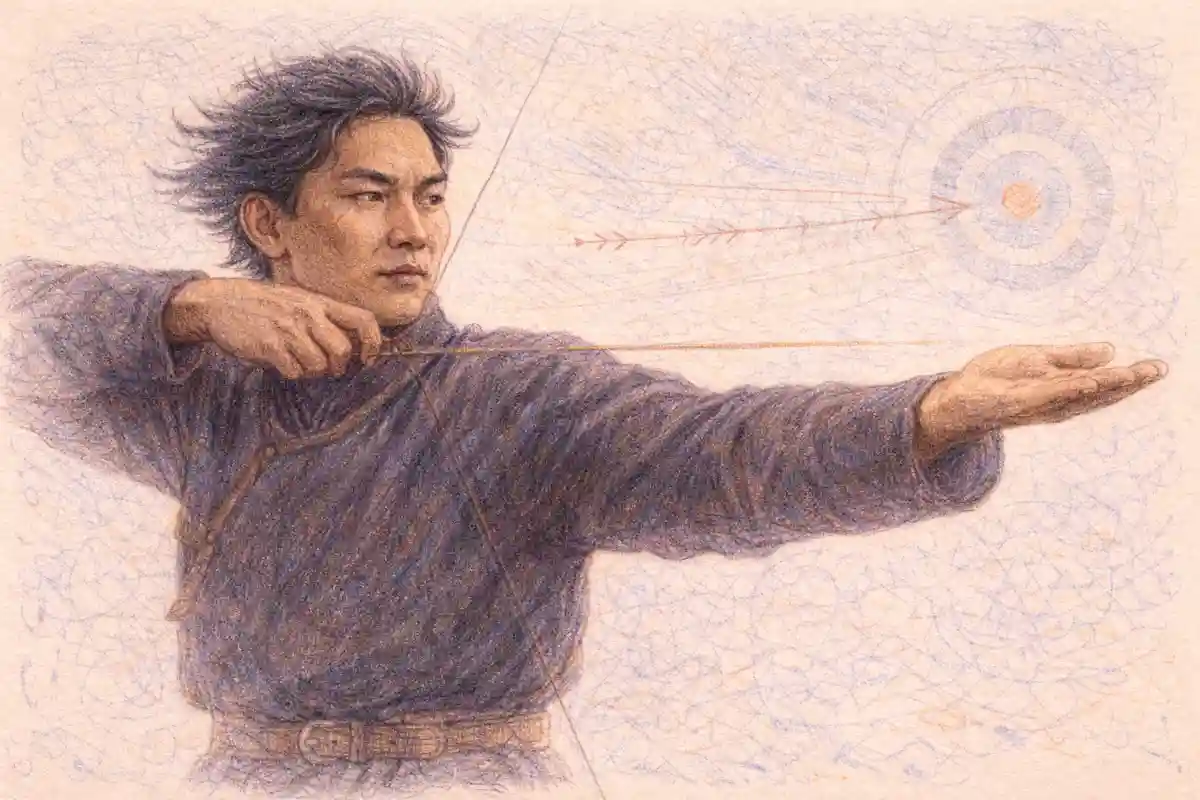
The wider movement, its three forms, its economics, and its transmission to Europe are covered in the article on the rise of Egyptian monasticism. The Christian society it belonged to is set out in the complete guide to Coptic Egypt, and the buildings that grew from these settlements in the article on Egypt’s ancient monasteries. This article handles the man, the text that made him, the fathers and mothers of the desert settlements, and the body of counsel they left behind.
What We Are Working With
The evidence problem has to come first, because almost everything commonly stated about Antony rests on one document written by a man with purposes of his own.
The primary source is a biography composed within a few years of his death by Athanasius, bishop of Alexandria, the most prominent churchman of his generation and a central figure in the doctrinal controversies of the fourth century. It is a work of hagiography, meaning a life written to present a model rather than to record a biography in the modern sense, and it should be read as such throughout.
A second body of evidence exists and is much less used: a set of seven letters attributed to Antony, surviving in Coptic fragments and in Georgian, Arabic, and Latin translation. Modern scholarship has increasingly accepted these as genuine or as close to genuine, and they present a strikingly different figure from the one in the biography.
What sources do we have for Antony?
Two of very different kinds. Athanasius’s biography, written within a few years of his death, is the source for almost everything commonly said about him and is hagiography rather than biography. Seven letters attributed to Antony survive in translation and present a notably different figure.
A third layer is the sayings tradition, in which anecdotes and counsel attributed to Antony appear at the head of the alphabetical collection of desert sayings. These were transmitted orally for generations before being written down, and they are excellent evidence for the tradition’s spirituality and weak evidence for what any named individual said.
Beyond these there are references in travel narratives written by visitors to the Egyptian monastic settlements, in later church histories, and in the Coptic tradition, all of them later and all of them working from the biography.
What that evidence base supports is an outline: his origins, the general shape of his withdrawal, his emergence as a teacher, his two journeys to Alexandria, his death, and the substance of his spiritual teaching. What it does not support is a detailed biography, and readers should treat any confident narrative of his inner life as a construction from a document designed to edify.
The Life as a Document
Because the biography determines almost everything, understanding what it was written to do is the single most useful piece of context available.
Athanasius wrote it around 357 to 362, within a few years of Antony’s death, and he had personal knowledge of the Egyptian monastic communities, having spent periods among them during his own exiles. He addressed the work to monks abroad who had asked for an account.
Its purposes were several and they are visible in the text. It presents the ascetic life as the highest Christian vocation and supplies a model for imitation. It demonstrates that this model is orthodox, with Antony shown rejecting the doctrinal position Athanasius opposed. And it establishes the desert as a legitimate arena of Christian achievement, comparable to the martyrdom that had ended a generation earlier.
What was the Life of Antony written to do?
To supply a model for imitation, to demonstrate that the ascetic life was orthodox by showing Antony rejecting the doctrinal position its author opposed, and to establish the desert as a legitimate arena of Christian achievement now that martyrdom had ended with the persecutions.
Its structure follows a recognizable pattern: an early call, progressive withdrawal, struggle with demonic opposition, victory, emergence as a teacher, a long instructional discourse, miracles, encounters with the powerful, and a good death. That shape is not evidence of fabrication; it is the shape hagiography took, and a reader who recognizes it can distinguish structure from content.
The book’s reception is the reason it matters. It was translated into Latin within about a decade, circulated across the Mediterranean, and functioned as the principal means by which the monastic ideal reached people who had never seen a monk. Its effect on individual readers is documented in a way that few ancient texts can claim, including a famous account by a North African writer of a conversion partly prompted by hearing about it.
One consequence deserves emphasis. The Antony known to Christian history is Athanasius’s Antony, and every later portrayal, every medieval image, and every modern reference descends from that single portrait. The historical man is visible behind it only in outline.
The Letters and the Other Antony
The seven surviving letters are the most interesting problem in the study of this figure, and they are almost never mentioned in popular accounts.
Athanasius describes Antony as unlettered, a man without Greek education who spoke only Egyptian and who dictated when he needed to write. That characterization serves the biography’s argument that holiness requires no learning and that an unschooled peasant could surpass philosophers.
The letters do not read like the work of that man. They engage with theological and cosmological themes in a manner that assumes familiarity with a sophisticated intellectual tradition, using concepts and vocabulary that connect to the Alexandrian theological inheritance. They are pastoral letters to monastic communities, addressing self-knowledge, the healing of the fallen nature, and spiritual progress in terms that presuppose a developed system.
How do the letters change the picture of Antony?
Considerably. Athanasius presents an unlettered Egyptian peasant who spoke only Egyptian, which serves his argument that holiness requires no education at all. The letters instead engage with sophisticated theological and cosmological themes in a manner that presupposes real familiarity with the Alexandrian intellectual tradition.
Three explanations are available and scholars divide between them. The letters may not be his, though the manuscript tradition and internal evidence have persuaded many specialists that they are or are close to it. Antony may have absorbed a good deal of theological content through oral transmission from educated visitors without formal schooling, which is entirely possible in a settlement that attracted the learned. Or Athanasius may have simplified him deliberately, because an unlettered saint made a better argument than a well-read one.
The third possibility is the most interesting and it is not a charge of dishonesty. Hagiography selects, and a biography written to show that the desert produces holiness available to anyone has good reason to emphasize simplicity over sophistication.
What the letters establish beyond doubt is that the tradition around Antony contained more intellectual content than the popular image allows. The desert was not a place of pious illiterates; it attracted educated men, generated a sophisticated psychology, and produced writing that engaged with the philosophical currents of its age.
The Stages of Withdrawal
The shape of his life is the part of the biography most likely to be substantially accurate, because it is structural rather than dramatic and it matches what is known of the wider movement.
He was born around 251 CE in a village in Middle Egypt to a prosperous Coptic-speaking farming family that held a substantial amount of land. He was raised Christian, and the biography stresses that he avoided Greek schooling.
When he was around eighteen or twenty his parents died, leaving him responsible for the property and a younger sister. Some six months later, entering a church, he heard read the passage in which Christ instructs a rich young man to sell what he owns and give to the poor. He disposed of the land, distributed most of the proceeds, and shortly afterward, on hearing a further passage about not being anxious for tomorrow, gave away the remainder and placed his sister with a community of consecrated women.
Why did Antony go to the desert?
Because he heard a gospel passage read in church instructing a rich young man to sell his possessions and took it as addressed to him personally. He disposed of an inherited estate, placed his sister with a community of women, and began ascetic life at the edge of his village under an older solitary.
The first phase was local and instructional. He lived at the edge of the village under the guidance of an old man who had practised the solitary life from his youth, and he travelled to other ascetics in the district to learn particular disciplines from each: patience from one, prayer from another, freedom from anger from a third. That detail is important because it establishes that a network of ascetics already existed.
The second phase moved him into the tombs in the hills near the village, where he had himself shut in and food brought at intervals. This is the setting of the most famous episodes of demonic assault in the biography.
The third phase, around 285, took him across the Nile to an abandoned fort in the eastern desert, where he remained enclosed for roughly twenty years, receiving bread twice a year passed over the wall and speaking to nobody.
The fourth phase, around 305, followed his emergence, when disciples who had gathered outside broke open the door. He then accepted followers, organized cells around him, and taught. The fifth and final phase, around 312 or 313, took him far into the eastern desert to a mountain near the Red Sea coast with a spring and a small area he could cultivate, where he lived until his death.
The Sister and the Household He Left
A single sentence in the biography opens onto something the tradition rarely discusses, and it is worth following.
When Antony disposed of his inheritance he placed his younger sister with a community of consecrated women. That clause, given in passing, establishes several things at once. Communities of Christian women living celibately under some form of common discipline already existed in Egyptian villages around 270 CE, before any of the developments this article describes. They were sufficiently established that a young man could entrust a relative to one. And they had no founder whose name survives.
The biography mentions her once more, much later, noting that she had grown old in the community and become a guide to other women. That is the entire record of a person who spent perhaps sixty years in organized religious life, and it is more than survives about most of her contemporaries.
What happened to Antony’s family?
His parents died when he was around eighteen or twenty, leaving him an estate and a younger sister. He disposed of the property and placed her with an existing community of consecrated women, which shows such communities already existed around 270 CE. The biography notes later that she grew old there and guided others.
Two implications follow and both cut against the standard account. Female organized asceticism in Egypt predates the male desert movement rather than following it, which reverses the usual sequence in which women’s monasticism appears as a later adaptation. And the withdrawal that made Antony famous was made possible by an institution somebody else had already built.
The wider pattern is the same one this article has traced throughout. Antony’s originality is consistently overstated because his biography is the surviving document, and the details that survive in it incidentally, like this one, keep revealing an existing landscape of Christian ascetic practice that the narrative treats as background.
The disposal of the estate deserves a note too. He gave away land that the biography describes as substantial and well watered, and he did so in two stages, first distributing most of it and then, on hearing a further passage, the remainder. Renunciation of property on that scale by a young man of standing was a public act in a village where everyone knew what the family held.
The Twenty Years in the Fort
The central episode of the biography deserves attention because of one detail that is easy to miss and that tells us what Athanasius was arguing.
Antony entered the abandoned fort around 285 and remained enclosed for roughly two decades. Visitors came and were not admitted. Bread was delivered twice a year. He spoke to nobody through the door except occasionally to give counsel. The biography describes voices and disturbances around the building that those outside attributed to demons.
When disciples eventually forced the door around 305, expecting to find a wasted or deranged man, they found neither. The biography insists on this specifically: he emerged neither fat from inactivity nor emaciated from fasting, his body in its normal condition, his mind composed and his manner even. He was, in the text’s phrase, entirely balanced.
What happened when Antony emerged from seclusion?
He came out neither emaciated nor unwell but physically and mentally composed, and the biography insists on this detail deliberately. Two decades of extreme discipline had produced not a broken man but a balanced one, which is the text’s central argument about what asceticism achieves.
That insistence is the argumentative heart of the book. Athanasius is answering an objection that would occur to any educated reader: that extreme asceticism damages people. His answer is a man who spent twenty years alone in a ruin and came out well.
Whether it is true cannot be established. What can be said is that the tradition took the point seriously, since the sayings literature examined below is full of warnings against excess and counsel toward moderation, which is what a movement that has watched people break produces.
The two decades also function structurally in the narrative. They are the period of testing, after which the emergence is a kind of resurrection, and the man who comes out is qualified to teach. That pattern shaped every subsequent monastic biography in the Christian tradition.
What the Cell Contained
The physical reality of Antony’s life is recoverable in outline from the biography and in detail from the archaeology of the settlements that imitated it.
His own arrangements were minimal by design. The biography describes bread and salt with water, taken once daily after sunset and sometimes at intervals of two or four days, no meat or wine, sleep on a rush mat or on the bare ground, a hair garment worn beneath an outer skin, and a refusal to wash the body or anoint it with oil.
Work occupied the day. He plaited palm fibre into rope and mats, which was the standard desert occupation because it required little attention, produced a saleable product, and left the mind free for recitation. Later at the mountain retreat he cultivated a small plot, growing grain to spare his visitors the trouble of carrying bread in.
What did a hermit’s daily routine involve?
One meal after sunset of bread, salt, and water, sometimes taken only every second or fourth day; sleep on a mat or the ground; the day spent plaiting palm fibre into rope and mats while reciting memorized scripture; and night prayer that deliberately restricted rest.
Prayer ran continuously rather than at fixed hours only, achieved through short memorized formulae repeated during work, with vigils at night that deliberately curtailed sleep. The biography describes him praying through entire nights and greeting the sunrise with regret at its arrival.
Excavation at the settlements that followed his model has recovered what such a life required physically: a walled courtyard, a room to sleep and work in, a prayer space with a niche oriented for worship, storage for the year’s bread and for the fibre and the finished work, and arrangements for water. These are small organized compounds rather than caves.
That combination of extreme dietary restriction with a fully organized dwelling is the accurate picture, and it corrects the image in both directions. The life was materially harder than peasant farming in what it denied, and it was not squalid, improvised, or desperate. It was a designed regime, executed with considerable discipline, in a purpose-built structure.
The Demons
The most famous element of the Antony tradition is also the most misunderstood, and it needs handling with some care.
The biography describes sustained demonic opposition: temptations to return to his property and his family, assaults in the form of appearing beasts, physical attacks that left him injured, and appearances designed to frighten or to seduce. The most quoted episode has him beaten so severely in the tombs that he is carried out apparently dead, reviving to insist on being returned.
The imagery is of its time and some of it reads badly to a modern reader, including a personification of one temptation in terms that reflect the racial and social assumptions of late antiquity. Scholars discuss such passages in the context of the period’s demonology rather than treating them as neutral description, and this article notes their existence without reproducing them.
What did Antony teach about demons?
That they are real but powerless without permission, that their principal weapon is suggestion rather than force, that they can be dispelled by steadiness and the sign of the cross, and above all that they should not be feared, because fear is the condition they require in order to work.
The substance of the teaching, as the biography’s long instructional discourse presents it, is more interesting than the imagery. Demons in Antony’s account are real but weak. They cannot compel anything. Their weapon is suggestion, and their power depends entirely on the response they receive. A person who is not afraid of them removes their leverage.
That analysis translates readily into psychological terms, and the tradition itself made the translation. What the biography describes as demonic assault, the later systematization examined in the article on the rise of Egyptian monasticism describes as intrusive thoughts, analysed into categories with their occasions and their remedies. The vocabulary is different and the phenomenon described is recognizably the same.
The single best-known moment of the sequence has Antony, after the worst assault, asking where Christ had been during it, and receiving the answer that he had been present throughout, watching. Whatever one makes of the theology, it is a precise description of how a person feels after enduring something alone, and it is the reason the episode has been painted, written about, and reworked for sixteen centuries.
What the Discourse Contains
The biography includes a long instructional address to monks, and it is the closest thing to a systematic statement of Antony’s teaching that survives in that document.
Its principal theme is discernment: the ability to distinguish thoughts and impulses by their origin and their effect. Good movements of the soul bring peace and confidence; the others bring agitation, confusion, and fear. The test proposed is not doctrinal but experiential, examining what a suggestion does to a person rather than what it claims.
Its second theme is the powerlessness of opposition. Demons are described as defeated already, permitted to act only within limits, capable of noise and appearance rather than compulsion, and reduced to insignificance by a person who refuses to be impressed.
What did the Desert Fathers teach?
Discernment above all: distinguishing thoughts by their effect rather than their content, since good movements bring peace and the others bring agitation. Alongside it, humility, the refusal to judge others, remaining in one’s cell, unceasing prayer, manual labour, and moderation over spectacular austerity.
Its third theme is the ordinary means. Prayer, fasting, work, scripture, vigils, and the sign of the cross are presented as sufficient, and no special technique or secret knowledge is offered. That plainness is characteristic of the whole desert tradition and it is one reason the literature remained usable across centuries and traditions.
The fourth is humility, presented not as self-deprecation but as an accurate assessment that removes the target at which pride and despair both aim. A person who does not think himself advanced cannot be discouraged by failure or inflated by success.
Whether this discourse represents Antony’s teaching or Athanasius’s cannot be settled. What matters historically is that it was read as Antony’s for sixteen centuries, and that it therefore shaped the tradition regardless of authorship.
The People Who Came
One of the biography’s most useful features is its account of visitors, because it shows what the desert had become within Antony’s own lifetime.
Monks came in numbers, first settling outside the fort and later gathering around the mountain retreat, seeking instruction and a rule of life. The biography describes him organizing cells, giving counsel, and travelling periodically to visit communities.
The sick came for healing, and the biography records cures at length. Antony’s own position on this, as the text presents it, is worth noting: he consistently refuses credit, insists that healing is not his to give, and treats requests for it as a distraction from the reason people should have come.
Who travelled to see Antony?
Monks seeking instruction and a rule of life, the sick seeking healing, officials and litigants seeking intercession with the authorities, and educated Greeks who came specifically to argue philosophy with him. The biography also reports that emperors wrote to him and that he was notably unimpressed by the fact.
Officials and ordinary people came seeking intercession with authorities, arbitration of disputes, and letters of recommendation, which shows the holy man occupying a social and quasi-legal role in addition to a religious one. That function is characteristic of late antique holy men generally and it made monastic figures useful to their neighbours in entirely practical ways.
Educated Greeks came to argue. The biography describes philosophers arriving to test him and includes exchanges in which he answers them, which serves the text’s argument that the unlettered Egyptian could out-reason the schools. Whether the exchanges happened as recorded, the fact that the desert attracted such visitors is confirmed by the presence of educated men in the settlements.
Letters came from emperors, and the biography’s account of Antony’s reaction is the most characteristic anecdote in the whole book: he was unmoved, remarked that they were men who would die like anyone else, and had to be persuaded by his disciples that replying would be a kindness.
That range of visitors, within a single lifetime, is the strongest evidence for this article’s thesis. A man who had gone to the desert to be alone had become, by his sixties, a destination.
The Two Journeys
Antony left the desert twice according to the biography, and both occasions are politically revealing.
The first came around 311, during a persecution, when he travelled to Alexandria to support Christians who had been imprisoned and condemned. The biography describes him attending the courts, visiting confessors in the mines and prisons, and making himself conspicuous in the hope of being arrested. He was not arrested, and the account presents the authorities as deliberately avoiding him.
That episode connects the desert to the martyr tradition directly, which is precisely its function in the text. Antony sought martyrdom, did not receive it, and returned to the desert to practise what the tradition came to call a daily witness in its place. The article on persecution and the Coptic martyrs treats the events themselves.
Why did Antony leave the desert?
Twice, and both times for the church. Around 311 he went to Alexandria during a persecution to support imprisoned Christians and to seek martyrdom, which he did not receive. Around 337 or 338 he went again in old age to support the bishop against a doctrinal opponent.
The second journey came around 337 or 338, when he travelled to Alexandria in old age at the request of the bishops to make a public statement against the doctrinal party Athanasius opposed. The biography describes crowds gathering, conversions following, and the great hermit denouncing the position in plain terms.
That episode is the one most obviously shaped by the author’s interests, and it should be read with that in mind. Athanasius was engaged in a career-long struggle against that party, and a testimonial from the most respected holy man in Egypt was worth a great deal. Whether Antony held or expressed the views attributed to him is not independently verifiable.
The general point stands regardless. A hermit whose entire practice was withdrawal was twice drawn back into the world by the needs of the church, and the movement he founded would be drawn in far more decisively over the following century. The tension between withdrawal and ecclesiastical usefulness begins with him.
The Miracles
A hagiography contains miracles and a historical article has to say something useful about them, which means describing what the text claims and what can be said about it.
The biography reports healings of the sick and the possessed, prophetic knowledge of events at a distance, visions including one of souls ascending, and protection from harm. These are distributed through the narrative and function as demonstrations of the authority the ascetic life confers.
What the text also does, unusually, is police them. Antony is repeatedly shown refusing credit, insisting that healing comes from elsewhere, discouraging people from seeking him for it, and warning that the ability to perform wonders is no measure of holiness. The biography states directly that working miracles is not ours and is not the point.
Did Antony perform miracles?
The biography reports healings, prophetic knowledge, and visions, as any hagiography would, while also having Antony repeatedly refuse credit and warn that miracles are no measure of holiness. That internal caution is unusual and is more historically interesting than the miracle accounts themselves.
That internal caution is more interesting historically than the miracle accounts. A text written to build a reputation contains a sustained argument against measuring holiness by wonders, and the same argument appears throughout the sayings tradition, where monks who perform signs are treated with suspicion and the advanced are those who attend to their own faults.
The historian’s position on the accounts themselves is straightforward and does not require adjudication of the underlying question. These are claims made in a devotional text within a genre where such claims were expected, they cannot be verified, and nothing in the historical argument of this article depends on them.
What can be said is that Antony’s reputation attracted people who wanted healing, that the desert generally became associated with such expectations, and that the tradition’s own leadership tried repeatedly and unsuccessfully to redirect the attention. That tension between what a holy man offers and what people want from him is one of the most durable features of the whole phenomenon.
The Desert Fathers Table
Setting Antony beside the great desert settlements and their leading figures makes the movement’s geography and its teaching legible at once.
| Figure or centre | Location | Dates | Characteristic teaching | Influence | Reliability of evidence |
|---|---|---|---|---|---|
| Antony the Great | The village edge, then Pispir, then the Inner Mountain near the Red Sea | Circa 251 to 356 | Discernment of thoughts; demons powerless without permission; ordinary means suffice | The model hermit for the entire Christian tradition through Athanasius’s biography | Firm on outline, hagiographic on detail; the letters complicate the picture |
| Amoun | Nitria, in the desert southwest of the Delta | Circa 315 to 330 | The semi-eremitic pattern: alone in the week, together at the weekend | Founded the settlement type that produced the sayings tradition | Firm on foundation, thin on the man |
| Kellia, the Cells | Further into the desert, founded for those seeking greater solitude | From circa 338 | Greater withdrawal within reach of a community | Extensively excavated, giving the physical form of the life | Very strong, archaeology and texts agree |
| Macarius the Great | Scetis, the deepest and most prestigious settlement | Circa 330 onward | Practical counsel, non-judgment, moderation over austerity | Scetis produced a disproportionate share of the surviving sayings | Sayings are traditional attributions rather than records |
| Arsenius | Scetis, a former imperial court official | Late fourth century | Flee the world, keep silence, pray; the value of silence | Represents the educated Greek-speaking element in the desert | Traditional attribution |
| Poemen | Scetis and afterward | Fifth century | Shrewd practical counsel; refusal to condemn; attend to yourself | The largest single body of sayings attributed to any father | Traditional attribution; the collection may compress several figures |
| Moses | Scetis, described as an Ethiopian and a former robber | Fourth century | Non-judgment above all; the leaking basket as a rebuke to those who judge | The tradition’s clearest statement that origin is irrelevant to holiness | Traditional attribution |
| Evagrius | Kellia, an educated Greek arriving in the 380s | Circa 345 to 399 | The eight generic thoughts, analysed with occasions and remedies | Transmitted to the Latin West and became the seven deadly sins | Firm; his own writings survive |
| The ammas | Scetis and elsewhere; Syncletica, Sarah, Theodora | Fourth to fifth century | Identical in character to the fathers: humility, thoughts, non-judgment | Establish that women held recognized standing as elders | Traditional attribution; the material survives in the collections |
That table is the article’s findable artifact and the last column is the point of it. Notice how much of the tradition rests on attributions transmitted orally for generations, and how the two figures whose own writings survive, Evagrius and Antony through his letters, are precisely the two who look least like the popular image of the desert monk. Readers who want to keep the table and build study notes around it can save this guide and build your own Egypt timeline free on VaultBook, which is a useful place to keep the reliability column separate from the teaching column.
The Desert Settlements
The three great centres lay in a depression southwest of the Nile Delta and their arrangement explains a great deal about how the life worked.
Nitria was founded first, around 315 to 330, by a man named Amoun who had lived celibately with his wife by agreement before withdrawing. It lay closest to the cultivated land, which meant supplies, visitors, and the sale of woven work were all practical, and it grew into a substantial settlement with a church, bakeries, a guest house, and a doctor.
Kellia, meaning the Cells, was established when Nitria became too crowded for those seeking greater solitude, on the advice attributed to Antony. Monks lived in individual cell complexes scattered across a wide area, out of sight of each other but within reach.
Where did the Desert Fathers live?
In three settlements in the desert southwest of the Nile Delta: Nitria, nearest the cultivated land and largest; Kellia, further out for those seeking greater solitude; and Scetis, deepest, harshest, and most prestigious. Antony himself lived separately in the eastern desert near the Red Sea.
Scetis lay furthest south into the desert, was the harshest and most remote, and became the most prestigious. It produced a disproportionate share of the figures whose sayings survive. Its remoteness also made it vulnerable, and it was raided repeatedly in the fifth century by desert peoples, with monks killed and the community scattered and refounded more than once.
Excavation at Kellia has recovered the physical reality of this life in unusual detail: hundreds of cell complexes across a wide area, each typically with a walled courtyard, living and sleeping space, a room for prayer with a niche oriented for worship, storage, and water facilities. Some carry painted inscriptions and images. These are small organized dwellings rather than the bare caves of the popular imagination.
Antony himself lived apart from all three, in the eastern desert between the Nile and the Red Sea, first at the abandoned fort and then at the mountain retreat where a monastery bearing his name later stood. The geography matters: the man who became the movement’s symbol was never a member of its principal communities.
The Fathers by Name
The sayings collections preserve material attributed to around one hundred and thirty named figures, and a handful recur often enough to have distinct characters.
Macarius the Great is the presiding figure of Scetis, associated with practical counsel and with a consistent refusal to condemn. A distinct Macarius of Alexandria appears separately, associated with Kellia and with more spectacular feats of endurance, and the two are frequently confused.
Arsenius was a Roman of high standing who had held a position at the imperial court before withdrawing, and his sayings preserve the tension of a cultivated man in a settlement of Egyptian peasants. The counsel attributed to him as the reason for his withdrawal, to flee, to keep silence, and to pray, is among the most quoted lines in the whole tradition.
Who were the best-known Desert Fathers?
Macarius the Great of Scetis, associated with non-judgment; Arsenius, a former imperial court official who counselled flight and silence; Poemen, whose sayings are the most numerous and the most practically shrewd; Moses, described as an Ethiopian and a former robber; and John the Dwarf, remembered for obedience.
Poemen has the largest body of sayings attributed to him, and their character is distinctive: practical, shrewd, deflating, and consistently concerned with attending to one’s own faults rather than others’. Specialists note that the collection may compress the counsel of several figures under a single respected name.
Moses is described as an Ethiopian and a former robber who became a monk and eventually a priest, and he is the subject of the tradition’s most pointed teaching story about judgment, in which he arrives at a meeting called to condemn a brother carrying a leaking basket of sand behind him, and explains that his own faults are pouring out behind him where he cannot see them while he comes to judge another’s.
Others recur with distinct notes: John the Dwarf for obedience carried to the point of absurdity and vindicated by it, Pambo for weighing his words, Agathon for hospitality, Sisoes for humility that increases rather than decreases with progress, and Silvanus for a company of disciples that carried the tradition to Palestine.
The historical caution applies throughout. These are remembered attributions in a tradition that assigned teaching to authoritative names, and what they preserve reliably is the shape of the spirituality rather than the biography of any individual.
The Mothers of the Desert
Women appear in the sayings collections as elders in their own right, addressed by the feminine form of the title given to the fathers, and their material deserves separate attention because it is routinely omitted.
Three figures have substantial bodies of counsel preserved. Syncletica is the most extensively represented, with a separate biography also attributed to her, and her sayings are among the most rigorous in the whole collection, using images of fire, seafaring, and treasure to describe the ascetic struggle.
Sarah is remembered for a small number of sayings of unusual sharpness, including a response to visiting monks who condescended to her that survives as one of the collection’s most quoted exchanges, and for a statement about the length of her own struggle with temptation that is candid in a way the male material rarely is.
Who were the Desert Mothers?
Women elders of the desert settlements, addressed by the feminine form of the title given to the fathers, with substantial counsel preserved in the sayings collections. Syncletica, Sarah, and Theodora are the three best represented, and their material is indistinguishable in rigour from the men’s.
Theodora appears with counsel on humility, on the necessity of enduring difficulty, and on the responsibilities of those who teach, and her sayings show a figure consulted by others including bishops.
Their material is indistinguishable in character from the men’s. The same concerns appear: humility, thoughts, non-judgment, perseverance, and suspicion of spectacular austerity. Nothing in the content marks it as women’s teaching, which is itself the most significant thing about it.
The evidence for women in the desert is thinner than for men and the reason is structural rather than demographic. The collections were compiled, copied, and transmitted by male monastic communities, which preserved what interested them. Women’s communities were generally located nearer settled land for safety, making them less visible as examples of desert heroism. And the visitors who wrote travel accounts of the settlements were men whose access to women’s communities was limited.
The article on the rise of Egyptian monasticism sets out how women’s communities were built into the first monastic federation from its beginning, which establishes that female monasticism was present at the movement’s foundation rather than added later.
The Raids and the Writing Down
The reason the sayings exist as a book rather than as a memory is a series of disasters in the fifth century, and the connection is worth making explicit.
Scetis, the deepest and most prestigious of the settlements, was raided repeatedly by desert peoples during the fifth century. Monks were killed, cells destroyed, and the community scattered, and the settlement was refounded more than once after successive attacks.
Dispersal broke the transmission mechanism. A tradition carried orally from elder to disciple within a stable settlement depends on that settlement continuing, and monks scattered into Palestine, into other parts of Egypt, and further afield could not maintain the chain.
Why were the Sayings written down?
Because the oral tradition was endangered. Raids on Scetis in the fifth century killed monks and scattered the community repeatedly, breaking the chain of transmission from elder to disciple. Collecting the material in Greek, probably in Palestine, preserved what dispersal was destroying.
Collection followed. The material was gathered in Greek during the fifth and sixth centuries, probably in Palestine, where dispersed Egyptian monks and their disciples had settled, and the two great arrangements were produced. What had been a living practice became a book, which is both a preservation and a loss.
The loss is worth naming. A word given to a particular person in a particular condition, read by a stranger centuries later, is no longer the same instrument. The collections themselves seem aware of this, since they preserve the situations along with the counsel rather than extracting principles, which keeps the specificity visible even when the original context is gone.
The preservation is what allows this article to exist. Without the raids and the dispersal, the tradition might have continued orally in Egypt and reached us only through the biographies and travel accounts, which would have left the movement’s actual spirituality almost entirely unrecorded. A catastrophe produced the literature.
The Sayings as a Body of Literature
The literary form the desert produced is unlike anything else in ancient literature and it is worth describing on its own terms.
The unit is the saying: an anecdote or a piece of counsel, typically a sentence to a paragraph, arising from the practice of a younger monk approaching an elder and asking for a word. The request was for something addressed to his own condition rather than for general instruction, which is why the answers are so specific and so various.
These circulated orally for generations. They were collected in Greek in the fifth and sixth centuries, probably in Palestine, and the timing is not accidental: the raids that scattered Scetis in the fifth century threatened an oral tradition, and writing it down was a preservation measure.
What form do the Sayings take?
Short anecdotes and pieces of counsel, typically a sentence to a paragraph, arising from a younger monk asking an elder for a word addressed to his own condition. They circulated orally for generations before being collected in Greek in the fifth and sixth centuries.
Two arrangements were produced and both survive. The alphabetical collection organizes the material by the name of the speaker, running to around a thousand sayings from some hundred and thirty figures. The systematic collection organizes it by theme, in chapters on discernment, obedience, humility, hospitality, and the rest. An anonymous collection preserves further material with no attribution.
Translation followed rapidly and widely: into Latin, Syriac, Coptic, Armenian, Georgian, Ethiopic, Arabic, and later Slavonic. Few bodies of ancient literature travelled so far or so fast, and the reason is that the material is practical, short, and requires no theological training to use.
Their literary character is distinctive. There is almost no exposition, no argument, and no system. A situation is described and a response is given, frequently surprising, sometimes comic, occasionally harsh, and often refusing the question asked in favour of a better one. The reader is left to work out the principle.
That form has a consequence worth noticing. A collection of concrete responses to particular situations resists systematization, which is why the desert tradition has been read continuously by people who agreed on very little else. It offers cases rather than doctrine.
The Desert as a Destination
Within a single lifetime the Egyptian desert became a place people travelled to see, and the phenomenon is worth describing because it explains how the model spread.
Two travel narratives written by visitors in the late fourth and early fifth centuries survive and both circulated widely. Their authors journeyed through the Egyptian monastic settlements, recorded what they saw, described individual monks, and returned to write accounts that functioned as guidebooks to a way of life.
Their tone is admiring to the point of credulity. They report population figures that strain belief, miracles at every stop, and a landscape transformed into a city of ascetics. As evidence for numbers they are unusable; as evidence for how the desert was perceived they are excellent.
Why did people travel to the Egyptian desert?
To see the Christian life being lived at its most demanding. Visitors from across the Mediterranean journeyed through the monastic settlements and wrote accounts on returning, which circulated as guidebooks and prompted foundations elsewhere. For roughly two centuries Egypt was the destination for anyone serious about asceticism.
Wealthy Roman women travelled among the visitors, founded establishments on their return, and became patrons of monastic figures, which opened a channel of transmission running through aristocratic networks rather than through texts alone.
Founders came too. Individuals who spent time among the Egyptian communities and then established houses elsewhere carried the practice directly into Palestine, Asia Minor, Italy, and Gaul, and the resulting foundations reproduced Egyptian arrangements with local adaptations.
The consequence for Egypt was a reputation unlike any it had held before. A province known for grain, papyrus, and monuments became, for roughly two centuries, the place educated Christians went to observe holiness being practised, and the accounts they wrote turned a regional development into a Mediterranean movement.
That reputation is also what makes the sources problematic. Nearly everything written about the desert was written by admirers, which means the useful evidential move is to notice where an admiring source concedes something inconvenient. The repeated warnings against excess, and the recorded cases of monks who broke down or left, are conceded evidence from a tradition with no interest in recording failure.
Asking for a Word
The pastoral method of the desert is the most transferable thing it produced, and it is worth describing because it explains why the literature takes the form it does.
A newcomer attached himself to an experienced monk, settled nearby, and sought guidance. The relationship was personal rather than institutional, chosen rather than assigned, and it carried no formal authority beyond what the younger man granted. There was no rule requiring it and no office attached to it.
The characteristic request was for a word: not a lecture, not a rule of life, and not a doctrine, but a single piece of counsel addressed to the asker’s actual condition. The elder’s task was to see the person accurately and say the one thing that would help him.
How did spiritual guidance work in the desert?
Through a chosen personal relationship rather than an office. A newcomer settled near an experienced monk and asked for a word, meaning a single piece of counsel addressed to his particular condition rather than general instruction. The elder’s task was to see the person accurately.
That format explains the sayings’ character completely. They are short because a word is short. They are various and sometimes contradictory because they were addressed to different people with different problems. They frequently refuse the question asked in favour of a better one, because the elder judged that the asker had misdiagnosed himself.
Obedience stories form a distinctive subgenre and they are difficult for modern readers. A disciple is told to do something pointless, absurd, or impossible, does it without argument, and the story treats the compliance as the achievement. The point being made is about the will rather than the task, and the tradition’s own literature also contains counsel against obedience to bad direction, which complicates any simple reading.
The relationship was also where discernment was learned. A monk could not reliably assess his own thoughts, since the faculty doing the assessing was the one under attack, and an external observer with experience was the practical remedy. That is a shrewd piece of psychology and it is the reason the tradition insisted on it.
The Core Teaching
Extracted from the sayings and the discourse, the desert’s practical teaching has a consistent shape, and setting it out is more useful than quoting.
Discernment comes first: examining thoughts by their effect rather than their content, on the principle that what comes from a good source brings peace and what does not brings agitation, whatever it claims about itself.
The cell comes second, and it is the tradition’s most characteristic counsel. Remain where you are. Movement, novelty, and changed circumstances are presented as evasions, and staying put is what forces a person to encounter himself rather than his surroundings.
What is the most characteristic desert counsel?
To remain in the cell. The tradition consistently treats movement, novelty, and changed circumstances as evasions, and staying put as what forces a person to confront himself rather than his surroundings. The counsel is the least romantic and the most repeated in the entire collection.
Non-judgment comes third and is the most emphasized single principle. Condemning another monk is treated as the characteristic failure of the advanced, and the collection returns to it constantly, with the most memorable teaching stories built around it.
Humility comes fourth, understood as accurate self-assessment rather than performance, and presented as the ground of everything else because it removes the target that both pride and despair aim at.
Moderation comes fifth and it surprises readers expecting extremism. The collection consistently rebukes competitive austerity, commends breaking a fast for a guest, and counsels those attempting more than their strength allows to do less. A tradition of extreme ascetics whose repeated advice is restraint had evidently watched a great many people break.
Unceasing prayer comes sixth, achieved through short repeated formulae recited during manual work, and this is the practice with the longest downstream history. It developed into the contemplative tradition of the Christian east, and the article on the rise of Egyptian monasticism traces the transmission westward.
Manual labour comes seventh, not as a means of support only but as part of the discipline, since work that occupies the hands and leaves the mind free is precisely what continuous recitation requires.
The Question of His Age
The biography states that Antony died at an extraordinary age, and the figure is worth examining because it is a useful test case for handling ancient numbers.
The text gives him a hundred and five years, which would place his birth around 251 and make him the longest-lived figure in the entire monastic tradition. The claim is repeated by every later source, which is unsurprising since they all derive from the biography.
Three considerations bear on it. Ancient reports of extreme longevity are systematically unreliable, since ages were not recorded at birth for most people and round or symbolic numbers were common. Extreme longevity attributed to a holy figure serves a purpose in the narrative, demonstrating that the ascetic life preserves rather than destroys. And the biography also insists that his teeth, eyesight, and general health were unimpaired at the end, which reads as an argument rather than an observation.
How long did Antony live?
The biography gives him a hundred and five years, which would set his birth around 251. Ancient longevity reports are systematically unreliable, and a great age serves the text’s argument that asceticism preserves rather than destroys, so the figure indicates a very long life rather than a documented one.
Against those cautions, the general chronology is coherent. If he withdrew around 270, was enclosed at the fort from around 285 to 305, moved to the mountain around 312, appeared in Alexandria around 337 or 338, and died around 356, the sequence requires a life of somewhere between eighty and a hundred and five years, and the shorter end of that range is entirely plausible.
The defensible position is that he lived a very long time, that the specific figure is a claim rather than a measurement, and that the difference does not affect anything historically consequential.
That approach applies throughout this subject and it is worth stating as method. Ancient numbers attached to holy figures function rhetorically, and treating them as data produces bad history. The series applies the same discipline to grain quantities and monastic populations, where the reasoning is identical.
What a Hermit Lived On
The economics of the solitary life are rarely discussed and they are entirely reconstructible, which makes the whole arrangement more concrete.
The universal desert occupation was plaiting palm fibre into rope, mats, and baskets. It required almost no attention, could be done sitting in a cell, used a material available locally, and produced a durable saleable product. Every account of the settlements mentions it.
The weekly rhythm at the semi-eremitic settlements built the economy in. Monks worked alone through the week, walked to the church on Saturday evening, kept vigil, celebrated on Sunday morning, ate a common meal, handed over the week’s work, received supplies, and returned. Somebody sold the accumulated production in the settled land and bought bread, oil, salt, and fibre.
How did a desert hermit support himself?
By plaiting palm fibre into rope, mats, and baskets, which required little attention, used local material, and produced a saleable product. Work was handed over at the weekend gathering, sold in the settled land, and exchanged for bread, oil, salt, and more fibre, with surplus given away.
Surplus went to charity rather than to accumulation, and the sources are emphatic about this. A monk who kept more than he needed was failing at the exercise, and the settlements supported the poor of the surrounding districts, ransomed captives, and fed travellers.
Hospitality complicated the economy usefully. The guest house at the larger settlements had to feed visitors, and visitors arrived in numbers, particularly at the sites near the cultivated land. The tradition treated feeding a guest as taking priority over a monk’s own discipline, which is one of its most consistent teachings and one of its most attractive.
Antony’s own arrangements at the mountain retreat were different because of his isolation. He cultivated a small plot with grain and vegetables, the biography says, specifically so that visitors would not have to carry bread across the desert to him. A hermit growing food to reduce the burden on the people who came to bother him is a small detail with a great deal of character in it.
The Death and the Hidden Grave
The account of Antony’s death contains the single most historically interesting detail in the whole biography, and it is almost always overlooked.
He died around 356 at his mountain retreat, having, according to the biography, reached an extraordinary age. He gave instructions to the two disciples who attended him, left his sheepskin cloak and an outer garment to the bishop of Alexandria and to another bishop, and directed that his body be buried in a place known only to those two.
The reason he gave is explicit and it matters. Egyptians had a custom of keeping the bodies of the holy dead above ground, wrapped and cared for in houses rather than buried, and Antony had objected to the practice publicly during his lifetime and had pressed clergy to stop it. He did not want it done to him.
What did Antony ask for at his death?
Secret burial in an unmarked place known only to the two disciples who attended him, specifically to prevent his body being kept above ground and venerated, a practice he had opposed publicly during his lifetime. His grave was not identified for two centuries.
That instruction is a direct engagement with pharaonic funerary practice in its late form. Egyptian tradition had preserved bodies above ground for three thousand years, and Christian Egyptians in the fourth century were doing something continuous with it for their holy dead. Antony refused, and the biography records his refusal as a teaching.
Historically the episode cuts against the grain of hagiography, which normally wants relics, and its presence in a text otherwise concerned to build a cult is a reason to take it seriously as something that actually happened.
The instruction did not hold. Later tradition records the discovery of the body in the sixth century, its removal to Alexandria, and further translations afterward, with a claim that relics reached western Europe in the medieval period, where they were associated with a hospital order and with the treatment of a particular disease. Those later movements are traditions rather than documented events and should be treated as such.
The irony is complete and worth stating. A man who asked to disappear became the most represented monastic saint in European art, and his supposed remains travelled further after his death than he ever travelled in life.
Antony in the Egyptian Tradition
The figure known to European Christianity through a Greek text translated into Latin looks somewhat different in the tradition of the people among whom he actually lived.
A Coptic version of the biography exists and there has been long debate about whether the Greek or a Coptic original came first, with most scholarship holding that Athanasius wrote in Greek and that Coptic versions followed. Either way, the Egyptian church received him in its own language early and made him a foundational figure.
The Coptic tradition emphasizes different things. Antony appears less as a demonstration of a doctrinal position and more as the father of a monastic inheritance that the Egyptian church regards as its own particular gift to Christianity. He is remembered alongside a dense company of Egyptian monastic saints rather than as an isolated exemplar.
How does the Egyptian tradition remember Antony?
As the father of a monastic inheritance the Coptic church regards as its own gift to Christianity, remembered alongside a company of other Egyptian monastic saints rather than as an isolated figure, and commemorated in the Coptic calendar with his own feast.
The monastery bearing his name, established at the site of his mountain retreat in the eastern desert, has functioned for many centuries and is among the oldest continuously inhabited monastic sites anywhere, treated in the article on Egypt’s ancient monasteries.
Later Arabic Christian writing in Egypt preserved and elaborated his memory, and the medieval Coptic tradition produced further material about him within its own historical writing, which means the figure has a continuous reception in Egypt independent of the European one.
That double reception is worth registering. In Europe Antony became an image, painted repeatedly, surrounded by monsters, attached to a hospital order and a pig. In Egypt he remained a founder, commemorated liturgically, with a monastery at the place he actually lived. The two receptions have almost nothing to do with each other, and only one of them is in continuous contact with the geography of the events.
Antony in Art and Imagination
The afterlife of this figure in European culture is a large subject and it distorts the historical picture in identifiable ways.
The standard image shows a bearded old man in a monastic habit with a T-shaped staff or cross, sometimes with a bell, and frequently accompanied by a pig. The pig has no basis in anything Antony did; it derives from a medieval hospital order that used his name and held a privilege allowing its animals to forage freely, and the animal migrated into the saint’s iconography from there.
The dominant artistic subject is the temptation. From the late medieval period onward, painters treated the demonic assaults as an opportunity for grotesque invention, producing landscapes filled with hybrid monsters and impossible creatures, and one celebrated altarpiece made the subject a meditation on physical suffering.
How is Antony usually depicted?
As a bearded old man in a monastic habit with a T-shaped staff, often with a bell and a pig, neither of which has any basis in his life. The pig derives from a medieval hospital order that used his name. The dominant subject in art is the temptation, treated as an opportunity for grotesque invention.
The subject continued into the modern period, taken up in a nineteenth-century French novel that made the temptation an encounter with the whole history of religion, and again by twentieth-century painters who found in it a vehicle for the fantastic.
The distortion produced by all this is specific. Antony has become, in general culture, the saint who was tormented by monsters, which reduces a documented spiritual psychology to a bestiary. The demons of the biography are analysed as suggestions to be discerned and dismissed; the demons of the paintings are creatures to be looked at.
That gap between the record and the reception is the same pattern this series has traced elsewhere, and the article on the real Cleopatra versus the legend sets out the method for handling it. Find the earliest source, ask what later versions wanted, and check the claimed content against the text.
The historical Antony taught that demons were weak, that fear was their only lever, and that ordinary discipline was sufficient against them. The Antony of European art is besieged by spectacular horrors. The second is more entertaining and the first is what the document says.
How Antony Reached the West
The transmission of this figure into Latin Christianity happened quickly and through identifiable people, and the details matter because they explain the shape of the European reception.
The biography was translated into Latin twice within a short period, first in a version now largely lost and then in the rendering that circulated widely, produced by a bishop of Antioch. Speed mattered: the model became available to Latin readers within a decade or so of the text’s composition.
Its most famous documented effect belongs to a North African writer whose account of his own conversion describes a visitor telling him about Antony and about Egyptian monasticism, and the shattering realization that unlettered men were achieving what he, with all his education, could not. That passage is one of the most influential in Western Christian literature and its trigger is a story about an Egyptian peasant.
How did Antony become known in the Latin West?
Through rapid translation. The biography was rendered into Latin within about a decade and circulated widely, prompting documented individual conversions including one described at length by Augustine. A rival tradition promoted by Jerome then complicated the picture by claiming an earlier hermit.
A complication arrived almost immediately and it is instructive. Jerome, working in Palestine, wrote a life of an otherwise unknown figure whom he presented as an earlier hermit than Antony, and in whose account Antony appears as a visitor who learns that he was not the first. Modern scholarship generally treats that work as substantially fictional, composed in part to complicate the claims being made for Antony.
That episode shows how quickly the figure became a contested asset. Within a generation of the biography’s composition, competing accounts were being written to adjust the credit, which is a reliable sign that the credit had become worth having.
The decisive Latin transmission came slightly later through a monk who had lived among the Egyptian communities for years and then settled in southern Gaul, writing two works that carried Egyptian practice and its psychology into the Latin monastic tradition. The chain from there to the rule that organized medieval European monasticism is traced in the article on the rise of Egyptian monasticism.
What the Desert Left Behind
The legacy of these settlements runs in several directions and it is larger than the movement’s size would suggest.
The institutional legacy is monasticism itself, transmitted westward through texts and founders and eventually organizing medieval European religious life, agriculture, and learning. That chain is traced in the article on the rise of Egyptian monasticism.
The psychological legacy is the analysis of thought. The desert’s examination of how intrusive suggestions arise, develop, and can be interrupted was systematized at Kellia and carried to the Latin West, where it became the framework for moral analysis for a thousand years.
What is the legacy of the Desert Fathers?
Monasticism as an institution, an analysis of intrusive thought that became the framework for Western moral psychology, a contemplative practice of short repeated prayer that shaped the Christian east, and a body of practical counsel that has been read continuously for sixteen centuries.
The contemplative legacy is the practice of continuous short prayer, which developed in the eastern Christian tradition into a sustained discipline with its own literature and remains central to it.
The literary legacy is the sayings themselves, which have been copied, translated, and read continuously since the fifth century in more languages than almost any other body of ancient material, and which are still published and read by people with no monastic intention whatever.
The pastoral legacy is the relationship between a person seeking guidance and an experienced elder, which the desert formalized as the request for a word and which became the model for spiritual direction across Christian traditions.
There is a negative legacy too and honesty requires it. The desert produced casualties, its literature records people who broke down or abandoned the life, and the model of extreme physical discipline has been imitated destructively at various points in Christian history by people who took the austerity and left the moderation. The tradition’s own counsel warns against exactly that, which is a defence of the fathers rather than of everyone who invoked them.
The Man Behind the Model
A last attempt at the historical person is worth making, assembled only from what the sources concede rather than from what they assert.
He came from money. The biography wants a saint and it records an estate substantial enough that disposing of it was a public event, which means the founding act of Christian monasticism was performed by a young man of local standing rather than by the poor.
He was not the first and his biographer says so. The older solitary near the village, the other ascetics he visited to learn particular disciplines, and the community of women that took his sister are all recorded incidentally, in a text with no interest in diminishing his originality, which makes them unusually reliable.
What can be said about the historical Antony?
That he came from a landed family, learned from ascetics already practising, withdrew further and stayed longer than his predecessors, emerged intact after two decades, accepted disciples, twice returned to the world for the church, opposed the Egyptian custom of preserving holy bodies, and asked to be buried where nobody could find him.
He endured. Two decades enclosed in a ruin, then four more at a remote mountain, receiving visitors he had gone there to avoid, is a very long time to sustain a chosen difficulty, and the persistence is the part of the record least likely to be invention because it is the least dramatic.
He was practical. The counsel attributed to him is consistently ordinary, offering no technique and no secret, and the biography’s own account has him growing vegetables so his visitors would not have to carry food across a desert.
He disliked being venerated. He refused credit for healings, warned that wonders measure nothing, opposed the Egyptian practice of preserving the bodies of holy people, and arranged to be buried where nobody would find him. A man who took that much trouble to avoid becoming a relic ended up as the most painted monastic saint in Europe, and the gap between those two facts is the subject of this whole article.
That is a person rather than a portrait, and it is recoverable from a hagiography by reading against its purposes. What remains is unremarkable in every particular and consequential in the aggregate, which is generally what founders turn out to be when the paint is removed.
The Movement’s Later Egyptian History
Following the desert settlements beyond the fourth century completes the picture and shows what happened to the world Antony started.
The fifth century brought the raids described above, scattering Scetis repeatedly and dispersing monks across the eastern Mediterranean. Communities were refounded, and the pattern of destruction and refoundation became a recurring feature of the settlements nearest the desert margins.
It also brought institutional entanglement. Monks became a political factor in the doctrinal conflicts of the age, appearing at church councils in numbers and functioning as a disciplined presence, and the church increasingly drew its bishops from monastic communities. The article on the origins of the Coptic church covers those conflicts.
What happened to the desert settlements afterward?
They were raided repeatedly in the fifth century and refounded, became entangled in the doctrinal conflicts of the age as monks turned into a political factor, and consolidated over time into a smaller number of walled monasteries with defensive keeps that have functioned for many centuries.
Consolidation followed. The scattered cells of the semi-eremitic settlements gave way over centuries to a smaller number of walled monasteries with churches, refectories, and defensive keeps, better able to survive raids and to function as economic institutions. Several of these have operated continuously for well over a millennium.
The desert tradition itself continued inside those institutions rather than beside them. Solitary practice persisted as an option for the advanced, attached to a community rather than independent of one, and that arrangement became standard across the Christian east.
What did not survive was the specific arrangement of the fourth century: a landscape of scattered independent cells with no rule, no enclosure, and no superior, held together by nothing but the personal authority of experienced elders and a weekend gathering. That form was fragile by design, dependent on stability it could not defend, and it lasted roughly a century and a half.
Its literature outlived it by sixteen hundred years, which is a reasonable trade.
Reading the Sayings Today
The collections remain in print and in use, and a short account of how to approach them belongs in an article that recommends them.
They resist continuous reading. A hundred pages of short counsel produces diminishing returns quickly, and the material was not designed for that. The tradition’s own practice was to take one saying and stay with it, which is closer to how the collections work.
They contradict each other, and this is a feature rather than a defect. One elder counsels strict fasting and another commends breaking it for a guest; one urges silence and another gives lengthy instruction. Each was addressed to a particular person with a particular problem, and reading them as a single system produces incoherence.
How should the Sayings be read?
Slowly and one at a time rather than continuously, since each was addressed to a particular person with a particular problem and the material resists being read as a single system. Their apparent contradictions are a feature rather than a defect, since different conditions required different counsel.
They are frequently harsh by modern standards and occasionally comic, and the comedy is deliberate. A number of the best-known stories work by deflating a questioner’s self-importance, and the tradition’s sense of humour is one of the reasons it remains readable.
They are also, in places, difficult in ways that require historical context rather than defence. The imagery reflects late antique assumptions, some of it about the body and some about categories of person, and a reader encountering such passages is meeting a fourth-century document rather than a timeless one.
The persistent quality that explains their survival is specificity. These are not principles but cases: this monk, this problem, this response. A body of concrete cases can be used by people whose theology, century, and circumstances differ entirely from the original, which is exactly what has happened, and it is why the desert fathers have been read continuously by Orthodox, Catholic, Protestant, and secular readers with no shared commitments at all.
Why This Movement and Not Another
A final analytical question deserves an answer: why did this particular development produce an institution when comparable religious enthusiasms have not.
The first reason is that it solved a real problem for its own moment. Persecution ended in the early fourth century and removed martyrdom, which had been the highest form of Christian witness, and a generation raised on martyr accounts had no route to that standing. Asceticism was offered explicitly as a substitute and the sources use the language of daily dying.
The second is that it was cheap. Requiring nothing but a person’s willingness, a cell, and a supply of palm fibre, the desert life was available to anyone regardless of education, status, or resources, in a society where every other institution was closed by inherited legal category.
Why did the desert movement become an institution?
Because it replaced martyrdom at the moment persecution ended, cost nothing to enter in a society where every other institution was closed by inherited status, produced a documented model in the Life of Antony, and generated an organizational form under Pachomius that ordinary people could sustain.
The third is that it was documented at exactly the right moment. A bishop of the first rank wrote the model’s biography within a few years of his death, it was translated rapidly, and it reached a Mediterranean audience that had never seen a monk. A movement invisible outside its own region becomes a movement everywhere when a book travels.
The fourth is that it developed an organizational form. The solitary life had a high failure rate and could not scale, and the communal form invented in Upper Egypt supplied routine, supervision, shared resources, and a written rule, which made the life sustainable for ordinary people rather than exceptional ones.
The fifth is that it produced literature people could use. The sayings are short, practical, concrete, and require no theological training, which is why they were translated into every Christian language and read continuously for sixteen centuries by people who agreed on nothing else.
Remove any one of those five and the movement probably remains local. Together they turned a young Egyptian’s decision about an inherited farm into the ancestor of every monastery in the world, which is a considerably stranger outcome than it is usually treated as being.
What Remains Unknown
An article grading claims should list the questions it cannot answer, and for Antony the list is long.
His own words are almost entirely unrecoverable. The discourse in the biography may be his teaching, his biographer’s, or a combination, and there is no way to separate them. The sayings attributed to him were transmitted orally for generations. The letters, if genuine, are the one exception and they are a small body of pastoral writing rather than a statement of his views.
His inner life is a construction. Everything about his temptations, his struggles, his consolations, and his development comes from a text designed to edify, following a narrative pattern, written by someone who was not present.
What do we not know about Antony?
His own words, since the biography’s discourse cannot be separated from its author and the sayings were transmitted orally for generations. His inner life, which is a hagiographic construction. His exact age and dates. His actual doctrinal views. And whether the letters attributed to him are his.
His dates are approximate throughout, resting on one source and on inference from the sequence of events. His age is a claim rather than a measurement. Whether he held the doctrinal position attributed to him in the Alexandrian episode cannot be verified independently, and the person reporting it had a strong interest in the answer.
The relationship between the man in the letters and the man in the biography is unresolved and may remain so. If the letters are genuine, either his biographer simplified him considerably or he acquired theological sophistication by routes the biography does not describe.
Set against those gaps stands what can be said with confidence: that a man of that name withdrew into the Egyptian desert in the late third century, that a network of disciples formed around him, that he was known widely enough for the bishop of Alexandria to write his life within a few years of his death, that the resulting text reached the Latin world within a decade, and that everything monastic in Christian history descends in some measure from what followed. That is a substantial historical claim and none of it requires the details that cannot be established.
A Chronology
The sequence is worth having in order, with the standard caution that every date attached to Antony is approximate and derives from a single source.
He is born around 251 CE in a village in Middle Egypt to a prosperous Coptic-speaking farming family. Around 270, at roughly eighteen or twenty, his parents die and he hears the gospel passage in church, disposes of the property, places his sister with a community of consecrated women, and begins ascetic life at the village edge under an older solitary.
He moves to the tombs in the nearby hills in the following years, and around 285 crosses the Nile to an abandoned fort in the eastern desert, where he remains enclosed for roughly twenty years.
What is the sequence of Antony’s life?
Born around 251, withdrawal around 270, the tombs, then twenty years enclosed in a fort from around 285, emergence around 305, the move to the mountain retreat around 312, Alexandria during the persecution around 311 and again around 337, and death around 356.
Around 305 disciples force the door and he emerges, accepts followers, organizes cells, and begins to teach. Around 311, during a persecution, he travels to Alexandria to support imprisoned Christians and to seek martyrdom, which he does not receive.
Around 312 or 313 he withdraws further, to a mountain near the Red Sea coast with a spring and cultivable ground, where he lives for the remainder of his life while continuing to receive visitors and to travel occasionally to the communities that had grown around his earlier site.
Meanwhile the settlements southwest of the Delta are founded: Nitria around 315 to 330, Scetis around 330, and Kellia shortly afterward on advice attributed to Antony himself. Pachomius founds the first communal monastery in Upper Egypt around 320.
Around 337 or 338 Antony travels to Alexandria a second time in old age, at the bishops’ request, to make a public statement in the doctrinal controversy. He dies around 356 at the mountain retreat, buried secretly by two disciples at his own instruction.
Athanasius writes the biography within a few years and it is translated into Latin within about a decade. Evagrius arrives at Kellia in the 380s and systematizes the tradition’s psychology. Scetis is raided repeatedly in the fifth century, and the sayings are collected in Greek during the fifth and sixth centuries.
Five Claims Tested
Five common statements about Antony and the desert tradition are worth grading directly.
The first claim is that Antony was the first Christian hermit. This fails, and it fails on the testimony of his own biographer, who records that he learned from an older solitary already practising near his village and travelled to other ascetics in the district to learn particular disciplines from each. A network existed before him.
The second claim is that Antony founded a monastery. This fails. He organized cells of disciples around his earlier location and gave counsel, and he never established a community under a rule with shared property and a superior. That invention belongs to Pachomius in Upper Egypt around 320, and the two forms are distinct.
The third claim is that the desert fathers were unlettered peasants hostile to learning. This overstates. Most were Egyptian-speaking and many were unlettered, and the settlements also contained a former imperial official, an educated Greek who produced a sophisticated psychological system, and, if the letters are genuine, an Antony with more theological content than his biographer allows.
The fourth claim is that the tradition valued extreme austerity above all. This fails against its own literature. The sayings consistently rebuke competitive fasting, commend breaking a discipline for a guest, treat contempt for others as complete failure, and counsel doing less to anyone attempting more than his strength allows.
The fifth claim is that the demons of the Antony tradition were spectacular monsters. This is reception rather than record. The biography’s demons are analysed as suggestions with no power to compel, dispelled by refusing to fear them. The monsters belong to European painting from the late medieval period onward.
Which claims about Antony are securely evidenced?
The general shape of his withdrawal, his emergence as a teacher, the two journeys to Alexandria, the secret burial, and the existence and rapid translation of the biography. The specific dates, his exact age, the miracles, and the wording of his teaching are not independently verifiable.
How to Argue This Topic Well
For a student or teacher handling this material, three habits produce a much stronger treatment.
The first is to name the source situation before making any claim. Almost everything comes from one hagiography written by a partisan bishop within a few years of the subject’s death, and an essay that establishes this at the start can then discuss the content with confidence instead of hedging every sentence.
The second is to use the letters. They are the single most underexploited piece of evidence about Antony, they complicate the biography’s portrait in a specific and interesting way, and mentioning them signals a reader who has gone past the standard account.
The third is to separate the record from the reception. The pig, the monsters, the hospital order, and the temptation as a subject for painters all belong to medieval and later Europe and none of it is in the fourth-century text. An essay that dates each layer is doing history rather than repeating a tradition.
What is the strongest way to write about the desert fathers?
Establish the source situation first, use the letters to complicate the biography’s portrait, separate the fourth-century record from the medieval and modern reception, and treat the sayings as reliable evidence for the tradition’s spirituality rather than for what any named individual said.
A fourth habit applies to the sayings. They are excellent evidence for the shape of desert spirituality and weak evidence for individual biography, because they were transmitted orally for generations in a tradition that assigned teaching to authoritative names. Saying so once allows the material to be used confidently for what it can actually support.
The Honest Verdict
Antony matters because of what followed him rather than because of what he originated, and that is a larger claim than it sounds.
He did not invent the hermit life. His own biographer says so, recording the older ascetic he learned from and the network of practitioners he visited. He did not found a monastery; that was somebody else, in a different part of Egypt, a generation later. He did not produce an original theology, and the writings that may be his are recognizably within an existing tradition.
What he did was go further into the desert than his predecessors, stay for decades rather than seasons, emerge intact, accept the disciples who gathered, and become the person everyone afterward pointed to. That is the founder’s role in the history of institutions, and being first matters less than being the example that gets copied.
The decisive factor was documentary and it lay outside his control. The most prominent bishop of the age wrote his life within a few years of his death, the book was translated into Latin within a decade, and it circulated across a Mediterranean world that had never seen a monk. Without that text he would be one more name in the sayings collections. With it, he became the model for an institution that reshaped European religious, agricultural, and intellectual life for a thousand years.
The desert around him produced something else, and it may be the more durable achievement. The settlements southwest of the Delta generated a body of practical counsel about attention, thought, judgment, and endurance that has been translated into more languages than almost any other ancient material and read continuously for sixteen centuries by people who share almost nothing else. It offers cases rather than doctrine, which is why it survives disagreement.
One comparison sharpens the point. Pachomius invented more than Antony did. He created the enclosed community, wrote the first rule, built a federation with a headquarters and an assembly, and produced the organizational form that Europe actually inherited. He is, by any measure of originality, the more consequential figure. He is also, outside specialist and Coptic circles, almost unknown, while Antony is painted on the walls of churches from Ireland to Ethiopia. The difference is not achievement. The difference is that one of them had Athanasius.
What a reader should carry away is the distinction between a founder and an inventor. Movements need an example more than they need an origin, and the example needs a document more than it needs a monopoly on priority. Antony supplied the first, Athanasius supplied the second, and the desert supplied the rest.
Frequently Asked Questions
Q: Who was Saint Antony the Great?
An Egyptian ascetic, born around 251 CE in a village in Middle Egypt to a prosperous Coptic-speaking farming family, who became the model hermit for the entire Christian tradition. After his parents died he heard a gospel passage read in church instructing a rich young man to sell his possessions, took it as addressed to him, disposed of the land, and provided for his sister. He withdrew progressively: first to the village edge under an older solitary, then to nearby tombs, then to an abandoned fort where he stayed enclosed for roughly twenty years, and finally to a mountain near the Red Sea. He died around 356. His importance rests on the biography written by Athanasius of Alexandria within a few years of his death.
Q: Why did Saint Antony go to the desert?
Because he understood a scriptural instruction as addressed to him personally. Entering a church some months after his parents died, he heard read the passage in which Christ tells a rich young man to sell what he owns and give to the poor. He disposed of the inherited land and distributed the proceeds, and shortly afterward, hearing a further passage about not being anxious for tomorrow, gave away what remained and placed his sister with a community of consecrated women. His progressive movement deeper into the desert was driven by a search for greater solitude, complicated by the fact that each stage attracted more followers and destroyed the solitude it had been undertaken to obtain.
Q: What did the Desert Fathers teach?
Discernment above all: examining thoughts by their effect rather than their content, on the principle that what comes from a good source brings peace while what does not brings agitation, whatever it claims. Alongside it came a consistent set of practical counsels. Remain in your cell, because movement and novelty are evasions. Do not judge another monk, which the collections treat as the characteristic failure of the advanced. Practise humility understood as accurate self-assessment rather than performance. Work with your hands while reciting memorized scripture. And above all avoid competitive austerity, since the tradition repeatedly rebukes spectacular fasting and commends breaking a discipline for a guest.
Q: What are the Sayings of the Desert Fathers?
Short anecdotes and pieces of counsel, typically a sentence to a paragraph, arising from the practice of a younger monk approaching an experienced one and asking for a word addressed to his own condition. They circulated orally for generations and were collected in Greek in the fifth and sixth centuries, probably in Palestine after raids scattered the Egyptian settlements. Two arrangements survive: an alphabetical collection organized by speaker, running to around a thousand sayings from some hundred and thirty figures, and a systematic collection organized by theme. They were translated rapidly into Latin, Syriac, Coptic, Armenian, Georgian, Ethiopic, Arabic, and later Slavonic, and have been read continuously since.
Q: How did Saint Antony resist temptation?
By steadiness rather than by technique, according to the biography. His teaching, as the text presents it, holds that demons are real but powerless to compel anything, that their only weapon is suggestion, and that their power depends entirely on the response they receive. A person who refuses to be frightened removes their leverage. The practical means offered are entirely ordinary: prayer, fasting, manual work, scripture, vigils, and the sign of the cross, with no secret knowledge or special method. The most famous episode has him beaten severely in the tombs, and afterward asking where Christ had been during it, receiving the answer that he had been present throughout, watching.
Q: How long did Saint Antony live?
The biography gives him a hundred and five years, which would place his birth around 251 and make him the longest-lived figure in the monastic tradition, and every later source repeats the figure because every later source derives from that biography. Three cautions apply. Ancient reports of extreme longevity are systematically unreliable, since ages were not recorded at birth for most people. A great age serves the text’s argument that the ascetic life preserves rather than destroys. And the biography’s insistence that his teeth, eyesight, and general health were unimpaired reads as argument rather than observation. He lived a very long time; the specific number is a claim.
Q: What is the legacy of the Desert Fathers?
Four things above all. Monasticism as an institution, transmitted westward through texts and founders and eventually organizing medieval European religious life, agriculture, and learning for a thousand years. An analysis of intrusive thought, systematized at Kellia into eight categories and carried to the Latin West, where it became the framework for moral psychology and eventually the seven deadly sins. A contemplative practice of short repeated prayer during work, which developed into a sustained discipline in the Christian east with its own literature. And the sayings themselves, translated into more languages than almost any other ancient material and read continuously for sixteen centuries.
Q: Where did the Desert Fathers live in Egypt?
Principally in three settlements in the desert southwest of the Nile Delta. Nitria, founded around 315 to 330, lay closest to the cultivated land, which made supplies, visitors, and the sale of woven work practical, and grew to include a church, bakeries, a guest house, and a doctor. Kellia, meaning the Cells, was established further out for those seeking greater solitude, and excavation there has recovered hundreds of cell complexes. Scetis lay deepest and was the harshest and most prestigious, producing a disproportionate share of the surviving sayings. Antony himself lived apart from all three, in the eastern desert between the Nile and the Red Sea.
Q: Who wrote the Life of Antony?
Athanasius, bishop of Alexandria, around 357 to 362, within a few years of Antony’s death. He was the most prominent churchman of his generation, a central figure in the doctrinal controversies of the fourth century, and a man who had spent periods among the Egyptian monastic communities during his own exiles. He addressed the work to monks abroad who had requested an account. It is hagiography rather than biography, written to supply a model for imitation, to demonstrate that the ascetic life was doctrinally orthodox, and to establish the desert as a legitimate arena of Christian achievement now that martyrdom had ended. It was translated into Latin within about a decade.
Q: Did Saint Antony perform miracles?
The biography reports healings of the sick and possessed, prophetic knowledge of distant events, and visions, as any hagiography of the period would. What is unusual is how the text polices them. Antony is repeatedly shown refusing credit, insisting that healing comes from elsewhere, discouraging people from seeking him for it, and warning that the power to work wonders is no measure of holiness. The same argument appears throughout the sayings tradition, where monks who perform signs are treated with suspicion. That internal caution is more historically interesting than the miracle accounts, and nothing in the historical case for Antony’s importance depends on them.
Q: Who were the Desert Mothers?
Women elders of the Egyptian desert settlements, addressed by the feminine form of the title given to the fathers, with substantial counsel preserved in the sayings collections. Three are best represented. Syncletica has the largest body of material and a separate biography attributed to her, and her sayings are among the most rigorous in the collection, built on images of fire, seafaring, and treasure. Sarah is remembered for a small number of unusually sharp responses, including one to visiting monks who condescended to her. Theodora appears with counsel on humility and on the responsibilities of teachers. Their material is indistinguishable in character from the men’s.
Q: Who were the most famous Desert Fathers?
Macarius the Great, the presiding figure of Scetis, associated with practical counsel and a consistent refusal to condemn. Arsenius, a Roman of high standing who had held a position at the imperial court, remembered for the counsel to flee, keep silence, and pray. Poemen, whose sayings are the most numerous and the most practically shrewd, though specialists suspect the collection compresses several figures under one name. Moses, described as an Ethiopian and a former robber, associated with the tradition’s sharpest teaching story about judgment. John the Dwarf for obedience, Pambo for weighing his words, Agathon for hospitality, and Evagrius for systematizing the psychology.
Q: Did Saint Antony found a monastery?
No, and the distinction matters. He organized cells of disciples around his earlier location and gave them counsel, and he never established a community living under a written rule with shared property, common meals, and a superior. That invention belongs to Pachomius, in Upper Egypt, around 320 CE, and it is a separate development from Antony’s solitary model. The two forms are distinct: the eremitic life of the hermit and the cenobitic life of the enclosed community. A third form existed and was numerically the largest, the semi-eremitic settlement of scattered cells with weekend gatherings, which is where most Egyptian monks actually lived.
Q: What did Saint Antony look like in art?
As a bearded old man in a monastic habit with a T-shaped staff or cross, frequently with a bell and a pig, neither of which has any basis in his life. The pig derives from a medieval European hospital order that used his name and held a privilege allowing its animals to forage freely, and the animal migrated into the iconography from there. The dominant subject in European painting is the temptation, treated from the late medieval period onward as an opportunity for grotesque invention, with landscapes of hybrid monsters. That reception distorts the record, since the biography’s demons are analysed as suggestions to be dismissed rather than creatures to be looked at.
Q: Where is Saint Antony buried?
Nowhere identifiable, by his own instruction. He directed the two disciples attending him to bury his body in a place known only to them, specifically to prevent the Egyptian custom of keeping the bodies of the holy dead above ground, wrapped and cared for in houses rather than buried, a practice he had opposed publicly during his lifetime. That instruction cuts against the grain of hagiography, which normally wants relics, and its presence in the text is a reason to take it seriously. Later tradition records the discovery of the body in the sixth century, removal to Alexandria, and further translations, but these are traditions rather than documented events.
Q: Is the Life of Antony historically reliable?
Reliable for the general shape and unreliable for the detail. It was written within a few years of his death by a man with personal knowledge of the Egyptian monastic communities, which is close contact by ancient standards. It is also hagiography, written to supply a model, to defend a doctrinal position, and to establish the desert’s legitimacy, and it follows a recognizable narrative pattern of call, withdrawal, struggle, victory, teaching, miracles, and good death. The outline of his withdrawal, his emergence as a teacher, his journeys to Alexandria, and his secret burial are plausible. The dialogue, the miracles, and the interior life are constructions.
Q: What did Saint Antony teach about demons?
That they are real but fundamentally weak. According to the long instructional discourse in the biography, demons cannot compel anything, are permitted to act only within limits, and are capable of noise and appearance rather than force. Their single weapon is suggestion, and their power depends entirely on the response they receive, which means fear is the condition they require in order to work. The remedies offered are ordinary: prayer, fasting, scripture, vigils, and the sign of the cross, with no special technique. That analysis translates readily into psychological terms, and the tradition itself made the translation, reworking demonic assault as intrusive thought.
Q: Did the Desert Fathers write anything themselves?
Some did, and the exceptions are revealing. Evagrius, an educated Greek who arrived at Kellia in the 380s, left a substantial body of writing systematizing the psychology of thoughts, and it is the intellectual foundation of the whole tradition’s inner analysis. Seven letters attributed to Antony survive in Coptic fragments and in translation, increasingly accepted as genuine or close to it, and they present a more theologically sophisticated figure than his biographer allows. Shenoute later wrote at length in Coptic. Most desert monks wrote nothing, which is why the sayings tradition exists: their teaching survives only as remembered counsel transmitted orally for generations.