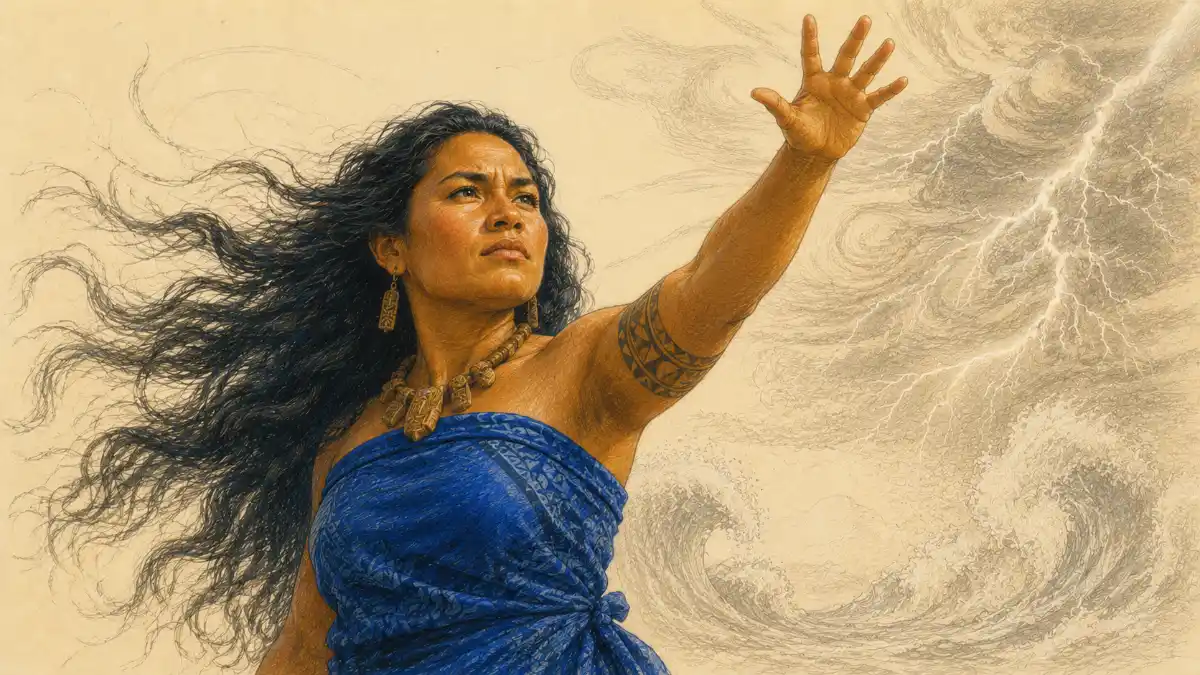
Introduction: The Sentence That Made Itself True
There is a sound recorded in a glass sphere deep beneath the Ministry of Magic, and that sound is the engine of the entire saga. Sybill Trelawney, slack-jawed and unaware, speaks a string of words in the upstairs room of a Hog’s Head pub. A man crouched at the keyhole hears half of them. He carries the half he heard to the most dangerous wizard alive, and that wizard, acting on a fragment, drives to a cottage in Godric’s Hollow and kills two people he need never have touched. Everything that follows across seven volumes, the deaths and the survivals, the marked boy and the broken man, unspools from that half-heard utterance. And the deepest joke of the series, the one Rowling spends six books setting up and one book detonating, is that the words themselves were never the cause of anything.
This is the bait-and-switch at the heart of the books. The reader is trained, by every fantasy convention available, to treat a prophecy as a load-bearing structure: the predicted thing will happen, the only question is how. We expect the prediction to be a constraint on reality, a track laid down in advance along which the plot must run. Rowling lets the reader believe this for years. Then, in a quiet office in Order of the Phoenix, she has Albus Dumbledore explain that the foretelling did nothing on its own. It described a condition that would only ever come into being if someone took the words seriously enough to act on them. The man who acted was the man who feared the words most. He believed the prophecy, and his belief, not the prophecy, built the world the prophecy described.
The argument this series makes about fate is therefore not the argument it appears to make. It is not “destiny is real and inescapable,” nor is it the easy inversion, “destiny is fake and we are wholly free.” It is something stranger and more precise. A prediction is performative rather than descriptive. It does not report a future that already exists; it offers a future that comes into existence only through the response it provokes. The words are inert until a believer animates them. And the believer who animates them does so by choice, even when the choice is disguised as obedience to fate. We are defined, the books insist, not by what is predicted for us but by what we decide to do once we have heard the prediction.
Hold that claim up against the way most readers first experience the story and the disorientation is productive. A child reads the early books and absorbs the idea that Harry is the Chosen One, singled out by cosmic machinery, born to a role. An adult rereads the later books and discovers that the machinery was a man’s terror dressed up as fate, that the “Chosen One” was chosen by a murderer rather than by the universe, and that the boy could have been a different boy entirely. The prophecy is a mirror that shows each character what they already are. To the wizard who fears death above all things, it shows an enemy who must be destroyed. To the headmaster who has thought hard about the relationship between knowledge and freedom, it shows a sound in the air that means only what people decide it means. The same words; two opposite worlds built from them.
The Self-Fulfilling Prophecy: How a Murderer Built His Own Nemesis
Begin with the mechanism, because the mechanism is the whole case. The relevant clause runs: neither can live while the other survives. Read coldly, before any of the plot has happened, that line describes nothing. It is a conditional whose condition has not been met. There is, at the moment Trelawney speaks, no “other” yet, no mutually exclusive pair, no zero-sum bond between a child and a Dark wizard. The sentence is a description of a situation that does not exist.
What brings the situation into existence is an act. The half-heard fragment travels to Lord Voldemort through his eavesdropping servant, and the man who receives it makes a decision. He decides the words are about him. He decides they name a threat. He decides to eliminate that threat before it can grow. And in deciding all this, he selects an infant, travels to a village, and performs the one act that converts the empty conditional into a binding reality. By trying to kill the child, he marks the child. By marking the child, he ties their fates together in exactly the way the words seemed to predict. The prediction did not produce the murderer’s behaviour. The murderer’s belief in the prediction produced the behaviour, and the behaviour produced the world in which the prediction is true.
This is the structure of every classic self-fulfilling prophecy, and Rowling executes it with unusual rigour. Consider the counterfactual she invites without ever stating outright. Suppose the Dark Lord had laughed at Trelawney’s words, or never heard them at all, or heard them and shrugged. Suppose he had dismissed the prediction as the babble of a fraud, which, on the evidence of her ordinary classroom performance, would have been a reasonable judgment. In that world, there is no attack on the Potters. In that world, Lily never has the chance to die for her son, so no protective enchantment is woven into the boy’s skin. In that world, no curse rebounds, no body is destroyed, no soul-fragment lodges itself in a child’s scar. The whole apparatus of the war, the thing the reader takes for granted as foreordained, depends entirely on the antagonist choosing to believe in foreordination. The most committed believer in destiny in the entire narrative is also the sole author of the destiny he believes in.
There is a cruelty in this that deserves to be felt rather than merely noted. The man spends the rest of his existence convinced that he is locked in a cosmic duel ordained before either combatant was old enough to speak. He treats the boy as an instrument of fate, a vessel of inevitability, a problem the universe has assigned him. He never once entertains the possibility that he is the universe in this equation, that the “fate” pursuing him is his own decision echoing back at him through the years. The dramatic irony runs so deep it becomes a kind of theology. To believe in this sort of fate is to surrender the recognition that you are making it. The prophecy does not trap the wizard. His belief in prophecy traps him, and the trap is the more perfect for being self-built.
Notice, too, how the language of the prediction colludes in the deception. Mark him as his equal: the phrasing implies a passive boy, acted upon, marked by an external force. But the marking is something the Dark Lord does. He raises the wand, he speaks the incantation, and the rebounding curse carves the lightning into the child’s forehead. The “marking” the prophecy describes is an action the prophecy’s believer performs in the act of trying to defeat the prophecy. Reach to defy the words and you enact them. This is not metaphysics. It is psychology rendered as plot. A person sufficiently afraid of a future will reorganise the present until that future arrives, and will experience the arrival as proof that the future was always coming.
The kind of layered analytical reading that the series rewards, where the surface meaning of a clause conceals an inversion that only careful pattern-tracing exposes, is exactly the skill that disciplined exam preparation cultivates. Candidates who work through the ReportMedic CAT PYQ Explorer learn to recognise how a question’s phrasing can steer a reader toward an obvious wrong answer while the structure of the problem points elsewhere, which is precisely the trap the eavesdropping wizard falls into when he hears a sentence and assumes it describes a track rather than a choice.
The Neville Counter-Reading: The Boy Who Was Almost Chosen
If the self-fulfilling structure establishes that belief animates the prediction, the figure of Neville Longbottom establishes who pulled the trigger. The prophecy, as Dumbledore eventually explains, did not name Harry. Its terms applied to two infants, both born as the seventh month died, both sons of parents who had thrice defied the Dark Lord. Either could have been the child of the words. The prediction was a description with two possible referents, an equation with two roots, and nothing in the metaphysics of the situation favoured one over the other. The decision between them was made not by fate but by a man with a wand who had to pick a house to visit first.
He picked the Potters. He could have picked the Longbottoms. The reasoning Rowling assigns him is its own dark joke: the Dark Lord chose the half-blood boy, the one who most resembled himself, the child of a Muggle-born mother, because he saw in that boy the greater threat and the closer mirror. The choice was an act of self-recognition, and the irony compounds, because in selecting Harry he created the very condition that the prophecy needed to become true of Harry. Had he gone to the other cottage, the round-faced boy whose courage the series spends seven books quietly proving would have been the marked one, and the lightning scar would have sat on a different forehead.
This is why the figure of the almost-chosen boy is so much more than a structural footnote. He is the living proof that the prophecy did not select its subject. A murderer selected the subject, and the prophecy retroactively wrapped itself around the murderer’s choice. The agency belonged to the choice-maker. Strip away that recognition and you have a story about cosmic election; restore it and you have a story about how a frightened man’s decision masquerades, even to himself, as the working-out of an inevitable plan.
The series develops the theme of the alternative subject with patience. The two boys grow up in the same year, attend the same school, fight in the same battles. One is celebrated as the Chosen One and resents the weight of it; the other is dismissed as a forgetful near-Squib and slowly reveals himself to be the equal the prophecy obscurely promised. By the final volume the round-faced boy stands before the assembled forces of darkness, draws a sword from a hat, and beheads the serpent that anchors the Dark Lord’s mortality to the earth. The act that ends the enemy’s immortality is performed not by the marked boy but by the one who was never marked. The prophecy’s terms, which seemed to belong so exclusively to the protagonist, turn out to have been fulfillable by his counterpart all along. The words named a role, and the role could have been filled by either of two people. The universe did not assign the part. A killer did the casting, and a different boy walked on at the end to finish what the cast member began.
This is the heart of what the saga has to say about the relationship between identity and assignment, and it dovetails precisely with the arc of the alternative boy himself. Readers who want to see how thoroughly the round-faced child grows into the courage the prophecy obliquely gestured at can trace it through the Neville Longbottom character analysis, where the long climb from terrified first-year to sword-wielding leader of the resistance reads, in this light, as the unwritten story of the boy the prediction could just as easily have crowned.
The Marking: When Defying Fate Becomes Fulfilling It
Return to the scar, because the scar is where the abstract becomes flesh. The lightning bolt on the boy’s forehead is the most famous image in modern children’s literature, and most readers carry it as a badge of destiny, the visible sign that this child was always going to be the hero. The truth the books eventually disclose is the precise opposite. The scar is not a mark of destiny. It is a mark of a man’s attempt to escape destiny, and the attempt is what produced it.
Trace the sequence with care. The Dark Lord hears the fragment. He concludes that a particular child threatens his existence. He acts to remove the threat. He raises his wand against an infant, and in that instant Lily Potter’s already-completed sacrifice turns the curse back on its caster. The rebound destroys the wizard’s body and tears a piece of his soul loose, and that fragment embeds itself in the only living thing nearby: the child. The scar is the wound where the soul-shard entered. The connection between hunter and quarry, the telepathic bond, the shared parseltongue, the visions, the entire architecture of intimacy between the two combatants, all of it dates from this moment. And the moment occurred because the wizard was trying to prevent precisely the bond it created.
This is the deepest level of the self-fulfilling structure, the one that elevates it from clever plotting into genuine philosophy. The prediction said the Dark Lord would mark the boy as his equal. The Dark Lord, in the act of trying to ensure no such equal could ever exist, performed the marking himself. He gave the boy the scar. He gave the boy the powers the prophecy hinted at, the “power the Dark Lord knows not” being layered atop a more literal transfer of abilities through the soul-fragment. He gave the boy the connection that would let the boy survive, learn, and eventually win. Every advantage the protagonist holds in the final reckoning is an advantage the antagonist conferred on him in the panic of trying to forestall the prophecy. Reach out to strangle the future and you midwife it.
The dramatic irony here is not incidental decoration; it is the series’ considered statement about the structure of fear. A person who organises their whole life around preventing a feared outcome will, with terrible reliability, bring the outcome about, because the prevention itself becomes the mechanism of arrival. The wizard could have lived in a world with no equal, no nemesis, no marked boy, simply by doing nothing. Instead he manufactured his own destruction in the laboratory of his anxiety and then spent years marvelling at the inevitability of fate. The books invite the reader to feel the full weight of this. Here is a being of immense power and intelligence, utterly unable to see that the thing pursuing him across the years wears his own face, that the destiny he flees is the shadow cast by his own flight.
There is a further turn worth naming. Because the soul-fragment lodges in the boy, the boy himself becomes a Horcrux, an unintended vessel of the enemy’s mortality. The prophecy’s believer, by trying to kill the prophecy’s subject, accidentally converts that subject into the one object he must never destroy if he wishes to remain whole, and yet the one object he is most desperate to destroy. The contradiction is total and self-generated. To kill the boy is to damage himself; to spare the boy is to leave the equal alive. The trap closes on the trap-setter, and every wall of the trap was raised by his own hand on the night he chose to believe a half-heard sentence about the shape of things to come.
The Empty Orb: Dumbledore’s Philosophy of the Inert Prophecy
Against the wizard who treats prediction as iron law stands the headmaster who treats it as a sound that means only what people decide it means. Dumbledore’s account of prophecy, delivered in fragments across the later volumes and most fully in the wreckage of his office at the close of Order of the Phoenix, is the series’ most explicit philosophical statement, and it is worth taking seriously as philosophy rather than as plot exposition.
The headmaster’s position can be reconstructed in a few moves. First: a prophecy is not a command. It binds no one. The future it describes is not guaranteed; it is, at most, conditional. Second: the condition under which a prophecy “comes true” is human action, specifically the action of someone who believes the prophecy enough to behave differently because of it. Third: therefore the prophecy’s power is entirely borrowed from the people who credit it. A prediction nobody believes is a prediction that does nothing. The glass orb in the Hall of Prophecy is, in the most literal sense, an inert object until a believer picks it up and lets the words reshape his conduct.
This is why the headmaster is so careful, across the final volumes, to tell the protagonist that he does not have to fulfil the prophecy. The point is not encouragement in the cheerful sense. The point is metaphysical instruction. The boy will go to face the enemy, the headmaster says, not because the prophecy compels him but because the boy will choose to, and the choice will be a true choice precisely because the prophecy does not compel it. The difference between marching to one’s death because fate demands it and walking to one’s death because one has decided the cause is worth it is the entire difference between a slave and a free agent. The headmaster wants the boy to understand that he is the second thing. The prophecy is not pushing him. He is walking.
There is a precise and beautiful structural reason the headmaster can hold this view while the Dark Lord cannot. The headmaster has thought about death, has made his peace with mortality, regards it as the next great adventure rather than an enemy to be defeated. Because he does not fear the ultimate outcome, he is not driven to reorganise the world to prevent it, and so he is free to see prophecy for the inert thing it is. The Dark Lord, consumed by terror of ceasing to exist, cannot tolerate a future in which he is vulnerable, and so he must act on any prediction of vulnerability, and so the prediction acquires the power his action lends it. The two men’s relationship to prophecy is downstream of their relationship to death. The one who fears death is enslaved by predictions; the one who accepts death is free of them. The metaphysics of fate, in this series, turns out to be a footnote to the psychology of mortality.
The kind of disciplined re-reading that lets a person notice how the same passage supports two incompatible interpretations, depending on what the reader brings to it, is a transferable analytical habit. Students who drill through the ReportMedic UPSC Previous Year Question Papers develop the instinct to ask not only what a statement asserts but what assumptions a reader must already hold for the statement to carry the weight it appears to carry, which is exactly the difference between the headmaster’s reading of the orb and the Dark Lord’s.
Karma Without Dharma: The Bhagavad Gita and the Conversion of Imposed Fate
The Western philosophical vocabulary of fate and free will, useful as it is, cannot quite capture the particular move the series makes in its final volume, and a borrowing from Hindu thought sharpens the picture. Two concepts are relevant. Karma, in the technical sense, names the accumulated consequences of past action, the web of cause and effect that binds a person to a situation they did not entirely choose. Dharma names duty, the right action that emerges from one’s specific position in the world, the thing one is called to do given who and where one is.
For most of the saga, the boy’s relationship to the prophecy is pure karma in this sense. He is bound to a situation produced by actions taken before he could speak, the murder of his parents, the marking, the lodged soul-fragment. None of it was his doing. He inherits a war the way one inherits a debt, and for six volumes he carries the prophecy as something done to him, a fate imposed by the deeds of others. He resents it, struggles against it, wishes it onto someone else, asks repeatedly why it had to be him. This is the condition of a person living inside karma without having found dharma: bound by consequences, not yet possessed of a freely chosen duty.
The conversion happens in the forest. When the boy walks toward the enemy in the final volume, having understood that the soul-fragment in his scar means he must let himself be struck down, something transforms in his relationship to the whole apparatus of prophecy. He is no longer acting because the prophecy binds him. He is acting because he has chosen the duty that his position makes available to him. The karma, the inherited consequence, is converted into dharma, the freely embraced obligation. The same walk to the same death means something categorically different depending on whether it is undertaken as compulsion or as choice. The boy who walks into the forest in Deathly Hallows is doing freely what the boy of the earlier books experienced as a sentence handed down.
This is, structurally, the very lesson Krishna delivers to Arjuna on the battlefield of Kurukshetra in the Bhagavad Gita. Arjuna, paralysed by the horror of the war before him, wants to refuse the fight. Krishna does not tell him the outcome is predetermined and resistance is futile. He tells him to act according to his dharma without attachment to the fruits of the action, to do the right thing because it is the right thing, regardless of whether it brings victory or death. The proper response to one’s situation, the Gita insists, does not depend on knowing or controlling the outcome. The boy in the forest performs exactly this. He acts rightly without knowing whether his sacrifice will work, without any guarantee that walking to his death will accomplish anything. He simply does the thing his position requires and lets the consequences fall as they will. The prophecy, which began as karma imposed, ends as dharma chosen, and the choice is the freedom.
The analytical lens does have to be honest about its own status. Rowling did not write the series as a Vedantic text, and the karma/dharma framework is a reader’s imposition, a tool brought to the books rather than extracted from them. But the structure the framework illuminates is genuinely present. The transformation of the boy’s relationship to his fate, from a sentence endured to a duty embraced, is the central spiritual event of the final volume, and the Hindu vocabulary names it more precisely than the Western language of “free will” manages. Free will, in the impoverished modern sense, suggests merely the absence of compulsion. Dharma names something richer: the active embrace of a duty that compulsion could never have produced, freedom not as the absence of constraint but as the presence of freely chosen obligation.
The Centaurs and the Stars: An Alternative Epistemology of Prediction
Tucked into the corners of the saga is a second philosophy of prophecy, never developed at length, given perhaps a single substantial scene, but rich enough to throw the human approach into relief. The centaurs of the Forbidden Forest practise divination of an entirely different kind. They do not enter trances and utter sentences. They read the stars, the movements of the planets, the slow patterns of the heavens, and from these they infer the shape of events to come.
The crucial line belongs to Firenze, the centaur who teaches Divination after Trelawney’s dismissal: the stars do not lie, but we may misread them. This single sentence contains a whole epistemology of prediction, and it is worth unpacking against the human model. The centaur tradition does not claim that the future is unknowable, nor that it is fixed. It claims that the patterns are real and legible but that the readers are fallible. The signal is true; the interpretation is uncertain. Where Trelawney’s prophecy arrives as a sourceless utterance that the speaker does not even remember producing, the centaur reads a text written in the sky and acknowledges that his reading might be wrong.
This is a subtler and more intellectually honest stance than the human one. The wizards of Britain treat a prophecy as a discrete event, a verbal artifact that either comes true or does not, a sentence stored in a glass orb. The centaurs treat prediction as continuous interpretation of an enormous, slow-moving text, always provisional, always subject to revision, never reducible to a single oracular pronouncement. The human model invites the believer to act decisively on a fixed reading, which is precisely how the self-fulfilling catastrophe gets started. The centaur model builds humility into its method, because misreading is always acknowledged as possible. A centaur who suspected war was coming would not rush off and murder an infant. He would watch the sky, hold his reading lightly, and wait for the patterns to clarify.
The contrast matters because it shows that the disaster of the series was not inevitable even within the rules of its own world. There existed, in the same forest, a way of relating to prediction that would never have produced the tragedy. The centaur approach treats the future as a probability to be inferred rather than a verdict to be obeyed, and that single difference in epistemology, prediction-as-inference versus prediction-as-verdict, is the difference between a community that watches the heavens with patience and a wizard who hears a fragment and reaches for a wand. Rowling gives the alternative one scene and then sets it aside, but the scene does its work. It reminds the reader that the catastrophic literalism with which the human characters treat prophecy is a cultural choice, not a feature of reality, and that other ways of knowing the future were available all along.
There is also a quiet rebuke embedded in the centaur posture toward Trelawney’s genuine prophecies. The centaurs regard the kind of fortune-telling the wizarding world prizes, the crystal balls and tea leaves and dramatic trances, as a debased and arrogant practice, beneath the dignity of true sky-reading. Their disdain is not entirely fair, since Trelawney does occasionally produce authentic predictions, but it points at something real. The human appetite for a clear, dramatic, actionable verdict about the future is itself a kind of vice, an impatience with uncertainty that the careful star-reader has disciplined out of himself. The wizards want to be told what will happen. The centaurs want to understand the patterns and remain humble about their limits. One of these stances breeds catastrophe; the other breeds wisdom, and the series knows the difference even if it only has time to gesture at it.
The Hall of Prophecy: Thousands of Unread Futures
Descend, for a moment, into the Department of Mysteries, into the cavernous chamber where the prophecies are kept. The Hall of Prophecy is one of the saga’s great images of scale and indifference. Shelf upon shelf, towering into darkness, each holding row after row of small glass orbs, each orb containing a recorded prediction, each prediction concerning a specific named person. The dust on the shelves tells the reader that most of these spheres have sat undisturbed for years, decades, perhaps centuries. The futures they describe have gone unread, unclaimed, unfulfilled, or fulfilled without anyone ever knowing a prophecy applied.
The negative space here is enormous and the series leaves it almost entirely unexplored, which is itself the point worth pressing. If the boy’s prophecy reshaped the world only because someone believed it and acted on it, then what of the thousands of orbs whose subjects never learned they had been prophesied about? Each of those glass spheres presumably contains words as potentially world-shaping as the ones that doomed the Potters. And yet they sit in the dark, inert, doing nothing, because the condition that activates a prophecy, a believer who acts, has never been met. The Hall is a vast monument to the series’ central thesis: prophecy without belief is merely furniture. An archive of futures that never happened because nobody picked them up.
Consider the implication for the boy’s own situation. He is famous, marked, treated as singular, the subject of the one prophecy that mattered. But the architecture of the Hall insists that there is nothing metaphysically special about his orb. It is one sphere among thousands. What distinguished it was not the content of the prediction but the contingent fact that a powerful and frightened man heard a fragment of it and chose to act. Somewhere on those shelves, the books quietly suggest, is the orb of a child whose prophecy was every bit as dramatic, every bit as freighted with destiny, and who lived an entirely ordinary life because no one with power ever heard the words. That unwritten child is the shadow self of the protagonist, the boy or girl who carried a prophecy and was never crushed by it, because crushing requires a believer and no believer ever came.
The architectural detail does more analytical work the longer one sits with it. The orbs can only be lifted by the people they concern, a security measure that means the vast majority of these futures are sealed off even from the prophets who made them and the Ministry that stores them. The Hall is thus a library no one can read, a collection of predictions designed to remain mostly unknowable. This is the opposite of how prophecy functions in most mythologies, where the oracle’s words are meant to be heard, debated, acted upon. Here the default state of a prophecy is silence and inaccessibility. The exception, the orb that gets heard and acted upon, is what generates the entire plot, and the exceptional nature of that event, against the backdrop of thousands of unheard predictions, is precisely what proves that the words alone are powerless. The rule is the dusty unfulfilled orb. The marked boy is the rare and terrible exception, and he is an exception not because his prophecy was special but because his enemy was afraid.
The Eavesdropper’s Fragment: How Partial Knowledge Drives the Tragedy
One detail of the founding scene deserves its own scrutiny, because it converts the prophecy’s philosophy into something closer to classical tragedy. The man at the keyhole heard only the first part. He carried to his master a fragment: a child born as the seventh month dies, with the power to vanquish the Dark Lord, marked as his equal. He did not hear, because he was detected and ejected before she finished, the clause that would have changed everything. Neither can live while the other survives. Either must die at the hand of the other.
The Dark Lord acted on the fragment. He never knew, until far too late, that the prophecy bound the two of them into a single fate in which the destruction of one was the precondition for the survival of the other. Had he known the full words, the tragedy might have unfolded differently. A wizard who understood that he could only be killed by the marked boy, and that the marked boy could only be killed by him, would have had every reason to keep the boy alive and powerless rather than to hunt him. The full prophecy describes a mutual entanglement that a careful reader could have used to manage the threat rather than to provoke it. The partial prophecy describes only a threat to be eliminated. The eavesdropper’s incomplete intelligence, the keyhole cut short, produced a response calibrated to half the truth.
This is the mechanism of dramatic tragedy in its purest form: a catastrophe produced not by malice alone but by the gap between what a character knows and what is true. The man acted rationally on his information. His information was incomplete. Acting on it, he created the very enemy the complete information would have warned him to leave alone. The half-heard sentence is the series’ version of the messenger who arrives too late, the letter that goes astray, the misread sign at the crossroads. Partial knowledge, treated as complete, drives the believer to the action that seals his doom.
The figure who carried the fragment becomes, in retrospect, one of the most agonised characters in the saga, because the woman whose death the fragment caused was the woman he loved. He delivered the words that doomed her, then spent the rest of his life atoning for the delivery. His position dramatises the moral weight of the prophecy’s epistemics. He did not know, when he passed on the fragment, that the words would be applied to the family of the woman he loved. He acted on partial knowledge too, and the partiality destroyed the thing he most wanted to protect. The chain of partial knowledge runs from the keyhole to the cottage to a lifetime of grief, and at every link the actors are doing the best they can with less than the whole truth. The relationship between the eavesdropper and the woman whose fate his fragment helped seal is itself a study in how prophecy entangles those who merely overhear it, a thread readers can follow further through the Sybill Trelawney character analysis, where the unwitting prophet’s role as the unconscious origin of the entire catastrophe receives the attention her dotty classroom persona usually denies her.
What makes this strand philosophically rich rather than merely sad is the way it reinforces the central thesis. If the prophecy were a genuine metaphysical force, the completeness or incompleteness of the eavesdropper’s knowledge would not matter; the predicted future would arrive regardless. But the prophecy is not a force. It is information that shapes behaviour, and the shape of the behaviour depends on the shape of the information. A complete prophecy might have produced caution; a partial prophecy produced aggression. The future bent to the believer’s knowledge, not to any fixed destiny, which is exactly what it would do if the future were being authored by human choices acting on human understanding rather than dictated by the stars.
Cassandra Inverted: The Prophecy That Was Believed Too Much
The Western literary tradition offers a famous figure for the prophet who is never believed: Cassandra, cursed by Apollo to speak true predictions that no one credits. She foresees the fall of Troy, the death of Agamemnon, the catastrophe at every turn, and she is dismissed as a madwoman each time. The horror of Cassandra is the horror of true knowledge that cannot save anyone because it cannot be heard.
The prophecy at the heart of this saga is, in a precise sense, the inverse of Cassandra’s. Cassandra’s predictions were true and disbelieved; the prophecy of the marked boy was partial and believed. Cassandra’s tragedy was that belief was withheld where it should have been granted. The Dark Lord’s tragedy was that belief was granted where it should have been withheld, or at least examined. The two cases bracket the whole problem of prophecy. On one side, the danger of disbelieving the true word; on the other, the danger of overbelieving the partial word. Between them lies the narrow path the centaurs walk, holding predictions as provisional, neither dismissing them as Cassandra’s listeners did nor seizing on them as the Dark Lord did.
The inversion illuminates something the series cares about deeply: the relationship between belief and catastrophe is not simply that more belief is safer. Cassandra shows that too little belief is fatal; the Dark Lord shows that too much is equally fatal. The wise stance toward prediction is not maximal credence or minimal credence but calibrated credence, the willingness to take a forecast seriously without surrendering one’s judgment to it. The Dark Lord’s failure was not that he believed a prophecy. It was that he believed it absolutely, took it as a verdict, and reorganised the world to defeat it, when a more measured response, treating it as one consideration among many, holding it provisionally, declining to act on a fragment, would have neutralised it entirely.
There is a further layer in the comparison. Cassandra cannot help being right; her curse is that her accuracy is wasted. Trelawney, by contrast, is almost always wrong, a fraud who produces genuine prophecy perhaps twice in her life and spends the rest of her career inventing dramatic deaths for her students. The wizarding prophet is unreliable in a way the Greek prophetess never was. This unreliability is itself an argument for the centaur’s caution. If most of what passes for prophecy is theatre, and only the rare utterance is genuine, then the rational response to any given prediction is precisely not to reorganise one’s life around it. The Dark Lord could not know, in the moment, whether Trelawney’s words were genuine prophecy or the usual fraud. He chose to treat them as genuine and to act decisively. A wiser being, knowing how often such predictions are empty, would have waited, watched, and declined to murder a child on the strength of a fortune-teller’s trance.
The Counter-Argument: Where the Theme Breaks Down
A serious account of any theme must name the places where the text resists the reading, and the prophecy material in this saga has several genuine soft spots that intellectual honesty requires putting on the table.
The first and largest is that the “prophecy is empty” reading is, strictly speaking, one character’s interpretation. It is Dumbledore who insists that prophecies require belief to function, that the boy is not compelled, that the words are inert without a believer. Dumbledore is wise, and the narrative clearly endorses him, but he is also a character with his own agenda, a man managing a teenager he is preparing for a possible death, with every motive to emphasise the boy’s freedom. The text never gives the reader an authorial, God’s-eye confirmation that the headmaster’s metaphysics is correct. It is entirely possible to read the saga as one in which prophecy genuinely is a metaphysical force, and the headmaster’s reassurances are a kind teacher’s noble lie, designed to give a doomed boy the dignity of feeling that he chooses. Rowling, to her credit, refuses to settle the question. The ambiguity is real, and a reading that treats the empty-prophecy interpretation as proven overstates the case.
Second, the self-fulfilling structure, elegant as it is, depends on a counterfactual the text cannot fully secure. The claim that the catastrophe would not have happened had the Dark Lord ignored the prophecy assumes that nothing else would have driven the two into conflict. But the saga gives plenty of reason to think the boy’s parents, members of the resistance, were on a collision course with the Dark Lord regardless. Perhaps the war would have reached Godric’s Hollow by another road. The self-fulfilling reading requires us to believe that the prophecy was the sole cause of the attack, and the text, while supporting this, does not absolutely guarantee it. The counterfactual is plausible rather than certain.
Third, the Neville counter-reading leans heavily on Dumbledore’s late explanation and on a single line about why the Dark Lord chose the Potters. The series spends very little narrative energy actually developing the alternative-subject idea before that explanation arrives. A skeptical reader might argue that the “either boy could have been chosen” framing is more retrofit than foundation, a clever piece of architecture installed near the end rather than a load-bearing wall present from the start. The reading is supported by the text but not richly dramatised by it, and the difference matters.
Fourth, and most awkwardly for any free-will reading, the soul-fragment complicates the boy’s agency in ways the series never fully resolves. If a piece of the enemy’s soul lives in the boy’s scar, granting him parseltongue, the telepathic bond, perhaps something of the enemy’s nature, then how free is the boy, really? His choices are made by a person who is, in some literal sense, partly constituted by his enemy. The series wants to argue that choice triumphs over fate, but it has also embedded fate inside the chooser at the level of the soul. The two ideas sit in unresolved tension. The boy is free, the series insists; the boy carries his enemy’s soul, the series also insists; and the relationship between these two facts is never worked out. The metaphysics of the Horcrux-scar undercuts the clean free-will reading at precisely the point where the reading most needs to be clean.
Fifth, the wizarding world’s complete failure to develop any systematic understanding of prophecy is a worldbuilding gap that limits the theme’s coherence. There is an entire Hall of Prophecy, an entire Department of Mysteries studying such things, and yet no character ever cites a study, a statistic, a track record. We are never told what proportion of prophecies prove true, whether there is a science of which predictions to credit, how the Unspeakables who guard the orbs understand the objects they protect. The theme of prophecy floats free of any institutional epistemology, which means the reader cannot fully evaluate the rationality of any character’s response. The Dark Lord might have been a fool to believe Trelawney, or he might have been acting on a well-established base rate that prophecies of this kind usually come true. The text gives no way to know, and the gap weakens the analytical ground beneath every claim about whether the characters responded wisely.
Naming these limits does not dismantle the central reading. The performative, belief-activated account of prophecy remains the most powerful and best-supported interpretation of the saga’s evidence. But the account is an interpretation, built on a wise character’s testimony and a set of plausible counterfactuals, rather than a theorem the text proves. The honest position is that Rowling builds a strong case for the empty prophecy and then, with real artistic discipline, declines to close the case entirely, leaving the metaphysics genuinely open in a way that rewards rereading and resists any single dogmatic summary.
Cross-Literary and Philosophical Dimensions
The prophecy at the centre of this saga belongs to one of the oldest and richest veins in world literature, the literature of fate and the attempt to escape it, and reading the books against that tradition reveals just how carefully Rowling chose her particular variation on an ancient theme.
The indispensable comparison is Sophocles and the Oedipus cycle, because the structure is identical and the contrast is instructive. An oracle tells Laius that his son will kill him and marry his wife. Laius, terrified, tries to prevent the prophecy by exposing the infant Oedipus to die on a hillside. The exposure fails; the child survives, is raised elsewhere, and grows up not knowing his true parents. Years later, an oracle tells Oedipus the same prophecy, and he, trying to prevent it, flees the only parents he knows, the foster parents, walking straight toward Thebes and the unrecognised father he will kill at a crossroads. In both generations, the attempt to evade the prophecy is the mechanism that fulfils it. Had Laius done nothing, Oedipus would have grown up knowing his parents and would have had no reason to kill a stranger at a crossroads or marry a widowed queen. The prophecy realises itself through the panic it inspires. This is precisely the structure of the Dark Lord and the marked boy: the attempt to prevent the predicted threat is the action that creates it. The difference, and it is the whole difference, is that Sophocles presents the mechanism as the work of the gods, an inescapable divine ordinance that human cunning cannot outrun, while Rowling strips out the gods entirely. There is no Apollo behind the wizarding prophecy, no divine will enforcing the outcome. There is only a frightened man and his belief. Rowling takes the Oedipal structure and secularises it, relocating the engine of fate from the heavens into the human psyche. The self-fulfilling prophecy survives; the divine necessity does not. What looks like fate is revealed as psychology.
The second essential comparison is Shakespeare’s Macbeth, where the witches’ prophecies operate almost entirely through the believer’s interpretation. The weird sisters tell Macbeth he will be king, and the prediction does not seize his hand and force him to murder Duncan. It plants an idea, and the idea, watered by Macbeth’s own ambition and his wife’s urging, grows into the action that makes the prophecy true. The witches predict; Macbeth chooses; the choice fulfils the prediction. And the later prophecies, that he need fear no man born of woman, that he is safe until Birnam Wood marches to Dunsinane, work through Macbeth’s literal-minded misreading of figurative language. He hears “none of woman born” and concludes he is invulnerable, never imagining a man delivered by caesarean section; he hears “until the wood moves” and concludes he is safe, never imagining soldiers carrying branches as camouflage. The prophecies are true but trap him through his own confident misinterpretation. This is the Dark Lord’s failure exactly. He hears a fragment, interprets it as a verdict, and acts on his interpretation, and the interpretation is what destroys him. Shakespeare and Rowling agree: the prophecy does not act on the world; the believer’s reading of the prophecy acts on the world, and a careless reader is a doomed one.
The third tradition is the long theological argument between predestination and free will, the debate that runs from Augustine through Calvin and Arminius and into modern Christian thought. Calvinist predestination holds that God has foreordained the saved and the damned before the foundation of the world, that human choice cannot alter the eternal decree. The Arminian and broadly Catholic counter-tradition insists on genuine human freedom, on the reality of choice as the ground of moral responsibility. The wizarding world stages this ancient theological quarrel in fairy-tale form, with the Dark Lord as the unwitting Calvinist, treating the future as foreordained and himself as merely an instrument working out a fixed decree, and Dumbledore as the defender of free will, insisting that the boy chooses and that the choice is real. The series comes down, finally, on the side of freedom, but it does so in a way that honours the seriousness of the predestinarian position. The Dark Lord is not simply wrong to fear that the future might be fixed; he is wrong in the specific sense that he mistakes his own choices for the operation of fate, which is the characteristic error of a certain kind of fatalist who has never noticed that the hand on the wand is his own.
A fourth lens comes from the Stoics, particularly Marcus Aurelius and Epictetus, whose central distinction is between what is within our control and what is not. The Stoic does not pretend to control the external course of events; he disciplines his response to those events, which is the one thing genuinely his. Apply this to the boy in the forest and the fit is exact. He cannot control the prophecy, cannot control the soul-fragment in his scar, cannot control whether his sacrifice will work. What he can control is his response, his willingness to walk toward death for the sake of others. The Stoic freedom is not freedom from fate but freedom within it, the freedom of the response rather than the circumstance. Marcus Aurelius, writing his private meditations as emperor of a world he could not fully command, kept returning to this single thought: the obstacle is not in the event but in your judgment of it. The boy who walks into the forest has learned the Stoic lesson. He cannot change what has been prophesied or what has been done to him, but he can choose the spirit in which he meets it, and that choice is the only freedom that was ever on offer, and it is enough.
The fifth tradition, the Bhagavad Gita and its doctrine of action without attachment to fruits, has already been developed at length above, but it deserves its place in this constellation because it supplies what the Western traditions lack: a positive account of free action that is neither rebellion against fate nor passive submission to it. The Gita’s Krishna offers a third way, the embrace of duty regardless of outcome, and it is this third way that the boy ultimately walks. Where the Stoic disciplines his response and the Calvinist submits to the decree, the Gita’s hero acts, fully and freely, while releasing all claim on the result. This is the spiritual posture the saga finally endorses, and it is closer to the Eastern text than to any of the Western ones.
Finally, the Cassandra tradition, treated earlier as an inversion, belongs in this survey as the boundary case that defines the others. Cassandra is the prophet believed too little; the Dark Lord is the believer who credits too much. Between Cassandra’s listeners, who perish for disbelieving truth, and the Dark Lord, who perishes for overbelieving a fragment, lies the whole spectrum of possible relationships to prediction, and the saga’s wisdom is to locate the right stance not at either pole but in the calibrated, provisional, humble reading that the centaurs practise and that the human characters, with their appetite for verdicts, almost never achieve. The literary inheritance here is vast, and Rowling draws on all of it, the Greek tragedians and the English playwright and the Christian theologians and the Stoic emperor and the Hindu scripture, weaving them into a children’s story that turns out to contain one of the more sophisticated meditations on fate in popular fiction.
Words That Do Things: The Prophecy as Performative Utterance
There is a strand of twentieth-century philosophy of language that names exactly what the prophecy does, and bringing it to bear sharpens the whole reading. The philosopher J. L. Austin drew a distinction between two kinds of sentence. A constative utterance describes a state of affairs and can be true or false: “the cat is on the mat.” A performative utterance does not describe anything; it performs an action by being spoken: “I promise,” “I name this ship,” “I now pronounce you married.” The performative does not report a reality that exists independently; it brings a new reality into being through the act of speaking. The married couple were not married before the words; the words made the marriage.
The prophecy of the marked boy looks, on its surface, like a constative. It appears to describe a future state of affairs, to report what will happen. The whole tragedy turns on the fact that it is treated as a constative, a true description of a fixed future. But the saga’s deepest argument is that the prophecy was actually performative. It did not describe a pre-existing destiny; it created one, through the action it provoked in the believer. The words “the one with the power to vanquish the Dark Lord approaches” did not report a fact about the world. They were a kind of speech-act that, once heard and believed, generated the reality they seemed merely to describe. Speaking the prophecy, in the presence of a listener who would act, was itself the deed that made the prophecy true.
This is why the metaphysics of the inert orb matters so much. A constative is true or false regardless of whether anyone believes it; the cat is on the mat whether or not you credit the report. But a performative requires uptake, requires the right conditions, requires a hearer who takes it up in the right way. “I promise” creates a promise only if there is someone to promise to and conditions under which promising is possible. The prophecy in its glass orb is a performative awaiting uptake. Until a believer lifts it, hears it, and acts, it has performed nothing. It is potential speech-act, dormant. The Dark Lord’s tragedy was to supply the uptake, to provide the conditions under which the performative could perform. He completed the speech-act by believing it, and the completed act remade his world.
The reading clarifies the difference between the headmaster and the Dark Lord one final way. The headmaster understood, at least intuitively, that the prophecy was performative rather than constative. That is what he means when he says it requires belief to function. He grasped that the words were not a description to be verified but a potential action awaiting a believer to enact it, and he therefore knew that the way to defuse a prophecy was to refuse it uptake, to decline to let it perform. The Dark Lord, by contrast, treated the words as a constative, a true report of a threatening future, and rushed to neutralise the future the report described. He never understood that the report was not a report at all, that by acting on it he was not preventing a description from coming true but completing a performance that would otherwise have stayed dormant in the dark. The philosophy of language and the psychology of fear converge on the same lesson: a prophecy is a thing words do, not a thing words describe, and the doing requires a doer who has already decided to believe.
What Rowling Leaves Unresolved
For all the architectural care lavished on the prophecy, the saga leaves a striking number of questions deliberately or accidentally open, and tracing these silences is part of taking the work seriously.
The largest unresolved question is the precise metaphysical status of prophecy in this world. The series wants, through the headmaster, to argue that prophecies are inert until believed, mere words requiring uptake. But it also presents Trelawney’s two genuine predictions as authentically foreknowing, as if some real channel to the future occasionally opens in her. If prophecy is purely performative, why does it ever come true in cases where no believer acts? And if it can foreknow genuinely, then the empty-prophecy reading is incomplete. The saga never reconciles these two pictures, the prophecy-as-inert-words and the prophecy-as-real-foreknowledge, and the reader is left to choose, or to hold both in uneasy suspension. Rowling may have intended the ambiguity; she may simply not have noticed the tension. Either way, the metaphysics is never nailed down.
A second silence concerns the afterlife of the prophecy once its terms are met. By the end, the marked boy has faced the enemy, the enemy is dead, the condition “neither can live while the other survives” has resolved into one living and one dead. What is the status of the prophecy now? Does it dissolve, its purpose served? Does it persist as a record of something that happened? Could its terms somehow reactivate in a later generation? The saga does not say. The orb is shattered in the Department of Mysteries before its words can be heard there a second time, which is itself a quiet narrative statement, but the deeper question of what becomes of a fulfilled prophecy goes unasked and unanswered.
A third gap is the entire question of prophetic governance and ethics. The wizarding world stores thousands of prophecies in a guarded hall, prophecies concerning specific living people who, in the overwhelming majority of cases, have no idea they exist. What are the ethics of this archive? Does a person have a right to know what has been prophesied about them? Is there harm in the knowledge, given that belief is what activates a prophecy and so knowing might be the very thing that makes a dormant prediction dangerous? The Ministry maintains this collection of secret futures and the series never interrogates the propriety of doing so. An entire ethics of prediction, of who may know, who must be told, who is protected by ignorance, lies unexplored beneath the surface of the Hall.
A fourth unresolved matter is the relationship between the prophetic gift and the bloodline politics that obsess the wizarding world. Trelawney is descended from a celebrated seer, and the gift is said to run in families. In a society fixated on blood purity, the inheritance of prophetic talent ought to be a charged political fact, a thing certain families might prize, collect, or weaponise. The series gestures at the hereditary nature of the gift and then drops the thread entirely. Whether prophecy figures in pure-blood ideology, whether old families curate prophetic lineages, whether the gift is differently distributed across the social order, all of this is raised and abandoned.
Finally, the saga never resolves the tension between its endorsement of free choice and its insistence on the soul-fragment lodged in the protagonist. The free-will reading wants the boy’s choices to be wholly his. The plot embeds a piece of his enemy’s soul in his body, granting him abilities and a connection that are, by definition, not his own. The series wants to say both that the boy is free and that the boy is partly constituted by the very enemy he must defeat, and it never explains how both can be true. This is the deepest and most interesting of the unresolved questions, because it sits exactly on the fault line the whole theme is built over. The reading that says choice defeats fate has to reckon with a hero who carries fate inside him at the level of the soul, and the saga, having raised the problem with great vividness, declines to solve it.
These silences are not failures, or not only failures. The richest works of literature are the ones that leave the reader something to do, questions to carry away and turn over. The prophecy material in this saga is generative precisely because it refuses to resolve into a tidy doctrine. It states a powerful thesis, the performative, belief-activated account of fate, and then complicates that thesis with genuine foreknowledge, with an embedded soul-fragment, with an unexamined archive of secret futures, leaving the reader to keep working long after the last page. The future, the saga finally suggests, is like the prophecy itself: not a fixed thing waiting to be read, but an open thing waiting to be made, and the making is never quite finished.
The Weight of Being Told: The Psychology of Living Under a Prophecy
The philosophical machinery of the prophecy would be a cold thing if the saga did not also render, with great emotional precision, what it feels like to be the person the words are about. The protagonist’s relationship to his own prophecy is one of the most psychologically truthful threads in the books, and it traces an arc from imposed burden to chosen duty that mirrors, at the level of feeling, the karma-to-dharma conversion described above.
For most of the series the boy does not know the contents of the prophecy at all. He knows only that he is famous for surviving, that adults look at him with a peculiar mixture of awe and pity, that he has been marked in some way he cannot name. This is its own kind of weight: to be treated as significant without being told why, to carry a destiny one cannot read. He resents the fame, resents the staring, resents the sense that everyone around him knows something about his life that he himself has not been permitted to learn. The early books render this with real acuity. The child who is told he is special, but not told what the specialness consists of or requires, lives in a peculiar anxiety, forever bracing for a meaning that has not yet arrived.
When the full words finally reach him, at the end of Order of the Phoenix, in the wreckage of the headmaster’s office, his response is not exaltation but a kind of horror. He learns that he must either kill or be killed, that he and his enemy are bound in a fatal exclusivity, that the deaths of those he loves trace back, through the chain of the prophecy, to the night the words were spoken. The knowledge does not ennoble him in the moment; it crushes him. He has spent the year watching a beloved guardian die, and now he is handed a sentence that seems to make his whole life a foregone conclusion, a track he must run whether he wishes to or not. The boy who hears the prophecy is a boy who feels his freedom has just been revoked.
What the saga then does, slowly, across the final two volumes, is dramatise the recovery of freedom from inside the apparent sentence. The crucial turn is the headmaster’s insistence, repeated and emphasised, that the boy is not compelled. The boy will pursue the enemy, the headmaster says, not because the prophecy forces him but because the boy himself would never rest while others suffered, because his own character, his own love for his friends, his own moral nature, would drive him to the fight regardless of any prediction. This reframing is the gift the headmaster gives the boy: the recognition that what looks like fate is actually the expression of who he already is. The prophecy does not make him pursue the enemy. His own nature makes him pursue the enemy, and the prophecy merely happened to describe what a person of his character would do.
This is a subtle and profound consolation, and it deserves to be felt in its full force. There is a world of difference between “you must do this because the universe decrees it” and “you will do this because of who you are, and who you are is your own.” The first is bondage; the second is a kind of freedom, even a self-knowledge. By the time the boy walks into the forest in the final volume, he has fully absorbed the lesson. He goes not because a prophecy drives him but because he has understood the soul-fragment in his scar and has chosen, freely and with full knowledge of what it means, to let himself be struck down so that others may live. The walk is the most constrained action imaginable, a march to apparent death, and it is also the freest action in the entire saga, because it is undertaken in complete clarity, without compulsion, as the pure expression of a settled character. The prophecy that began as the revocation of his freedom ends as the occasion of its fullest exercise.
The emotional truth here generalises beyond the wizarding world. Everyone, at some point, is told something about who they are supposed to be: by family, by circumstance, by the expectations that gather around a person before they are old enough to consent to them. The question the saga poses, through the boy’s arc, is what to do with such tellings. One can experience them as sentences, as cages, as fates imposed from outside, and live in resentment of them. Or one can come, through a harder and slower process, to recognise which of the things one has been told actually express who one already is, and to claim those freely as one’s own, converting the imposition into a choice. The boy does the second thing. He looks at the prophecy that was supposed to define him and decides that he will do what it predicts, not because it predicts it, but because he has examined himself and found that he would do it anyway. That is the whole movement of the books in miniature: the conversion of fate into freedom, not by escaping what one has been told, but by choosing it.
There is one more psychological subtlety the saga captures, which is the relief that the headmaster’s reframing brings. Once the boy understands that he is not compelled, that the choice is his, a paradoxical lightness enters even the darkest stretch of the final volume. The burden of fate is heavier than the burden of choice, because fate offers no dignity, only obedience, while choice, even the choice to walk toward death, restores agency to a person who felt it stripped away. The boy who chooses his death is, strangely, freer and even calmer than the boy who felt sentenced to it, and the saga understands this perfectly. The cruelest thing about a prophecy is the way it seems to steal one’s authorship of one’s own life. The most liberating thing the headmaster ever does is hand that authorship back.
Choices, Not Abilities: The Sentence Beneath the Whole Saga
There is a line the headmaster delivers in the second volume, long before the prophecy is ever revealed, and it functions in retrospect as the thesis statement for everything the books have to say about fate. It is our choices, he tells the boy, that show what we truly are, far more than our abilities. Read in the moment, it is a piece of reassurance for an anxious child who fears he belongs in the house of dark wizards. Read across the whole saga, with the prophecy in view, it is the philosophical key to the entire structure.
The prophecy is the ultimate test of this principle, because a prophecy is, on its surface, the negation of choice. It seems to say: here is what you are, here is what you will do, the matter is settled, your abilities and your fate are fixed in advance. The headmaster’s line stands against this with quiet stubbornness. What you are is not what has been predicted about you, not the abilities you were born with or the destiny that was spoken over your cradle. What you are is the sum of what you choose. And so the prophecy, far from contradicting the choices principle, becomes its supreme illustration. The two characters who hear the prophecy choose opposite responses, and their choices, not the words, determine who they become.
The Dark Lord chooses to believe the words as a verdict and to act on them with violence. That choice, repeated across years, makes him what he is: the slave of a prediction, the author of his own nemesis, a being so committed to escaping his fate that he becomes its sole engineer. The boy, taught by the headmaster, chooses to see the words as describing a nature he can claim or disown, and chooses finally to claim the duty they imply, walking to his death freely. That choice makes him what he is: a free agent who does what the prophecy predicted, but does it as an act of will rather than an act of submission. Same words; opposite choices; opposite men. The prophecy supplied the identical raw material to both, and what each became was the work of decision, not destiny.
This is why the prophecy theme cannot be separated from the choices theme that runs through every volume. They are the same argument approached from two directions. The choices line says that what we are is determined by what we decide. The prophecy material says that even the most apparently determining thing, a prediction of our future spoken before we could understand it, has power only through the decisions we make in response to it. A prophecy is not an exception to the rule that choices define us. It is the hardest case of that rule, the place where the rule is tested most severely and holds most firmly. The future is not read off a fixed track. It is assembled, choice by choice, from the materials each person has been handed, and the prophecy is simply one of those materials, no more binding than any other once a person decides how to meet it.
The saga ends, fittingly, not with a prophecy but with a choice made calm. The boy who walks into the forest, who lets himself fall, who returns to finish the work, is a person who has fully internalised the headmaster’s line. He has stopped asking why it had to be him and started deciding what he will do now that it is. The transformation from the first question to the second is the whole journey. To ask why it had to be me is to stand inside fate, helpless. To ask what I will do now is to step into freedom, even when the doing is hard and the outcome unknown. The prophecy never decided anything. It only ever waited to see what the people who heard it would choose, and the choosing was always, from the first half-heard word in the upstairs room of a shabby pub, the only thing that was ever really real.
Frequently Asked Questions
Does the prophecy in Harry Potter actually predict the future, or is it empty?
The saga deliberately holds both possibilities open. Through Dumbledore, it argues that a prophecy is inert until someone believes it and acts, making the prediction performative rather than descriptive. On this reading the words created the conflict only because the Dark Lord credited them. Yet Trelawney does produce genuine foreknowledge on at least two occasions, which suggests some real channel to the future occasionally opens. Rowling never fully reconciles these pictures. The strongest interpretation is that the prophecy was empty until belief animated it, but the text leaves enough genuine foreknowledge in play that a reader cannot be entirely certain. The ambiguity appears intentional, designed to keep the metaphysical question alive rather than settling it into doctrine.
Why is the prophecy considered self-fulfilling?
Because the predicted situation did not exist when Trelawney spoke and came into being only through the believer’s response. The clause “neither can live while the other survives” described no actual condition at the moment of utterance; there was no mutually exclusive pair yet. The Dark Lord, hearing a fragment and crediting it, attacked an infant, and the attack created the very bond the words seemed to foretell. By trying to eliminate a predicted threat, he manufactured that threat. Had he ignored the prediction, the condition it described would never have obtained. This is the textbook structure of a self-fulfilling prophecy: the act of believing and responding to a prediction produces the reality the prediction describes, so the prophecy is true only because someone made it true by acting on their belief in it.
Could Neville Longbottom have been the Chosen One instead of Harry?
Yes, and this is one of the saga’s most important points about agency. The prophecy’s terms applied to two infants, both born as the seventh month died, both children of parents who had thrice defied the Dark Lord. Either boy could have been the subject. The Dark Lord chose Harry by attacking the Potters first, reportedly because the half-blood child resembled him most closely. The prophecy did not select Harry; a murderer selected him, and the prediction wrapped itself retroactively around that choice. The round-faced boy spends the series quietly proving he had the requisite courage, and in the final battle he beheads the serpent that anchors the enemy’s mortality, demonstrating that the prophecy’s role could indeed have been filled by him all along.
What does Dumbledore mean when he says Harry is not bound by the prophecy?
He is making a metaphysical and a psychological point at once. Metaphysically, he holds that a prophecy compels no one; it describes a conditional future that requires human action to realise. Psychologically, he wants the boy to understand that he will pursue the enemy not because the words force him but because his own character, his love for others, his refusal to let people suffer, would drive him to it regardless. The reframing transforms an apparent sentence into a free expression of who the boy already is. The prophecy does not make Harry act; Harry’s nature makes him act, and the prophecy merely happened to describe what a person of his character would inevitably choose to do anyway.
How does the lightning scar relate to the theme of fate?
The scar is the perfect emblem of the self-fulfilling structure. Readers tend to see it as a badge of destiny, proof the boy was always meant to be the hero. In fact it marks the enemy’s attempt to escape destiny. The clause “the Dark Lord will mark him as his equal” was fulfilled by the Dark Lord himself, who carved the scar by attacking the child and triggering the rebounding curse. He created the mark in the act of trying to prevent the future the mark represents. The scar is therefore not evidence of fate but evidence of a frightened man enacting the very prophecy he feared, conferring on his enemy both the wound and the powers that would eventually defeat him.
Why does Voldemort act on only half the prophecy?
Because his servant was detected and ejected from the Hog’s Head before Trelawney finished speaking, carrying away only the opening portion. The Dark Lord never learned, until far too late, the full clause binding the two of them into mutual exclusivity, that each could die only at the other’s hand. Acting on the fragment, he treated the boy as a threat to be eliminated rather than as an entangled twin whose survival was structurally linked to his own. Had he known the complete prophecy, a more careful strategy, perhaps keeping the boy alive and powerless, might have suggested itself. The partial knowledge produced aggression where full knowledge might have produced caution. This gap between what the believer knows and what is true drives the tragedy in the classical manner.
How is the prophecy similar to the Oedipus myth?
The structure is nearly identical. In Sophocles, an oracle warns Laius that his son will kill him, so Laius tries to destroy the infant Oedipus; the attempt fails and sets in motion the very chain of events that fulfils the prophecy. Years later Oedipus, trying to evade the same prophecy, flees toward the disaster he hopes to avoid. In both cases the effort to escape the prediction is what realises it. The saga reproduces this exactly with the Dark Lord and the marked boy. The crucial difference is that Sophocles attributes the inevitability to the gods, while Rowling removes divinity entirely. There is no Apollo enforcing the wizarding prophecy, only a frightened man and his belief, so what reads as fate in the Greek is revealed as psychology in the modern story.
What is the role of the centaurs’ view of prophecy?
The centaurs offer the saga’s alternative epistemology of prediction. Rather than uttering oracular sentences, they read the stars and the slow movements of the heavens, and Firenze articulates their humility in a single line: the stars do not lie, but readers may misread them. Their tradition treats prediction as continuous, provisional interpretation rather than a fixed verdict to be obeyed. This stance builds caution into the method, since misreading is always acknowledged as possible, and it would never produce the catastrophic literalism with which the human characters treat Trelawney’s words. The centaurs demonstrate that a wiser relationship to the future was available within the same world, one that watches patterns patiently instead of seizing on a fragment and reaching for a wand.
Does Harry have genuine free will given the soul-fragment in his scar?
This is the saga’s deepest unresolved tension. The free-will reading wants the boy’s choices to be entirely his own, yet the plot embeds a piece of the enemy’s soul in his scar, granting him parseltongue, the telepathic bond, and perhaps something of the enemy’s nature. If part of his constitution is literally his enemy, how fully free are his choices? The series insists both that the boy is free and that he is partly made of the very being he must defeat, and it never explains how both can be true. The tension sits precisely on the fault line the whole theme is built over. A reading that celebrates choice defeating fate must reckon honestly with a hero who carries fate inside him at the level of the soul.
Why does Dumbledore relate to prophecy so differently from Voldemort?
The difference flows from their relationship to death. The headmaster has made his peace with mortality, regarding it as the next great adventure, and because he does not fear the ultimate outcome he feels no compulsion to reorganise the world to prevent it. This frees him to see a prophecy as the inert object it is. The Dark Lord, consumed by terror of ceasing to exist, cannot tolerate any prediction of vulnerability and must act on it, thereby lending the prediction the power his action supplies. Their opposite stances toward prophecy are downstream of their opposite stances toward death. The one who accepts mortality is free of predictions; the one who fears it is enslaved by them. The metaphysics of fate turns out to be a footnote to the psychology of mortality.
What happens to the prophecy after Voldemort’s death?
The saga leaves this genuinely open. By the end, the condition “neither can live while the other survives” has resolved into one living and one dead, so the prophecy’s terms have been met. Whether it then dissolves, persists as a record, or could somehow reactivate in a later generation is never addressed. The glass orb containing the prophecy is shattered earlier in the Department of Mysteries before its words can be heard there again, which functions as a quiet narrative statement that the recorded prediction is spent. But the deeper metaphysical question of what becomes of a fulfilled prophecy goes unasked. This is one of several deliberate silences around prediction that the books raise vividly and then decline to resolve into tidy doctrine.
How does the Bhagavad Gita illuminate the prophecy theme?
The Gita distinguishes karma, the binding consequence of past action, from dharma, the duty that emerges from one’s specific position, and it teaches action without attachment to the fruits of action. For most of the saga the boy lives in pure karma, bound by deeds done before he could speak, carrying the prophecy as something imposed. In the forest this converts to dharma: he acts rightly, walking toward death for others, without any guarantee that his sacrifice will work, releasing all claim on the outcome. This is precisely Krishna’s counsel to Arjuna on the battlefield, to do the right thing because it is right, regardless of result. The Hindu vocabulary names the central spiritual event of the final volume more precisely than the Western language of free will manages.
Is the prophecy more like Macbeth’s witches or the Greek oracles?
It draws on both. Like the Greek oracle, it has a self-fulfilling structure in which the attempt to evade the prediction realises it. Like Macbeth’s witches, it operates through the believer’s interpretation rather than any direct force, planting an idea that the believer’s own fear and ambition grow into the fulfilling action. Macbeth’s literal misreading of figurative prophecies, his confidence that no man born of woman could harm him, mirrors the Dark Lord’s confident misreading of a fragment as a verdict. Shakespeare and Rowling agree that the prophecy does not act on the world; the believer’s reading of it does, and a careless reader is a doomed one. The saga blends the Greek inevitability of structure with the Shakespearean emphasis on interpretation.
What is the significance of the Hall of Prophecy being mostly dust-covered?
The dusty, undisturbed shelves embody the central thesis. Thousands of orbs hold predictions about specific named people, and the dust shows most have sat unclaimed for years, their futures unread, unfulfilled, or fulfilled without anyone knowing a prophecy applied. If a prediction reshapes reality only when a believer acts on it, then these dormant orbs are doing nothing precisely because no believer ever lifted them. The Hall is a vast monument to prophecy without belief, an archive of futures that never happened. It proves that the marked boy’s prophecy was not metaphysically special; what distinguished it was the contingent fact that a powerful, frightened man heard a fragment and chose to act. The rule is the dusty unfulfilled orb; the marked boy is the terrible exception.
Could the prophecy have been avoided entirely?
On the strongest reading, yes, and trivially so. Had the Dark Lord laughed off Trelawney’s words, never heard them, or treated them as the usual fortune-telling theatre, no attack on the Potters follows. Without the attack there is no protective sacrifice, no rebounding curse, no lodged soul-fragment, no marked boy, no war as the reader knows it. The entire apparatus depended on the antagonist choosing to believe in inevitability. The text supports this counterfactual strongly, though it cannot absolutely guarantee that some other path to conflict would not have emerged, since the Potters were resistance members already in the enemy’s path. Still, the prophecy as a specific engine of catastrophe was entirely contingent on a frightened man’s decision to credit a fragment and act decisively on it.
What does the eavesdropper’s role reveal about the theme?
It converts the prophecy into classical tragedy by showing that catastrophe springs from the gap between what a character knows and what is true. The man at the keyhole heard only the opening and carried that fragment to his master, who acted rationally on incomplete intelligence and thereby created the enemy that the complete intelligence would have warned him to leave alone. The same figure later spends his life in anguish because the words he delivered doomed the woman he loved. The chain of partial knowledge runs from the keyhole to the cottage to a lifetime of grief. The strand reinforces the central thesis: the future bent to the believer’s information rather than to any fixed destiny, which is exactly what would happen if human choices, acting on imperfect understanding, were authoring events.
How does Stoic philosophy connect to Harry’s choices?
The Stoics distinguish what lies within our control from what does not, urging us to discipline our response to events rather than struggle against the events themselves. Marcus Aurelius returned constantly to the thought that the obstacle lies not in the event but in one’s judgment of it. The boy in the forest enacts this exactly. He cannot control the prophecy, the soul-fragment in his scar, or whether his sacrifice will succeed. What he can control is the spirit in which he meets his situation, and he chooses to walk toward death for the sake of others. The Stoic freedom is not freedom from fate but freedom within it, the freedom of the response rather than the circumstance, and it is the only freedom the prophecy ever genuinely allowed him.
Why does the series treat Trelawney as both a fraud and a real prophet?
The doubleness is thematically deliberate. As a teacher, Trelawney is mostly theatre, inventing dramatic deaths for her students and dressing ordinary observation in mystical costume, which the series treats with gentle comedy. Yet twice she produces authentic prophecy, slipping into a trance she does not remember afterward. This combination makes a point about the rarity and unpredictability of genuine foreknowledge. If most of what passes for prophecy is performance, the rational response to any given prediction is precisely not to reorganise one’s life around it. The Dark Lord could not know, in the moment, whether the words were genuine or the usual fraud, and his decision to treat them as binding, to murder a child on a fortune-teller’s trance, was the error that destroyed him.
What is the performative theory of the prophecy?
Borrowing from the philosopher J. L. Austin, a constative sentence describes a state of affairs and is true or false, while a performative sentence performs an action by being spoken, like “I promise” or a marriage pronouncement, bringing a new reality into being. The prophecy looks constative, appearing to describe a fixed future, and the tragedy turns on its being treated that way. But the saga’s deepest argument is that it was actually performative: it did not report a destiny, it created one through the action it provoked in a believer. The orb in the Hall is a dormant performative awaiting uptake, performing nothing until someone lifts it, believes, and acts. The Dark Lord supplied that uptake, completing the speech-act, and the completed act remade his world.
What is the single most important lesson the prophecy teaches?
That we are defined not by what is predicted for us but by how we respond to prediction. The prophecy itself is empty until belief animates it; the future it describes comes into being only through the choices of those who hear it. The Dark Lord, treating the words as a verdict, made himself their slave and built his own destroyer. The boy, taught to see the words as describing rather than dictating his nature, converted an apparent sentence into a freely chosen duty and met his fate as a free agent. Between these two responses lies the whole moral of the saga. Fate, the books finally insist, is not a track laid down in advance but the thing we make from what we have been told, and the making is always a choice.