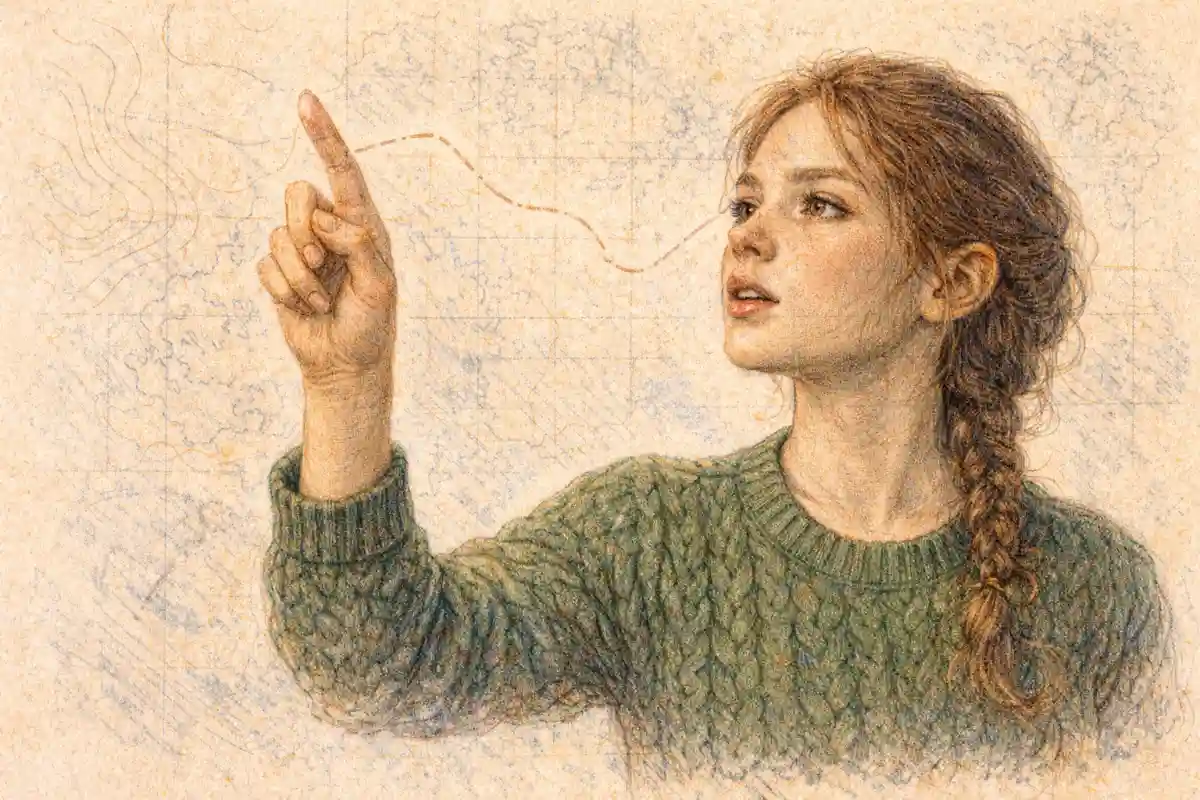
Introduction: Two Ways of Being Right
The question is not which of these two witches is smarter. Put them in an examination hall and the contest is over before it begins; one of them will finish first, score highest, and correct the proctor’s grammar on the way out. The question that actually matters is harder and stranger. It asks whether a person who believes only what can be proved and a person who believes anything that cannot be disproved are running the same mental operating system at different settings, or whether they are running fundamentally different machines that happen to arrive, now and then, at the same correct answer.

Rowling builds her seven-book argument about knowledge around exactly this pairing, and she does something the casual reader rarely notices: she refuses to declare a winner. The bushy-haired girl who reads every book in the library and the pale girl who reads a tabloid her father edits are not set up as the right way and the wrong way to think. They are set up as two halves of a single requirement. The resistance to a fascist regime, the series quietly insists, needed the researcher who could decode a snake’s anatomy and the seer who could walk a corridor by instinct. Neither could have carried the war alone. The friendship between them, threadbare and underwritten as it is, turns out to be the most precise study Rowling ever produces of how two incompatible methods of finding truth can sit in the same room without one devouring the other.
That is the wager of this comparison. Hold the empiricist and the visionary in the same frame, and you stop asking which is correct. You start asking what kind of world requires both.
The Surface Parallel
Before the differences can mean anything, the likeness has to be established, because a comparison between two characters who share nothing is merely a list. These two share a great deal, and the symmetry is deliberate enough that it reads as design rather than coincidence.
They belong to the same cohort. Both arrive at Hogwarts within the same span of years, sit the same examinations, walk the same corridors, and end up fighting the same battle in the same underground chamber beneath the Ministry. Both are clever, though the cleverness points in opposite directions. Both spend their early school years socially marooned, each in a manner that becomes a kind of signature. The first is isolated by reputation, the insufferable know-it-all whose hand is always in the air, the girl other children find exhausting before they find her indispensable. The second is isolated by atmosphere, the dreamy oddity who talks about creatures no one else can see and wears jewellery made of vegetables, the girl whose belongings vanish because her dormitory-mates think the theft is funny.
Both lose mothers, and the losses rhyme without matching. One witch watches her mother die in a botched bit of experimental magic when she is nine, an event that becomes, retroactively, the explanation for what she can see that others cannot. The other will engineer her own parents’ disappearance from her life, wiping herself out of their memories and dispatching them to the far side of the world to keep them safe, a sacrifice so total that it has no equivalent anywhere else in the books. Different mechanisms, different ages, different moral textures, and yet both girls carry a wound around the absence of a parent, and both convert that wound into a way of operating in the world.
Both join the secret defence society organised in a year when the official curriculum has been gutted. Both fight at the Department of Mysteries, that labyrinth of locked doors and impossible rooms. Both are captured during the war that follows. One is held prisoner in the cellar of a grand and rotting house. The other is tortured on the drawing-room floor of that same house, a knife at her throat and a curse in her veins, while a deranged aristocrat carves a slur into her arm. The structural mirror is built into their biographies down to the level of the building they suffer in.
So the comparison is not arbitrary. It is, if anything, over-determined. Rowling has given the reader two intelligent, isolated, motherless, brave young women of the same generation, run them through the same institutions and the same horrors, and then made them think in ways so different that they constitute a genuine philosophical disagreement about how a person should come to know what is true. The likeness is the frame. The difference is the painting.
Dimension 1: The Architecture of Knowing
Strip everything else away and this is the bedrock distinction. Each of these witches has a different theory of where truth comes from, and every other contrast in their characters grows out of this root.
The researcher knows by accumulation. She reads. When a problem appears, her instinct is to go to the source, and the source is always written down somewhere, indexed, cross-referenced, waiting in a restricted section if necessary. Confronted with the mystery of what is petrifying students in her second year, she does not have a vision or a hunch; she tears a page from a library book, works out that the creature is a basilisk, and deduces that the petrified victims survived because they glimpsed the monster through a reflection or a camera lens rather than meeting its gaze directly. The whole method is on display in that single act. Notice the assumption underneath it. The truth already exists, fixed and findable, in a text produced by someone who knew. Her job is to locate it, verify it, and apply it. This is the empiricist’s faith, and it is a faith, even though it disguises itself as the opposite of faith: the conviction that the world is legible, that evidence is reliable, that careful reading of the record will yield the answer.
The dreamer knows by openness. She takes seriously a thing precisely because it has not been ruled out. Her father edits a magazine that prints stories about conspiracies and invisible creatures and the secret machinations of the Ministry, and where any sensible person would dismiss the lot, she treats the whole catalogue as a set of live possibilities. The crumple-horned snorkack, the nargles in the mistletoe, the heliopaths the Minister supposedly keeps as a private army: she believes in these not because she has seen them but because no one has proved they are not there. Her epistemology runs on the unfalsifiable. And here is the trap Rowling lays for the reader who wants to laugh at her. The same openness that admits the snorkack also admits the truths the empiricist cannot reach. The visionary believes the dead are not gone, and the series never contradicts her. She believes things will come back, that what is lost is not lost permanently, and the architecture of the final book bends to confirm it.
Watch how the two methods perform under pressure, because performance is where a theory of knowledge proves its worth. The kind of layered analytical reading the series rewards, the habit of cross-referencing evidence across hundreds of pages until a pattern declares itself, is the same discipline that competitive examination candidates sharpen through tools like the ReportMedic CAT PYQ Explorer, where studying years of past questions teaches the eye to see the structure beneath the surface. The researcher’s mind works like that. She holds the locket, the diadem, the cup, the diary, the ring, and the snake in her head at once and assembles them into the theory of the divided soul. No one hands her the word for what Voldemort has done. She arrives at it the way a scientist arrives at a model, by gathering the scattered data until only one explanation survives.
But the visionary performs differently, and her performance is the one the empiricist cannot replicate. She knows the way through the Ministry’s labyrinth not because she has a map but because she does not panic when the map fails. She moves by a calm that looks like dreaminess and functions like navigation. In the chaos of the Department of Mysteries, when the carefully laid plans collapse, it is her unflustered intuition that keeps the group moving rather than freezing. The researcher’s evidence has run out; there is no book for this corridor. And in the gap where evidence ends, the other girl simply keeps walking, because her method never depended on evidence in the first place.
This is the deepest thing the comparison reveals about how minds work. The empiricist is unbeatable inside the domain of the recorded and the provable. The visionary is unbeatable at the edges of that domain, in the territory where nothing has been written down because nothing can be. Rowling refuses to rank these, and the refusal is the point. A world that contained only the first kind of mind would have no one to walk the unmapped corridor. A world that contained only the second would have no one to name the basilisk.
Dimension 2: The Two Kinds of Social Courage
Both of these young women are brave in a way that has nothing to do with battle, and the bravery takes opposite forms, which is what makes the pairing so revealing about the cost of being seen.
The researcher cares, achingly, about being perceived correctly. Watch her in the early years and the hunger is unmistakable. She wants to be recognised as good, as right, as belonging. When other children mock her she is genuinely wounded; she retreats to a bathroom and cries on the day the boys she wants for friends repeat a cruel thing one of them said about her. Her response to social pain is not withdrawal but redoubled effort. She will be so excellent, so prepared, so unanswerably correct that the contempt becomes untenable. There is a particular kind of courage in this, the courage of the person who keeps presenting herself for judgement in the hope of a better verdict. Her campaign for the rights of house-elves, the badges, the pamphlets, the knitted hats left out for creatures who do not want them, springs from the same place: a conviction that if she only argues well enough, marshals the evidence persuasively enough, the world will be made to see what she sees and agree.
The dreamer’s courage is the reverse, and it is rarer and stranger. She does not care whether she is seen correctly because she has detached her sense of self from the verdict of others entirely. She wears the radish earrings. She wears the spectacles that supposedly reveal invisible pests. She wears a necklace strung with the corks of butterbeer bottles. When her belongings are stolen and hidden, she does not stage a confrontation or collapse into self-pity; she assumes, with an equanimity that is almost unbearable, that they will come back, and she goes on as before. This is not obliviousness, though it can read as obliviousness. It is a self that has been constructed without reference to the audience. She has, in effect, opted out of the entire economy of social approval that governs adolescence, and the opting-out gives her a freedom the researcher will spend years trying to earn through achievement and never quite reach.
Set the two courages side by side and the asymmetry is illuminating. One girl runs toward the judgement of the group, again and again, and dares it to be kind. The other has simply walked off the field where that judgement is administered. The first is the courage of engagement; the second is the courage of indifference. Neither is cowardice. Both require something most people do not have. But they cost different things and they protect different things. The researcher’s path keeps her tethered to the social world, which is why she can organise, mobilise, lead a campaign, build the secret society’s membership list and bind it with a hex against betrayal. The dreamer’s path frees her from the social world, which is why she can say the true and tactless thing at the funeral, can sit with the grieving without performing grief, can tell a frightened boy that losing is bearable in a voice no one would dare to fake.
There is a moment that crystallises the difference. When the researcher finally feels accepted, it is an achievement, a thing won. When the dreamer is finally embraced by a circle of friends, it costs her nothing, because she never bought into the premise that she needed it. The series treats both arrivals as victories. It simply notes that they were reached by opposite roads.
Dimension 3: The Grammar of Grief
Loss is the test that exposes a person’s deepest assumptions, and these two meet loss with opposite grammars. One responds with a verb; the other with a posture. One inquires; the other accepts.
Confront the researcher with death and she reaches, instinctively, for the mechanism. How does this curse work, what is its history, is there a counter-curse, what does the literature say about reversal, what is the legal status of the spell that wiped her parents’ memories, can it be undone, has anyone undone it. Grief, for her, becomes a problem with a possible solution, or at least a problem whose contours can be mapped through study. This is not coldness. It is the only way she knows to love something that is slipping away: by understanding it well enough to fight it. When she modifies her parents’ memories before the war, she does so with surgical knowledge of exactly what she is doing, and the precision is itself a form of devotion. She has researched the spell. She knows the cost. She pays it deliberately, eyes open, the way she does everything.
The dreamer meets death with acceptance so complete it unsettles people. She speaks of her dead mother without flinching and without the performance of recovery that the bereaved are usually required to stage. She tells the boy who has just lost the closest thing he had to a parent that the voices behind the veil are not gone, only out of reach, and she says it with a serenity that he finds, against all expectation, consoling. Her certainty about an afterlife is presented as her position rather than as confirmed fact, and that distinction matters: the series does not tell the reader she is right, only that her conviction gives her a steadiness in the presence of death that the researcher, for all her learning, cannot manufacture. The dreamer does not try to solve the grief of the people around her. She sits with it. She lets it be what it is.
Here the comparison turns genuinely profound, because it maps onto one of the oldest divisions in human thought: the division between those who treat suffering as a problem to be eliminated and those who treat it as a condition to be borne. The researcher belongs to the long tradition of those who believe enough knowledge can fix anything, the tradition that built medicine and engineering and the modern world. The dreamer belongs to the older tradition that says some things are not for fixing, that the proper response to certain losses is not the scalpel but the open hand. Neither is naive. The researcher knows that some things cannot be undone, which is why her decision about her parents is a tragedy and not a project. The dreamer is not a fatalist who does nothing; she fights in every battle she can reach. But faced with the irreducible fact of a death already accomplished, the two of them stand in completely different relations to it.
The series gives the last word to neither. It simply shows that the boy at the heart of the story needs both. He needs the friend who will research the impossible curse, and he needs the friend who will tell him, without a tremor, that the dead are not as far away as he fears. Take either consolation away and his survival becomes harder to imagine.
Dimension 4: The Thestral Test
There is a single creature in this world that functions as a perfect instrument for measuring the difference between these two minds, and the series deploys it with a precision that rewards close attention.
The skeletal winged horses that draw the school carriages are invisible to anyone who has not witnessed a death and absorbed the fact of it. The dreamer sees them from her very first day at the school. The researcher never sees them at all, across the entire seven-book span. This is not an accident of plotting. It is the comparison made literal, rendered in flesh and bone and leathery wing.
Consider what the creature requires of its observer. To see it, you must have stood in the presence of death and let the reality of it enter you. The dreamer has done this; she watched her mother die. But the deeper point is about how the two girls metabolise experience. The researcher has, by the later books, certainly been near death, has seen people fall, has fought in battles where people died. And still the creatures remain invisible to her, or are rendered so for most of the narrative. The series uses the beast to dramatise a truth about her: that her relationship to the world runs through the filter of evidence and interpretation, that even direct experience reaches her processed, mediated, held at the analytical distance from which she examines everything. The dreamer’s relationship to the world is unmediated. She looks and she sees. She does not need the experience translated into data before she can register it.
This is the heart of the matter. The visionary’s epistemology depends on direct, unfiltered contact with reality, including its harshest contents. The empiricist’s epistemology depends on the careful processing of filtered evidence, and that very carefulness, that protective layer of method, can hold the rawest truths at one remove. The creature is visible only to those who have looked death in the face without the buffer. The dreamer has no buffer. That is her gift and her vulnerability at once. The researcher’s buffer is her armour and her limitation at once.
It would be a mistake to read this as the series declaring the visionary superior. The buffer that keeps the researcher from seeing the winged horses is the same discipline that lets her stay functional in the presence of horrors that would shatter a less guarded mind. She can work the problem while others panic precisely because she has interposed analysis between herself and the abyss. The dreamer’s openness, conversely, is not free. To see everything unmediated is to be unprotected from everything. The creature is a measuring instrument, and what it measures is not which witch is wiser but which kind of access to reality each one has purchased, and at what price.
The Friendship the Series Forgot to Write
Before the comparison can break down, it is worth naming the relationship it produces, because the bond between these two is the most intellectually interesting friendship in the entire saga, and Rowling barely shows it to the reader.
They are not best friends. They have no scenes of giggling intimacy, no long confessional nights, none of the texture the series lavishes on other pairings. What they have is something rarer and harder: trust across genuine difference. The researcher does not believe in the snorkack. She almost certainly thinks the magazine her friend’s father edits is nonsense. And yet, when it matters, she does not condescend. When she works out, late in the war, what the strange man actually wants, she does so without dismissing his daughter, without the eye-roll that would come so naturally. She has learned to hold two facts at once: that the dreamer’s beliefs are mostly unverifiable, and that the dreamer is not a fool. That is a harder cognitive achievement than any spell either of them performs.
This is the model the series offers for how empirical and visionary minds can collaborate. Not by one converting the other. Not by the researcher proving the snorkack does not exist, nor by the dreamer persuading the researcher to abandon her books. They collaborate by allowing each other’s method to stand, and by recognising, at the decisive moments, that the other’s way of knowing reaches places their own cannot. The structured analytical preparation that builds this kind of disciplined cross-checking, the patient willingness to test a claim against the full record before accepting or rejecting it, is precisely the skill that resources like the ReportMedic UPSC PYQ Explorer are designed to cultivate, where the candidate learns to weigh evidence across years of material rather than trusting a single impression. The researcher embodies that discipline. The dreamer supplies what the discipline cannot: the leap past the edge of the evidence. The friendship works because each respects the half of reality the other commands.
What makes this the series’s most precise study of collaboration is that it never pretends the difference dissolves. These two do not meet in the middle and become moderate empiricist-visionaries. They remain exactly what they are, an unsoftened researcher and an unsoftened dreamer, and the war is won partly because they do. A world that forced everyone to compromise toward a single method would have lost both the basilisk-naming and the corridor-walking. The friendship is valuable precisely because it does not require either party to become less herself.
Where the Comparison Breaks Down
Every comparison worth making eventually meets the place where the symmetry fails, and an honest analysis has to go looking for that place rather than smoothing it over. With these two, the symmetry fails in at least three directions, and the failures are instructive.
The first crack is academic. The two-epistemologies framing implies a kind of parity, as though the researcher and the dreamer were equal-but-different intelligences pointed at different targets. They are not equal in the formal arena. One of them is the most academically dominant student of her generation, the holder of top marks in nearly every subject, the witch who could have had a brilliant career in any field she chose. The other is competent but unremarkable in her coursework, a perfectly good student who never threatens the rankings. To pretend these are merely two flavours of the same excellence is to flatter the second and patronise the first. The researcher is simply better at the thing schools measure, and the comparison should say so plainly rather than dissolving the difference into a tidy duality.
The second crack runs the other way and complicates the first. The clean division of empiricist and visionary cannot survive close contact with either character’s actual range. The researcher is, in her own register, a visionary. She sees what no one else sees about the moral status of house-elves when the entire wizarding establishment, including her closest friends, regards them as furniture. She perceives the shape of an enemy’s strategy before the evidence is complete. That is not pure empiricism; that is insight running ahead of the data, the very thing the dreamer is supposed to monopolise. And the dreamer, for her part, is an acute empirical observer, often noticing the concrete detail of a situation that everyone distracted by drama has missed. She watches carefully. She reports accurately. Each girl contains the other’s supposed specialty, which means the framework that opposes them is a useful simplification rather than a literal truth.
The third crack is about the wounds. It is tempting to treat the two losses as parallel data points in a symmetrical structure, but they are not the same kind of loss at all. The dreamer’s mother died in front of her, a completed event, a grief with a fixed shape that she has had years to inhabit. The researcher’s loss of her parents is something she does to herself, a chosen erasure, a wound she inflicts as an act of protection and may or may not be able to reverse. One is suffered; the other is authored. To file them both under motherless girls is to miss that the second loss is an ongoing moral burden of a kind the first never becomes. The structural mirror is real, but it reflects two genuinely different objects.
What all three cracks share is a warning against the seduction of the neat binary. These are not two types. They are two compound intelligences, each of whom leans toward a method without being reducible to it. The comparison earns its keep only if it holds them as people who tend in opposite directions, not as personified philosophies wearing school robes. The moment the analysis forgets that, it stops describing them and starts using them.
What Rowling Reveals Through the Juxtaposition
Set these two minds against each other long enough and the deeper argument surfaces, and it turns out to be political as much as philosophical. Rowling is making a claim about what kind of cognitive diversity a society needs in order to survive an assault on truth itself.
The headline thesis is that intelligence is plural. There is no single faculty called being smart that the researcher has more of than the dreamer. There are different faculties pointed at different parts of reality, and a culture that honours only one of them has blinded itself to whatever the other faculty was built to see. The wizarding establishment, with its examinations and its rankings and its respectable opinions, rewards the researcher’s kind of mind and dismisses the dreamer’s. The series spends seven books demonstrating that the dismissal is a mistake, that the dreamy girl other people laugh at perceives things the credentialed adults cannot, and that a regime devoted to a single official version of reality is a regime already on the road to tyranny.
Because that is the buried connection: the assault on the dreamer’s way of knowing and the rise of the authoritarian regime are not separate threads. A government that insists there is one correct version of events, that controls the press, that punishes the man whose magazine prints the unsanctioned story, is a government waging war on epistemic pluralism. The dreamer and her father are persecuted not despite their strangeness but because of it, because the regime cannot tolerate a method of knowing it does not control. The researcher’s empiricism is, in its own way, a defence against propaganda: she checks sources, she demands evidence, she will not be told what is true by an authority. The dreamer’s visionary openness is a different defence: she will believe the suppressed story precisely because it has been suppressed. Both are antibodies against the same disease, and the disease is the monopoly on truth that every tyranny tries to establish.
This is why the resistance needed both. Trace the war and the pattern is unmistakable. The decisive break-in to the underground labyrinth succeeds because the dreamer can move through corridors the researcher’s analytical map could never have charted, and because the researcher can decode mechanisms the dreamer’s intuition could never have parsed. The hunt for the fragments of the enemy’s soul requires the researcher’s relentless cross-referencing, the assembly of scattered clues into a theory of what must be destroyed and where. But the morale that holds the resistance together through its darkest stretch owes a great deal to the dreamer’s unkillable conviction that things lost will return, that the dead are near, that the night is survivable. Strategy and spirit. Evidence and faith. The series argues, through these two women, that defeating fascism is not a single kind of work and cannot be done by a single kind of mind.
The final revelation is almost tender. Rowling does not resolve the tension between the two epistemologies because she does not think it should be resolved. She thinks a healthy world is one in which the empiricist and the visionary argue forever, each correcting the other’s excesses, neither winning. The researcher keeps the dreamer from floating off into pure credulity. The dreamer keeps the researcher from shrinking the world down to only what can be proved. The unresolved argument between them is not a flaw in the design. It is the design. A civilisation, the series suggests, is healthiest when it contains both kinds of mind in productive, permanent disagreement.
Cross-Literary Parallels
This pairing is not new. The opposition between the one who knows by evidence and the one who knows by vision is one of the deep grooves in the literary and philosophical record, and reading these two witches against their ancestors clarifies what Rowling has and has not done with the inheritance.
Begin with the two poles of nineteenth-century thought, the naturalist and the prophet. On one side stands the man who watched finches and tortoises and barnacles for decades, who would not advance a claim he could not anchor in observation, who built the most consequential theory of the modern age out of patient accumulation of evidence. On the other stands the engraver-poet who saw angels in a tree and heaven in a wild flower, who declared that the road of excess leads to the palace of wisdom and meant it, whose knowledge came not from the microscope but from the visionary eye. The researcher is the heir of the first; the dreamer is the heir of the second. And the nineteenth century could not decide between them either, which is rather the point. The age that produced the theory of natural selection also produced the great visionary poetry, and neither could be reduced to the other.
The detective tradition offers a sharper, more compressed version. The great deductive detective, the cocaine-addled reasoning machine who solves crimes by ruthless inference from physical traces, is the empiricist as folk hero. His quieter cousin, the unassuming priest-detective who solves crimes by intuiting his way into the soul of the criminal, by understanding sin from the inside rather than tracing footprints from the outside, is the visionary as folk hero. One reads the mud on a boot; the other reads the human heart. Both arrive at the murderer. The two methods are not ranked by their inventors; they are offered as alternative routes to the same truth, which is exactly the relation the series sets up between its researcher and its dreamer.
Consider next two women of intellect from different centuries, the laboratory scientist who isolated radioactive elements through years of brutal physical labour, measuring and refining and measuring again until the data forced the conclusion, and the medieval abbess who composed music and theology and medical treatises out of visions she understood as divine. The first knew by experiment; the second knew by revelation. To call only one of them intelligent is to impoverish the word. They were both, in their utterly different idioms, among the most formidable minds of their respective worlds, and the comparison between the witches gains depth from the recognition that the empiricist-visionary split has always cut across gender, has always produced women of the first rank on both sides.
A more modern register supplies perhaps the most familiar pairing of all: the pointy-eared officer who insists on logic and the irascible physician who insists on feeling, the two advisers between whom the captain must steer. Their endless argument is the engine of the better decisions, and the franchise understood, episode after episode, that the pure rationalist and the pure humanist each go wrong when unchecked by the other. The dreamer and the researcher are a version of this, transposed into a school for witchcraft. Neither should be allowed to win, because the value lies in the friction.
Finally, the deepest parallel, the one that reaches back to the foundations of tragedy: the two sisters of the ancient Theban play, the one who will defy the king to bury her brother because a higher law demands it, and the one who counsels caution, compromise, survival within the rules. The visionary sister follows a truth she cannot prove against the authority that can destroy her; the practical sister works within the verifiable constraints of power. In the original, this division ends in catastrophe. Rowling borrows the structure and removes the tragedy: her visionary and her practical thinker survive, fight together, and win. It is as though she took the ancient pairing and asked what would happen if the two sisters, instead of being torn apart by their difference, learned to need each other. The answer, across seven books, is that they save the world.
Legacy: Which Mind the Audience Loves, and Why
Readers do not respond to these two characters equally, and the pattern of the response says something about the readers themselves. The legacy of each, in the culture that grew up around the books, is shaped by what each woman offers the reader who is trying to find herself in the pages.
The researcher became the patron saint of the clever, lonely child. For every reader who was the one with her hand up, the one who read ahead, the one whose competence made her unpopular before it made her admired, this character is a vindication. She is proof that the irritating know-it-all is also the indispensable one, that the girl mocked for caring too much about her work is the girl who will eventually be needed most. Her arc, traced in full in the standalone study of her character, is the arc of intelligence learning to soften without dulling, of rigour acquiring warmth. The reader who loves her tends to be the reader who has been told, at some point, that she was too much, and who found in this fictional witch the assurance that too much was exactly enough. That readership is vast, and its loyalty is fierce, and it has made the researcher one of the most beloved figures the genre has produced. The full register of her contradictions and her growth is worth following through the complete Hermione Granger character analysis, which traces how the anxious overachiever becomes the moral spine of the trio.
The dreamer commands a different and in some ways more intense devotion. She became the patron saint of the strange child, the one who never learned the social rules and stopped trying, the one whose oddness was not a phase to be outgrown but a self to be defended. Readers do not merely like her; they protect her, the way one protects something fragile and rare. Her serene indifference to mockery offers a fantasy of liberation to anyone who has ever been crushed by the verdict of a peer group, and her unguarded kindness, the way she meets a grieving boy with exactly the right words because she is not censoring herself for effect, makes her, for many readers, the emotional high point of the later books. The deeper texture of her oddity, her grief, and her unexpected steel is laid out in the dedicated Luna Lovegood character analysis, which argues that her dreaminess is a discipline rather than a deficit. The reader who loves her tends to be the reader who has felt unseeable, and who found in this fictional witch the assurance that being unseeable might be a kind of freedom rather than a kind of exile.
What the divided affection reveals is that the two characters serve two different needs, and that most readers feel the pull of both because most readers contain both. There is a part of nearly everyone that wants to be recognised as competent and a part that wants to be free of the need for recognition entirely. The researcher speaks to the first; the dreamer speaks to the second. The endurance of the pairing, the fact that both remain among the most discussed figures in the entire fandom decades on, is the endurance of the human conflict they externalise. We argue about which of them we love more because we are arguing, really, about which of them we wish we were.
It is worth noting, too, which one the wider culture tends to underestimate, because the underestimation is itself the series’s point made flesh. The dreamer is the one more often reduced to comic relief, to the quirky friend, to a collection of eccentric accessories. The reduction repeats, in the reader’s casual judgement, exactly the error the series spent seven books warning against: the dismissal of the visionary mind as merely odd. Every reader who treats her as a joke is, in miniature, the establishment that laughed at her. And every reader who comes to see her as the wisest person in the room has undergone, in miniature, the education the books were designed to deliver.
The Two Relationships to Authority
A person’s theory of knowledge is never only private. It dictates how she stands toward the institutions that claim to hold knowledge, and on this axis the two witches diverge as sharply as on any other, in ways that illuminate the politics buried in the books.
The researcher is, by temperament, an insider to institutions even when they fail her. She believes in the school, in its rules, in the value of the prefect’s badge and the examination results and the proper channels. When something is wrong, her instinct is to reform from within: to organise, to petition, to build a campaign with rules and membership and a charter. Her secret society is not anarchic; it has a sign-up sheet bound by a clever hex, a structure, a purpose ratified by agreement. She trusts that institutions, correctly pressured and supplied with sufficient evidence, can be made to do right. This is the empiricist’s politics, the faith that the system is fundamentally legible and therefore fundamentally reformable. Even her rebellion is orderly.
The dreamer relates to authority as a person who was never quite inside it to begin with. She does not rebel against institutions so much as float free of them, untroubled by their approval and unintimidated by their disapproval. The official curriculum, the respectable opinion, the verdict of the establishment: none of these has purchase on her, because she was never seeking their endorsement. Where the researcher fights to make the institution see the truth, the dreamer simply holds the truth herself and lets the institution remain blind if it insists. This is the visionary’s politics, and it is harder to suppress precisely because it does not engage on the institution’s terms. You cannot expel a person from a club she never joined.
The regime that rises in the later books finds the researcher dangerous because she can organise and document and resist through structure, the very competencies institutions both produce and fear. It finds the dreamer dangerous in a different and more unsettling way: she cannot be co-opted, because she wants nothing the regime controls. Her father’s persecution and her own captivity follow from a refusal that is constitutional rather than strategic. She does not oppose the official truth; she is simply immune to it. Between the two of them, the resistance has both the asset who can fight the system on its own ground and the asset the system cannot reach at all, and a tyranny needs to defeat both kinds of opponent, which is a far harder task than defeating either alone.
The Unwritten Chapters
The most generative way to read this pairing is to attend to what the series leaves out, because the absences are themselves a kind of statement about the limits of the form.
Consider how much of the friendship between these two the books decline to show. They share a dormitory wing for years, spend time together at the rambling house where the resistance gathers, fight side by side, and grieve the same dead, yet the everyday texture of their relationship is almost entirely missing from the page. The reader never sees them argue about whether a printed story is true. The reader never watches the researcher try, once, to talk the dreamer out of a belief, or the dreamer offer the researcher a comfort her books cannot supply. The conversations about their fathers, about the dead, about what each girl makes of the other’s strangeness: all of it happens, presumably, in the white space between chapters. The series gives the reader the fact of the friendship and withholds its operation.
This absence is worth dwelling on rather than lamenting, because it points to something the form cannot easily hold. A narrative driven by a single protagonist’s perspective can only show what that protagonist witnesses, and the daily collaboration of two secondary characters falls outside his line of sight. The friendship between the researcher and the dreamer is structurally invisible for the same reason that most of the interesting cross-epistemological work in any society is invisible: it happens between people who are not at the centre of the story being told. The books model a thing they cannot depict.
Imagine the chapter the series never wrote. The two of them, alone, late in the war, in the upstairs room of the gathering-house. The researcher has a stack of books and a problem she cannot crack. The dreamer has no books and a calm the researcher envies and distrusts. What would they say to each other? The researcher might confess that the method she has trusted her whole life has reached its limit, that there is no text for the thing she now needs to know. The dreamer might answer, without triumph, that the limit was always there and that living past it is a skill rather than a failure. Neither would convert the other. The researcher would not stop believing in evidence; the dreamer would not start. But each might come away having glimpsed the shape of the country the other lives in, and that glimpse, repeated across a friendship, is how a person learns that her own way of knowing is one way among others rather than the way.
The series cannot stage that conversation, and so the analytical reader must reconstruct it, which is itself an exercise in the two methods the books dramatise. To imagine the unwritten chapter requires the empiricist’s attention to what the text actually establishes and the visionary’s willingness to move past the evidence into the plausible. The reconstruction needs both minds, which is the final and quietest proof of the thesis: even understanding the comparison between the researcher and the dreamer demands that the reader become, briefly, a little of each.
There is one more absence worth marking. The books never let either witch be wrong in a way that costs the other dearly. The researcher’s faith in evidence is never punished with a catastrophe born of her refusing to trust a hunch; the dreamer’s faith in the unprovable is never punished with a disaster born of her believing something false. Rowling protects both methods from the failure that would expose its limits most brutally, and this protection is itself a choice. A harsher writer would have shown the empiricist’s caution arriving too late, or the visionary’s openness admitting a lie that got someone killed. By declining to humiliate either way of knowing, the series keeps its argument balanced at the cost of a certain realism. Real empiricists are sometimes paralysed by their demand for proof; real visionaries are sometimes ruinously credulous. The two witches are idealised versions of their types, each shown mostly at her best, and the careful reader should notice that the even-handedness is purchased partly by sparing both of them their characteristic catastrophe. That the comparison still feels true, despite this gentleness, is a measure of how deeply Rowling understood the two minds she set against each other.
Frequently Asked Questions
Is Hermione smarter than Luna in Harry Potter?
In the narrow, examinable sense, yes, and the series does not pretend otherwise. The researcher posts top marks across nearly every subject and would have excelled in any academic field she entered, while the dreamer is a competent but unremarkable student. But the question itself imports a flawed assumption, that intelligence is a single quantity one person has more of than another. The series argues the opposite. The two witches possess different faculties pointed at different parts of reality. The first is unbeatable at the recorded and the provable; the second perceives truths that lie beyond evidence entirely. Asking which is smarter is like asking whether a telescope is smarter than a microscope. Each sees what the other cannot, and the war against the regime required both instruments aimed at once.
Why can Luna see Thestrals but Hermione cannot?
The skeletal winged horses are visible only to those who have witnessed a death and genuinely absorbed the fact of it. The dreamer watched her mother die and carries that reality unmediated, which is why the creatures are visible to her from her first day at the school. The researcher, even after being near death in battle, processes experience through a protective filter of analysis, holding the rawest truths at the analytical distance from which she examines everything. The series uses the beast as a literal instrument for measuring the difference between unfiltered and mediated access to reality. The visionary looks and sees; the empiricist must translate experience into evidence before it fully registers. The buffer that blinds the researcher to the creatures is the same discipline that keeps her functional amid horrors.
What does the friendship between Hermione and Luna represent?
It represents the rarest and most demanding kind of relationship the series depicts: trust across genuine intellectual difference. The two are not close in the conventional sense and share almost no intimate scenes, yet they extend each other a respect that neither party’s beliefs would seem to warrant. The researcher does not credit the dreamer’s unfalsifiable convictions, and the dreamer does not adopt the researcher’s evidentiary rigour, but at decisive moments each recognises that the other’s method reaches places her own cannot. The friendship is the series’s model for how empirical and visionary minds can collaborate without converting each other. They win the war partly because they remain exactly what they are rather than meeting in some diluted middle.
Does Rowling favour Hermione’s empiricism or Luna’s intuition?
She conspicuously favours neither, and the refusal to choose is the deepest argument the comparison makes. A world containing only the researcher’s mind would have no one to walk the unmapped corridor when the evidence runs out; a world containing only the dreamer’s would have no one to decode the basilisk or assemble the theory of the divided soul. The series stages the two epistemologies as permanent, productive rivals, each correcting the other’s excess. The empiricist keeps the visionary from floating into pure credulity; the visionary keeps the empiricist from shrinking reality down to the merely provable. The unresolved tension is not a flaw in the design. It is the design, and it reflects Rowling’s conviction that a healthy society needs both kinds of mind in lasting disagreement.
How are Hermione and Luna similar despite their differences?
The likeness is extensive enough to read as deliberate design. Both belong to the same school cohort, sit the same examinations, and fight in the same battle beneath the Ministry. Both are exceptionally intelligent, though in opposite directions. Both spend their early years socially isolated, one by her know-it-all reputation and the other by her dreamy strangeness. Both lose mothers, though by different mechanisms and at different ages. Both join the secret defence society, both fight at the Department of Mysteries, and both are captured during the war, held and harmed in the same grand decaying house. The symmetry is so over-determined that it functions as the frame within which their genuine philosophical disagreement about knowledge becomes legible and meaningful.
What is the central difference between intelligence and wisdom in this comparison?
The comparison maps the researcher onto a certain conception of intelligence, the capacity to gather, verify, and apply recorded knowledge with formidable rigour, and the dreamer onto a certain conception of wisdom, the capacity to remain open to what cannot be proved and to meet the irreducible facts of loss and death without flinching. Intelligence, in this scheme, solves problems; wisdom knows which problems cannot be solved and how to live alongside them. The researcher fights a death with research; the dreamer accepts a death with serenity. Neither is presented as superior, because the series insists that a complete person, and a complete society, requires both the problem-solving faculty and the problem-accepting one working in concert.
Did Hermione and Luna both fight at the Department of Mysteries?
Yes, and the episode is one of the clearest demonstrations of why the resistance needed both their minds. When the carefully laid plans collapse inside the labyrinth of locked doors and impossible rooms, the dreamer’s unflustered calm keeps the group moving through corridors that no analytical map could have charted, her intuition functioning as navigation precisely where evidence has run out. The researcher, meanwhile, supplies the decoding of mechanisms and the strategic reasoning that the dreamer’s intuition could never have parsed. The break-in succeeds because the two methods operate together, each covering the blind spot of the other. The sequence is, in miniature, the whole thesis of the comparison: strategy and spirit, evidence and instinct, accomplishing jointly what neither could manage alone.
Why does Luna believe in creatures like the Crumple-Horned Snorkack?
Her epistemology runs on the unfalsifiable. She takes a thing seriously precisely because it has not been ruled out, treating the catalogue of strange creatures her father’s magazine prints as a set of live possibilities rather than disproven nonsense. To the sensible observer this looks like credulity, and the series invites the reader to laugh before springing the trap. The same openness that admits the snorkack also admits the truths the empiricist cannot reach, such as her conviction that the dead are not wholly gone, which the narrative quietly confirms. Her belief in the unprovable creature and her access to the unprovable consolation spring from the identical source: a refusal to limit reality to what evidence has so far certified. The openness is a single faculty with a wide aperture.
Is Luna’s worldview presented as factually correct in the series?
The series is careful here, and the care matters. Her certainty about an afterlife and the nearness of the dead is presented as her position rather than as confirmed fact. The narrative does not step in to verify that the voices behind the veil are truly her departed loved ones waiting to return. What it does instead is show that her conviction grants her a steadiness in the presence of death that the researcher, for all her learning, cannot manufacture. The architecture of the final book bends toward vindicating her broad intuition that loss is not permanent, yet Rowling stops short of stamping her metaphysics as proven. This restraint preserves the comparison’s balance, keeping the visionary’s knowledge genuinely visionary rather than simply correct.
How do Hermione and Luna each respond to grief?
With opposite grammars. The researcher responds with a verb: she inquires. Confronted with loss, she reaches for the mechanism, studying how a curse works, whether it can be reversed, what the literature says, what the legal status of a memory charm is. Grief becomes a problem to map and possibly to solve, and the precision of her study is itself a form of love. The dreamer responds with a posture: she accepts. She speaks of her dead mother without the performance of recovery, sits with the bereaved without trying to fix their feelings, and meets death with a serenity that others find unexpectedly consoling. One treats suffering as a condition to be eliminated; the other as a condition to be borne. The grieving boy at the centre of the story needs both responses to survive.
Which character do Harry Potter readers prefer, Hermione or Luna?
The fandom divides, and the division is revealing. The researcher commands the loyalty of readers who were themselves the clever, lonely children with their hands always up, for whom she is a vindication that competence is worth more than popularity. The dreamer commands the fierce, protective devotion of readers who felt strange and unseeable, for whom her serene indifference to mockery offers a fantasy of liberation. Most readers feel both pulls because most people contain both impulses, the desire to be recognised as capable and the desire to be free of the need for recognition. The enduring argument over which witch is the greater character is, at bottom, an argument over which self the reader wishes to be, which is why it never resolves.
Is the contrast between Hermione and Luna a feminist statement?
It can be read as one, though the books wear the argument lightly. By offering two women of the first intellectual rank who think in completely different ways, Rowling refuses the reductive notion that there is a single template for a clever female character. The pairing also echoes a historical truth, that the division between the empiricist and the visionary mind has always produced formidable women on both sides, from laboratory scientists to medieval mystics. Crucially, the series treats the dreamer’s persecution and the researcher’s marginalisation as failures of a society that honours only one kind of mind. The implicit claim is that valuing cognitive diversity, including the strange and the unprovable, is part of valuing women fully rather than admitting only those who excel by the established rules.
What literary characters are Hermione and Luna most like?
The pairing sits in a deep groove of the literary record. The researcher echoes the patient naturalist who built a world-changing theory from accumulated observation, while the dreamer echoes the visionary poet who saw heaven in a wild flower. In the detective tradition they recall the ruthlessly deductive investigator and his intuitive, soul-reading priestly counterpart, two routes to the same culprit. Among women of intellect they suggest the laboratory scientist who knew by experiment and the medieval abbess who knew by revelation. The endlessly arguing rationalist and humanist advisers of a famous space saga supply a modern version. Deepest of all, they recall the two sisters of ancient tragedy, one defying authority for an unprovable higher law, the other counselling practical compromise, though Rowling removes the tragedy and lets her pair survive.
Why is Luna often underestimated by readers and characters alike?
Because her wisdom arrives dressed as eccentricity, and most observers cannot see past the costume. The radish earrings, the cork necklace, the talk of invisible creatures all read as comic before they read as profound, and so she is reduced to the quirky friend, the collection of strange accessories, the comic relief. This reduction repeats, in the reader’s casual judgement, the precise error the series spent seven books warning against: the dismissal of the visionary mind as merely odd. The wizarding establishment laughs at her and her father; many readers do the same. Coming to recognise her as the wisest person in many a room is the education the books are designed to deliver, and every reader who undergoes it has, in miniature, learned the central lesson.
Did Hermione ever come to respect Luna’s way of thinking?
The evidence suggests a hard-won, partial respect rather than conversion, which is exactly what makes it meaningful. The researcher never adopts the dreamer’s beliefs and almost certainly still regards the snorkack as nonsense. What changes is that she stops condescending. When she works out, late in the war, what the strange man actually wants, she does so without dismissing his daughter, without the eye-roll that would once have come naturally. She has learned to hold two facts simultaneously, that the dreamer’s convictions are mostly unverifiable and that the dreamer is not a fool. That cognitive achievement, holding respect and disagreement in the same hand, is harder than any spell either performs, and it is the foundation of the series’s model for collaboration across difference.
How does the Hermione and Luna contrast connect to the war against Voldemort?
Directly, because the assault on the dreamer’s way of knowing and the rise of the authoritarian regime are the same thread. A government that controls the press, insists on one official version of events, and persecutes the man whose magazine prints the unsanctioned story is waging war on epistemic pluralism itself. The dreamer and her father are targeted because the regime cannot tolerate a method of knowing it does not control. The researcher’s source-checking empiricism and the dreamer’s belief-in-the-suppressed are both antibodies against the monopoly on truth that every tyranny tries to establish. The resistance needed the researcher’s relentless cross-referencing to hunt the soul-fragments and the dreamer’s unkillable conviction to hold morale. Defeating fascism, the series argues through them, is not a single kind of work.
Are Hermione and Luna meant to represent science versus faith?
That is one valid frame, provided it is held loosely. The researcher embodies the scientific temperament, the demand for evidence, the trust in the legible and the recorded, while the dreamer embodies a faith-like openness to what cannot be proved, including an afterlife and the nearness of the dead. But the series resists a clean opposition, because each character contains the other’s supposed specialty. The researcher is a visionary about house-elves, seeing a moral truth the evidence-bound establishment cannot; the dreamer is a sharp empirical observer who notices concrete details others miss. So science versus faith captures the leaning of each mind without capturing the whole. They are compound intelligences who tend in opposite directions, not personified doctrines in school robes.
What is the significance of both characters losing their mothers?
The shared loss is part of the deliberate symmetry, and the differences within it are part of the meaning. The dreamer’s mother died in front of her in a botched piece of experimental magic, a completed grief with a fixed shape that became, retroactively, the explanation for what she can see that others cannot. The researcher’s loss is self-authored, an erasure she performs by wiping her parents’ memories and sending them away to protect them, a wound she inflicts deliberately with full knowledge of the cost. One loss is suffered; the other is chosen. Both convert into a way of operating in the world, but the second carries an ongoing moral burden the first never becomes. Filing them both under motherless girls would miss how genuinely different the two objects are.
Does the Hermione and Luna comparison have a winner?
No, and any reading that crowns one of them has misunderstood the design. The whole architecture is built to prevent a verdict. The researcher dominates the examinable world; the dreamer perceives what lies beyond evidence. The first names the basilisk and assembles the theory of the divided soul; the second walks the unmapped corridor and steadies the grieving. Each is indispensable precisely where the other is helpless. Rowling stages their difference as a permanent, productive rivalry rather than a contest, because she believes a healthy world keeps both kinds of mind in lasting disagreement, each curbing the other’s excess. To ask who wins is to make the establishment’s error of honouring one faculty and dismissing the rest. The answer the series gives is that both win, together, or neither does.
Why does the series make Luna a Ravenclaw and Hermione a Gryffindor?
The house assignments invert the lazy expectation and deepen the comparison. One might assume the bookish researcher belongs in the house of the clever and the dreamy visionary somewhere else, yet Rowling places the researcher among the brave and the dreamer among the wise-by-disposition. The choice signals that the researcher’s defining trait is not her cleverness but her courage, the willingness to keep presenting herself for judgement and to fight for unpopular causes, while the dreamer’s house captures a kind of intelligence the examinations cannot measure, the openness to unconventional truth. The sorting refuses to let cleverness be the property of a single house and insists that wisdom and bookishness are not the same thing. It is a small structural detail that quietly reinforces the entire argument about the plurality of intelligence.