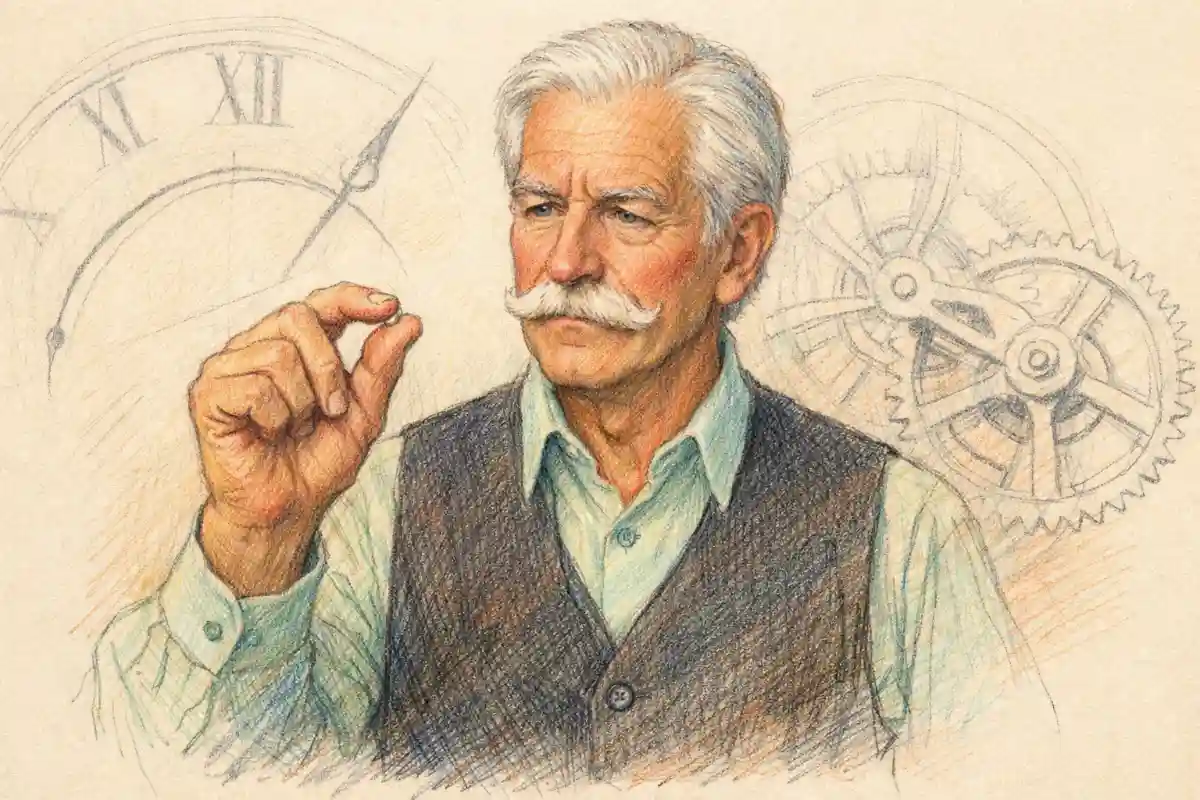
A Franciscan kneels in a garden before dawn, basket in hand, gathering weeds and flowers while the rest of Verona sleeps. He is talking to himself about poison. “Within the infant rind of this weak flower,” he observes, “Poison hath residence, and medicine power” (2.3.23-24, Arden second series, ed. Brian Gibbons). The lines arrive as botany and end as moral philosophy: the same plant that heals can kill, and the difference lies not in the herb but in the hand that uses it. Forty minutes of stage time later, that same hand will mix a draught that mimics death, hide a thirteen-year-old in a tomb, and stake two lives on a letter that never gets delivered.

The cultural shorthand files the friar under harmless: a kindly old priest who marries the young couple, frets a good deal, and turns up too late at the end to do any good. That portrait is comfortable and almost entirely wrong. The figure Shakespeare actually wrote is the busiest agent in the tragedy, the one character who could have stopped the catastrophe at half a dozen points and instead engineers it. Friar Laurence performs the secret marriage, supplies the potion, drafts the scheme, sends the failed message, and stands in the vault as the bodies cool. No other character touches so many of the play’s hinges. The question this article presses is not whether he means well, because he plainly does, but what to call a man whose every benevolent intervention deepens the disaster. Three labels compete for him: healer, schemer, bungler. The argument here is that the play sustains all three at once, and that refusing to choose between them is precisely what makes the character interesting rather than the prop the cliche reduces him to.
Who Friar Laurence Is and What He Does
Friar Laurence is a Franciscan friar of Verona, confessor to Romeo and, it emerges, trusted counselor to half the city. He appears in four scenes, and in each he is doing something consequential rather than commenting from the wings. In Act 2 Scene 3 he gathers herbs and delivers the soliloquy on the doubleness of nature before agreeing to marry Romeo and Juliet. In Act 2 Scene 6 he performs that marriage, hurrying the lovers to the altar with a warning about excess pressed into their hands on the way. In Act 4 Scene 1 he hears Juliet’s threat of suicide, talks her back from the ledge, and proposes the potion plot that will drive the rest of the action. In Act 5 Scene 3 he arrives at the Capulet vault, finds Romeo and Paris dead, fails to lead the waking Juliet to safety, flees at the noise of the watch, and returns to confess the whole sequence to the Prince.
That tally matters because the popular memory of the character compresses these four interventions into a single vague impression of benevolence. The friar is not a chorus who watches and moralizes. He is the play’s chief contriver, a man whose hands are on the marriage license, the drug, the timetable, and the undelivered letter. Verona treats his cell as a place of refuge and his counsel as authoritative; Romeo runs to him in crisis, Juliet runs to him in crisis, and the Prince, even after everything, calls him a holy man whose word the city has long trusted. To understand the tragedy is to understand that its most catastrophic decisions are taken not by the feuding patriarchs or the hot-blooded young men but by the gentlest figure on stage.
What kind of friar is Friar Laurence?
He is a Franciscan, an order founded on poverty, preaching, and care of the sick, and Shakespeare gives him the marks of all three: he lives simply, he counsels constantly, and he keeps a working knowledge of medicinal plants. His learning in herbs and “distilling liquor” places him in a long tradition of monastic physicians, and it is the root of both his usefulness and his danger.
The order matters for the play’s nerve. A Franciscan in Elizabethan England was not a neutral figure. England had broken with Rome two generations earlier, the monasteries had been dissolved within living memory, and friars in particular carried a charge of suspicion in Protestant culture as agents of a foreign and discredited faith. The source tradition behind the play, which the section below examines in detail, leans hard on that suspicion. Shakespeare’s choice to make his friar warm, learned, and grieving rather than scheming or lecherous is a deliberate act of rehabilitation, and it is one of the surest signs that the dramatist wanted the character read with sympathy rather than reflexive distrust. The pharmacological dimension, his command of plants that cure and plants that kill, is developed at length in the discussion of his garden of herbs that heal and poison by turns, and it supplies the play with its governing image of the double-edged remedy.
His position also grants him a peculiar freedom of movement. He can marry the children of warring houses because a priest stands outside the feud; he can keep Romeo’s confidence and Juliet’s because the confessional binds him to secrecy; he can move drugs and letters across the city because no one suspects a friar of intrigue. Every quality that makes him trustworthy also makes him capable of the secret machinery that ends in the vault. The play hands its most dangerous instruments to its safest pair of hands, and watches what happens.
The cell itself is worth pausing over, because the play makes it a counter-space to the feud-ridden street. Verona’s public places are arenas of provocation, the marketplace where Sampson bites his thumb, the square where Tybalt and Mercutio die. The Franciscan’s cell is the one location where a Montague and a Capulet can stand side by side without drawing steel, where confession is heard and counsel given and a marriage solemnized in defiance of the families’ hatred. The dramatic geography is pointed: the tragedy’s most consequential decisions happen not in the halls of the great houses but in a poor friar’s garden room, and the city that runs on public honor and public violence has quietly outsourced its private crises to a man with no rank and no sword. That displacement is part of why the catastrophe feels both intimate and uncontrollable. The mechanisms that destroy the lovers are set in motion in a place the feud cannot reach, by a man the feud cannot touch, and they fail anyway.
The friar’s relationships deepen the portrait. Romeo addresses him as “ghostly father” and “good father,” the language of a son to a trusted elder, and the boy’s first instinct in every crisis is to run to the cell. Juliet, who has the Nurse for a confidante and her parents for antagonists, turns to the friar at the moment of greatest danger, when no one else in Verona can be trusted with her refusal of Paris. The friar is, in effect, the parent the lovers choose over the parents they were given, and the substitution carries an irony the play does not spell out but plainly intends. The biological fathers, Montague and Capulet, drive the feud that dooms their children; the spiritual father, who means only to heal, supplies the marriage, the drug, and the plan that kill them. The play sets two kinds of fatherhood against each other, the one that hates and the one that helps, and lets the audience watch the helping fail more completely than the hating ever could.
The Friar in His Own Words
The case for and against Friar Laurence has to be built from the verse, because the play characterizes him almost entirely through how he speaks. Four passages carry the weight: the herb soliloquy, the marriage warning, the design of the plot, and the confession. Read closely, they reveal a mind that is genuinely wise about the world in the abstract and genuinely reckless about the world in front of him, and the gap between those two modes is the character.
The herb soliloquy in Act 2 Scene 3 opens the friar’s part. “The grey-eyed morn smiles on the frowning night, / Chequering the eastern clouds with streaks of light” (2.3.1-2). The couplets are calm, balanced, sententious; the rhyme itself enacts a temperament that likes things ordered and paired. Then the thought sharpens into the famous formulation of doubleness: “O, mickle is the powerful grace that lies / In plants, herbs, stones, and their true qualities” (2.3.15-16), building to the flower whose rind holds poison and medicine at once. “Two such opposed kings encamp them still / In man as well as herbs, grace and rude will” (2.3.27-28). The friar is describing pharmacology, but he is also stating the play’s moral physics: nothing is purely good or purely harmful, and outcomes depend on measure, timing, and use. The chilling irony is that the man who articulates this principle so clearly will violate it within hours, applying a powerful remedy in reckless haste and producing exactly the poisoned outcome his own philosophy warned against.
What does “wisely and slow; they stumble that run fast” mean?
The line is Friar Laurence’s parting counsel to Romeo at the end of Act 2 Scene 3, “Wisely and slow; they stumble that run fast” (2.3.94). It means that haste produces ruin, that the surest path is the measured one, and that speed in matters of love and consequence is a near guarantee of disaster. It is the friar’s deepest conviction and the play’s central warning.
What makes the line devastating is that the speaker disregards it immediately. Romeo has just told the friar that the boy who wept over Rosaline yesterday now wants to marry Juliet today, and the cleric’s response is to rebuke the speed of the change, “Holy Saint Francis, what a change is here!” (2.3.65), and to deliver the maxim about stumbling. Yet in the very same breath he agrees to perform the wedding, and his stated reason is not the lovers’ readiness but a political calculation: “For this alliance may so happy prove / To turn your households’ rancour to pure love” (2.3.91-92). The counsel of slowness is sincere, and the action that follows it is the opposite of slow. The friar preaches measure and practices speed, and the tragedy lives in that contradiction.
The marriage scene in Act 2 Scene 6 repeats the pattern at higher pressure. Waiting for Juliet, the friar tries once more to brake the rush: “These violent delights have violent ends / And in their triumph die, like fire and powder, / Which as they kiss consume” (2.6.9-11). The image is exact and prophetic, fire and gunpowder destroying each other at the moment of contact, and the prescription that follows is the friar’s whole ethic in two lines: “Therefore love moderately: long love doth so; / Too swift arrives as tardy as too slow” (2.6.14-15). Then Juliet enters, and the friar abandons his own counsel in the next sentence, hurrying the couple off to be married at once: “you shall not stay alone / Till holy church incorporate two in one” (2.6.36-37). The scene stages the contradiction as theatre. The audience hears the warning and watches the warner override it within a dozen lines.
The design of the plot in Act 4 Scene 1 is where the schemer takes over from the counselor. Faced with Juliet’s knife and her vow to die rather than marry Paris, the friar produces a remedy from the same shelf as his herbs: “Hold, daughter, I do spy a kind of hope” (4.1.68). The plan is intricate and confident. Juliet will drink a “distilling liquor” that mimics death for “two and forty hours” (4.1.105), be laid in the family vault, and wake to find Romeo, summoned by a letter, waiting to carry her to Mantua. Every clause of it depends on perfect coordination in a city the play has shown to run on accident and speed. The cleric who warned against running fast now stakes two lives on a sprint of his own design.
The confession in Act 5 Scene 3 closes the part and complicates every easy verdict. Caught in the vault among the dead, the friar does not flee the consequences; he tells the Prince everything, accurately and without self-exculpation. “I will be brief, for my short date of breath / Is not so long as is a tedious tale” (5.3.229-230). He lays out the marriage, the potion, the plan, and the failure of the letter, and he offers his own life to the law: “let my old life / Be sacrificed, some hour before his time, / Unto the rigour of severest law” (5.3.267-269). The honesty is total and the timing is, as usual, too late. The man who could not act slowly when slowness would have saved the lovers now speaks with perfect, useless clarity over their bodies.
The verse repays attention to its form, because the priest’s speech is patterned in ways that mark him off from every other voice in the play. His soliloquy and his maxims run heavily to rhymed couplets and to antithesis, the rhetorical balancing of opposites: morning against night, poison against medicine, grace against rude will, swift against slow. The couplet is a closed form, a unit that resolves and seals, and the friar reaches for it whenever he wants to fix a truth in place. The habit characterizes a mind that craves order and believes the world can be balanced like a prescription, two parts this against one part that. The tragedy then arranges for that orderly mind to be overrun by a disorderly world, and the gap between the tidy couplets and the chaos they fail to control is itself a form of characterization. When the friar tries to manage the catastrophe in Act 5, his speech grows hurried and broken, the couplets giving way to anxious half-lines, “Saint Francis be my speed! how oft tonight / Have my old feet stumbled at graves!” (5.3.121-122). The order he prized has deserted his own verse, and the man who counseled against stumbling stumbles in the dark among the tombs.
The confession’s rhetoric is its own small masterpiece of too-late clarity. The friar narrates the whole concealed plot in a single sustained speech, and the narration is lucid, sequential, and complete, the very qualities his earlier actions lacked. He could not slow himself when slowness would have helped; now he is all measured order, laying out cause and effect over the bodies the disorder produced. Shakespeare gives the contriver his moment of perfect competence only after competence can save no one, and the cruelty of that arrangement is precise. The cleric’s final speech is the play telling the audience, in the friar’s own ordered cadences, exactly how much intelligence was present throughout and exactly how little it availed.
The Three Verdicts: Healer, Schemer, Bungler
The friar invites three labels, and the strongest reading is the one that refuses to discard any of them. Each captures a real facet of the character; each fails as a complete account; and the play’s design keeps all three in play to the end. To test them rather than merely assert them, the analysis below scores the friar against the four scenes that define him, the herb cell at 2.3, the marriage at 2.6, the plot at 4.1, and the vault at 5.3, asking in each case whether the evidence supports healer, schemer, or bungler. Call the resulting instrument the InsightCrunch Friar rubric.
| Scene | Healer (the case for) | Schemer (the case for) | Bungler (the case for) |
|---|---|---|---|
| 2.3 Herb cell | Articulates the ethic of measure and grace; counsels patience; reads Romeo’s fickleness clearly | Consents to the secret marriage on a political calculation about ending the feud, not on the lovers’ welfare | Ignores his own maxim within minutes; agrees to a clandestine wedding of two children he barely pauses over |
| 2.6 Marriage | Warns against violent delights; prescribes moderate love; tries to slow the rush | Solemnizes a binding sacrament in secret, committing the lovers and himself to concealment | Performs the very haste he has just condemned; binds Juliet in a marriage that will collide with the Paris match |
| 4.1 The plot | Talks Juliet back from suicide; offers a path to reunion rather than despair | Devises an elaborate deception, a feigned death, a hidden body, a smuggled letter | Builds a scheme dependent on flawless timing in a play of accident; trusts the message to a single courier |
| 5.3 The vault | Comes to free Juliet; confesses fully; offers his life to justice | Has staged the whole concealment that the vault scene exposes | Arrives late; flees at the watch’s approach; leaves Juliet alone with the knife |
The rubric makes the pattern legible. The healer column is genuine and consistent: at every turn the friar’s stated motive is care, reunion, peace, the saving of lives. The schemer column is equally real but darker: the same man is, scene by scene, the architect of a clandestine marriage, a faked death, and a deception elaborate enough to deceive two great houses. And the bungler column is the one the play returns to most insistently, because in every scene the confessor’s intervention, however kindly meant, makes the situation worse. The marriage that should reconcile the houses instead binds Juliet to a husband she cannot acknowledge; the potion that should buy time instead places her senseless body where Romeo will find and mourn it; the letter that should coordinate the rescue instead never arrives. The friar’s tragedy is that his competence and his catastrophe are the same actions seen from different ends.
What the rubric also exposes is the escalating ambition of the interventions. The first is a marriage, an act within the friar’s ordinary office, however irregularly performed. The second is a feigned death, a far bolder stroke that turns his herbal learning toward deception. The third is a coordinated rescue across two cities, dependent on drugs, timing, a hidden body, and a smuggled message, the most elaborate single design in the play. Each remedy is larger and more fragile than the last, and the friar reaches for the larger remedy precisely because the smaller one has already failed to hold. The secret marriage was meant to settle the matter; when it instead collides with the Paris match, the friar must escalate to the potion; when the potion requires Romeo’s cooperation from exile, the friar must escalate to the letter. The pattern is that of a physician increasing the dose as the patient worsens, exactly the error his herb soliloquy warned against, and the play traces the deterioration with grim precision. The contriver is not careless. He is, if anything, too ingenious, and his ingenuity keeps building structures too intricate to survive contact with a world of accident.
The single most damning detail in the schemer’s design is the friar’s reliance on one messenger for the linchpin of the entire plan. Having staked two lives on Romeo’s arriving at the vault at the precise hour of Juliet’s waking, the Franciscan commits the indispensable letter to Friar John and provides no redundancy, no second copy, no confirmation, no contingency for delay. In a play that has shown the audience again and again how readily news miscarries and how fast rumor outruns truth, the contriver builds his rescue on a single thread. When plague seals Friar John in a quarantined house, the thread snaps, and the friar learns of the failure only when it is irreversible. A defender will call the quarantine pure misfortune, unforeseeable and unfair, and so it is. But the design that allowed a single misfortune to be fatal was the friar’s, and the question of whether the collapse should be charged to fortune or to the over-clever architect is the hinge on which the whole verdict turns.
The priest’s kinship with the comic-contriver tradition sharpens the diagnosis. Romantic comedy runs on benevolent older figures who scheme to unite young lovers against parental will, and in that genre the schemes work, the disguises hold, the timing comes right, and the play ends in marriage and reconciliation. Verona’s holy man is built to exactly this template, and through the first half of the action he behaves as the convention promises, brokering the secret wedding that should fold the feud into a comedy of reconciliation. The structural turn that the series locates at Mercutio’s death, the point where the comic machinery of the early acts gives way to the tragic logic of the later ones, is also the point where the contriver’s tools stop working. The same scheming that would have produced a happy ending in a comedy produces a vault full of corpses in a tragedy, not because the contriver has changed but because the world around him has. Reading the figure against the comic convention clarifies why his competence and his catastrophe coincide: he is doing precisely what his theatrical type is supposed to do, in a play that has quietly stopped rewarding it.
The contriver does not work alone, and the pairing with the Nurse is instructive. Both are go-betweens, older figures who carry the lovers’ secrets and enable the clandestine match, the Nurse ferrying messages and the holy man performing the rite. Both mean the young couple well, and both, in the crisis, fail them: the Nurse by counseling Juliet to forget Romeo and take Paris, the cleric by fleeing the tomb. The play sets the bawdy, worldly nurse and the grave, learned friar as a matched pair of helpers whose help runs out at the decisive moment, and the symmetry suggests a deliberate design. The lovers are surrounded by adults who adore them and abandon them, and the two who do the most to bring the marriage about are the two who are absent or useless when it would most need defending. The friar’s failure is not an isolated lapse but part of a pattern the play builds across all its older characters, the failure of an entire adult world to protect the children it claims to love.
Is Friar Laurence a healer?
Yes, in intention and in self-conception, and the play never lets the audience doubt his sincerity. He saves Juliet from immediate suicide in Act 4, he frames every plan as a route to reunion rather than ruin, and his herbal learning is presented as a gift for tending the sick and ordering nature. The Prince’s verdict, “We still have known thee for a holy man” (5.3.270), is the city’s settled judgment of a life spent in care.
But the healer label cannot stand alone, because the friar’s remedies poison everything they touch. He is a physician whose every prescription kills, not through malice but through misjudgment of dose and timing, the exact errors his own herb soliloquy warned against. A healer who cannot heal, whose cures become the instruments of death, is precisely the figure his opening speech described: the flower in which medicine and poison share a single rind. The play uses him to dramatize the terrifying nearness of cure and catastrophe, the medicine and the poison sharing one rind, one cell, one pair of hands.
Is Friar Laurence a schemer?
He is, undeniably, in the literal sense that he schemes, and the schemes escalate. The secret marriage is a scheme; the feigned death is a more dangerous scheme; the smuggled letter and the planned exfiltration to Mantua compose the most elaborate scheme in the play. The friar moves drugs, forges timetables, and orchestrates a deception designed to fool two families, a county-bound suitor, and the law.
What the schemer label gets wrong is the motive behind the machinery. Brooke’s source tradition reads the friar’s contrivances as evidence of a deceitful and self-serving character, the scheming cleric of Protestant caricature. Shakespeare’s friar schemes for the lovers, not against them, and his designs are improvised rescues rather than calculated plots for gain. He is a schemer the way a desperate doctor is a schemer when the standard treatment has failed and only a reckless experiment remains. The scheming is real; the villainy the word usually implies is not there. The closest the play comes to indicting his designs is the question of whether the elaboration itself, the sheer over-cleverness of the plan, was the flaw, a question pursued in the close study of exactly where the scheme came apart.
Is Friar Laurence a bungler?
This is the label the action supports most consistently, and it is also the cruelest, because bungling implies the failure of good intentions through incompetence rather than malice. The priest marries the lovers in haste, devises a plan of baroque fragility, entrusts its linchpin to a single messenger, and is undone by a quarantine he could not foresee but should have planned around. At the climax he arrives late, panics at the noise of the approaching watch, and abandons Juliet in the tomb at the exact moment his presence might have saved her. “Come, go, good Juliet,” he urges, “I dare no longer stay” (5.3.159), and then he is gone, and she takes Romeo’s dagger.
Yet even the bungler verdict needs qualification, because the play arranges the friar’s failures so that fortune does much of the damage. The letter fails not through his carelessness but through plague; Romeo reaches the tomb first because Balthasar’s news outraces Friar John’s message. The friar’s plan is fragile, but the world is also unusually cruel to it. Whether the collapse is incompetence or bad luck, and how the blame divides between the man and his stars, is the central question of the full accounting of how guilty the holy man truly is, and the honest answer is that the play distributes responsibility rather than assigning it cleanly.
The verdict the evidence best supports is this: Friar Laurence is a healer by vocation, a schemer by improvisation, and a bungler by result, and the tragedy depends on his being all three at once. Strip away the healer and he becomes a villain the play never wrote. Strip away the schemer and he becomes the passive priest of the cliche. Strip away the bungler and the catastrophe loses its agent. The character works because the three readings do not cancel one another; they compound, exactly as poison and medicine compound in the flower he holds at dawn. If a single word must be chosen, bungler comes closest, because the play’s whole machinery turns on benevolence misapplied. But the word only carries its full weight when the healer and the schemer are heard inside it.
The moral weight of the central gamble is easy to underrate, and Juliet’s own scene measures it precisely. When she takes the vial to her chamber in Act 4 Scene 3 and steels herself to drink, her soliloquy runs through the terrors the cleric’s plan has loaded onto a thirteen-year-old: the fear that the draught will not work, the darker fear that it is poison the priest has mixed to cover his part in the secret marriage, the horror of waking alone among the bones of her ancestors with the freshly buried Tybalt at her side. “What if it be a poison which the friar / Subtly hath ministered to have me dead” (4.3.24-25), she wonders, and the line is extraordinary, because it voices, only to dismiss, the very suspicion the play’s source tradition pressed against the character. Juliet considers that her confessor might be a poisoner and rejects the thought on the strength of his reputation for holiness, and the audience is invited to make the same judgment. But the scene also exposes what the plan costs the one who must carry it out. The contriver designs the scheme; Juliet endures its terror, drinks the death-counterfeiting liquor alone, and lies down in the tomb on his word. The episode is the sharpest reminder that the friar’s remedies are tested on bodies other than his own, and that the courage his plan demands is borrowed from a child while the risk he runs is, until the vault, only to his conscience.
That asymmetry sits at the center of any honest reckoning with the character. The cleric never drinks his own potion, never lies in the vault, never faces the knife. He prescribes, designs, and sends, and the consequences fall on the young. This is not to accuse him of cowardice, since he comes to the tomb in the end and offers his life to the law, but to register that the structure of his interventions consistently places the danger on others and the planning on himself. A physician who experiments with desperate remedies on a desperate patient may be a healer and may be reckless at once, and the friar is both, which is why the cleanest verdict still has to keep all three labels in view.
What the Critics Have Made of Him
The friar has divided readers for as long as the play has been read seriously, and the disagreement is genuine rather than a matter of emphasis. Three positions can be set against one another: the friar as dramatic machinery and choric voice, the friar as the benevolent contriver of a comic world that turns lethal, and the herbalist as complicit in the very violence he claims to oppose.
Harley Granville-Barker, in his Preface to the play, reads the friar primarily as a function of dramatic construction. For Granville-Barker the character is the necessary engine of the plot, the figure who must exist to marry the lovers and devise the scheme, and his sententious, rhyming speech marks him as a deliberately formal, almost choric presence whose maxims frame the action rather than psychologize it. On this account the friar’s contradictions are not flaws of characterization but signs that Shakespeare is using him structurally, as a voice of order against which the lovers’ impetuosity can be measured. Granville-Barker’s friar is essentially sympathetic, a craftsman’s device handled with care.
Susan Snyder sharpens the structural reading into something more precise and more useful. In her account of the play as a comedy that turns into a tragedy, the friar belongs unmistakably to the comic machinery. The benevolent older man who manipulates events to bring young lovers together against parental opposition is a stock figure of romantic comedy, the manipulator whose schemes, in comedy, always succeed and always end in marriage and reconciliation. Snyder’s insight is that Shakespeare imports this figure wholesale and then sets him to work in a world that has stopped obeying comic rules. The friar does everything a comic contriver should do, and the machinery that would untangle a comedy instead tightens into a noose. On this reading the friar is not incompetent; he is a comic device misfiring in a tragic universe, and the failure is generic rather than personal. The turn from comedy to tragedy, which the series locates at Mercutio’s death and treats as the play’s structural break, governs the confessor’s fate: his plot belongs to the first half of the play and detonates in the second.
Rene Girard, in his study of mimetic desire across the plays, takes the harshest line. For Girard the friar’s sermons on moderation are not wisdom but symptom, part of the same diseased order that produces the feud. The friar preaches measure while enabling the most immoderate acts in the play, and his “neutrality” is a fiction; by marrying the lovers in secret and scheming to manage a violence he refuses to name openly, he becomes an accomplice to the catastrophe rather than its would-be physician. Girard’s friar is culpable in a deep structural sense, complicit in the mechanism he claims to stand outside.
The disagreement between Snyder and Girard is the one worth adjudicating, because it turns on the central question of blame. Snyder’s friar is structurally innocent, a good device in a bad world; Girard’s friar is structurally guilty, a bad faith dressed as benevolence. The evidence of the verse favors a position between them, and closer to Snyder. Girard is right that the cleric’s moderation is hollow in practice, since the man who preaches slowness acts with relentless speed, but Girard overstates the bad faith. The friar’s grief in the vault is real, his confession is complete and self-incriminating, and nothing in the text suggests he profits from or secretly desires the disaster he creates. The contradiction between his counsel and his conduct is better read, with Snyder, as the tragedy of a benevolent figure whose tools no longer work, than, with Girard, as the unmasking of a hypocrite. The confessor is not innocent of the catastrophe; his haste and his over-cleverness are causes of it. But he is innocent of the malice Girard’s reading requires, and the play’s insistence on his holiness, voiced by the Prince at the end, is a textual fact that the complicity reading has to explain away rather than accommodate.
Earlier readers tended toward warmth. Samuel Taylor Coleridge admired the friar as one of Shakespeare’s finely drawn characters and singled out the opening soliloquy for its blend of natural observation and moral reflection, reading the figure as an embodiment of contemplative wisdom rather than as an agent of ruin. That admiration belongs to a critical era more comfortable with the friar as a vessel of sentiment, and it survives in the modern tendency to play him as a lovable elder. The corrective the close reading offers is not to abandon Coleridge’s sympathy but to complicate it: the friar is wise and the friar is catastrophic, and a criticism that hears only the wisdom misses half the play.
Coppelia Kahn’s work on gender and the feud opens a further angle that neither the structural nor the complicity readings fully capture. For Kahn the play is shaped by a patriarchal order in which masculine honor and the control of marriage drive the action, and the friar can be read as a mediating patriarch of an unusual kind, a father-figure who operates outside the violent code of the great houses yet still arranges the lives of the young around him. On this account the priest’s secret management of Juliet’s body, his decision to drug her, hide her, and route her to Romeo, is a benign version of the same controlling impulse that makes Capulet promise her to Paris. The friar means kindness where Capulet means dominance, but both men decide for Juliet rather than with her, and the potion plot, however protective in intent, places a thirteen-year-old’s fate entirely in an older man’s hands. Kahn’s framing does not make the friar a villain, but it unsettles the easy sympathy, suggesting that even his care belongs to a system that treats the young woman as an object to be managed.
The editorial tradition adds its own emphasis. Brian Gibbons, in the Arden second series, stresses how thoroughly Shakespeare reworked Brooke’s hostile materials into a sympathetic portrait, reading the friar as central to the play’s moral architecture rather than as a mere device. Rene Weis, in the Arden third series, attends to the textual life of the friar’s scenes across the early printings and to the way his sententious speech functions within the play’s larger pattern of formal set pieces. Both editors treat the character as a serious interpretive problem rather than a supporting part, and both resist the temptation to reduce him to either saint or culprit. Their caution is instructive: the editorial mind, trained on the text’s exact words, tends to find in the friar more ambiguity than the critical schools that arrive with a thesis.
Reception across the centuries tracks the shifting comfort with the character. Samuel Johnson, who found the play’s catastrophe genuinely affecting, registered the friar within the broader eighteenth-century unease about the work’s mixture of the comic and the tragic, the very mixture Snyder would later theorize. William Hazlitt, writing in the Romantic period, responded to the confessor with the era’s characteristic sympathy for moral feeling, valuing the contemplative cast of the herb soliloquy. The long arc of reception runs from this Romantic warmth, through the structural cool of the twentieth century, to the suspicious scrutiny of more recent criticism, and the friar’s reputation rises and falls with each turn. What remains constant is the impossibility of settling him. Every era finds in the character what its assumptions predispose it to find, and the text obligingly supports the sympathy, the structural analysis, and the suspicion in turn, which is the surest sign that the ambiguity is built into the writing rather than imposed by the reader.
The Friar from Brooke to Shakespeare
No element of the friar’s character can be understood without the source, because Shakespeare’s most significant choice in building him was to invert the moral framing he inherited. The play descends, through a chain of retellings, from the Italian novella of Luigi da Porto and Matteo Bandello, into Pierre Boaistuau’s French version, then into English through William Painter’s prose translation in The Palace of Pleasure (1567) and, decisively for Shakespeare, through Arthur Brooke’s long narrative poem The Tragicall Historye of Romeus and Iuliet (1562). Brooke supplied the plot almost entire: the feud, the secret marriage by the friar, the potion, the failed message, the deaths in the tomb. What Brooke also supplied, and what Shakespeare pointedly discarded, was a hostile reading of the friar himself.
How is Friar Laurence different in Brooke’s poem and in Shakespeare’s play?
Brooke frames the friar within a Protestant suspicion of Catholic clergy, presenting clandestine marriages and meddling friars as instruments of disorder, and his prefatory address to the reader condemns the lovers for trusting their secret counsels to superstitious friars. Shakespeare keeps the cleric’s actions but strips out the moralizing hostility, giving the audience a learned, sympathetic, grieving man whose failures are tragic rather than corrupt.
Brooke’s poem comes with a notorious address “To the Reader” that frames the whole story as a cautionary example of unbridled passion, disobedience to parents, and the dangers of confiding in unreliable advisers, friars and gossips among them. The friar in Brooke is a figure the reader is invited to distrust on principle, his secret rites and herbal contrivances marked as exactly the kind of clerical meddling that Reformation England had learned to suspect. The dissolution of the monasteries was within living memory when Brooke wrote, and a friar in an English text of 1562 carried an unavoidable charge of the old religion, foreign, secretive, and discredited.
The Italian sources behind Brooke had treated the cleric quite differently, and recovering them shows how much the moral coloring shifted with each translation. In Luigi da Porto’s early sixteenth-century novella and in Matteo Bandello’s fuller version, the Franciscan, Frate Lorenzo, is a man of learning and reputation, skilled in natural philosophy and trusted across the city, his command of herbs and hidden properties presented as wisdom rather than menace. The figure was admired in the Italian telling, a confessor whose knowledge of nature made him a natural keeper of secrets. As the story passed into Pierre Boaistuau’s French rendering and then, through Boaistuau, into Brooke’s English verse, the surrounding Protestant culture recolored the same actions, so that the learned confessor of the Italian novella became the suspect friar of the English moral. Shakespeare, working from Brooke, reaches back past Brooke’s hostility to something closer to the Italian respect, restoring the friar’s learning to the status of a gift and his secrecy to the status of pastoral care. The trajectory is a useful reminder that the character’s reputation was never fixed; it bent with the religious assumptions of each culture that retold the tale, and Shakespeare’s contribution was to bend it back toward sympathy.
Shakespeare’s transformation of this inheritance is the clearest evidence of how he wanted the character received. He keeps every plot function Brooke assigns the friar and removes the hostile commentary entirely. The friar’s first appearance, the herb soliloquy, has no equivalent in Brooke and exists to establish the man as a thoughtful naturalist and moralist before he does anything questionable. His motives are repeatedly framed as the reconciliation of the feuding houses, a civic good. His grief at the end is given full weight, and the Prince’s verdict that the city has always known him as a holy man stands unqualified. Where Brooke’s reader is primed to see a dangerous cleric, Shakespeare’s audience is given a good man undone, and the difference is the difference between a sermon and a tragedy. The full lineage of that transformation, scene by scene against the source, is traced in the study of the friar’s passage from Brooke’s poem into the play, and it shows a dramatist working deliberately against the grain of his own material.
The choice carries a real interpretive cost, and Shakespeare seems to have accepted it knowingly. By rehabilitating the friar, the play loses the easy villain that Brooke’s moral scheme provided and gains a far harder problem: if the friar is good, then the catastrophe cannot be blamed on clerical wickedness, and the question of cause becomes genuinely open. The blame must be distributed among the feud, the haste of the young, the accidents of plague and mistiming, and the holy man’s own well-meant errors. Shakespeare trades a clear moral for an ambiguous one, and the ambiguity is the play’s gain. A scheming friar would make the tragedy a morality play; a holy one makes it a tragedy about how good intentions, applied with too much speed and too much cleverness, can destroy what they mean to save.
The Friar on Stage and Screen
The friar’s interpreters have wrestled with the same three labels, and a production’s reading of the character often reveals its reading of the whole play. The stage tradition long favored gravity and age, the friar as a venerable elder whose counsel carries the weight of years, a choice that leans toward the healer and softens both the schemer and the bungler. Played old and grave, the friar becomes the play’s moral center, and his failures register as the tragedy of wisdom overtaken by circumstance.
Film has been more willing to complicate him. In Franco Zeffirelli’s 1968 film, Milo O’Shea plays the friar with a brisk, slightly bumbling warmth, an energetic herbalist whose good cheer makes the later catastrophe land harder, and whose haste in the wedding scene reads as enthusiasm rather than calculation. The performance tilts toward healer and bungler and largely sets the schemer aside, in keeping with the film’s romantic emphasis on the lovers.
Baz Luhrmann’s 1996 Romeo + Juliet sharpens the friar considerably. Pete Postlethwaite plays Father Laurence as a modern priest with a back tattoo of a cross, a man of evident faith and evident worldliness, and the film makes the failure of the message brutally literal: the letter to Romeo is dispatched by a courier service and simply fails to find him, the plan’s fragility translated into the indifference of a modern delivery system. Luhrmann’s friar is competent, sincere, and defeated by accident, a reading that foregrounds the bungler verdict while preserving the healer’s sincerity.
Carlo Carlei’s 2013 film gives the part to Paul Giamatti, in what is widely regarded as the most emotionally weighted screen friar. Giamatti plays the character as a man of deep feeling whose grief in the latter half is almost unbearable, weeping over the consequences of his own plan, and the performance makes the bungler reading tragic rather than merely unfortunate: this is a healer destroyed by the failure of his own remedy. The casting of a major dramatic actor in the role is itself a statement that the friar is a central figure rather than a supporting elder.
Beyond film, the adaptation history bears on the herbalist’s plot in a revealing way. David Garrick’s hugely influential 1748 stage version altered the tomb scene so that Juliet wakes before Romeo dies, giving the lovers a final dialogue, and Thomas Otway’s earlier Caius Marius (1679) had introduced a comparable device. These alterations, which held the English stage for over a century, effectively rewrote the friar’s plan to almost succeed, converting the catastrophe of mistiming into a near-rescue that fails by a hair. The popularity of those rewrites is itself evidence that audiences felt the cruelty of the original timing and wanted the priest’s scheme brought closer to working. Restoring Shakespeare’s text, in which Juliet wakes only after Romeo is dead, restores the full force of the bungler’s tragedy: the plan does not nearly succeed, it fails completely, and the friar arrives to find the failure already accomplished.
The musical adaptations keep the friar at the center of the mechanism even when they compress the rest. Charles Gounod’s 1867 opera retains Frere Laurent as the officiant of the secret marriage and the deviser of the sleeping draught, and the role carries the grave authority of a bass voice, the figure of settled wisdom whose counsel the impetuous lovers overrun. Hector Berlioz, in his dramatic symphony of 1839, gives the friar an extended choral finale in which he pronounces the reconciliation over the dead, expanding the confession into a sustained meditation on forgiveness and turning the contriver into the voice that draws the moral. Sergei Prokofiev’s ballet of the late 1930s renders the friar in mime and gesture rather than speech, but preserves his two decisive functions, the marriage and the potion, as pivots of the choreography. Across these forms the cleric proves indispensable in a way the cliche never registers: strip the kindly old priest from the story and the plot has no engine, because it is the friar who marries, drugs, schemes, and fails, and without those acts there is no tragedy to set to music.
The modern stage has grown more willing to interrogate the character than the older tradition of grave elders allowed. Productions increasingly cast the friar younger, or play his haste as a flaw rather than a virtue, or stage the flight from the tomb as a genuine moral failure rather than an old man’s understandable panic. Some directors emphasize the political calculation in his consent to the marriage, presenting a friar who marries the lovers less out of tenderness than out of ambition to broker a peace and earn the credit. Others lean into the pharmacological menace, surrounding him with the apparatus of his herbs and drugs so that the cell reads as a laboratory of dangerous knowledge. The drift of recent staging is away from the sentimental priest and toward the ambiguous agent the text supports, a sign that the theatre, like the criticism, has caught up with the harder reading the play always contained.
The Friar and the Shape of the Tragedy
The friar’s significance reaches beyond his own scenes into the play’s deepest structural concerns. He is the point at which the tragedy’s two great forces, fate and human agency, become impossible to separate, because his interventions are simultaneously the freest choices in the play and the surest engines of the predetermined ending the Prologue promised. The Chorus calls the lovers star-crossed and announces their death-marked love before a line of dialogue is spoken, and yet the play then shows a man choosing, scene by scene, the actions that will fulfill that prophecy. The Franciscan is where determinism and decision meet.
His herb soliloquy supplies the metaphor that organizes the whole tragedy. The flower that holds medicine and poison in one rind is the play in miniature: love that kills, a marriage that divides, a sleeping draught that leads to a real grave, a remedy that becomes the instrument of death. The friar states the principle that everything depends on measure and timing, and the tragedy is precisely a failure of measure and timing. In this sense the friar is not merely a character in the play but its presiding intelligence, the figure who understands its logic best and is least able to act on that understanding. His wisdom is theoretical and his practice is reckless, and the distance between them is the distance the tragedy travels.
He also embodies the play’s preoccupation with haste, the relentless compression of the action into a few days. The friar is the one character who consistently preaches slowness, “wisely and slow,” “love moderately,” “too swift arrives as tardy as too slow,” and he is overruled every time, sometimes by the lovers and sometimes by himself. The play seems to test his philosophy and find that it cannot survive contact with the velocity of Verona. Whether the moral is that the friar is right and the world is wrong, or that the friar is a hypocrite whose counsel his own conduct refutes, is left for the audience to weigh, but either way the character is the play’s chosen vessel for its central anxiety about speed.
There is a further dimension worth pressing: the priest as a possible figure for the dramatist himself. The friar is the play’s internal plotmaker, the contriver who arranges deaths that are not real, manages disguise and concealment, and tries to bring the action to a designed conclusion. His failure is, among other things, the failure of a plot to come off, a scheme of timed entrances and exits undone by a missed cue. Read this way, the friar is a darkly comic image of the playwright’s own art, the maker of fictions whose carefully timed machinery, in this one case, fatally misfires. The reading should not be pushed too hard, since the text does not insist on it, but it accounts for the strange intimacy between the friar’s contrivances and the play’s own structure, and it deepens the sense that this character carries more of the tragedy’s self-awareness than his modest station suggests.
The friar also carries the play’s religious weight, and the way he carries it is revealing. He is the work’s only sustained voice of providence, the one who insists that a greater power governs events and that grief should be met with patience and submission. In the vault he tells the waking Juliet that “a greater power than we can contradict / Hath thwarted our intents” (5.3.153-154), framing the catastrophe as the will of heaven rather than the failure of a plan. The line is consolation and evasion at once. It is the friar’s faith speaking, and it is also the architect of the plan declining to own the plan’s collapse, attributing to providence what his own design and a quarantine produced. The play does not resolve whether the friar is right that a greater power was at work, the Prologue’s talk of star-crossed fate lends his providential reading some support, or whether he reaches for heaven to avoid the harder truth that the disaster was made by human hands. That irresolution is the play’s deepest engagement with its own religious frame, and the friar is the figure through whom the question is posed. He is the play’s theologian and the play’s chief blunderer, and the tragedy will not say which role is the truer one.
His preoccupation with consolation extends the point. The friar’s longest speech in the latter half is an attempt to comfort the Capulets over Juliet’s supposed death, urging them to find in her elevation to heaven a cause for restraint rather than wild grief. The speech is doctrinally orthodox and dramatically grotesque, since the confessor alone knows the death is feigned and is therefore offering false comfort with full knowledge of its falsity. The scene catches the contriver in his most uncomfortable posture, mouthing the language of providence to console mourners over a grief he has manufactured. It is the clearest instance of how the friar’s good intentions and his deceptions have become impossible to separate, and of how the play implicates its holiest voice in its most disquieting ironies.
What does Friar Laurence reveal about Shakespearean tragedy?
He reveals that Shakespearean tragedy can turn on good intentions rather than on a villain or a fatal flaw of the hero. The holy man is neither wicked nor proud nor blind in the manner of a tragic protagonist; he is decent, intelligent, and well-meaning, and the catastrophe flows from his decency misapplied. The play locates its disaster in care, not in malice.
This is an unusual and important feature of the tragedy. The pattern of the great later tragedies tends to place the engine of ruin inside the hero, in Macbeth’s ambition or Othello’s jealousy or Lear’s rash pride. Romeo and Juliet distributes the engine outward, across the feud, the haste of the young, the accidents of fortune, and, crucially, the interventions of a man whose only motive is help. The friar shows that the early tragedy is experimenting with a different model of catastrophe, one in which no single guilty will produces the outcome and the disaster emerges instead from a web of decisions, most of them well meant. The character is the clearest evidence that this play does not yet, or does not choose to, organize its tragedy around a flawed hero. It builds the ruin out of ordinary goodness colliding with bad timing and a poisoned world, and the friar is the figure who carries that experiment. To watch him is to watch Shakespeare discovering how to make a tragedy without a villain, and the discovery is one reason the play repays the close attention its fame has tended to discourage.
Why the Friar Is Misread
The dominant misreading of Friar Laurence is the one the cliche enforces: the kindly, harmless old priest, a benevolent background figure who does his best and is simply unlucky. This portrait is not invented from nothing; it draws on the genuine warmth Shakespeare gave the character and on a long stage tradition of playing him as a grave elder. But it suppresses the half of the character that the play insists on, the friar as the tragedy’s chief contriver, the agent whose decisions drive the catastrophe.
The misreading has identifiable sources. The first is selective memory: audiences and readers retain the friar’s gentleness and his grief and forget the marrying, the drugging, and the scheming, because the gentle moments are emotionally vivid and the contriving is plot mechanics. The second is the stage tradition of casting age and gravity, which encourages the choric, sententious reading and obscures the reckless practitioner underneath the wise speech. The third, and deepest, is the loss of the source context. Modern audiences no longer feel the Protestant suspicion of friars that Brooke’s readers brought to the story, so they no longer register the daring of Shakespeare’s rehabilitation, and a character built as a deliberate revision of a hostile type flattens into a generic kindly cleric.
The correction is to read the two halves together. The friar is gentle and he is catastrophic; he is wise about the world and reckless within it; he preaches measure and acts in haste. The cliche keeps only the first term of each pair and produces a harmless old man. The play keeps both terms and produces a tragic agent. A famous instance of the flattening is the common classroom summary that the friar’s plan failed because the message was not delivered, as if the Franciscan were a bystander to a postal accident. The text shows a man who built a plan so dependent on a single message that a single accident could destroy it, and who chose to entrust that message to one courier in a play that has shown the city to run on chance. The accident is real, and the design that made the accident fatal is the confessor’s. To call him merely unlucky is to absolve the contriver and lose the tragedy.
The friar also tends to be misread as morally simple in either direction: wholly good, in the sentimental tradition, or secretly culpable, in the modern suspicious one. The play is more interesting than either. It gives the audience a good man who does great harm, and it refuses to resolve the contradiction into either innocence or guilt. The discomfort of holding both at once is the point. A tragedy that needed its friar to be either a saint or a villain would be a simpler and lesser play.
The villain misreading deserves a closer look, because it has gained ground as the sentimental tradition has receded. Faced with the friar’s catastrophic record, some modern readers swing to the opposite extreme and recast him as the play’s hidden culprit, the meddler whose vanity or ambition engineers the deaths. The reading is understandable, since the contriver’s hands are indeed on every fatal hinge, but it founders on the text’s insistent signals of his goodness: the herb soliloquy’s moral seriousness, the consistent framing of his motives as reconciliation and rescue, the unforced grief of the vault, the complete and self-incriminating confession, and the Prince’s closing verdict of holiness. To make the friar a villain, a reader must treat all of these as ironic or insincere, and nothing in the verse licenses that suspicion. The play is not hiding a wicked friar behind a kindly mask; it is showing a kindly friar whose kindness is lethal, which is a stranger and harder thing. The villain misreading, like the saint misreading it replaces, flattens the character by resolving an ambiguity the text works hard to keep open.
A related distortion treats the friar’s failure as evidence that the whole tragedy is merely a chain of unlucky accidents, a story that would have ended happily but for a quarantine and a missed letter. This reading drains the play of its design. The accidents are real, but they fall on a structure the friar built to be fragile, within a feud that made secrecy necessary, among lovers whose haste the friar enabled rather than restrained. To call the catastrophe a run of bad luck is to ignore how thoroughly the play has prepared its inevitability through character and choice. The friar’s plan does not merely happen to fail; it is the kind of plan that was always going to fail in this kind of world, and the accidents are the occasion of the collapse rather than its cause. Reading the holy man correctly means holding the accident and the design together, exactly as it means holding the healer, the schemer, and the bungler together.
A Healer with a Poisoned Touch
The Franciscan who gathered weeds at dawn told the truth about his own story before it began. The flower holds medicine and poison in a single rind, and the difference lies in measure and timing, in the hand and its use. Friar Laurence is that flower. His learning is real, his kindness is real, his grief is real, and every remedy he reaches for turns lethal in the reaching. He marries the lovers to heal a feud and binds Juliet to a husband she must hide; he gives her a sleeping draught to save her and lays her senseless where her husband will mourn and die; he writes a letter to coordinate a rescue and watches it dissolve into the indifference of plague and accident.
Healer, schemer, bungler: the play will not let any one word stand alone, because the character is the collision of all three. He heals by scheming, schemes by good intention, and bungles by the very competence that makes his schemes possible. The cliche of the kindly priest survives because it is comfortable, and the play survives because it is not. Friar Laurence is the gentlest figure in Verona and the deadliest, and the tragedy is what happens when a good man with a remedy for everything mistakes the dose. The last word belongs to the Prince, who looked at the wreckage the friar made and called him, with no apparent irony and no evident doubt, a holy man. The play asks the audience to agree, and to see exactly how a holy man brought the house down.
Frequently Asked Questions
Q: Is Friar Laurence a good man or a dangerous meddler in Romeo and Juliet?
He is both, and the play refuses to resolve the tension. His intentions are consistently benevolent: he marries the lovers hoping to end the feud, talks Juliet back from suicide, and devises his plan to reunite the couple rather than for any gain of his own. Yet every intervention deepens the catastrophe, because he acts with a haste and a cleverness that his own philosophy warns against. The most accurate description is a good man whose remedies poison what they touch. The Prince’s closing judgment that the city has always known him as a holy man stands unqualified in the text, which is why the suspicious modern reading of him as secretly culpable runs against the grain of what Shakespeare actually wrote. The character works precisely because goodness and harm are inseparable in him.
Q: What does Friar Laurence mean by “wisely and slow; they stumble that run fast”?
The line, spoken to Romeo at the close of Act 2 Scene 3, means that haste leads to ruin and that the measured path is the safer one. It is the friar’s central conviction and the play’s recurring warning against the speed at which the young lovers move. The devastating irony is that the friar disregards his own counsel within the same scene, agreeing immediately to perform a secret wedding for a boy whose affections shifted overnight. The maxim returns in different words at the marriage scene, where he warns that violent delights have violent ends and prescribes moderate love, then hurries the couple to the altar in the next breath. The line is sincere and the speaker’s conduct contradicts it, and that contradiction between preached wisdom and reckless action is the heart of the character.
Q: Why does Friar Laurence agree to marry Romeo and Juliet so quickly?
His stated reason is political rather than romantic. He has just rebuked Romeo for the speed of his change of heart, but he consents to the wedding because he hopes the alliance between a Montague and a Capulet might transform the families’ hatred into peace, “to turn your households’ rancour to pure love” (2.3.91-92). The motive is a genuine civic good, the ending of a feud that has already shed blood in the streets. But the decision violates his own counsel of slowness, commits two children to a binding secret, and sets in motion the chain of concealment that the rest of the tragedy follows. The friar gambles a sacrament on a hoped-for reconciliation, and the gamble is the first of the well-meant interventions that compound into disaster.
Q: What does Friar Laurence’s sleeping potion actually do?
The draught the friar gives Juliet in Act 4 Scene 1 is described as a distilling liquor that, once drunk, will stop the outward signs of life and produce the appearance of death for two and forty hours. The body grows cold and stiff, the pulse and breath fade, and to every observer the drinker seems a corpse, after which the effect wears off and the sleeper wakes as from rest. The cleric intends the seeming death to let Juliet escape the forced marriage to Paris: laid in the family vault as dead, she will wake to find Romeo, summoned by letter, waiting to carry her to Mantua. The drug works exactly as designed. The plan fails because the coordinating letter never reaches Romeo, so he arrives believing her truly dead.
Q: Why does Friar Laurence’s plan fail in Romeo and Juliet?
The plan depends on a single letter reaching Romeo in Mantua to tell him the death is feigned and to time his arrival at the vault for Juliet’s waking. The friar entrusts the message to Friar John, who is detained when authorities seal the house he is in on suspicion of plague, so the letter never leaves the city. Meanwhile Romeo’s servant Balthasar brings the false news of Juliet’s death first, sending Romeo to the tomb in despair before Juliet wakes. The scheme requires flawless timing in a play built on accident and speed, and a single unforeseen quarantine collapses the whole structure. Whether the failure is bad luck or the predictable result of an over-clever design dependent on one fragile link is the question the tragedy leaves genuinely open.
Q: How is Friar Laurence different in Arthur Brooke’s poem and in Shakespeare’s play?
Brooke’s 1562 poem, Shakespeare’s principal source, frames the friar within a Protestant suspicion of Catholic clergy. Brooke’s prefatory address to the reader treats the story as a warning against passion and disobedience and casts secret-keeping friars as the kind of unreliable adviser the young should avoid. The friar’s contrivances read as evidence of a dubious character. Shakespeare keeps every plot function Brooke gives the herbalist, the marriage, the potion, the failed message, but removes the hostile moralizing entirely. He adds the herb soliloquy that establishes the friar as a thoughtful naturalist, frames his motives as the reconciliation of the houses, and gives his grief full weight. The result is a sympathetic figure undone by accident and his own errors rather than a scheming cleric, a deliberate rehabilitation of a hostile inherited type.
Q: Does Friar Laurence get punished at the end of Romeo and Juliet?
No. After confessing the entire sequence of events to the Prince in the final scene, the friar offers his own life to the law, asking that he be sacrificed to the severest justice if he is found at fault. The Prince declines to punish him, declaring that the city has always known him as a holy man. The friar’s honesty is complete and self-incriminating; he conceals nothing and excuses nothing. The Prince’s refusal to condemn him is one of the strongest textual signals that Shakespeare wanted the character judged with sympathy rather than treated as the cause of the tragedy. The blame, the play suggests, lies more broadly, with the feud, the haste of the young, and the accidents of fortune, than with the man whose remedies failed.
Q: What is the significance of Friar Laurence’s herb soliloquy in Act 2 Scene 3?
The soliloquy, which has no equivalent in Brooke’s poem, introduces the friar as a learned naturalist and supplies the metaphor that governs the whole tragedy. Gathering plants at dawn, the friar observes that the same flower holds poison and medicine in a single rind, and that the difference between cure and harm lies in measure and use, not in the substance itself. He extends the principle to human nature, where grace and rude will contend in every person. The speech establishes the friar’s wisdom and foreshadows his catastrophe, since he will violate his own teaching by applying a powerful remedy in reckless haste. The image of the double-edged flower becomes the play in miniature: love that kills, a draught that leads to a grave, a remedy that becomes the instrument of death.
Q: Is Friar Laurence to blame for the deaths of Romeo and Juliet?
He bears real responsibility, but the play distributes blame rather than assigning it to him alone. The cleric’s choices, the secret marriage, the elaborate potion plot, the reliance on a single fragile message, are direct causes of the catastrophe, and his haste contradicts his own counsel of slowness. Yet the play also surrounds his failures with forces beyond his control: the feud that makes secrecy necessary, the plague that detains the crucial letter, the speed of Balthasar’s false news, and the lovers’ own impetuosity. The friar is neither innocent nor the sole author of the disaster. The most defensible verdict is that he is a contributing cause whose well-meant interventions, applied with too much speed and too much ingenuity, helped turn a feud into a double death, but who acts without malice throughout.
Q: Why does Friar Laurence run away from the tomb in Act 5 Scene 3?
When the cleric reaches the vault and finds Romeo and Paris dead and Juliet waking, he urges her to leave with him at once, but the sound of the approaching watch panics him. “I dare no longer stay” (5.3.159), he says, and he flees, leaving Juliet alone beside Romeo’s body with the dagger she will use. The flight is the clearest single instance of the bungler’s failure, the moment when his presence might have saved her and his nerve fails. It is also, in fairness, the act of an old man caught at a murder scene with everything to explain and no time to explain it. The panic is human and the consequence is fatal, and the scene refuses to let the audience either excuse or wholly condemn him.
Q: What does “These violent delights have violent ends” reveal about Friar Laurence?
Spoken as he waits to marry the lovers in Act 2 Scene 6, the warning that violent delights have violent ends, dying in their triumph like fire and gunpowder that consume each other at the kiss, reveals the friar at his most clear-sighted and most contradictory. The image is exact and prophetic: the lovers will indeed destroy each other at the height of their union. The friar sees the danger precisely and names it. Then, in the same scene, he overrides his own insight, hurrying the couple to a hasty secret wedding rather than counseling the moderation he has just prescribed. The line shows that the friar understands the tragedy’s logic better than anyone on stage and is nonetheless powerless, or unwilling, to act on that understanding. His wisdom is real and his practice betrays it.
Q: Why did Shakespeare make Friar Laurence so sympathetic compared to his Catholic source?
The choice carries an interpretive cost that Shakespeare seems to have accepted deliberately. A scheming or corrupt friar, the type Brooke’s Protestant framing supplied, would make the tragedy a morality tale with a clear villain and a clear lesson. By rehabilitating the friar into a learned, kindly, grieving man, Shakespeare forfeits the easy villain and gains a harder question: if the friar is good, the catastrophe cannot be blamed on clerical wickedness, and the cause becomes genuinely open. Blame must be spread among the feud, the haste of the lovers, the accidents of plague and mistiming, and the friar’s own well-meant errors. The sympathetic friar transforms a sermon into a tragedy about how good intentions, misapplied through speed and over-cleverness, can destroy what they aim to save. The ambiguity is the play’s gain.
Q: What does the Prince mean by calling Friar Laurence “a holy man”?
In the final scene, after the priest has confessed the entire chain of events, the Prince declares that the city has always known him as a holy man, “We still have known thee for a holy man” (5.3.270), and declines to punish him. The phrase is the city’s settled judgment of a life spent in counsel and care, and it functions as the play’s official verdict on the character. Coming after a full account of the marriage, the potion, and the failed plan, the line insists that the friar’s holiness and his catastrophic role are both true at once. The Prince does not excuse the harm; he affirms the man’s goodness in spite of it. The line is the strongest textual obstacle to any reading that treats the friar as secretly culpable or hypocritical.
Q: How do film versions like Zeffirelli, Luhrmann, and Carlei portray Friar Laurence?
Each film foregrounds a different facet. Franco Zeffirelli’s 1968 version, with Milo O’Shea, plays the friar as a brisk, warm, slightly bumbling herbalist whose good cheer makes the later grief land harder, emphasizing the healer and the bungler. Baz Luhrmann’s 1996 film, with Pete Postlethwaite as a tattooed modern priest, makes the failed message brutally literal, dispatched by a courier service that simply fails to deliver, foregrounding the bungler defeated by accident. Carlo Carlei’s 2013 film gives the role to Paul Giamatti in the most emotionally weighted screen version, a man of deep feeling who weeps over the consequences of his own plan, making the bungler reading fully tragic. Casting a major dramatic actor in the part is itself a statement that the friar is central rather than a supporting elder.
Q: Is Friar Laurence a choric figure in Romeo and Juliet?
Partly, and the question divides critics. Harley Granville-Barker read the friar as a largely choric and structural presence, his sententious rhyming speech marking him as a voice of order against which the lovers’ impetuosity is measured. The herb soliloquy and the moralizing couplets support this reading, since they frame the action with general wisdom rather than advancing the confessor’s personal psychology. But the friar is far more than a chorus, because unlike the Prologue’s Chorus he acts, and his actions drive the plot. He is a commentator who is also the chief contriver, and that double role is what makes him more than a device. The choric reading captures his formal speech and his function as the play’s moral voice, but it underestimates how thoroughly his hands are on every hinge of the tragedy.
Q: Could Friar Laurence have saved Romeo and Juliet?
At several points, yes, which is what makes him a tragic agent rather than a bystander. He could have refused the hasty secret marriage, counseled the lovers to seek their parents’ consent, declined the desperate potion plot in favor of openness, chosen a more reliable means of getting word to Romeo, or, at the very end, stood firm in the vault instead of fleeing at the watch’s approach. Each of these was within his power and each would have changed the outcome. The play arranges matters so that the friar’s failures are also surrounded by accident, the plague that detains the letter, the speed of false news, so that fortune shares the blame. But the friar is the character with the most opportunities to avert the catastrophe, and his repeated choice of the bold remedy over the cautious one is what converts those opportunities into the path to the tomb.
Q: What does Friar Laurence’s confession in Act 5 Scene 3 add to the play?
The confession serves several functions at once. Dramatically, it allows the surviving characters and the audience to learn the full sequence of secret events, closing the gaps the concealment created. Morally, it establishes the friar’s honesty beyond doubt, since he conceals nothing, excuses nothing, and offers his own life to the law. Thematically, it completes the portrait of a man whose clarity always arrives too late: he speaks with perfect accuracy over the bodies his plan helped produce, the same wisdom that could not slow his actions now narrating their consequences. The confession also prompts the reconciliation of the families, since the truth of the secret marriage shames the houses into peace. It is the friar’s last intervention, and unlike the others it succeeds, but only because everyone it might have saved is already dead.
Q: Why does Friar Laurence keep so many secrets in Romeo and Juliet?
Secrecy is built into his position and into the situation. As a priest he is bound by the confessional, so the confidences of Romeo and Juliet are his to keep; as the officiant of a marriage between feuding houses, he must conceal the union to protect the couple from their families’ fury. Each secret seems necessary in the moment: the marriage must be hidden because the feud forbids it, the potion plot must be hidden because it depends on a feigned death, the letter must travel discreetly because the whole scheme is illicit. The trouble is that secrets compound, and the Franciscan’s habit of solving each crisis with a further concealment builds a structure so dependent on hidden coordination that a single failure of communication brings it down. His secrecy is well motivated at every step and catastrophic in sum.