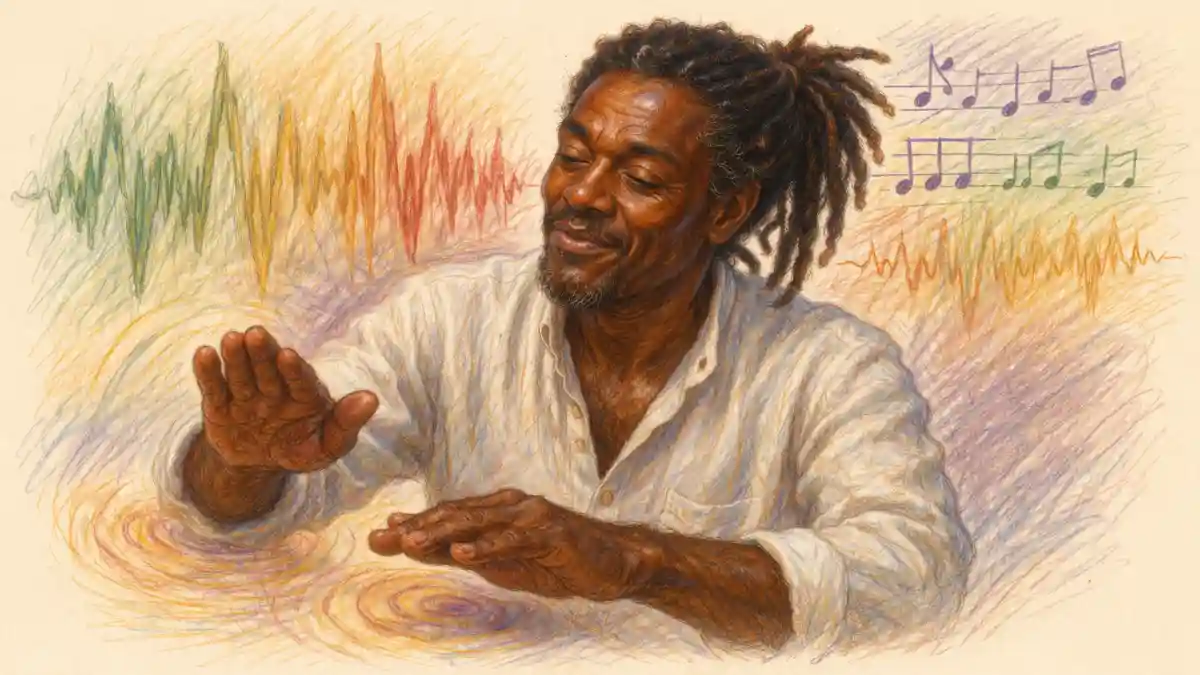
Gatsby built the whole apparatus for one spectator. The orchestra, the imported fruit, the cars stacked five deep in the drive, the strangers who arrived uninvited and left without thanking him: every Saturday of that summer was a signal flare fired across the bay toward a single house, in the hope that one woman would see the light and come. In Chapter 6 she finally comes. Daisy at the party is the moment the entire strategy is tested, and it is the moment the strategy fails. The night Gatsby designed to win Daisy Buchanan is the first thing about him that repels her, and a careful reader watches his dream begin to fail not because anyone attacks it, but because it finally meets the person it was built for.
This is one of the quietest disasters in the novel, and one of the easiest to skim past, because nothing violent happens. There is no broken nose, no car crash, no gunshot. A guest is bored at a party. Yet this short scene does work that the louder chapters cannot do. It shows the dream and its object in the same room for the only sustained social evening they share, and it lets a reader measure the exact distance between what Gatsby thinks he is offering and what Daisy actually receives. That distance is the subject of this article. Read the full chapter alongside the complete Chapter 6 summary and analysis, then return here for the scene that hinges the chapter.
Where the Daisy party scene sits in the arc
Chapter 6 is the hinge of the novel, the place where illusion first meets resistance, and Fitzgerald structures it as a sequence of three pressures pushing against Gatsby’s vision in turn. The chapter opens with Nick interrupting the rumors to tell the true story of the poor boy from North Dakota, the James Gatz reveal that strips Gatsby’s invented self down to its origins. It closes with the famous exchange about the past, Gatsby insisting that of course it can be repeated. Between those two pressures sits the party, and its placement is not accidental. Fitzgerald has just told us what Gatsby is made of, and now he shows us that manufactured self performing for the one audience it was manufactured to win.
The position matters because each of the three movements does the same thing from a different angle. The James Gatz pages expose the dream from below, showing the ordinary clay it was shaped from. The repeat-the-past exchange exposes the dream from inside, showing the logical impossibility at its core. The party scene, sitting in the middle, exposes the dream from outside, from the vantage of the person whose approval is its whole purpose. Of the three, the party is the only one that lets Daisy do the exposing. She is not told about Gatsby’s poverty, and she does not argue about the philosophy of time. She simply walks through his world for an evening and dislikes it, and her dislike turns out to be more damaging than any fact Nick could supply.
By this point in the nine-chapter structure, the reunion has already happened. Chapter 5 delivered the meeting the whole first half promised, the agonizing wait, the rain, the tour of the mansion, the shirts. That chapter ended in something close to triumph, Gatsby lit up with a joy so total that the green light he had worshipped lost its enchantment because the thing it stood for now stood beside him. Chapter 6 is the morning after that triumph, and the party scene is where the triumph starts to leak. A reader who treats Chapter 5 as the emotional peak needs to register that the peak is already eroding here, gently and from a direction Gatsby never guarded against.
Does Daisy enjoy Gatsby’s party?
No. Daisy attends one of Gatsby’s lavish West Egg parties in Chapter 6 with her husband Tom, and despite the spectacle she has a miserable time. She is unsettled by the crowd and the raw newness of the money on display, and Gatsby registers, with dismay, that the evening built to win her has instead pushed her away.
The dream was more beautiful at a distance
To understand why a party can wound a dream, it helps to remember what the dream had been until this evening. For five years Gatsby’s longing for Daisy lived almost entirely at a distance. She was a light across the water, a figure on the far side of a bay, an idea polished by separation until it gathered a perfection no living person could carry. Chapter 1 ended with Gatsby reaching toward the green light at the end of her dock, and that posture, the arm extended across dark water toward a small far gleam, is the truest image of how his desire worked. It thrived on the gap. The distance was not an obstacle to the dream; the distance was the dream’s medium, the thing that let Daisy stay flawless because she stayed unreachable.
Chapter 5 began to close that gap. The reunion brought Daisy into Gatsby’s house and into his arms, and Fitzgerald marks the cost of that arrival with a small, precise stroke: once Daisy stands beside him, the green light loses some of its enchantment, because an object that has been reached can no longer be worshipped from afar. The symbol that had organized his whole inner life dims the instant its meaning becomes physically present. That is the quiet logic the party scene then completes. Chapter 5 brought the dream and its object together in private, where Gatsby could still control the frame. Chapter 6 brings them together in public, in a crowded garden full of strangers, where he controls nothing, and the perfection that survived five years of distance cannot survive one evening of proximity.
So the party is not just a social failure; it is the failure that distance had always been holding off. As long as Daisy remained a light across the bay, Gatsby never had to watch her be bored, never had to see her flinch at his guests, never had to learn that the world he built to honor her struck her as coarse. The party strips away the protective distance and forces him to see her seeing him, and the dream cannot bear the exposure. This is why the scene matters out of all proportion to its events. Nothing dramatic occurs, yet the structural condition that kept the dream alive, the gap between the dreamer and the dreamed-of, collapses in real time, and a careful reader can feel the worship curdle into something closer to anxiety. The reaching arm of Chapter 1 has finally touched what it reached for, and touching it is how it loses it.
What happens when Daisy comes to the party
Read as analysis rather than recap, the scene divides into three beats: the arrival, the meal, and the aftermath. Each beat tightens the same screw.
The arrival establishes the wrongness of the fit. Tom comes too, which is itself a problem, because the party was never designed to host the husband; it was designed to make the husband irrelevant. Tom arrives on horseback with a small riding party, a detail that quietly asserts a different relationship to wealth, the inherited East Egg manner that treats money as a private fact rather than a public performance. From the first minute, the scene stages two economies side by side: the West Egg economy of display, where everything is shown, and the East Egg economy of assumption, where everything is taken for granted. Daisy belongs to the second, and Gatsby has spent his fortune perfecting the first.
The meal sharpens the contrast into discomfort. Gatsby moves Daisy through his guests, and Nick watches her try to find something to like. She does find one thing, a brief enchanted moment that this article will read closely, but the rest of the evening curdles for her. She is unsettled by the crowd, by the loudness of strangers who do not know one another and do not seem to care, by the sense that the whole gathering runs on a vitality she finds coarse. Nick is careful to record that her distaste is not snobbery in the simple sense. It is a recoil from an emotion she cannot place, a rawness she has no social vocabulary for, and the precision of that distinction is what raises the scene above gossip.
The aftermath is where Gatsby learns the verdict. When the guests are gone, Gatsby asks Nick about the evening, and his question carries the whole weight of his hope. He had wanted the night to confirm that the dream was working, that the bridge he had built between his fortune and Daisy’s love was load-bearing. Nick gives him no comfort, and Gatsby reaches the conclusion himself: she did not have a good time. The dismay in him is total, because the failure is not local. It is not that one party went badly. It is that the instrument he built to win her is the wrong instrument, and at some level he begins to sense it.
To see the chapter’s three pressures working together, hold this scene against the James Gatz origin reveal that precedes it: the same chapter that tells us Gatsby invented himself out of nothing also shows that invention failing its only real exam.
Close reading: one night through two sets of eyes
The scene’s power comes from a gap, and the cleanest way to hold the gap in view is to track the same evening through two perceptions at once. To Gatsby, every element of the party is a love letter. To Daisy, the same elements register as noise, vulgarity, or worse. Fitzgerald never spells this contrast out as a thesis; he builds it into the texture of the prose, in the way Nick’s narration keeps Gatsby’s intentions and Daisy’s reactions in the same sentences without reconciling them. The findable artifact below names that gap and lays it out evidence by evidence, so that a reader can see the mechanism the chapter is running.
The Reception Gap: what the night means to Gatsby versus what Daisy receives
| Element of the evening | What it means to Gatsby (intention) | What Daisy receives (reception) | What the gap exposes |
|---|---|---|---|
| The scale of the party | Proof of arrival, a fortune large enough to deserve her | Excess without grace, money that has not learned manners | New wealth can buy size but not the restraint old money reads as taste |
| The uninvited crowd | A kingdom of admirers gathered in his name | A press of strangers running on an emotion she cannot place | Belonging cannot be staged for a guest who knows the difference |
| The display of everything | Generosity, openness, a gift laid at her feet | A gesture too loud to be elegant, a vitality that chafes | East Egg assumes; West Egg announces, and announcing reads as need |
| The one Hollywood moment | An incidental detail among many | The single thing she finds lovely all night | What charms Daisy is theatrical glamour, not Gatsby’s homemade kingdom |
| Tom’s presence and contempt | An obstacle to be outshone | A familiar world she has not actually left | The husband is not outshone; he is the standard Gatsby is measured against |
| Gatsby watching for her verdict | The night’s whole purpose, the test of the dream | Largely unnoticed; she is busy disliking the room | The dreamer needs the dream confirmed; the object owes it nothing |
The table is not a summary; it is the engine of the scene made visible. Call it the Reception Gap, the distance between a gift’s intention and its reception, and notice that the gap widens as the evening goes on. Every column that should have converged on Gatsby’s success instead splits further apart. This is the namable claim of the article: the dream meets its audience and loses, and the very lavishness designed to win Daisy is the thing that first repels her. The machine Gatsby built turns against its purpose, and it does so on the one night it was supposed to prove itself.
Reading the scene this way also corrects a common classroom shorthand, the idea that the party “shows how shallow the rich are.” It shows something more precise and more painful. Gatsby is not shallow; he is sincere to the point of desperation, and that sincerity is exactly what Daisy cannot stand to see displayed. The shallowness, if the word applies anywhere, belongs to the inherited world she comes from, the world that has trained her to find raw feeling embarrassing. The scene is not a portrait of rich people being empty. It is a portrait of a poor boy’s sincerity colliding with a rich world’s reflexes, and losing.
The one thing Daisy loved
For a single moment the evening works, and the moment is worth dwelling on because of what it reveals. Among all the noise, Daisy is charmed by one tableau: a famous moving-picture actress and her director, seated together under a white plum tree, the actress described with an almost botanical strangeness, an orchid of a woman holding still in the half light while her director slowly leans toward her. Daisy points to them. This, and almost nothing else at the party, delights her.
The detail is doing careful work. The one thing that pleases Daisy is the one element of the party that is not Gatsby’s at all. It is borrowed Hollywood glamour, a piece of professional theater that has wandered into his garden. It is elegant in the practiced, surface way Daisy understands, a performance that knows it is a performance and never lets its need show. Everything Gatsby made for her, by contrast, betrays its need in every line. The party announces too loudly that it wants something. The actress under the plum tree wants nothing; she simply poses, beautiful and complete, and that completeness is what Daisy responds to.
So the scene gives Gatsby a cruel piece of information that he is too hopeful to read correctly. Daisy can be charmed at his party, but only by something he did not build and does not control. Her pleasure points away from him, toward a register of glamour that is cool, theatrical, and self-sufficient, the opposite of the hungry sincerity that animates the rest of his fortune. The orchid under the plum tree is a small image, easy to pass over, and it quietly tells the reader everything about why the larger gift will fail.
The light, the night, and the staged enchantment
The sensory register of the evening deserves attention, because Fitzgerald uses light and darkness to frame the failure he is staging. Gatsby’s parties are creatures of artificial brilliance, gardens lit so completely that the night is pushed back to the edges of the property, and that blaze of manufactured light is part of the offering. The lit house is a beacon, the same beacon that has been firing across the bay all summer, and on this night the beacon finally has its intended audience standing inside it. There is a terrible literalness to it: the man who reached toward a small green light across dark water has built, on his own side, an entire mansion of light, and he has lit it for her.
The light works against him. Where the green light across the bay was small, distant, and therefore enchanting, Gatsby’s own blaze is near, total, and exhausting. It illuminates everything, and illumination is the enemy of glamour, because glamour depends on shadow, on the half-seen, on the withheld. The one image that charms Daisy, the actress and her director under the plum tree, occupies a pocket of relative stillness and half light within the glare, and that placement is not accidental. The thing she loves is the thing the lighting allows to remain partly mysterious, while everything Gatsby made for her is lit too brightly to keep any mystery at all. He has flooded his world with light in order to be seen, and being fully seen is exactly what undoes him.
There is a deeper irony in the contrast between the manufactured enchantment and the genuine one. Gatsby has spent a fortune trying to produce wonder, hiring it, importing it, staging it across acres of lawn, and the only authentic flicker of wonder in Daisy all night attaches to a Hollywood tableau that produces its effect for free, simply by being beautiful and self-contained. The professional glamour of the film world, cool and practiced, achieves in one quiet image what Gatsby’s enormous expenditure cannot achieve across a whole evening. Manufactured enchantment, the scene suggests, announces its labor and so dispels the very wonder it is reaching for, while real glamour hides its effort and keeps its spell. Gatsby’s lit garden is all labor, all visible reaching, and the reaching breaks the spell it was built to cast.
By the end of the night the lights are still burning while the guests drain away, and that image, a blazing house emptying of people, is the scene’s quiet emblem of what has happened. The enormous effort remains, lit up and pointless, after the one person it was for has gone home unmoved. Soon Gatsby will have the lights put out for good, and the dark house of Chapter 7 will be the after-image of this one. The brilliance he built to be seen by ends the evening shining on no one who matters, a beacon that drew its ship to shore only to watch it turn away.
“Appalled by West Egg”: the class fault line
When Nick reaches for the word that names Daisy’s feeling, he writes that “she was appalled by West Egg.” The phrase deserves slow attention, because the choice of word does precise work. To be appalled is not to be bored or to be snobbish in the ordinary sense; it is to be confronted with something that violates an order one cannot articulate. Daisy is not merely unimpressed. She is faced with a place that breaks her sense of how money is supposed to behave, and the violation unsettles her at a level deeper than taste.
What appalls her is not poverty; West Egg is rich. What appalls her is a particular kind of wealth, money that is new enough to still be visible, money that has not yet learned to disappear into manners. East Egg, where Daisy lives, is built on the opposite principle. There, money is old enough to be silent, to express itself in understatement, in the assumption that no one needs to be told. West Egg has all the money and none of the silence. It shows everything, and to a person raised on the East Egg code, showing everything is a kind of nakedness.
What does “appalled by West Egg” mean?
It means Daisy is not merely unimpressed by Gatsby’s world but disturbed by it. West Egg’s new money shows itself openly, while her East Egg world treats wealth as a silent assumption. The raw, visible newness violates a social order she cannot name, and that violation, more than any snobbery, drives her recoil.
This is the class fault line the dream cannot cross, and it explains why Gatsby’s strategy was doomed before Daisy arrived. He believed that enough wealth would erase the difference between himself and Tom, would buy his way back across the line that separated James Gatz from the people who had always had money. The party scene reveals the error. The line is not a matter of how much money one has; it is a matter of how the money carries itself, and that carriage cannot be purchased in a season or even a decade. Gatsby has the fortune and not the fluency. He can build the kingdom, but he cannot make it read as belonging, and Daisy’s instinct registers the difference the moment she walks in. The deeper logic of her recoil belongs to her whole character, traced across the novel in the complete Daisy Buchanan character analysis, where the same instinct that fails Gatsby here recurs at every decisive turn.
It is worth being exact about what this does and does not say about Daisy. It does not make her a deep social critic; she is not analyzing class, she is reacting to it. But the reaction is true, in the sense that it correctly identifies a real boundary that Gatsby’s whole project depends on ignoring. Daisy feels the fault line without naming it, and her recoil is the novel’s way of letting the reader see a wall that Gatsby has spent five years pretending is not there.
The texture of Daisy’s discomfort
Fitzgerald is careful not to let Daisy’s unease settle into a simple, nameable complaint, and that carefulness is worth reading closely, because the imprecision is the point. Daisy is not bored in the way a guest is bored by a dull host; she is disturbed by something she cannot locate. Nick records that what offends her is less a thing she can point to than an atmosphere she cannot place, a raw vitality running under the surface of the evening that chafes against everything her world has taught her to expect. The party does not break a specific rule she could cite. It breaks an unspoken one, and the breaking registers in her as an emotion rather than a judgment.
That distinction, between an emotion and a judgment, is the heart of her discomfort. A judgment can be argued with; an emotion cannot. If Daisy had simply decided the party was tacky, Gatsby might have reasoned with the verdict or changed the décor. But her recoil is not a decision; it is a reflex, a flinch of social instinct trained into her since childhood. She responds to West Egg the way one responds to a smell that is wrong, immediately and below the level of thought. This is why the failure is irreversible. Gatsby is trying to win a verdict, and Daisy is not delivering a verdict; she is having a reaction, and reactions do not respond to evidence or effort.
The quality of the vitality that unsettles her is also precise. What chafes is not vulgarity in the cartoon sense, not loud colors or bad taste, but a kind of unguarded human energy that the East Egg code keeps under wraps. The strangers at the party feel things in public. They laugh too freely, attach too quickly, run on an emotion that is not performed but felt, and to Daisy that openness reads as a lack of control she finds faintly frightening. Her world prizes the managed surface, the feeling held in reserve, the gesture that means less than it shows. West Egg shows more than it means and means it, and that excess of genuine feeling, paradoxically, is what strikes her as coarse.
Reading the discomfort this way keeps the scene from flattening into class comedy. Daisy is not merely a rich woman wrinkling her nose at the help. She is a person whose entire sensibility has been shaped to find raw sincerity embarrassing, encountering a world built entirely out of raw sincerity, and recoiling from it the way a trained nerve recoils from a touch it was taught to avoid. Gatsby’s tragedy is that the sincerity she recoils from is his deepest virtue. The very openness of his longing, the unguarded enormity of his want, is the thing his money keeps trying to express, and it is the thing Daisy’s instincts are organized to reject. He cannot win her by being more himself, because being himself is precisely what appalls her.
Two economies in one garden
The party scene works because it forces two opposed relationships to money to share a single lawn, and Fitzgerald stages the opposition through gesture rather than statement. The first economy is the West Egg economy of display. In it, wealth is something you perform: you light the whole house, you hire the orchestra, you stack the food and the cars and the strangers high enough that the abundance becomes a public fact. The logic is generous and anxious at once, because display is a way of asking to be seen, and asking to be seen is a way of admitting you were once unseen. Every lavish detail of Gatsby’s party is, at bottom, a sentence that says: look how far I have come. The sentence is sincere, and its sincerity is the problem.
The second economy is the East Egg economy of assumption, and Tom embodies it the moment he arrives. He comes on horseback with a small riding party, casually, as though dropping by, and the casualness is the whole point. Tom does not perform his wealth because he has never had to prove it. For him money is not an achievement to be announced but a condition to be assumed, as invisible and unremarkable as air. The riding party is not a display in Gatsby’s sense; it is the opposite, a gesture of belonging so secure it does not bother to impress anyone. Where Gatsby’s evening shouts, Tom’s arrival murmurs, and to Daisy, raised inside the murmuring world, the shout is faintly unbearable.
The collision of these two economies is the scene’s deep subject, and it explains why Gatsby’s fortune cannot do the work he needs it to do. He has been operating on the theory that money is a single thing, that having enough of it will close the gap between James Gatz and the people Daisy was born among. The party proves the theory false. There are two kinds of money in that garden, and they are not separated by amount but by manner, by the question of whether wealth announces itself or assumes itself. Gatsby has the amount and the wrong manner. His money is loud because it is new, and its loudness marks him as surely as poverty once did. The very abundance he offers as proof of arrival is read by Daisy as proof that he has not, in the way that matters to her, arrived at all.
This is the cruelty hidden inside the spectacle. Gatsby cannot solve the problem by spending more, because spending more only makes the display louder, and the loudness is itself the disqualifying trait. Tom’s quiet horseback entrance does more to assert status than Gatsby’s entire fortune, precisely because it asks for nothing. The scene thus dramatizes a wall that money cannot climb, since the higher Gatsby builds, the more visibly new his wealth becomes, and visible newness is exactly what the inherited world is trained to look down on. The garden holds two economies, and the one Gatsby commands is the one Daisy has been taught to find embarrassing.
Gatsby reads the verdict
The aftermath is brief and devastating. With the guests gone and the lights still burning, Gatsby and Nick talk, and Gatsby’s hope narrows to a single question about whether Daisy enjoyed herself. He wants Nick to tell him the night succeeded. Nick cannot, and Gatsby arrives at the truth on his own, saying that she did not have a good time. The flatness of the line carries its grief. There is no argument in it, no excuse, just a man stating the failure of the thing he cared about most.
What follows is the more revealing part. Gatsby does not conclude that the party was the wrong gift; he concludes that the gift has not yet been delivered fully enough, that the problem is distance rather than design. He confesses that he feels far from Daisy, that it is hard to make her understand, and the reader sees that he has misread the evening at the deepest level. The lesson the night offered was that no amount of spectacle can close the gap, because the gap is not a quantity. Gatsby hears it as a call for more, when the truth is that more is precisely what is repelling her.
Why is Gatsby disappointed after the party?
Gatsby is disappointed because the party was never entertainment; it was an instrument for winning Daisy, and the instrument failed. He sees that she had a miserable time, and the failure tells him the bridge he built between his fortune and her love is not holding, though he still misreads the cause as distance rather than the spectacle itself.
This is also where the chapter’s three pressures finally converge, because the aftermath leads directly into the repeat-the-past exchange. Stung by the failure, Gatsby reaches for his governing belief, and when Nick gently warns him that the past cannot be relived, Gatsby cries that of course it can. The cry is usually read as the chapter’s thesis about time and illusion, and that reading is correct, but the party scene gives it a sharper edge. Gatsby is not insisting on repeating the past in the abstract; he is insisting on it in the specific aftermath of a night that proved how far the present has drifted from the past he worships. The party is the evidence against him, and he answers the evidence by denying it. For the full weight of that closing exchange, the Chapter 6 analysis holds the repeat-the-past line in its proper place; here it functions as the wound the party opened.
Is it snobbery? The counter-reading
The most common misreading of this scene is the simplest one: that Daisy is being a snob, that a spoiled rich woman turns up her nose at vulgar new money, and that the scene is one more piece of evidence for her carelessness. This reading is tempting because it is partly true and emotionally satisfying, and because it lets a reader dismiss Daisy and side cleanly with Gatsby. It should be resisted, not because Daisy is admirable, but because the snobbery reading throws away the scene’s actual analytical content.
Does the scene reduce to snobbery?
It does not. The snobbery reading is partly accurate and wholly insufficient. Her recoil functions as diagnosis, locating the real boundary between inherited and new money that Gatsby’s plan ignores. Read that way, the moment explains his doom rather than merely condemning her, which is why a strong analysis refuses to stop at the easy verdict.
Here is the stronger reading. Daisy’s recoil is doing diagnostic work the novel needs, regardless of whether her motives are noble. Through her discomfort, Fitzgerald shows the reader a boundary that Gatsby cannot see and cannot cross, the difference between having wealth and wearing it as one’s birthright. If the scene were only snobbery, it would tell us about Daisy and nothing about Gatsby. Read as diagnosis, it tells us why the entire project is built on sand: the thing Gatsby most wants, acceptance into Daisy’s world on Daisy’s terms, is exactly the thing his money cannot buy, and her body knows it before her mind frames it.
The counter-reading also rescues the scene from sentimentality. If we side wholly with Gatsby and against the snob, we flatter his dream and miss its flaw. The novel is more honest than that. It allows Gatsby’s sincerity to be moving and his project to be doomed at the same time, and it uses Daisy, careless and limited as she is, as the instrument that exposes the doom. A reader who only condemns her misses how much work she is doing for the book. The party is not a morality play in which the good poor host is wronged by the bad rich guest. It is a structural revelation, delivered through a guest who feels the truth without understanding it.
Imagery, diction, and narration at work
The scene’s effects are built at the level of the sentence, and three techniques carry most of the weight. The first is Fitzgerald’s habit of keeping intention and reception in the same breath. Nick narrates Gatsby’s hopes and Daisy’s reactions without ever pausing to reconcile them, so the gap between them lives inside the prose itself rather than being stated as a conclusion. The reader feels the dissonance because the sentences refuse to resolve it.
The second technique is the strategic single image, the orchid of a woman under the white plum tree. In a chapter crowded with people, Fitzgerald isolates one tableau and gives it a strange, hyper-aesthetic stillness, and he does this precisely because it is the one thing Daisy loves. The image is cool where the rest of the party is hot, posed where the rest is spontaneous, and that contrast does silent argumentative work. Fitzgerald lets the picture make the point that exposition would flatten: Daisy responds to glamour that withholds itself, not to a kingdom that gives itself away.
The third technique is Nick’s calibrated narration, which keeps the scene from collapsing into simple judgment. Nick neither fully condemns Daisy nor fully pities Gatsby. He notices Daisy’s distaste and also notices its precision; he records Gatsby’s dismay and also its self-deception. This double vision is what makes the scene analysis rather than melodrama, and it is a reminder that Nick’s controlled, withholding voice is itself one of the novel’s chief instruments. The way the parties are made to mean different things at different moments is examined at length in the study of Gatsby’s parties as symbol and spectacle, which reads the gatherings across the whole book; this chapter supplies that study with its turning point, the night the spectacle stops working.
What Daisy does not say
One of the scene’s most effective strokes is an absence. Across the novel, Daisy is associated with speech, with a voice so famous that Gatsby will later say it is full of money, with witty, glittering lines that draw every eye in a room. Yet at the party, the scene that most directly tests her feeling for Gatsby, she is given almost nothing memorable to say. The brilliant talker goes quiet, and the quiet is its own kind of statement. Fitzgerald withholds from Daisy the very thing she is known for, and the withholding tells the reader that this is a setting in which her charm does not operate, a place where she has no good lines because she is not enjoying herself enough to produce them.
Her near-silence also throws the weight of the scene onto reaction rather than dialogue. Because she does not announce her disapproval, the reader has to read it off her body, her attention, the single thing she points to with pleasure and the many things she lets pass without comment. Nick becomes the translator of a feeling Daisy never speaks, and that arrangement is deliberate. A spoken complaint would give Gatsby something to answer; an unspoken recoil gives him nothing to grip. The most damaging verdict in the scene is the one Daisy never puts into words, because a verdict withheld cannot be argued away, only felt.
The contrast with her famous earlier speech sharpens the effect. The woman who could fill a drawing room with talk in Chapter 1 has, in Gatsby’s garden, retreated into a guarded quiet, and the retreat measures the distance between the worlds. Among her own kind she performs effortlessly; among Gatsby’s she withdraws. Her silence at the party is the sound of a person who does not feel at home, and Gatsby, straining to read her, hears it correctly even as he refuses to accept what it means. The absence of her voice is the clearest signal the night gives him, and it is a signal precisely because it is an absence, a withholding from the one person whose speech he has organized his life around.
This is why Nick’s narration has to do so much. With Daisy largely silent and Gatsby largely hopeful, the burden of meaning falls on the observer who can see both, who can register the host’s anxious watching and the guest’s quiet recoil and hold them in a single frame without resolving them. The scene runs on what is not said, and a reader who waits for Daisy to declare her feelings will miss the declaration entirely, because it is written in her quiet, her inattention, and the one bright moment that points away from her host.
The crowd as a mirror Daisy holds up
The strangers who fill Gatsby’s garden have always been part of his legend, but in this scene they take on a new function: they become the mirror in which Daisy sees what Gatsby’s world is made of, and what she sees repels her. Through the earlier chapters the uninvited crowd reads as glamorous abundance, proof of a host so magnificent that people pour toward him without invitation. Seen through Daisy’s eyes in Chapter 6, the same crowd reads differently. It is a press of people who do not know one another, drawn by free liquor and spectacle rather than by any bond with the man whose house they are filling, and that rootlessness is precisely what unsettles her.
Why does the party crowd unsettle Daisy?
The crowd unsettles Daisy because it does not cohere. Her world treats a gathering as a network of shared families and histories, while Gatsby’s party is an assembly of strangers held together only by the occasion. To a sensibility built on belonging, that improvised society feels thin, rootless, and faintly frightening.
What Daisy registers, without naming it, is that the crowd does not cohere. In her world a gathering is a network of relations, families and connections and histories that everyone present already shares. Gatsby’s party is the opposite, an assembly of strangers held together by nothing but the occasion itself, a society improvised for a single night out of people who will not recognize one another tomorrow. To a sensibility built on belonging, this improvised society feels thin and slightly frightening, a vitality with no roots under it. The crowd’s energy is real, but it is the energy of people running from emptiness toward a brief shared brightness, and Daisy’s instinct reads the emptiness underneath the brightness.
The crowd also exposes something about Gatsby that the earlier chapters kept hidden. A host surrounded by strangers is, finally, alone, and the party that looked like proof of his connection turns out to be proof of his isolation. Daisy, standing inside it, is positioned to see that the magnificent social machine has produced no actual society, only a nightly crowd that uses the house and departs. The legend of Gatsby the great host depends on never looking too closely at who the guests are; Daisy looks closely, and the legend thins under her gaze. The same crowd that built his myth in Chapter 3 begins, in Chapter 6, to unbuild it, because it is now being seen by the one guest whose opinion the whole performance was meant to win.
This is why the crowd belongs to the scene’s argument rather than to its scenery. Fitzgerald does not include the strangers merely to set a mood; he includes them so that Daisy can react to them, and her reaction completes the picture of a world that cannot hold her. The party offers her a kingdom of admirers, and she sees a room full of strangers. It offers her proof of Gatsby’s greatness, and she sees evidence of his rootlessness. The crowd that was supposed to dazzle her becomes the clearest sign that his world and hers are made of different materials, and the difference is one no amount of brilliance can dissolve. What the eventual abandonment of Gatsby will make tragic in the final chapters, this scene quietly previews: the crowd is large, and none of it is his.
What the scene sets up and pays off
The Daisy party scene is a quiet pivot, and its consequences run forward through the rest of the novel. The most concrete consequence comes early in Chapter 7, when Nick notices that the lights of Gatsby’s house fail to go on one Saturday and learns that the parties are over. Gatsby has dismissed the servants and ended the spectacle, and the reason is Daisy. The parties had only ever been a means to her, and once she has come and gone and the means has failed, he has no further use for them. The scene in Chapter 6 is what makes that silence legible. Without Daisy’s bad night, the ending of the parties would be a loose detail; because of it, the dark house in Chapter 7 reads as the direct result of the verdict she delivered here.
The scene also sets up the chapter’s closing claim about the past and, beyond it, the tragedy of the second half. Gatsby’s refusal to read the party correctly, his insistence that the problem is distance rather than design, is the same refusal that drives him to the Plaza in Chapter 7 and to his death in Chapter 8. The man who answers a failed party by demanding more of the past is the man who will demand that Daisy renounce her entire marriage, and who will wait by a telephone that does not ring. The Daisy party scene is the first clear instance of the pattern that kills him: confronted with evidence that the dream cannot work, he responds by enlarging the dream rather than questioning it.
There is a structural payoff as well. This evening is one half of a deliberate pair, the social bookends of Gatsby’s party-throwing. The first party, in Chapter 3, builds the legend of Gatsby for a reader who has not yet met him. This second party, attended by Daisy, dismantles the legend’s purpose by showing it failing in front of its intended audience. Fitzgerald clearly wants the two evenings read against each other, and the side-by-side comparison of the two party scenes traces how the same setting comes to carry opposite meanings; the night Daisy attends is where the second meaning is born.
Tom’s suspicion and the danger entering the scene
The party is also where Tom begins to turn from an obstacle into a threat, and reading that shift is part of reading the scene honestly. Until now Tom has been an obstacle in the static sense, the husband to be outshone, a fixed condition of Daisy’s life rather than an active danger to Gatsby. At the party that begins to change. Tom watches, and what he watches is the unmistakable warmth between his wife and the host, and a man as territorial as Tom does not need much to start hunting. His contempt for the West Egg crowd is the surface of his reaction; underneath it, a suspicion is forming that will harden into the investigation that exposes Gatsby at the Plaza.
This is a crucial piece of what the scene sets up, because it means Daisy’s bad night is not the only damage done. The same evening that fails to win Daisy succeeds in alerting Tom, and the two failures compound. Gatsby came to the party hoping to advance his dream and instead managed to weaken it from two directions at once: he lost ground with Daisy and he gained an enemy in Tom. The host who watched all night for Daisy’s verdict did not notice that another man was watching too, and that other man read the night more accurately than Gatsby did. Where Gatsby saw a party that almost worked, Tom saw a rival who needed to be destroyed.
The doubling gives the scene its forward motion into the tragedy. The thread that begins with Tom’s narrowed eyes at this party runs straight to his exposure of Gatsby’s bootlegging in Chapter 7, and from there to the chain of events that ends with Gatsby dead in his pool. The party, in other words, does not only mark where the dream begins to fail; it marks where the counterattack begins to organize. A reader tracking the machinery of the plot should note that this quiet social evening is the place where Tom is activated, where a complacent husband becomes a watchful one, and where the destruction of Gatsby acquires, for the first time, a human agent who means to bring it about.
There is a grim symmetry in how the two readings of the evening converge. Gatsby leaves the party believing the problem is distance, that he simply needs to bring Daisy closer, while Tom leaves it understanding the situation more clearly than the dreamer ever will. The man with the illusion misreads the night, and the man with the suspicion reads it true, and that asymmetry is itself a comment on the dream. Illusion blinds, and Gatsby’s particular blindness is to mistake a verdict for a delay. While he plans how to close a gap that cannot be closed, his rival has already begun planning how to win, and the difference in their clarity at the end of the same evening is the difference between the man who will be destroyed and the man who will do the destroying.
How to write about Daisy at the party in an essay
A strong essay on this scene starts by refusing the recap. The events are simple and a grader has read them many times, so summary earns nothing. The value is in the argument, and the scene hands a writer a ready-made one: this is the moment Gatsby’s dream first fails on contact with its object, and it fails not because of an enemy but because of the dream’s own design. A thesis built on the Reception Gap, the distance between what the party means to Gatsby and what Daisy receives, gives an essay a precise, defensible spine that most student responses lack.
From there, the discipline is to read evidence rather than collect it. Rather than listing what happens, pin an argument to two or three exact details and read them hard. The orchid under the white plum tree is the strongest single piece of evidence, because it lets a writer argue that the one thing Daisy loves is the one thing Gatsby did not make, which proves that her pleasure points away from him. The word “appalled” is a second anchor, because its precision separates a real class recoil from simple snobbery. Gatsby’s flat verdict that she did not have a good time is the third, because it shows the dreamer reading his own defeat. Three details, each squeezed for its full meaning, will always beat a paragraph that gestures at the whole party.
The mistake to pre-empt is the snobbery reading, and a sophisticated essay names it and answers it rather than ignoring it. Concede that Daisy’s distaste carries condescension, then argue that reducing the scene to snobbery throws away its real function, which is to expose the class boundary Gatsby’s plan depends on denying. An essay that anticipates and defeats the easy reading signals exactly the kind of analytical maturity that examiners reward. To read and annotate the scene line by line before you draft, you can read and annotate The Great Gatsby free on VaultBook, where the full annotated text, close-reading tools, a searchable quotation bank, and character and theme trackers sit beside the novel and the library keeps growing over time. Annotating the party pages directly is the fastest way to gather the three anchored details a strong paragraph needs.
The verdict
The Daisy party scene is the night the machine turned against its purpose. Everything Gatsby built, he built to win one woman, and on the single evening she spends inside his creation, the creation repels her. The failure is not loud and it is not anyone’s fault in the ordinary sense; it is the dream meeting its object and losing, because the dream was always more beautiful as a distant light than as a crowded garden. Daisy, careless and limited, feels a boundary she cannot name, recoils from a sincerity she has been trained to find embarrassing, and delivers a verdict that Gatsby is too hopeful to hear. The strongest reading of the scene is the one that holds both truths at once: Gatsby’s longing is moving, and his project is doomed, and this quiet bad night is where the doom first becomes visible.
For a reader, the scene is a lesson in how Fitzgerald works. He does not announce the death of the dream; he stages a party that goes wrong and lets the reader measure the gap. Learn to read the gap here, in the distance between a gift and its reception, and the rest of the novel opens, because the same gap, enlarged and made fatal, is what carries Gatsby from this dark garden to the Plaza, the pool, and the empty funeral. The night Daisy was bored is the night the green light began to go out.
It is worth holding onto how much the scene accomplishes with how little. A guest is unhappy at a party, a host is disappointed afterward, a husband narrows his eyes: stated as plot, the evening is almost nothing. Stated as meaning, it is the turning of the novel’s whole machine. The dream that needed distance loses its distance; the fortune that promised belonging proves its newness; the sincerity that was Gatsby’s virtue becomes the thing that repels the one person it was meant for; and the husband who was merely an obstacle becomes a hunter. Five separate threads of the tragedy are touched in a single quiet evening, and none of them is announced. That compression, that refusal to raise its voice while changing everything, is exactly why the Daisy party scene rewards the close attention this series brings to it, and why a reader who learns to slow down here will read every later chapter better.
Frequently Asked Questions
Q: What happens when Daisy attends Gatsby’s party in Chapter 6?
In Chapter 6, Daisy comes to one of Gatsby’s elaborate Saturday-night parties, the only time she experiences his West Egg world as a social occasion. Tom comes with her, arriving with a small riding party, which itself signals a different relationship to wealth. Gatsby moves Daisy through the crowd hoping the evening will confirm his dream, and for one brief moment she is charmed by a film actress and her director seated under a white plum tree. The rest of the night, though, leaves her uncomfortable and unhappy. She is unsettled by the loud, uninvited crowd and the raw newness of the money on display. After the guests leave, Gatsby realizes she did not enjoy herself, and the failure quietly begins to unsettle the entire project he has built around her.
Q: Why does Daisy dislike Gatsby’s party?
Daisy dislikes the party because it embodies a kind of wealth her world finds embarrassing: new money that shows itself openly instead of assuming itself quietly. Raised in East Egg, where fortune expresses itself through understatement and inherited manners, she is unsettled by West Egg’s loudness, by a crowd of strangers running on a raw vitality she has no social vocabulary for. Nick is careful to record that her distaste is not simple boredom or ordinary snobbery; she is faced with something that violates her sense of how money should behave. The party’s whole logic is display, and to a person trained in the East Egg code, displaying everything reads as a kind of nakedness. Her recoil is partly condescension, but underneath it lies an accurate instinct about the class boundary Gatsby’s spectacle cannot cross.
Q: How does Daisy react to the West Egg party?
Daisy’s reaction moves from polite curiosity to deepening discomfort. She tries to find things to enjoy, and she succeeds exactly once, when she points out the film actress and her director under the plum tree, the one tableau that pleases her. Everything else curdles. Nick observes that she is appalled by West Egg, by its raw energy and its press of strangers, and the word he chooses signals something stronger than mild disapproval. Her body registers a violation she cannot articulate, a wrongness in the way the money carries itself. She does not make a scene or insult anyone directly; her recoil is quiet and largely internal, visible mainly to Nick and, afterward, painfully clear to Gatsby. The understated nature of her reaction is part of what makes it devastating, because it cannot be argued with or fixed.
Q: Why is Gatsby upset after Daisy’s visit to the party?
Gatsby is upset because the party was never entertainment for him; it was a precision instrument built to win Daisy, and on the night it mattered most, the instrument failed. When the guests are gone, he presses Nick about whether she enjoyed herself, and Nick gives him no comfort. Gatsby reaches the conclusion himself: she did not have a good time. His dismay is total, because the failure feels structural rather than local. It is not that one party went badly; it is the dawning sense that the thing he built may be the wrong thing entirely. He confesses that he feels far from Daisy and that it is hard to make her understand, which shows him misreading the lesson. He hears the night as a call for more effort, when the truth is that the spectacle itself, the very lavishness, is what pushed her away.
Q: What does Daisy’s recoil reveal about class?
Daisy’s recoil reveals that the boundary between old money and new money is not about quantity but about carriage, about how wealth holds itself. Gatsby has the fortune; Tom and Daisy have the fluency, the inherited assumption that money needs no announcement. West Egg shows everything, and East Egg shows nothing, and Daisy’s discomfort exposes the gap between them. The scene clarifies why Gatsby’s entire strategy is doomed: he believed enough money would erase the line separating James Gatz from people who had always been rich, but the line is a matter of manner, not amount, and manner cannot be bought in a season. Her instinct identifies a real wall the moment she enters his world, a wall Gatsby has spent five years pretending is not there. The novel uses her reaction less to judge her than to make this invisible boundary visible to the reader.
Q: How does the party begin to undo Gatsby’s dream?
The party undoes the dream by testing it against reality for the first time as a social fact. For five years Gatsby’s vision of Daisy lived at a distance, protected from contact, glowing like the green light across the bay. Chapter 5 brought the dream and its object into the same room privately; Chapter 6 brings them together publicly, and the public test fails. The dream was always more beautiful as a far light than as a crowded garden, and the party forces that truth into the open. Daisy’s bad night shows Gatsby, though he refuses to fully see it, that no amount of spectacle can close the gap between them, because the gap is not a quantity to be filled. The dream begins to fail not because an enemy attacks it but because it finally meets its audience, and the meeting reveals a flaw that was there from the start.
Q: Does Tom go to Gatsby’s party, and how does he behave there?
Yes, Tom accompanies Daisy to the party, and his presence and manner sharpen the scene’s central contrast. He arrives with a small riding party rather than as a humble guest, a detail that asserts the casual, inherited confidence of East Egg wealth. At the party he is contemptuous, treating the crowd and the host with the condescension of a man who assumes his own superiority needs no defending. His suspicion of Gatsby also stirs here, the first clear sign that he is beginning to sense the threat. Crucially, Tom is not outshone by the spectacle, as Gatsby hoped; instead, he functions as the standard against which Gatsby is measured and found wanting. His ease with wealth throws Gatsby’s effortful display into relief, and his presence reminds Daisy of the world she has not actually left, making Gatsby’s bid to win her back even harder.
Q: What is the one thing Daisy enjoys at Gatsby’s party?
The one thing Daisy genuinely enjoys is a single tableau: a famous moving-picture actress and her director seated together under a white plum tree, the actress described with a strange, almost botanical stillness, like an orchid holding its pose in the half light. Daisy points to them, delighted, and almost nothing else at the party pleases her. The detail is quietly devastating because that tableau is the one element of the evening that is not Gatsby’s creation. It is borrowed Hollywood glamour, professional theater that has wandered into his garden, elegant in the cool, self-sufficient way Daisy understands. It withholds itself; it shows no need. Everything Gatsby built, by contrast, betrays its hunger in every line. Her pleasure, in other words, points away from him, toward a register of glamour he did not make and cannot control, which tells the reader exactly why his larger gift will fail.
Q: What does Nick mean when he says Daisy was appalled by West Egg?
When Nick writes that Daisy was appalled by West Egg, he chooses a word stronger than bored or unimpressed. To be appalled is to be confronted with something that violates an order one cannot quite articulate. Daisy is not merely failing to enjoy the party; she is faced with a place that breaks her sense of how money is supposed to behave. What appalls her is not poverty, since West Egg is rich, but a particular kind of wealth, money new enough to still be visible, money that has not learned to disappear into manners. East Egg trains its people to treat fortune as a silent assumption; West Egg announces it. To Daisy, that announcing reads as a kind of nakedness, an emotional rawness she has been raised to find embarrassing. Nick’s word captures a recoil that runs deeper than taste, a disturbance at the level of social instinct rather than mere preference.
Q: What does Gatsby watch for while Daisy is at the party?
Throughout the evening, Gatsby watches Daisy for a verdict. The party is the test of his five-year project, and he is desperate to see it confirmed, to catch the moment when her face shows that the dream is working. He moves her through his guests, presents his world, and waits for her approval the way an inventor waits to see whether his machine will run. This watchfulness is part of what dooms the night, because his hope makes him blind to what he is actually seeing. He registers her one moment of delight and inflates its meaning, while underreading the discomfort that fills the rest of the evening. After the guests leave, his anxious questions to Nick reveal how completely the night was about reading her reaction. The dreamer needs the dream confirmed, but the object of the dream owes him nothing, and Daisy spends the evening busy with her own distaste rather than delivering the verdict he craves.
Q: Is Daisy just being a snob at the party?
Not only that, and reading her as a simple snob wastes the scene. Her distaste does carry class condescension; she is a product of East Egg and looks down on West Egg’s loudness. But if the scene were merely snobbery, it would tell us something about Daisy and nothing about Gatsby. Read more carefully, her recoil does diagnostic work the novel needs: it accurately locates a real boundary between inherited and new money, the very fault line Gatsby’s whole plan depends on ignoring. Fitzgerald uses her discomfort less to judge her than to expose a wall Gatsby cannot see and cannot cross. The scene is not a morality play in which a good poor host is wronged by a bad rich guest; it is a structural revelation delivered through a guest who feels the truth without understanding it. A sophisticated reading concedes the snobbery and then insists on the deeper function, which is to show why the dream is built on sand.
Q: Why can’t Gatsby’s spectacle win Daisy over?
Gatsby’s spectacle cannot win Daisy because the thing he is trying to buy is not for sale. He believes that enough wealth, displayed grandly enough, will make him the equal of the world Daisy was born into, but acceptance into that world depends on a manner he does not possess. His money is real, yet it carries itself with a hunger that betrays its newness, and Daisy’s instinct reads that hunger instantly. The spectacle is, in a sense, too sincere; it announces too loudly that it wants something, and announcing need is precisely what the East Egg code forbids. The one thing she loves all night is the cool, self-sufficient glamour of the Hollywood pair, who want nothing and simply pose. Gatsby’s garden wants everything from her, and that wanting is what repels her. More spectacle only deepens the problem, because the problem is not insufficient size but the visible need the whole display expresses.
Q: Why does Fitzgerald place the Daisy party scene right after the James Gatz reveal?
The placement is deliberate and gives the scene much of its force. Fitzgerald has just stripped Gatsby down to his origins, telling the true story of the poor North Dakota boy who invented Jay Gatsby out of nothing. Immediately afterward, he shows that invented self performing for the one audience it was built to win, and failing. The sequence lets the two pressures rhyme. The James Gatz pages expose the dream from below, showing the ordinary clay it was made from; the party scene exposes it from outside, through the eyes of the woman whose approval is its purpose. Knowing what Gatsby is made of makes the party’s failure sharper, because the reader can see the homemade self straining to pass as native to a world it has only imitated. The reveal and the party are two angles on the same vulnerability, and placing them back to back forces the reader to hold both at once.
Q: What does Gatsby’s disappointment after the party foreshadow?
Gatsby’s disappointment foreshadows the pattern that will destroy him. Faced with clear evidence that the dream cannot work, he responds not by questioning the dream but by enlarging it, insisting the problem is distance rather than design. This is the exact logic that drives the rest of the novel. The man who answers a failed party by demanding more of the past is the same man who will demand, at the Plaza in Chapter 7, that Daisy renounce her entire marriage and declare she never loved Tom, and who will later wait by a telephone that never rings. The party scene is the first clear instance of his fatal habit: confronted with proof of the dream’s impossibility, he doubles down. His refusal to read the night correctly is a small rehearsal for the larger refusals that carry him toward the confrontation, the death in the pool, and the empty funeral. The bad party is where the tragic mechanism first shows itself.
Q: What role does Nick play as the observer of Daisy at the party?
Nick’s narration is what turns the scene from melodrama into analysis. He occupies a double vision throughout, refusing to side fully with either party. He notices Daisy’s distaste and also its precision, recording that she is appalled while implying that her recoil identifies something real. He registers Gatsby’s dismay and also his self-deception, letting the reader feel the host’s grief and his blindness at once. Nick keeps intention and reception in the same sentences without reconciling them, so the gap between what the party means to Gatsby and what Daisy receives lives inside the prose itself. This calibrated, withholding voice is one of the novel’s chief instruments. A less controlled narrator would tip the scene toward simple sympathy or simple judgment; Nick holds it in tension, which is exactly what allows the reader to see the structural truth the night reveals rather than just the emotions on its surface.
Q: How should a student analyze Daisy at the party in an essay?
Start by refusing recap; the events are simple and a grader has read them many times, so argument is where the value lies. Build a thesis on the gap between what the party means to Gatsby and what Daisy actually receives, the claim that this is the night his dream first fails on contact with its object. Then anchor the argument to two or three exact details rather than surveying the whole evening. The orchid under the white plum tree is the strongest, because it lets you argue that the one thing Daisy loves is the one thing Gatsby did not make. The word “appalled” is a second anchor, separating a real class recoil from mere snobbery. Gatsby’s flat admission that she did not have a good time is a third, showing the dreamer reading his own defeat. Finally, name and answer the snobbery reading rather than ignoring it, which signals the analytical maturity examiners reward.
Q: Why does Gatsby stop throwing parties after Daisy’s visit?
Gatsby stops throwing parties because they had only ever been a means to Daisy, and once that means has failed, he has no further use for them. Early in Chapter 7, Nick notices that the lights of Gatsby’s house do not go on one Saturday and learns that the parties are over; Gatsby has dismissed his servants and shut the spectacle down. The detail reads as a direct consequence of Daisy’s bad night. The whole apparatus of orchestras, imported food, and uninvited crowds existed to draw her across the bay, and now that she has come, disliked it, and reunited with him privately, the public machinery is pointless. The silenced house is one of the novel’s quietest and most telling images, marking the moment Gatsby’s performance ends and his single-minded focus on Daisy alone begins. The dark mansion is the physical proof that the party scene in Chapter 6 changed everything.