Cold Open
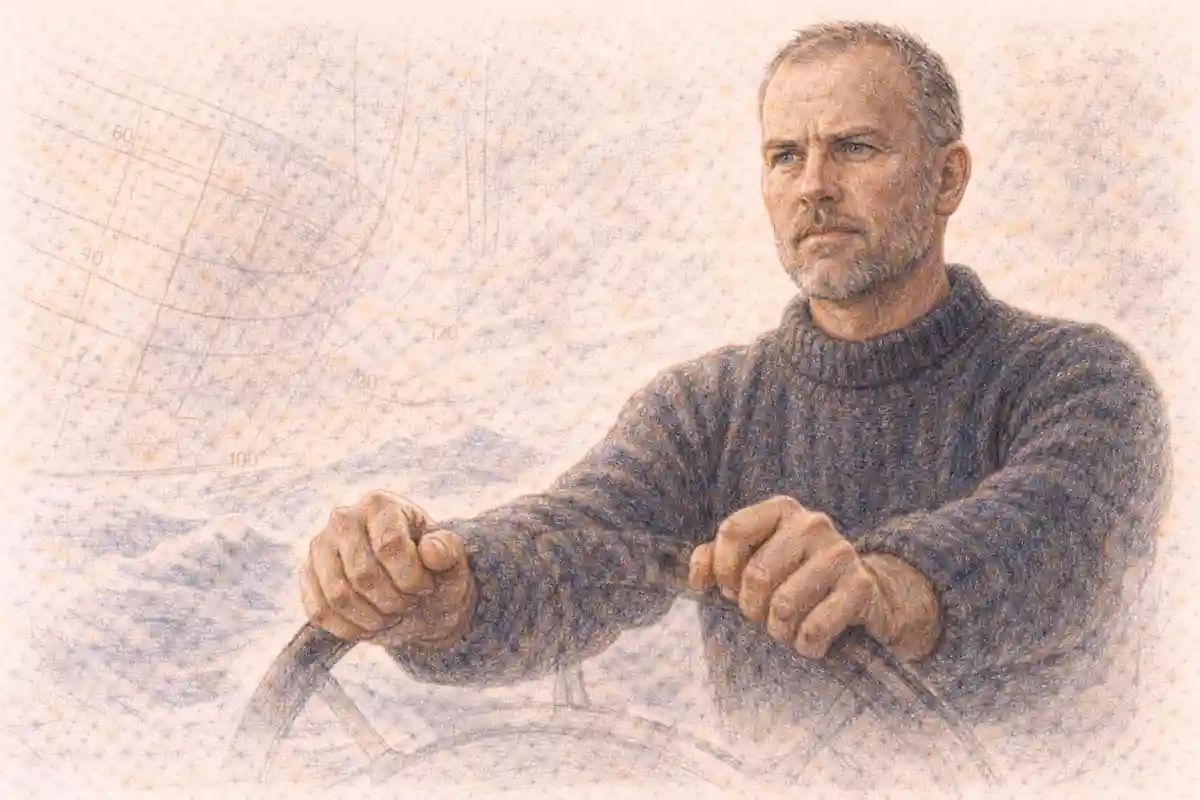
The hut is warm in the way a small room is warm when a stove has been lit early and left to settle. Bren Oule sits with his back to the wall so that he can see the door, the desk, and the window over the barrier in one turn of his head, and he does not need to turn it often. Outside, the road comes down from the Accord side in a long, pale straight, loses its gravel at the barrier, and goes on beyond the line as a track that narrows in grass and stone until distance takes the detail from it. In the other direction the road climbs again toward the customs houses and the patrol turn, and that way too it is empty. It has been empty since the light came. It will likely be empty until the light goes, except for weather moving across it and the shadow of the barrier beam shortening and lengthening on the ground.
On the desk there are four things in their places. The stamp sits on its pad, heavy in the base, with a handle worn smooth where his palm fits it. The ink pad is dark and even, neither dry nor flooded, because he tends it the way a man tends anything he uses without thinking, a wipe, a press, a check of the edge. The manifest book lies open under the window light, its ruled pages filled in a hand that is not his, line after line in the same careful order, form upon form, each sheet complete before it reaches him. And there is his book, the one that is his own, a thick volume with a broken spine that lets it lie flat, open at a place marked by a strip of manifest paper he cut for the purpose and never replaced with anything better.
The manifest for the morning is already on the desk when he looks at it properly. It has come down with the dawn post in the leather pouch, as they all come, sealed at the fold, the outer sheet addressed to the crossing in the formal hand the Carrowmere office uses for all its paper. He breaks the seal with his thumbnail. He lays the sheets flat. He reads them the way he reads all of them, not for story, not for sense in the larger world, but for completeness, because completeness is his part in it.
The paper is excellent. That is the first thing, and on most mornings it is also the last thing he thinks about it. The form is the correct form, the one with the narrow margin and the boxed heading for the crossing name, and the crossing name is entered in full, without abbreviation. The consignment is described in the proper sequence, alloy, grade, count of crates, weight of load given in words in the space that asks for words, and again in the tally column where the tally belongs. The seals are correct. There is the Office seal at the head, round and clean, and the foundry seal below it, and the carrier mark in the corner where carrier marks go. The signatures are correct. One signs for dispatch, one signs for carriage, one signs for the authority that will receive, and each signature sits on its own line with its own title beneath it, spelled as it is spelled on every other sheet in the book. The sequence is correct. Dispatch before carriage, carriage before receipt to come, dates in story order that no one in this hut needs to name aloud, numbers of sheets matching numbers of crates matching numbers of entries in the summary box. If there is a fault in it, the fault is not on the paper.
He lifts the stamp. The weight of it is a familiar thing, more than the paper, more than the book, a small solid certainty that comes up into his hand and settles there. Metal holds a grip. The base is cold at first touch and warms while he holds it. He sets it once on the pad, not hard, and lifts it to look at the face. The letters come up dark and whole. He aligns the manifest by its corner to the worn line he has scored, very lightly, into the desk varnish for this purpose, a private mark no inspector has ever remarked on because inspectors look at paper, not at desks. He brings the stamp down.
The sound is soft and complete. It is the sound the hut is built around, though nobody would say so. A thump through paper into wood, a pause while the weight rests, a lift. The impression is clean. Crossing name, officer mark, the small device that says a load has passed from one jurisdiction toward another. It sits over the receipt line exactly where it should sit. The convoy it certifies is described two inches above it in perfect order. The road outside the window, which he can see without turning his head, is empty in both directions. No dust stands on it. No vehicle waits at the barrier. The barrier beam itself is down, as it stays down on quiet days, its painted end resting in its iron shoe, unlifted since the last ordinary crossing, whenever that was.
Bren enters the stamp in the crossing book. He writes the hour in words, as the book requires, and the manifest number in words, as the book requires of him here though the manifest itself carries its number in the usual way, and the count of crates, and the destination as named on the sheet. The destination has a depot. The depot has a receiving authority. The authority has a title longer than most titles on the paper he handles, and he writes it out in full because the book has room and because fullness is the habit of this place. His handwriting is plain and upright. It does not hurry. A man who hurried at this desk would finish his work before the stove had warmed and would then have to invent more work to fill the day, and Bren learned long ago, at other posts before this one, that a steady pace is a kind of honesty a quiet post can afford.
He blots the entry. He closes the manifest book on the stamped sheet, to be collected with the pouch on its return. He puts the stamp back on its pad, face down, as he always leaves it, so the letters keep their ink and the dust keeps off them. Then he draws his own book toward him and finds his place again.
The story, insofar as he follows it, concerns a family in a valley town who are disputing a mill. He has been with the dispute for some days of reading. The miller has a daughter. The daughter has a suitor the father dislikes for reasons that seemed sufficient two chapters ago and seem thinner now, which Bren takes to be the author’s intention rather than a flaw. He reads a page. He reads another. The stove ticks as it cools a fraction and then settles. Wind finds the hut’s one loose shutter and moves it and lets it rest. Somewhere beyond the line, out where the track gives out to grass, a bird calls once and does not call again.
This is the ordinariness of it, and he does not experience it as anything else. A post must be kept. Paper must be stamped. A crossing that handles four vehicles a week, by its own returns, will have long stretches in which no vehicle is present, and paper that travels ahead of goods, or after them, or in place of the officer travelling himself, will arrive at hours when the road shows nothing. These are explanations he has not needed to assemble in so many words for a long time. They assembled themselves in his first month here and have since worn smooth, like the stamp handle. When a farmer from the Accord side comes down with a cart of fence posts for a cousin beyond the line, Bren lifts the barrier, checks the load by eye and by hand, writes that entry differently, in the part of the book reserved for traffic seen and passed, and the difference between the two kinds of entry is a difference of column, not of conscience. Both are paperwork. Both are his.
At midmorning he makes tea on the stove in a tin cup blackened at the base. He drinks it standing at the window, because standing is a change and the day is long. The road north shows the patrol for a moment, far off, two riders at a walk, following the line road at their usual interval. They do not turn down toward the hut. They have no reason to. Their gap and their circuit are matters he knows by long adjacency rather than by instruction. South, beyond the barrier, the track runs on empty to the place where the ground dips and the grass takes it. Nothing moves in the dip.
He sits again. He reads. In the early afternoon a second pouch comes down, with returns to sign, a request for a replacement pad, approved, and a note about barrier paint, deferred. He signs the returns. He stamps one copy because a copy that leaves this hut unstamped would look unfinished, and unfinished paper draws questions that finished paper does not. The impression is clean.
There are men who would find the quiet of this post a punishment, and he is not one of them. He did not refuse when the posting was read out and his name stood near the top of a list for reasons of seniority and an unblemished record of exactly this kind of steadiness. The hut suits him. The desk suits him. The book suits him. If the convoys named on his manifests pass at hours nobody watches, that is the nature of convoys and of night roads. If they pass on paper first and on the road later, that too is a nature he has seen at every post he has kept. Paper is patient. Roads are not obliged to perform for the officer who stamps them.
Late in the day the light goes the colour of the manifest paper itself, cream deepening at the edges. He reads the last page he will read. The miller’s daughter has refused the suitor in a speech Bren finds well made and slightly too long, and he approves of the length. He marks his place with the strip of manifest paper. He rises and lifts the barrier for nobody, out of habit, to keep the hinge from stiffening, and lowers it again into its shoe. He checks the stove. He sets the stamp on its pad. He looks once at the road, empty north, empty south, the track beyond the line holding the last light on its stones, and he bolts the door from inside against the night wind, and opens his book again in the lamplight while the crossing he keeps settles around him, quiet, complete, and entirely undisturbed by the convoy he has passed that morning.
Tasking
The room in Carrowmere where Commissioner Ilse Harrand gave her taskings was not large, and it made no attempt to seem so. It had a table that had been a desk for someone senior enough to need drawers on both sides, and a window that looked onto a yard where Office vehicles waited in rows. Mira stood because Harrand had not yet told anyone to sit, and Rask stood beside her with his splinted left hand held slightly away from his body, the way he had learned to carry it so that doors and table edges stopped finding it. Leyden stood near the door with a file under his arm and the expression of a man who had already read what was in the file and had come to prevent it being acted on.
Harrand laid out the paper herself. She set each sheet on the table and turned it so Mira could read it where she stood, and the first sheet was the snow record.
It was an Office record of pass closures, kept by season, in a clerkly hand that changed twice across the page as clerks changed across the years it covered. Against each northern pass it gave the months of closure, the cause given as snow in most years and as snow and drift in the worst of them, and the date of reopening as reported by the pass wardens. Harrand put one finger on the column for the northern crossing that the manifests favoured. Five of the nine months the manifests covered, that crossing had been shut. Not doubtful, not reported difficult. Shut, recorded, and countersigned by wardens who had no interest in the alloy trade and no knowledge that their record would ever be laid beside a manifest book in this room. Mira read the column twice. The record did not argue. It accumulated.
The second sheet was the crossing return, the paper crossing’s own account of itself, rendered quarterly and signed by its officer. Four vehicles a week. That was its official traffic, stated plainly, averaged across the quarter, made up of farm carts, a carrier’s wagon, a survey team in one month, and the post’s own supply cart in most weeks. Four vehicles a week, none of them described as a convoy, none of them carrying alloy in any quantity the return had a column for. Harrand let that sit beside the manifests, which described, in their excellent sequence, convoy after convoy of crated alloy passing that same crossing toward a depot beyond the line. The two papers did not quarrel either. They simply described different crossings that happened to share a name and a hut.
The third sheet was not a return at all but a survey note, copied into the file by a patrol clerk, from a patrol that had come back along the line two months earlier by a route that took it, briefly and without authority, within sight of ground inside the Scour. The patrol had reported a loading apron. Mira read the description slowly. A slab of poured stone and concrete, large enough for vehicles to turn on, a low shed at its edge, ruts in the ground running to it from the direction of the line and away from it toward the interior. It had not been visited. It had not been read. No Weigher had stood on it, and the patrol, being sensible men, had not lingered to count anything except the obvious. It sat in the file as a place that existed in the world the way the destination on the manifests existed only on paper, and the contrast between the two kinds of existence was, Mira understood, the shape of the case Harrand was building on the table.
The fourth thing Harrand established was not a sheet but a number she stated herself, and had Leyden repeat back to her so that the record of the meeting would show it had been fixed before anyone crossed anything. Ninety minutes. That was the window. The longest an officer could be across the line and back inside one patrol gap, measured from the line itself, with the patrol pattern on the Accord side setting the start of the gap and the light setting its end, because a crossing made in darkness on the way out had to be remade before full dark on the way back if the track was to be read at all by eye. Ninety minutes was not a target. It was a hard limit, set at tasking, in this room, and Harrand said, in terms, that an officer who let it run out in pursuit of one more fact had not been brave but had misunderstood the arithmetic of being unrecoverable.
Then she named the cost, and she named it before she named the task, which Mira noted and filed as the most honest thing about the morning.
The Accord has no standing in the Scour, Harrand said. None. It is ungoverned ground beyond the line, not a province in rebellion, not a territory in dispute, simply ground where the Accord’s writ does not run and never has. An officer who crosses enters it as a person, not as an office. Anything found there is unusable. It cannot be sworn to, it cannot be entered, it cannot support a proceeding, because the finding itself was made where no finding has force. And anyone lost there is unrecoverable, in the plain sense that no party will be sent, no demand will be made, and no record will state more than that the officer did not return within the window allowed. She said this looking at Mira and not at the paper. She said it without emphasis, the way the snow record accumulated, and then she gave the task.
The seller’s chain, which the foundry list work had traced to one protected seller and four places of making, ran onward from the seller through paper that ended at a crossing into the Scour. Mira was to work the paper, visit the crossing openly on the Accord side, examine the northern crossing as a route, and establish whether the destination named on the manifests existed in any sense an Office could act on. If the work drove her to the line itself, the window governed. Harrand did not order the crossing. She did something colder and more exact. She described the conditions under which it would become the only remaining move, set the limit that would govern it, and left the decision where decisions of that kind, in her stated view, belonged, with the officer whose loss would be unrecoverable.
Leyden objected then, on the record, as he had plainly come to do. His objection was not foolish and Harrand did not treat it as foolish. The Ninth Office, he said, was being asked to spend a Weigher on paper. Forgery was a matter for the ordinary inspectorate, and the Scour was a place the Office had, by long policy, agreed to leave alone precisely because nothing found there could be used. He said Mira was not the instrument for this. He said it in front of her, which she preferred to the other way.
Harrand overruled him in two sentences. The inspectorate could prove a form false, she said. It could not prove where the weight of the trade had actually gone, and until that was known the false form would simply be replaced by a better one. The objection was heard, noted, and set aside, and Leyden closed his file.
It was then that Rask’s part was settled, and settled as a bar, not as a preference. Rask held his licence as a Stiller under a class that existed, as most licence classes did, only inside the Accord’s standing. An officer of his class crossing without standing would not merely act without authority. He would end his licence by the act itself, the way a seal ends by being broken, automatically, whether anyone saw it or not, because the licence was written to die on that ground. Harrand stated it. Rask confirmed it in one sentence, without self pity, looking at his splinted hand as if the hand were the smaller of his two current limitations and the less worth mentioning. So any crossing, if it came to that, was Mira’s alone. Rask would wait on the Accord side, at the line, where his presence was lawful and his practice, if it were needed, could still be used on Accord ground. He would be the fixed point she counted her ninety minutes back toward. He accepted that role the way he accepted most roles, by asking one practical question about where exactly he should wait, and remembering the answer.
Last, and not as an afterthought, Harrand addressed Mira’s state, and she did it in cost terms, not in admiration, which Mira was grateful for in a way she did not show. Mira was entering reduced. The tasking said so in plain words. She was still carrying the Rann family outcome from the foundry run, a household that had closed its business on a list she had helped to read, and grief of that domestic kind did not clear from her quickly because it had nowhere dramatic to go. She was carrying, heavier and duller, ten years of one man’s carefulness from the seller’s records, Teodor Bask’s ten years of doing a protected thing patiently and well, the dullest thing she had ever carried and the hardest to put down, because carefulness taken on as affect settles into the hands and the habits and makes a Weigher check things that do not need checking at hours when she should be sleeping, which she largely was not. Two heavy reads in succession had already cost her sleep and warmth for days. A third, if the apron was what the patrol note suggested, would be taken on top of those, not instead of them. Harrand did not soften it. She entered it in the tasking as a limiting condition, the way the ninety minutes were a limiting condition, and she said that if the depletion, rather than any judgement of Mira’s, was what finally fixed how far the route could be read, then that was the finding and it would be recorded as such.
Mira asked three questions. She asked whether the crossing officer, Bren Oule, knew his returns were being read beside his manifests, and Harrand said not yet, and that he was to be visited openly and without accusation until the paper itself accused him, if it did. She asked whether the private register she kept, the notebook in her coat pocket in which she recorded absences against a standing instruction to stop keeping it, was to be surrendered before she went. Harrand said the instruction stood and the question of the notebook would keep until her return, which was not permission and was not confiscation, and which Mira accepted as the narrow ledge it was. She asked, finally, what would count as success. Break the provenance, Harrand said. If the paper is lying, break it on the record so it cannot be used again. The route itself is beyond us. That, she said, is why this is a partial errand even if you do it perfectly.
Outside, in the yard, Rask fell in beside her and said nothing about the crossing he could not make. He asked whether the northern pass road was worth the ride in this season, and she said the snow record made it worth exactly one ride and no more, and they went to arrange horses in the practical quiet of two people who had been given a window, a bar, a record of snow, a return of four vehicles a week, and a slab of stone glimpsed inside ground where neither of them had any standing.
Ground Truth
She began with the paper, because the paper was where the case lived and because Harrand, whatever else she intended, had been right to lay the sheets out in an order that made paper the first ground to stand on. In a records room on the second floor of the Carrowmere office, with a clerk at the far end of the table whose work was his own and who answered the telephone when it rang and otherwise left her to the file, Mira worked the manifests as paper for the better part of two days.
The method was dull and she trusted it for that reason. She took the manifests in sequence and set each against three other papers that owed it nothing. The first was the crossing’s own returns, quarterly, signed by Bren Oule in the plain upright hand she would later see in his book, giving the crossing’s seen traffic week by week. The second was the Office file on the seller’s chain, the slow accumulation from the foundry list work, in which four places of making fed the one seller protected for nine years by a warning that arrived before its cause, and the seller’s consignments acquired, at a certain point in their journey, a new set of documents. The third was the set of stamped copies retained at the crossing itself, copies of the same manifests, stamped by Oule, which the Office had called in as paper, lawfully, on the Accord side, and which a courier had brought down in a pouch identical to the pouches that had carried the originals out.
Sheet by sheet, the manifests agreed with themselves perfectly, and sheet by sheet, that agreement was the problem she was learning to look at. A genuine consignment, in her experience of Office paper, acquires small injuries as it travels. A count is corrected and initialled. A name is spelled two ways by two clerks and reconciled in a margin. A seal is struck twice because the first strike was faint. The manifests in this file had no injuries. Their seals were whole at the first strike in copy after copy. Their counts reconciled without a margin note anywhere. Their signatures, dispatch, carriage, and receipt to come, kept not only their spellings but their relative positions on the page, sheet after sheet, as if the paper had been produced by a process that had solved the problem of human variation by declining to include any. She did not conclude from this. She recorded it, in the file’s language, as a uniformity beyond the ordinary run of clerical practice, and she went on to the destination, which was the part of the paper that carried the case’s weight, though weight, in the sense that was hers, was exactly what paper held worst and shortest.
Every manifest named the same destination. Beyond the line, in the Scour, there was, according to the paper, a named settlement. In the settlement there was a receiving depot. Over the depot there stood a named receiving authority, with a title, a seal of its own reproduced in the receipt line, and an officer whose signature closed each manifest like a door closing at the end of a corridor. Mira took the settlement’s name to the survey returns first. The Office held surveys of the border country going back through several administrations, made by men who had ridden the line and, in the older surveys, some distance beyond it, before the present understanding about standing had hardened into policy. She worked through them by index and then by hand. The settlement was not in them. She took the name to the postal and carrier returns, which listed every place to which the Accord’s carriers would contract to deliver, including places beyond the line where delivery was at the carrier’s risk. It was not there. She took it to the wardens’ reports and the pass books and the gazetteer the Office kept for its own officers, a fat, corrected, much annotated volume that listed hamlets of six houses if a warden had ever slept in one. It was not there. The depot, being a building, might have escaped a gazetteer. The authority, being an authority, could not have escaped all of them, because authorities tax, or requisition, or correspond, or quarrel with wardens, and each of those activities leaves paper in other people’s files. This authority had left none anywhere except on the manifests themselves, where it existed completely, with a seal and a signature and a title, and nowhere else in the world the Office could consult.
She set that down too, carefully, as a negative finding at this stage rather than a conclusion, because the ground truth of a case, as she had been taught it and as she had relearned it at cost in a foundry yard where three crates of forty read as nothing and shared one stamp, was not a place where conclusions were hurried. It was the stage at which what could be known by ordinary means was established so thoroughly that the extraordinary means, when they were used, would have something solid to be measured against. So she went out to the crossing to see it with her eyes, openly, in daylight, as the tasking directed, with Rask beside her and a letter of inspection that any customs officer was obliged to honour on Accord ground.
The ride took most of a morning. The road narrowed as the country emptied. Fields gave out to rough grazing, grazing to scrub, and the line, when they reached the country of it, announced itself not by any wall or wire but by a change in the maintenance of things, the ditch cleared on the Accord side and not beyond, the road metal fresh on the Accord side and old beyond, and by the hut itself, set where a hut had to be set, with a view of the road in both directions and of the track beyond the barrier running on into ground that belonged, administratively, to nobody the Accord would name.
Bren Oule received them correctly. He was a man in his middle years with a reader’s habit of keeping one finger in a closed book while he attended to business, and he attended to theirs without haste and without obstruction. He produced his books when the letter asked for books. He showed them the barrier mechanism when Rask, out of a Stiller’s professional interest in things that open and close, asked about the beam. He answered questions about his returns in the same tone he used for questions about barrier paint, which is to say as questions about the keeping of a post, and if he understood that his stamped copies had already been read in Carrowmere beside his own returns, he gave no sign of it that Mira could catch, and she was watching for a sign with the part of her attention that was not, at that moment, cataloguing the hut as a place she would later have to read.
For that catalogue, made openly and without practice, only with eyes, was the other purpose of the visit, and she did it thoroughly while Rask kept the conversation on hinges and paint. The hut was one room with a stove, a desk, a shelf, and a bed behind a curtain that was not drawn. Its anchors, the places where whatever had happened here would have laid itself down most durably, named themselves to a Weigher’s eye the way furniture names itself to a mover. The stamp desk, first, scarred and varnished and heavy, metal and dense wood, which would hold repetition better than anything else in the room. The barrier beam, second, long timber bound in iron, worked by hand many times a day for years, out in the weather but iron shod where hands and the shoe took it. The hut’s stone threshold, third, a single slab worn in the middle, crossed by every foot that had entered or left since the post was built, stone being the best holder of all and a threshold being repetition concentrated into a few inches of ground. She noted all three, and noted also what would hold almost nothing. The paper on the desk. The curtain. The book in Oule’s hands, which would keep a man’s reading the way cloth keeps warmth, briefly and then not at all. If the manifests described reality, then somewhere in the desk, the beam, and the threshold there would be the laid down rhythm of convoys, of loaded alloy, of a trade in heavy things passing a barrier in convoy order, and if they did not, then those same anchors would hold the rhythm of whatever had actually happened here instead, and either way the hut, read later and properly, would testify in the only language it had.
She asked Oule, as a matter of form, about night traffic. He answered as a matter of form. Convoys, he said, if they came, came at the hours convoys preferred, and an officer’s returns recorded what his stamps recorded, and his stamps recorded what the paper brought him. It was an answer that could be innocent and could be the whole confession of the case, delivered in the tone of a man discussing barrier paint, and she wrote it down in neither spirit. She wrote down the words.
The northern crossing took a day to reach and an hour to dispose of as a piece of geography, though its disposal as an argument would take the snow record and longer. It lay eighty miles north, where the line met a pass between two shoulders of high ground that gathered weather the way a cup gathers water. There was a warden’s hut there too, unmanned in this season, a barrier newer than Oule’s, and a road that came down out of the pass in steep, well made turns that any carrier would be glad of in summer. Standing there with the wind taking the words out of ordinary conversation, Mira could see exactly why the manifests favoured it on their face. It was the better crossing. It was the crossing a real trade would choose, with a real road onward and a pass that, open, halved the journey to the country beyond. Everything about it fitted the paper. Everything about it fitted, that is, except the pass itself, which in this season stood open under a late sky, but which the snow record, produced and consulted at tasking and carried in her file in a clerk’s copy, showed shut for five of the nine months the manifests covered, shut with drift and countersigned closure, while the manifests ran through those same months unbroken, convoy upon convoy, as regular in the depth of the closed season as in the height of the open one. She stood in the pass and looked at the shoulders of ground above the road and understood how much snow those shoulders could deliver onto those turns, and the northern crossing became, in her mind, not a lie but a stage set, a real place doing fictional work, which was a more useful thing to understand than a simple falsehood would have been.
On the ride back, and in the records room on the following day, she assembled what the ground truth had given her into the shape the Office required before any practice was authorised or any line was crossed, and at the centre of that shape she set, fairly and in order, the three live possibilities, because until the hut was read and the apron was stood upon, all three were alive and each deserved to be stated as strongly as its evidence allowed.
The first possibility was that the crossing is real and quiet, and the convoys pass at hours nobody watches. This was Oule’s implied account and it was not a foolish one. Frontier traffic does move at night. A post manned by one officer cannot watch a road for every hour of darkness, and returns that record stamps rather than sightings will always show a thinner traffic than the road in fact carries. Under this possibility the destination existed, the depot received, the authority signed, and the Office’s surveys were simply old, or incomplete, or wrong about a settlement in ungoverned ground that had every reason to keep itself out of Accord paper. The uniformity of the manifests would then be the uniformity of a well run trade, and the snow record would mean only that the northern crossing was a preference, not a necessity, the stamped crossing at Oule’s hut being the route actually used in the closed months.
The second possibility was that the crossing is fictional and the goods go elsewhere. Under this account the hut, the stamps, and the destination were a screen, complete and maintained, behind which the alloy moved by another route entirely, most plausibly the northern crossing whose road and pass fitted the paper so well, or by some third route the file had not yet shown her. The destination might be real under this possibility, its paper merely routed through a fictional gate for reasons of tax, or secrecy, or the protection the seller’s chain had enjoyed for nine years. The snow record pressed hard against the northern version of this possibility, but pressing was not killing, not yet, not until the closed months were weighed against the manifest sequence in full, and a third route, if there was one, would not be found on paper at all but on the ground, by weight, at whatever place the trade actually used.
The third possibility was that the crossing is fictional and so is the destination. Under this account the paper did not screen a route to a real place. It invented the place itself, depot, authority, settlement and all, a country made of paper, so that a consignment travelling on those manifests acquired a provenance that ended in a fiction and could be questioned no further, because there was no one beyond the line to question and no place at which questions could arrive. The goods, under this possibility, went somewhere, since alloy is heavy and does not vanish, but where they went was written nowhere, and the somewhere would have to be found, if it could be found at all, at the one physical place the file contained that was not made of paper, the apron the patrol had glimpsed, a slab of poured stone inside the Scour with ruts running to it and away from it. This possibility was the darkest of the three and also, Mira noted without yet concluding, the one that best explained why the manifests had no injuries. Paper that describes a real journey gets hurt by the journey. Paper that describes an invented one stays as clean as the desk it was invented on.
To hold the three possibilities still, so that they could be compared rather than merely felt, she made the crossing table, and she made it in the prose of her report because Harrand had no patience with appendices that carried the argument a report was afraid to make. The table set three routes against season, capacity, and manifest count, and it read as follows.
| Route | Season | Capacity | Manifest count |
|---|---|---|---|
| The paper crossing at Oule’s hut | Open in all seasons, a low road with no pass to close | Four vehicles a week of ordinary traffic, by its own returns | The full count, every convoy in the file, without a gap in any month |
| The northern crossing | Open in four of the nine months, snow shut in five | The highest of the three when open, a made road able to take heavy convoys in convoy order | The full count, if the manifests are assigned to it by their descriptions of road and pass, including convoys dated in the closed months |
| The unmarked track to the apron | No season recorded against it, being no official route at all | Unknown except as the patrol note implies it, a turning place for vehicles in numbers the ruts suggest but no return states | None. No sheet in the file names it, describes it, or alludes to it in any margin |
She wrote beneath the table what the table settled, and she was careful to claim no more for it than it carried. It settled that the paper, taken as a whole, described a traffic that no single real crossing could have carried as described, since the crossing that was always open lacked, by its own returns, the traffic, and the crossing that had the road lacked, for five of nine months, the season. It settled that the third route, the only one with no paper, was also the only one against which no contradiction yet stood, which was not evidence for it but was, in a case built of contradictions, a fact worth the sentence it took to state. And it settled the order of the work that remained. The hut had to be read, to say what a year at that desk had actually contained. The destination had to be searched once more, exhaustively, against every return the Office could call in. And if those two things broke the provenance without revealing the route, then the apron, the one anchor the route had offered, would have to be stood upon and read inside the ninety minutes, on the far side of the line, where nothing she found could be used and everything she found could be lost with her. She would refer to the table again, she wrote, when the collapse came, because tables do not change their minds under pressure, and people, in her experience of herself included, do.
She worked the destination search a second time, because a negative finding that would carry a case had to be more than a morning spent failing to find a name. The records clerk, whose name was entered in the file as the officer assisting and whose patience with the telephone was greater than hers, called in returns the Office did not keep on its own shelves. He called the carrier registry and had them search their contract places under the settlement name and under two spellings of it that a tired clerk might plausibly have produced. He called the pass wardens’ central book and had the northern and southern warden districts searched for any correspondence from a receiving authority of the kind the manifests described, since an authority that received convoys of alloy would need, at the least, a road kept passable and a water supply it did not itself carry, and both needs generate letters even in ungoverned country, letters that arrive on the Accord side and are filed by men who file everything. He called the survey office and had the oldest border survey brought up from the lower rooms, the one made when officers still rode some distance beyond the line and wrote down what they found in a hand that expected to be believed, and Mira read that survey herself, settlement by settlement, well by well, ruin by ruin, because the older surveyors had been thorough in the way of men who knew no one would check their work for a generation. The settlement was not in the old survey either. A place might be founded after a survey, she allowed, in the note she wrote on the search. A depot might be built in a season. But an authority with a seal, a title, a signing officer, and a correspondence with foundries on the Accord side did not spring up in ungoverned ground without touching, somewhere, a warden, a carrier, a well keeper, or a tax dispute, and the search had now covered the places where such touching would be kept. She wrote the finding in the file’s driest language and underlined nothing, because underlining, in a file that Harrand would read, was a form of arguing, and she wanted the absence to argue for itself.
The stamped copies from the crossing repaid a second working as well, and she gave them one on the long table with the light falling across them from the records room window, laying them in order of their dates and reading them not as individual documents but as a run, the way a Weigher reads a room not for a single event but for the rhythm events leave when they repeat. Read as a run, the copies showed a rhythm that belonged to a desk rather than to a road. Convoys were stamped at intervals that suited the arrival of the pouch. They were stamped in batches that corresponded, though she checked this twice before she trusted it, to the days on which paper reached the hut rather than to any pattern of weather, road condition, or foundry output that the seller’s own file recorded. A road has seasons inside its seasons. Loads wait for a thaw, for a bridge, for a carrier’s horses, for a foundry to finish a casting run. The stamped run waited for none of these things. It waited for paper. When the pouch was delayed, the stamps bunched. When the pouch came early, the stamps spread themselves obligingly across the days it covered. She set that observation beside the uniformity of the seals and signatures and let the two observations keep each other company in the file without yet marrying them into a conclusion, because ground truth, properly laid, is a floor and not a verdict, and a floor must bear the weight of either verdict that is later built on it.
Rask, who had ridden to the northern crossing with her and who had spent the records room days on the unglamorous work of checking the seller’s file for any mention of the apron, brought her his own contribution late on the second afternoon and laid it on the table without ceremony. In all the seller’s paper, across nine years of protection and four places of making, no document mentioned a loading place inside the Scour by description, by bearing, or by the kind of coded reference men use when they are being careful in writing. The apron existed in exactly one Office document, the patrol note, and the patrol had found it by accident of route, in the course of coming home by a way that was not their ordered way, because a stream had taken a bridge on their ordered way and made the choice for them. A trade that ran forty vehicles a month, if the ruts were to be believed even in part, across a slab of poured stone, had contrived to leave no reference to that slab in any paper the Office held, while leaving, at the same time, a complete and beautiful paper trail to a destination that no survey, registry, warden, or gazetteer could find. Mira wrote that down as well. Silence in one place and eloquence in another is itself a kind of testimony, though it is testimony about the intentions of whoever arranged the paper, and intentions, unlike snow, cannot be countersigned by wardens.
She also walked, in those two days, the short distance in Carrowmere to the Office’s own map room and stood over the great border sheet that the map keepers maintained for officers who worked the line, a sheet corrected in pencil by many hands and inked in only when a correction had survived a season of checking. On that sheet the line was drawn with the confidence the Accord reserved for things it could enforce. On the Accord side, every crossing, warden’s hut, pass, and track was named. Beyond the line the sheet grew honest in a different way. Settlements the surveyors had verified were named in a smaller hand. Routes reported but not verified were drawn broken. And in the region where the manifests placed their settlement, their depot, and their receiving authority, the great sheet showed open country, a watercourse drawn broken where it left the verified ground, and the map keeper’s small, neat annotation that the country beyond had not been surveyed in the present administration. She asked the map keeper, a man who treated all questions about his sheet as questions about his character, whether a settlement of the size the manifests implied could stand in that open country unrecorded. He considered the question with the seriousness it deserved. A camp could, he said. A depot with a signing authority could not stand there through a single season of convoys without a carrier, a warden, or a rival authority writing its name on something that eventually reached his room. He had received no such writing. He offered to enter the name on the sheet in pencil, as reported and unverified, and she declined, because a name entered on the great sheet, even in pencil, would begin at once to acquire the borrowed solidity that all recorded things acquire, and the whole labour of the ground truth was to prevent paper from acquiring solidity it had not earned.
That labour, she understood as she carried the file back up the stairs, was the real substance of these two days, and it was why Harrand had been right, in the tasking, to insist that the paper be worked before any place was read and any line was approached. Weight, her own gift, was a seductive witness. It spoke in rhythms and durations, it was immune to the ordinary temptations of clerks, and it could not be cross examined by anyone who did not share it, which meant that a case built on weight alone would stand or fall on trust in the Weigher. A case built first on snow records kept by wardens, on returns signed by the crossing officer himself, on surveys, registries, gazetteers, and a map keeper’s character, stood on ground that any inspector could walk after her. If the hut, when she read it, gave her a year of quiet, that quiet would be believed because the paper had already shown a traffic that could not have passed. If the apron, when she stood on it, gave her movements in their dozens, those movements would matter because the paper had already shown that no manifest had ever named the place where they happened. The ground truth did not compete with her gift. It fenced it, the way the line fenced the Accord, and a fenced gift, like a fenced jurisdiction, could be trusted precisely where its fence ran, and not one step beyond it. She wrote a version of that thought into the report in language dry enough for the file, and then she wrote the table, and then she stated the three possibilities, and by then the light in the records room had gone the way the light went at Oule’s hut at the end of his day, and the clerk had covered his telephone with its cloth cover, and the case had acquired the shape it would keep through everything that followed.
It was on the evening of that second day in the records room, with the table drafted and the three possibilities stated, that the opposition in the case showed itself, not as an argument made to her face, but as a scene she would only learn of later and which belongs here in the order of the ground truth because it was happening, in Carrowmere, while the ground truth was being laid.
Commissioner Ilse Harrand sat alone in her office after the clerks had gone. The yard outside her window was emptying in rows. On her desk there were two files, the tasking file, thin, and a second file, thinner, which she had opened that morning and which contained a single form, the formal reprimand provided for an officer who crosses the Accord’s line without standing and returns to report evidence obtained there. She took the form out. She filled it in her own hand, which she did for no other document of its class, her clerks being paid, as she sometimes said, precisely so that her handwriting would not appear on routine paper. She entered the officer’s name. She entered the crossing, described as unauthorised in fact though foreseen at tasking, a distinction she worded twice before she was satisfied that it was exact and not merely severe. She entered the ground of the reprimand, that evidence obtained without standing endangers every proceeding it touches and teaches every younger officer watching that the line is a formality. Then she signed it. Then she dated it, with the date of that day, honestly entered, the day of drafting, two days and more before any crossing had been made or finally decided. She blotted the signature. She placed the form in its file, and the file in the drawer reserved for instruments awaiting an event, and she locked the drawer.
She was right about one thing, and the fairness the record owes her requires it to be stated as plainly as she stated the cost at tasking. The crossing would happen whatever the paper said. She had foreseen it at tasking, Leyden had foreseen it in objecting, and Mira, laying her table in the records room at that same hour, was arriving at it by arithmetic. When it happened, the evidence it won would be unusable in any proceeding, and everyone concerned would be under pressure, from relief, from loyalty, from the simple human wish to make a dangerous act retroactively wise, to treat it as authorised by its results. Against that pressure the Accord owned exactly one honest instrument, a reprimand written while the facts were still plain, before relief could soften it and before loyalty could rewrite the tasking as an order. So she wrote it in advance, signed it in advance, and dated it with the day she wrote it, because a reprimand written afterwards, in the warmth of a safe return, would be a lie about when the judgement had been formed, and Harrand, who believed the Ninth Office should not exist and who was sometimes right in ways the Office found hardest to answer, would not sign a lie of that particular kind even to punish an officer she expected to deserve it. She washed her hands at the small basin in the corner of her office, dried them on the towel that hung there for her alone, and went home through the yard in the last of the light, leaving the drawer locked on a judgement already made, about an act not yet committed, by an officer not yet across the line.
Mira, of course, knew none of this as she closed the file on the ground truth and sat a while in the records room with the cold of the paper work still on her, which was not the cold of practice but its poorer cousin, the tiredness that comes of holding three possibilities fairly when the hands want to close on one. The clerk had gone. The telephone did not ring. In her coat, hung on the back of her chair, the notebook in the pocket kept its own counsel, its list of absences unadded to, for the paper country, whatever else it was, was not an absence in her sense. An absence was a place where weight should be and was not. This was the opposite shape. This was paper where a place should be and was not, assertion without anchor, a destination with a seal and no stone threshold anywhere in the world for a foot to wear down. She put on the coat. She took the file to the night clerk for copying. On the third day of the work, she would go back to the hut and ask Bren Oule, openly and on Accord ground, to let her sit a while in his quiet room with her hands on his desk, and she would find out what a year of that quiet had actually contained, and the first of her three possibilities would begin, though she did not yet know it, to die the way the northern route was already dying, not by argument, but by accumulation, the way snow closes a pass, the way a record, honestly kept by wardens who knew nothing of alloy, closes a road that paper insisted had been open all winter.
The Collapse
The northern crossing had been the kind answer, and Mira had wanted it to hold longer than it deserved.
It was the answer that let everyone stay inside the map. If the convoys named on the manifests had not used the little post where Bren Oule sat with his book and his stamp, they could still have gone honestly, after a fashion, by another road that the Office knew and could name. Eighty miles north there was a pass with a gate and a shelter and a track worn by use, a place that appeared on surveys without apology, a place where vehicles could be counted and drivers questioned and loads inspected by officers acting where the Accord still stood. Every manifest could be laid beside that pass and made to fit. The weights were within what its track could bear in a season. The intervals matched the rhythm a northern run would need. The destinations beyond it, read generously, could be reached from it without inventing a mile. On paper, and only on paper, it was complete.
That completeness was why she had distrusted it from the first, and why she had also, privately, hoped for it. A fictional crossing with a real detour was a forgery that could be closed. Papers could be voided, a route could be watched, men could be stopped on Accord ground where a stop meant something in a proceeding. A fictional crossing with a fictional destination was a different animal. It meant the lie had not been built to hide a road. It had been built to replace one.
She went back to the snow record first, because it was the one piece of the case that had never tried to please anyone.
The record had been produced at tasking, in Harrand’s room, without ceremony. It was an Office record of pass closures, kept by season, entered by hands that had no interest in alloy or manifests or the Scour. A clerk in a cold office far from the northern gate copied reports as they came in. A patrol noted a drift. A shelter keeper noted a fall. A supply run turned back and said why. The entries accumulated in the plain order in which weather happens, and nobody smoothed them afterwards, because nobody had imagined a use for them beyond deciding when a pass could be attempted and when an attempt would waste horses, fuel and men.
Mira spread the manifests beside it again, in the small room the Office had given her on the Accord side, with the window shut against a wind that found every edge of the frame. Rask sat across the table with his splinted left hand resting clear of the papers, doing the sorting with his right, laying each month in its own pile and weighting the piles with whatever came to hand, a cup, a ruler, the flat of a closed knife. He said nothing while she worked. He had learned, in the time they had worked together, that there were stretches of a case where talk was only another way of asking her to hurry, and that she hurried worst when she was being helped.
Nine months of manifests. Nine months unbroken.
The stamps did not pause. The sequence did not pause. Convoy followed convoy at intervals that suggested a trade settling into habit, the way a real trade does when buyers learn to expect it and sellers learn to promise it. Loads were named, sealed, signed for and sent onward into a receiving system that, on the face of the paper, received them. In the first month the hand was careful, almost formal. By the third the entries had the ease of routine. By the sixth they had the slight impatience of men who have done a thing often enough to resent being made to write it down each time. Whoever had made the paper had understood that rhythm, or the paper had grown from real handling at Oule’s desk, which came to the same thing for the purpose she had in front of her.
The snow record ran beside it, indifferent.
For five of those nine months, the northern pass had been shut.
Not doubtful. Not difficult. Not passable at risk by a driver who knew the drifts and was willing to be cold. Shut, in the record’s own flat language, again and again, across the middle of the manifest run and out to either side of it. A fall early in the season that closed the upper track. A second fall that took the shelter roof and made the gate unreachable. Weeks in which the entry was the same entry copied forward because nothing had changed except the depth. A brief thaw that the record itself refused to call an opening, noting water over ice and a track that would take a man on foot and kill a loaded vehicle for its trouble. Then more snow.
She checked the months three times, by three different routes, because the whole case was about to turn on arithmetic and she did not trust arithmetic done once in a warm room.
First she took the manifests in stamped order and marked each one against the closure entries for its month. Then she took the closures in their own order and asked, for each stretch of shut pass, whether any manifest claimed a crossing inside it. Then she had Rask read the months aloud while she kept her finger on the record, so that a second mind, working at speaking pace, would catch any slide her eye had made in silence.
The result did not move.
Five months shut. Nine months claimed. The claimed crossings ran straight through the shut months without a gap, without a note, without the small embarrassed adjustments real paperwork makes when weather interrupts trade. No manifest said held. No manifest said delayed. No manifest said rerouted, stored, returned or spoiled. The convoys, if they had used the northern pass, would have had to cross snow that the Office record said no vehicle crossed, in weeks when patrols on foot had turned back from the lower approach, and they would have had to do it repeatedly, on schedule, carrying alloy, and leave no mark in any other return the Office held.
Rask put the last pile down and aligned its edge with the table, one handed, with the patience of a man who refuses to let an injury make him slovenly.
That kills it, he said.
It kills it as the route, she said. It does not kill it as a design.
He looked at her across the piles.
She meant the shape of the thing. The northern crossing had not been chosen at random as a false lead, if it had been chosen at all. It fit too well in every respect except the weather. It fit in capacity, in distance, in the kind of traffic it was known for in its open months. A reader who checked the manifests against a map would find it and be satisfied. A reader who checked them against capacity would find it and be satisfied. Only a reader who checked them against a closure record kept for another purpose entirely, by clerks with no stake in the answer, would find the seam. The forgery, if forgery it was, had been built for the checks its makers expected. It had not been built for weather filed in a different room.
Or the makers had known about the snow and had not cared, because the northern pass was never meant to be travelled, only to be plausible for as long as plausibility was needed.
Either way, the kind answer was dead. The goods had not gone elsewhere by the northern crossing. That possibility had carried a great deal of the case’s comfort with it, and she felt its loss in practical terms at once. There was no longer a real gate to watch in place of the paper one. There was no longer a stretch of Accord ground where the trade could be interrupted with authority. What remained was a quiet hut on an empty road, a stamp, and a destination she had not yet finished dismantling.
She set the northern papers aside, in a single stack, face down. In her notebook, the private register she kept in her coat pocket against instruction, she did not write the northern crossing at all. That book was for absences, and this was not one. This was an ordinary death, by evidence, of a reasonable idea. It belonged in the Office file, where she put it, in her own hand, in plain words: northern route excluded by closure record, five months of nine, manifests unbroken through closure.
Then she went to read the hut.
She had visited the crossing openly already, in daylight, as an officer of the Accord may do on Accord ground, and she had named its anchors to herself as she walked it, the way she had been taught and the way the work demanded if a later read was to mean anything. A place read cold, without preparation, gives a Weigher noise dressed as feeling. A place prepared, its fixed points learned by eye and by hand in ordinary light, gives less, and what it gives can be trusted further.
The stamp desk. The barrier beam. The stone threshold of the hut.
Those three she had chosen, and those three she returned to, late in the day, with Oule’s leave asked and given in the unhurried manner of a man for whom an inspection was one more piece of paper moving across his desk. He made her tea she did not drink. He offered her the chair with the sound leg. He went on with his book at the other end of the hut while she worked, turning a page now and then, and the ordinariness of his presence became part of what she had to work through, because a man reading in his own hut lays down the strongest note in the room simply by being at ease in it.
She began at the threshold, because thresholds collect repetition in its purest form. Every entry, every exit, every pause with a hand on the frame to look at the weather, every boot scraping grit from the lane, passes over the same narrow band of stone. Stone holds well. Stone holds long. If convoys had been worked through that hut, if drivers had come in out of the cold with papers in their hands and alloy on their minds and the particular sustained intent of men moving valuable goods under false names, the threshold would know the rhythm of it even if it knew nothing else. She had once stood beside the bound load on a border station whose binding could not be felt where it sat and learned how eloquent a place could be about everything except the one thing that had been hidden from it. Weight does not record who. It records that a kind of thing happened, and how often, and with what feeling gathered around it.
She put her hand flat to the stone, inside the door, where the wear was deepest.
The cold came first, as it always did, a cold that was hers to pay and not the place’s to explain. Then the year came up under it, slowly, the way a long exposure shows itself when there is no single bright event to seize on.
A year of quiet.
That was the shape of it, whole and unmistakable. Four vehicles a week of ordinary traffic, in ordinary weather and in bad, each one a small event with small feelings attached. A farmer’s impatience. A carrier’s boredom. A traveller’s relief at a stamp obtained and a road allowed. Paper presented, paper examined, paper returned. Tea made. The book opened. The book closed. Rain at the door in its season and the particular annoyance of a man who must cross the yard in it. Wind worrying the barrier rope. Long evenings with nobody at all, which in a threshold read as a flattening, a place resting between uses, neither neglected nor busy, kept.
She stayed with it longer than comfort allowed, because absence in a read is a claim that must be earned minute by minute. Any Weigher can miss a faint thing by lifting her hand too soon. She let the year unroll at its own pace, month laid over month in the compressed way stone offers time, not as a story but as a density. Busier weeks pressed thicker. Empty weeks thinned almost to the stone itself. Nowhere in it did the density change its character.
No convoy.
No alloy.
No loaded weight of the kind the manifests described, ever.
No train of vehicles arriving together with the gathered intent of men who know their cargo matters and their papers are false. No repeated surge of arrivals at night, which would have shown as a rhythm at odds with the daylight traffic even if every other detail had been scrubbed away. No fear laid in by repetition, no violence, no grief, none of the heavy weather that valuable contraband drags behind it through a place where it is handled. The hut had handled paper about convoys. The hut had never handled the convoys themselves. Those were different statements, and the threshold, patiently, made both of them.
She lifted her hand. The cold stayed, settling into her wrist and up toward the elbow, and with it a portion of the hut’s long quiet, which was not peace exactly, but the flat calm of a place where very little has been asked. She would carry that calm like a stone in a pocket for hours, and it would make her own thoughts feel loud by contrast. She flexed her fingers until the feeling in them was ordinary again.
At the desk she read more briefly, and got less, and expected less. Wood and paper hold poorly, and the desk was wood worn smooth, its surface a palimpsest of brief contacts. The stamp itself, metal cased, held better, and what it held was repetition without heat: the small satisfaction of a form completed, the minor irritation of an ink pad drying, the habit of a hand that had done the same motion often enough to do it while thinking of something else. If Oule had known the manifests were false, and the read could not tell her whether he knew, his knowing had not lived in his hand at the moment of stamping. It had lived, if anywhere, in whatever arrangements brought the paper to him. The desk gave her diligence. It did not give her dread.
The barrier beam gave her weather and maintenance, a man testing the rope, a man repainting a stripe with more care than the task required, vehicles passing under singly and without ceremony. Four a week. The beam agreed with the threshold. The whole post agreed with itself, which was the most damning agreement in the whole case. A place where a great lie is worked usually disagrees with itself somewhere, in a corner nobody thought to rehearse. This place did not disagree. It simply described a small, quiet, lawful post, handling almost nothing, while its paper described a trade.
Mira stood in the doorway afterwards and looked at the road in both directions, as Oule must have looked at it on a thousand ordinary days. Empty to the Accord side, empty to the line. Grit, puddles holding the sky, the barrier’s shadow lying across the lane. Somewhere beyond the line, if the patrol report and the survey note were right, a poured slab waited with ruts in its approaches, unvisited and unread. She did not look toward it by any act of will she could have named. She looked at the road she could see, and she thought about paper.
Because with the northern route dead and the stamped route empty, the paper itself had become the object of the case.
Until then the manifests had been evidence about movement. Now they were the movement’s replacement. Somebody had needed consignments of alloy to have travelled, in the only sense that mattered to buyers, auditors and officers downstream, which was the documentary sense. A consignment with a provenance can be sold, insured, pledged, resold and defended. A consignment without one is a problem that follows its owner from desk to desk. The manifests gave the alloy a past. They gave it an origin, a route, a crossing, a receiving depot and a receiving authority, each in correct form, each in correct sequence, seals where seals belonged and signatures where signatures belonged, so that any later holder could point to the paper and say, here, it came through here, it was received there, by them.
She went back to the table in the small room and laid the destination out under the lamp, one manifest copy beside another, until the named settlement and its named receiving authority repeated down the page in slightly different hands and identical words.
Then she checked them against everything the Office held.
It took the rest of the day and part of the evening, and most of it was done by telephone and by clerk, in the unglamorous way that real dismantling is usually done. A records clerk in Carrowmere, whose voice she knew and whose name she did not need, worked the survey index while she worked the returns. They took the settlement name in its manifest spelling first, then in every plausible variant the clerk could devise, then under the receiving authority’s name, then under the depot’s designation alone, stripped of place, in case a depot might exist somewhere under a different settlement’s heading. They worked the gazetteer of the Scour compiled from patrol reports, which was incomplete and admitted it on its own title page. They worked the older surveys made before the line was drawn where it now stood, in case the place had existed once and been abandoned, renamed or absorbed. They worked the Accord’s own returns from the crossing itself, nine months of them, in case the destination appeared anywhere except on the manifests it was meant to dignify. They worked the receiving returns, such as they were, from every depot on the Accord side that handled alloy in any form, in case the name was a corruption of a real one and the paper country had grown from a clerical error honestly repeated.
It was not there.
Not misspelled. Not renamed. Not abandoned, not absorbed, not recorded under a variant, not remembered by the clerk, who had the kind of memory that made other clerks uneasy, as a place she had once filed and forgotten. The settlement did not appear on any survey the Office could consult. The receiving authority did not appear in any list of authorities, Accord, local or otherwise, that the Office held. The depot had no returns, no establishment, no history of staffing, supply, complaint or inspection, none of the dull debris that even the smallest real depot sheds into the record simply by existing through a winter.
Mira asked the clerk to run the search a second time with the names reversed in order and the authority treated as a place, because tired people miss obvious things and she was tired. The clerk did it without comment, and the line was quiet for a while except for paper moving at the far end, and then the clerk said, in the tone of a woman closing a drawer, that there was nothing to find.
She sat with that nothing and let it settle into its proper weight.
The destination had been invented whole.
Not embellished. Not borrowed from a real place and dressed. Invented, entire, with its authority and its depot composed to fit the forms that would receive them, the way a key is cut to fit a lock it will never be asked to open. Because that was the elegance of it, if elegance was a word she was willing to spend on a forgery that had eaten nine months of her Office’s attention. The paper country never needed to survive a visit. It needed to survive reading, by busy men, at desks, in sequence, each of whom would check the form against the form before it and find the sequence unbroken. A destination that does not exist cannot contradict its manifests. It cannot report a short delivery. It cannot lose a consignment, mislay a seal, write a complaining letter or be visited by an auditor with questions about a month when the snow, eighty miles north, had shut a pass it had never depended on. It receives everything, perfectly, forever, in silence.
Rask, who had come in with tea she would also not drink, read her face and then read the top manifest where it lay.
So the third of your three, he said.
She had stated three live possibilities fairly, at the start of the ground work, and she had meant the fairness. The crossing real and quiet, the convoys passing at hours nobody watched. The crossing fictional and the goods gone elsewhere. The crossing fictional and the destination fictional too. Procedure demanded that all three be carried until evidence killed them, and evidence had now killed them in order, like lamps going out along a road, until only the last one burned.
The crossing is fictional, she said, and so is the destination.
And the goods.
The goods are real, she said. Alloy is being made, and alloy is being sold, and men do not invent a country to give a past to metal that stays where it was made. The goods went somewhere. Only not through that hut, and not to that depot, and not by the northern pass in the months when the snow had it.
She wrote it up that night in the plain language the file required, keeping her own register out of it, keeping the cold in her wrist out of it, keeping the hut’s long quiet in it only as a finding stated in terms a proceeding could use if a proceeding ever got the chance. Northern crossing excluded by the closure record. Stamped crossing read at three anchors and found consistent with its own returns and inconsistent with every manifest. Destination, receiving depot and receiving authority not found in any survey, gazetteer or return held by the Office, after search and repeated search. Those three sentences closed more of the case than any arrest she could have made on Accord ground, and she knew, even as she wrote them, that they also marked the exact edge of what the Accord could reach. Everything she had proved sat on her side of the line. Everything that would explain it sat on the other.
On the table, the crossing table she had built during the ground work lay under the manifest copies, its three routes set against season, capacity and manifest count, all its numbers written as words in her careful hand. She pulled it clear and looked at it once more. The paper crossing row, quiet in every season, able in principle, empty in fact. The northern row, able in its open months, shut for five of the nine, claimed for all nine. The third row was the thinnest and the least proved, and it was the only one left standing: an unmarked track, a short distance from the stamped post, crossing the line without paper, running to a poured apron inside the Scour where vehicles turned and unloaded. That row had no manifest count, because it generated no manifests. It had no capacity anyone had certified, only ruts and a patrol’s glimpse and a survey note. It had no season, because nobody kept its closures.
The table settled it as far as paper could settle anything. It also told her, with the same clarity, what paper could not do next.
She could prove a country did not exist without ever leaving the Accord. She could not prove where the alloy went, or who received it in the real world beyond the line, or how far the real route ran, from a desk on the lawful side of a barrier, with a cold wrist and a fair chance of being believed. For that she would need the apron itself under her hand, its stone read the way she had read the hut’s threshold, repetition and duration and nothing more, but even that nothing more would be a fact from inside the Scour, and facts from inside the Scour had a price that had been named at tasking, in Harrand’s room, before any of this was proved.
Rask watched her fold the table into the file.
You are counting the window again, he said.
Ninety minutes, she said.
I know what it is. I am asking whether you are counting it as a plan or as an argument with yourself.
She did not answer at once, because he had earned an honest answer and the honest answer was that she did not yet know. The hut’s year of quiet sat on her still, flattening her, making the apron’s imagined traffic feel louder than it should. Beneath that, older and duller, the ten years of one man’s carefulness that she had carried out of the foundry work still weighted her attention, and beneath that, the Rann family’s closed gates and shuttered yard, which she had carried further than any finding required. She was, in the phrase the tasking had used without admiration, reduced. A crossing made at the end of such a day, alone, on a counted window, was not a thing to drift into because the paper had run out.
It is a plan, she said at last. Tomorrow it is a plan. Tonight it is a finding.
He accepted that, as he accepted most of her distinctions, by putting the cups where they belonged and switching off the lamp over the table and leaving the file squared in the dark. Outside, the wind worked at the window of the small room and then gave up and went elsewhere. The road past the post was empty, as it had been empty through a year of quiet, through nine months of excellent paper, through five months of snow that had shut a pass nobody in this trade had ever used.
The manifests lay in their piles, unbroken.
The country they named lay nowhere at all.
Pressure
She made the decision at the table, in daylight, with Rask watching.
She said it plainly. She would cross. Alone. Inside the patrol gap. Ninety minutes from the line and back to the line. No longer. She would read the apron. She would read nothing else unless the apron gave it to her without a step further. She would not follow the far track. She would not look for a junction. She would come back inside the window whether the read was finished or not.
Rask did not argue the decision. He argued the edges of it. He always did. He checked her coat. He checked her notebook. He checked the time against his own watch and against the post clock. The two watches disagreed by a minute. They used his. His was the watch staying on the lawful side. His was the watch that would have to say when she was late.
He could not cross with her. They both knew why. His licence class ended at the line. Crossing without standing would end the licence itself. Not suspend it. End it. A Stiller with no licence was a man with a gift nobody could lawfully use. He would not spend that for company. She would not ask him to spend it. So he would wait. He would wait on the Accord side. He would watch the track. He would watch the clock. He would do the waiting well, which was its own kind of work, and neither of them said so.
His splinted hand rested on the table while he checked her things. The splint was clean. The fingers under it were still. He worked one handed and he worked without fuss. She watched the hand once. Then she stopped watching it. It had been crushed holding a gate she had asked him to hold. Looking at it before she crossed would not change the count. It would only spend attention she needed elsewhere.
The crossing point was not the hut. It was not the barrier. It was the unmarked track. It lay a short distance from the stamped post. Patrols knew it. Smugglers knew it. The Office knew it and wrote it down in the careful language offices use for things they cannot stop. The track left the lane at a place where the fence had been mended too often. It crossed rough ground. It dipped. It rose. It crossed the line where the line was only a set of stones and a shared understanding.
She waited for the gap. The patrol pattern gave the gap. The light gave the gap. Both had been fixed at tasking. Both held. The near patrol passed. Its sound faded. The far patrol was still beyond the rise. The light was low and flat. It made distances hard to judge. It also made a moving figure hard to pick out against rough ground. That was the bargain. She took it.
She set the count in her head at the line. Ninety minutes. Starting now.
The ground on the far side felt no different. That surprised some part of her every time she thought about borders. The grit was the same grit. The stones were the same stones. The wind came from the same quarter. What changed was standing. On the near side she was an officer. On the far side she was a woman alone in a place where the Accord had no standing. Anything found there was unusable. Anyone lost there was unrecoverable. Harrand had said it at tasking. Leyden had objected at tasking. The objection had been heard and overruled. None of that travelled with her. Paper stayed on its own side. She crossed with her hands, her coat, her notebook and her training. Nothing else had authority here. She had none either. She knew it with every step.
She moved at a steady pace. Not fast. Fast drew the eye. Fast spent breath. Fast made noise in loose ground. She kept to the track where the track was worn. She left it where the worn line passed open ground. She counted her minutes in blocks. She checked the light. She checked behind her once, and once only, at the dip. The line was already out of sight. The hut was out of sight. Rask was out of sight. That was correct. That was also a fact her body disliked. Her body wanted a witness. Her training overruled her body. She went on.
The apron announced itself by smell first. Old oil. Cold stone. A shed’s worth of stored things breathing out through a door that did not fit. Then the ruts appeared. They cut across the track. They were deep. They were repeated. They turned where a vehicle must turn if it meant to leave facing the way it came. She slowed. She stopped at the edge of the slab. She listened. She heard wind. She heard a loose sheet of something tapping in the shed. She heard no engine. She heard no voice. She stepped onto the stone.
The apron was poured stone and concrete. It was larger than the patrol note had suggested. It had room for vehicles to turn and room for vehicles to wait. The shed stood at its far edge. It was low. It had a rail along one wall. It had a door standing half open. Crates stood under a lean cover, stacked with care. Nothing was labelled where she could see. Nothing needed to be. This was a working place. Working places label things for strangers only when strangers are expected to stay.
She chose her anchor. The centre of the turning circle was the obvious place. Vehicles gathered there. Loads shifted there. Drivers waited there while other men worked. Repetition would be thickest there. She crossed the slab. She kept her steps light out of habit, though nobody was reading her. She knelt. She set her palm flat to the stone. The stone was cold through her skin at once. She breathed out. She let the place come up.
It came fast. Stone holds well. Repetition holds better. The apron had been used the way a ferry landing is used. Again. Again. Again. Arrivals in darkness. Turnings. Pauses with engines running, which she felt as a tremor remembered in the stone rather than heard. Departures at intervals. The rhythm of it was monthly and weekly at once. A pulse of activity. A quiet. A pulse again. She counted the way she had been taught. Not by images. There were no images. Not by faces. There were no faces. By surges. By the layered density of each arrival laid over the last. By the small differences in weight between a vehicle arriving loaded and a vehicle leaving light, which the stone registered as intent and effort and strain, never as cargo she could name.
Forty. She counted forty vehicle movements in a month.
She counted again, slower, against the grain of the first count. The number held. Forty movements. In. Out. Turned. Waited. Gone. The feelings around them were workmanlike. Impatience. Tiredness. The low alertness of men doing a familiar task in a place they believed unwatched. No celebration. No dread. A trade, running at a tradesman’s pace, through a slab of stone in an ungoverned place, while paper on the other side of the line described the same trade passing through a hut where nothing passed at all.
And nothing of who.
The stone gave her no name. It gave her no face. It gave her no voice, no origin, no destination. Weight never gives who. It gave her how often, and how hard, and with what gathered feeling. Forty movements in a month. That was the fact. It was a large fact. It was also a fact with its edges cut clean off. She could not say who drove. She could not say who loaded. She could not say who owned, or who bought, or who profited. She pressed a moment longer, not for identity, which would not come, but for direction. The surges pointed onward. Vehicles did not end here. They turned here. They unloaded here, or part unloaded. Then the route ran on. The stone knew the onward pull as a habit of departure, laden in a different way, aimed away from the line and deeper in. The far end pulled at her attention the way a sound pulls at a dog. Three hundred miles on. That was what the case believed. Three hundred miles of track and choices and junctions, ending somewhere she could not see, at a place she could not name, held by people she could not identify.
She lifted her hand. The cold stayed in it. The apron’s feelings stayed too. Tiredness that was not hers sat behind her eyes. Impatience that was not hers shortened her temper to a thread. She let both pass through and out, the way she had been taught, and they went slowly, because she was already carrying too much. The hut’s quiet was still in her. The foundry years were still in her. A family’s closed business was still in her. Each read that day had added a layer. Each layer cost room. She had known that at the table. Knowing it and feeling it were different things. She stood. The slab seemed to tilt, very slightly, and then it steadied. She noted the tilt. She noted it without drama. It was information. Her store was low. Not empty. Low.
She should have gone back then. The read was done. The fact was won. Forty movements in a month, against four vehicles a week at a hut that had seen no convoy in a year. That was enough to break a provenance. That was enough to write up. That was the errand. She knew it. She also knew the far track left the apron at its far edge, past the shed, and that a junction lay somewhere along it, not far, perhaps, where a second anchor might sit in stone or iron and give her the next leg. A gate hinge. A bridge footing. A fuel store’s slab. One more anchor could carry the route a long way. One more read could turn a partial into something nearer whole.
She went to look at the shed first. It was a small decision. She watched herself make it. She told herself she was checking her exit. She told herself she was confirming the apron’s layout for the file. Both were true. Neither was the whole truth. The whole truth was that the far end pulled, and she was a Weigher, and an unread route at her feet was a kind of unfinished sentence. She moved along the shed wall. She kept the rail on her left. She kept her steps quiet on the concrete apron. The sheet of loose metal tapped. It tapped again. It covered small sounds well. It covered hers. It covered his too.
He was inside the shed doorway. She had not counted him. The apron had read as routine. Routine has no fear in it. A watchman at rest, in a place he knows, waiting through a shift he expects to be empty, lays down almost nothing. No alarm. No intent. Just a man in a doorway where the shadow was deepest, seeing her before she saw him, because she was the moving thing against the light.
He came out fast. He said something she did not catch. It may have been a challenge. It may have been a warning to someone else. She never learned which. He reached for her arm. She gave him the arm and turned with it, the way training teaches, using his pull to close the distance on her terms. The shed rail was there. The crates were there. The apron’s own furniture did the work furniture does in a close struggle. A shoulder hit the rail. A crate shifted and held. Her footing went on loose grit and came back on concrete. His weight was greater. Her balance was better. She got his wrist. She lost it. She got it again lower, where the joint has fewer choices. Pain narrowed him. Fear narrowed her, cleanly, the way fear sometimes does when there is no time in it. She drove him the short distance the rail required. She used the rail as the second pair of hands she did not have. She came off his belt with her free hand while his attention was on the wrist, and the belt was in her grip, and then it was around the rail and around him, drawn tight with the strength she had left in her forearms. He pulled. The rail held. The belt held. He pulled again, harder, and understood, and his fury came up all at once, hot and loud in its beginnings. He was intact. He was held. He was bound with his own belt to the shed rail. He could breathe. He could struggle. He could not follow. He began to shout as she was already moving, and the shout followed her across the slab, and it told anyone within hearing that the apron was discovered, and it told her nothing she did not already know about her minutes.
She did not run. Running on that ground, with her store that low, would end in a fall. A fall would end in minutes lost, or worse. She walked fast. She walked with her arms loose and her breath counted. The shout faded behind her. The shed’s tapping sheet took up its rhythm again. The apron fell behind. The track took her. Her world had narrowed. It narrowed further with every minute she spent on the wrong side of the line. She was aware of a few things only. The track under her boots. The light, going. The count in her head, which she kept losing and recovering. A sound behind her that might have been pursuit and might have been the wind moving something loose at the shed. She did not turn to check it. Turning costs steps. Steps were minutes. Minutes were the whole estate she owned.
The far track junction pulled at her once more, from somewhere off to her left as she passed the apron’s outer track, a sense of iron and repeated use, faint, at the edge of what she could feel without stopping. An anchor. Perhaps. A gate. Perhaps. It would take a stop to know. It would take a kneel, a hand, a read, and minutes she no longer had, with a perception already narrowed to a track, a light and a sound. She understood, with a clarity that had no self pity in it, that she could not do it. Not because she had erred. She had not erred. The read at the apron had been clean. The fight had been short and had ended as well as such a thing can end, with a man intact and shouting and nobody dead on a slab in a place with no law to sort it out. She could not go on because she was spent. Her endurance was low and the low was the cause. Depletion, not error. The distinction mattered to her even then, with the count slipping. Error can be corrected next time. Depletion is a budget. She had spent hers on a threshold, on a stamp, on a beam, on a slab, and on a man in a doorway she had not counted because routine leaves no fear to count. The far end asked for coin she no longer held. She passed the pull. She let the junction go unread. Three hundred miles stayed three hundred miles, untouched, beyond a track she could see the start of and could not follow.
Rask was at the line. She saw the stones first. Then she saw him, standing where standing was still lawful, with his good hand visible and his splinted hand at his side, and his face doing nothing at all, which was how she knew the minutes had gone close. She crossed. Her boot came down on the near side. The count in her head stopped wherever it had got to. She did not know if she was inside the window until he told her. He told her by stepping forward and taking her elbow with his good hand, steadying her without comment, and saying the time, once, in a level voice. Inside. By a margin neither of them described. She stood on Accord ground and breathed air that had standing in it, and the far side went on existing behind her, unusable and unrecoverable and now, in one small part, known.
Behind her, far off, a man was shouting at an empty apron, bound to a rail by his own belt. Ahead of her, the hut sat quiet on its empty road, with its stamp and its book and its year of nothing. Between them lay everything she had won and everything she had not. Forty movements in a month. A route running on for three hundred miles. A far end unread. She walked back toward the post with Rask beside her, saying nothing, because there was nothing yet that needed saying, and because her store was empty enough that silence was not a choice but a condition.
The Silence
She did not speak when they reached the post, and Rask, who knew the shape of a read’s aftermath as well as any man who had never carried one, did not ask her to.
The hut was warm. Oule’s book lay closed on the desk. The stamp sat in its place. Mira sat where she could see the door and the road beyond it, and she let the stillness lay out, in order, everything the case had fairly given her before she lent it her voice. The fair chance deserved its moment, because a finding spoken too early hardens, and hardened findings stop listening.
The snow record lay first in her thought. An Office record of pass closures, kept by season, by clerks with no stake in alloy. It said the northern pass had been shut for five of the nine months the manifests covered. Against it, the manifests ran unbroken. That pairing alone killed a route, without any gift of hers at all.
The four vehicles a week came next. The paper crossing’s own returns said them, month after month, in figures nobody had thought to inflate. Four vehicles a week of ordinary traffic at a post with a hut, a barrier, a stamp and a man who read. That was the lawful life of the place, stated by the place itself.
Then the stamp, metal cased, ink dark at its edge. It had made the paper excellent. Every manifest bore its mark in sequence, seals correct, signatures correct, form correct. The stamp was real, and the stamping had really happened. That was the uncomfortable heart of the forgery. A real stamp, a real desk, a real hut, a real officer. Only the convoys had been absent.
Then the hut’s year of quiet, taken from its stone threshold, still sitting in her wrist as a cold that warmth was slowly persuading out. A man reading. Weather at the door. No convoy, no alloy, no loaded weight of the kind the manifests described, ever. Stone accumulates, and what it had accumulated there was the opposite of the paper’s claim.
Then the apron, last, still holding her tiredness and the memory of a shout across poured stone. Forty vehicle movements in a month. Arrivals and turnings in stone and concrete, workmanlike, unwatched, real. And nothing of who. No names. No faces. A route running onward, three hundred miles on, past a junction she had felt at the edge of her reach and had not read, to a far end she could not touch without an anchor she did not have.
Five things. A record, a return, a stamp, a threshold, a slab. Paper and stone, agreeing at last, from opposite sides of a line, about where the trade had never been and where it had.
She sat until the cold in her wrist had thinned. Rask waited across the room, his splinted hand clear of the table edge. She let the five things stand in their order, unspoken, while the fair chance to read them any other way was given its full time to present itself.
It did not present itself. No gentler arrangement of them would make the convoys pass through that hut, or make the northern snow lift for five months, or make a named settlement appear on a survey, or make forty movements on a slab inside the Scour into anything other than a real trade wearing a paper country as its coat.
When she spoke at last, it was to Rask, and only about the order of the writing, because the speaking that mattered would be done on paper, in the Office, where findings either enter the record or evaporate. The silence had not changed the outcome. It was never meant to. It had made certain the outcome would be the case’s and not merely hers.
Close
In the Office, the provenance broke on the record, and it broke the way well made things break when the one false member is removed, all at once and along every joint at once.
The finding was entered in plain language. The manifests stamped at the paper crossing named a destination that did not exist. They named a settlement that appeared on no survey, in no gazetteer, in no return the Office held. They named a receiving depot that had no establishment, no staffing, no history and no debris of existence. They named a receiving authority that appeared in no list of authorities the Office could consult. The destination, the depot and the authority had been invented whole, composed to fit the forms that received them, and every consignment that had travelled on that paper had travelled, in the documentary sense that governed its sale and resale, to a country made of paper.
Once that was entered, the rest followed with the grim tidiness of a sequence reversing itself. A provenance is a chain of assurances, each link resting on the one before it. Origin rested on crossing. Crossing rested on receipt. Receipt rested on the receiving authority’s existence. Remove the authority, and receipt fell. Remove receipt, and crossing became a stamp on a road to nowhere. Remove crossing, and origin stood alone as an assertion by interested men. Every consignment that had moved under those manifests lost its provenance at a stroke, not because the alloy had changed, not because the metal could be faulted, but because the story that made the metal saleable had been proved to be a story. The alloy remained alloy. Its past became paper, and its paper became void.
Mira wrote the apron into the file in the terms the file could hold, and she felt the inadequacy of those terms as she wrote, and wrote them anyway, because a record that reaches for more than it can hold will be discarded entire by men looking for a reason. A loading apron of poured stone and concrete inside the Scour, at the head of an unmarked track a short distance from the stamped crossing. Vehicle ruts. A low shed. Room to turn. Read by a Weigher at its centre and found consistent with forty vehicle movements in a month, by repetition laid into stone. Nothing of identity. Nothing of cargo that a proceeding could name. She wrote the hut against it, read at its threshold, its desk and its beam, consistent with four vehicles a week and a year of quiet, inconsistent with every manifest stamped inside it. She wrote the northern crossing out of the case on the strength of the snow record, five months shut of nine claimed. The three findings stood in a row in the file like the three routes in her crossing table, and only one of them pointed anywhere real, and it pointed out of reach.
Because the partial had to be stated plainly, in the same beat and the same breath as the victory, and she stated it herself rather than leave it for a reader to discover and discount the rest for its absence.
The route itself survived.
It survived because it ended inside the Scour, where the Accord had no standing and no officer could act with any authority. It survived because its far end lay three hundred miles on from the apron, along a track she had seen the start of and could not follow, past a junction she had felt at the edge of a narrowed perception and had not read. Reach without an anchor is no reach at all. A Weigher cannot read a place she cannot touch, and she could no more read the far end of that route from the apron than fly to it. What the route carried, where it divided, who received at its end, what other aprons and sheds and quiet men with books and stamps served it along its length, all of that stayed unread and untouched, protected not by any cleverness of its makers alone but by distance, by jurisdiction and by the simple physical limit of her gift. The provenance was broken. The trade’s road home was not. Both sentences belonged in the file, and she put them there side by side, where neither could be quoted without the other by anyone honest.
What followed procedurally followed on the Accord side, where procedure had ground to stand on, and she watched each step taken with a care that would have looked like slowness to anyone who had not understood the case.
The stamped manifests were voided as provenance in the Office file. Not burned, not discarded. Voided, which is a stronger and more useful thing, a formal statement entered against each consignment’s record that the paper it travelled on named a place that did not exist, so that any later holder, buyer, auditor or officer who reached for that provenance would find the voiding first and would have to reckon with it before the paper could do any further work in the world.
The paper crossing’s returns were seized as paper. Officers acting lawfully on Accord ground took the returns, the copies, the stamped sequence and the desk record of the post into Office custody, as documents. The hut remained a hut. The barrier remained a barrier. What was seized was the evidence, which was paper, and which had always been paper, and which could now be kept in a room where its sequence could be studied by men who understood sequences.
Bren Oule was left at his post, under watch, and not arrested. That decision was not mercy, and the file did not dress it as mercy. His stamp was evidence, and evidence of a particular kind, alive only while the paper kept arriving. Arrest Oule, and the paper would stop, or reroute, or find another quiet man at another quiet post, and the Office would hold a frightened customs officer and a dead sequence. Leave him, watched, and the sequence might continue to arrive, each new manifest a fresh confession written in correct form, naming a country that had been proved not to exist, stamped by a hand the Office now studied as it stamped. He sat on at his desk with his book, in his warm hut, on his empty road, and the watch on him was the kind that does not announce itself, and whether he knew of it she was not told and did not ask. His part in the making of the paper country, knowing or unknowing, willing or merely routine, was a question the file left open with its eyes open, because the read at his desk had given her diligence and habit and no dread, and weight cannot detect truth in speech or guilt in a man, and she would not write into a record what her gift had not given her.
The apron was recorded as a place the Office knew and could not touch. That sentence, too, went into the file in so many words, because future officers deserved to inherit the limit stated plainly rather than discover it at a line in failing light with a count running in their heads. Known. Located. Read once, at cost. Untouchable under any standing the Accord possessed. Let the next officer who drew this file begin from honesty, as she had not quite been able to do, having begun from hope for a northern pass and a kind answer.
And the cost paid was stated plainly, as the tasking had promised it would be, in full, without discount for the finding won.
Ninety minutes of personal jeopardy, spent alone across the line in a place where anything found was unusable and anyone lost was unrecoverable. That was the first item, and it was entered as jeopardy and not as heroism, because the file had no column for heroism and she would not have used it if it had.
A formal reprimand from Commissioner Harrand, entered against her record for the crossing. That was the second item.
And the knowledge that the reprimand had been prepared in advance. That was the third item, and in some ways the heaviest of the three, and she insisted on its wording herself when the clerk drafting the closing entry would have softened it into the general fact of the reprimand alone. The jeopardy had ended when her boot came down on Accord ground. The reprimand would last as paper lasts in an Office file, which is longer than a career’s good days and roughly as long as its bad ones. But the knowledge was a different kind of cost. It altered the shape of the tasking behind her. It meant that while Harrand had listened to Leyden’s objection and overruled it, while the cost had been named and the window fixed and the snow record produced, another document had been moving through that room’s future in Harrand’s own hand, complete except for the return it waited on. She had crossed a line carrying a finding that did not yet exist, toward a judgment that already did. She did not call that unjust. She was not certain it was unjust. She recorded it as cost because it had cost her something real, which was the simple belief that judgment follows action in the order the forms pretend. It did not, here. Here it had preceded her, signed and waiting, and she would carry that knowledge into every tasking that came after this one, the way she carried a foundry family’s ruin and a careful man’s ten years, quietly, and at a price in room.
Leyden’s objection, heard and overruled at the start, was noted at the close without triumph on either side. He had objected to a crossing that would win unusable evidence at personal risk. The evidence was unusable in any proceeding, exactly as the objection had foreseen, and it had also broken a provenance across nine months of consignments, which no other act available to the Office could have done. Both things were true. The file, to its credit, had room for both, and Mira, reading the closing entries over the clerk’s shoulder with the cold finally gone from her wrist and a tiredness in its place that sleep would be slow to repay, found that she had no wish to strike either sentence out.
The case was closed as a forgery closes, with the provenance broken. She initialled the closing entry. The route ran on, three hundred miles of it, somewhere beyond a line she could see from the Office window only in imagination. The paper country was struck from the record’s belief, its depot unbuilt, its authority unnamed in any honest list, its settlement returned to the blank on the survey from which it had been conjured. That was the whole of the victory, and the whole of its limit, and she let the file shut on both together.
The Notch
Rung sixteen was cut in the register the way the others had been cut, one notch and no more, in her own hand, in the private notebook she kept in her coat pocket against instruction to stop.
She wrote what the installment had earned and nothing it had not. The seller’s chain runs into the Scour, where the Accord has no standing, and someone chose that deliberately.
That last clause was the notch. Not the Scour itself, which any map could have told her. Not the absence of standing, which the tasking had stated before she ever left Carrowmere. The choice. A chain of alloy, made in four places and sold through one protected seller, could have been routed anywhere its makers wished. It had been routed, at its final and most vulnerable stretch, into the one country where pursuit lost its authority, evidence lost its use and an officer lost any hope of recovery if she was lost. That does not happen by drift. Routes drift toward profit, toward ease, toward habit. This one had been aimed, deliberately, at the exact ground where the Accord’s long arm came off at the shoulder. Someone, at some desk or in some yard she would never see, had studied the limits of the power hunting them and had built the end of their road inside those limits, the way a man builds a house just past a boundary stone he has paced out himself.
She turned the thought over once, looking for the next rung behind it, because the register always tempted her onward when a notch was fresh. Who had chosen. From which side of the line the choosing had been done. Whether the protection that had covered the one seller for nine years and the choice that had covered the route’s end were the same hand at two kinds of work. The installment had earned none of those answers. It had earned a slab, a count of forty movements, a dead pass, an empty hut and a country that did not exist. She cut the one notch, and she left the wood beyond it unmarked, and the discipline of that restraint felt, as it always felt, less like virtue than like honesty about the size of her own hands.
One question carried out of the case, concrete as an object, and she could name the object because she had held it.
The reprimand page.
It lay in the file and then, for a while, in her hand, a single sheet in Harrand’s controlled script, signed, dated, complete. Its text concerned a crossing of the line into the Scour without standing, an act described in the level language of formal censure, with its consequences for her record set out in the order such consequences are always set out. Nothing in it surprised her. That was not the question it carried. The question it carried was in its making, and the making was the one thing about this case that no read, no record, no survey and no snow could settle for her. The reprimand had been written before she crossed. Drafted and signed in an office in Carrowmere while the crossing was still a plan argued over a table, while Leyden’s objection was still warm in the air, while she herself had still been calling it, to Rask, a finding for one night and a plan for the next day. Harrand had not waited to learn whether the evidence would be won, or what it would cost, or whether the officer reprimanded would return at all to be handed her censure in person. She had written it while the facts were still plain, before loyalty or relief could soften it. That reasoning had been shown fairly and she did not dispute its force. She carried the question anyway, because force and answer are not the same thing, and the page in her hand asked it every time she looked at the signature.
Whether a judgment written before an act can ever quite be a judgment of that act, or whether it becomes, by its earliness, a judgment of the woman expected to commit it.
She did not write that question in the register. The register was for absences, and this was not an absence. It was a presence, dated and signed, that would sit in her file and travel with her name. She carried it the way the case required her to carry it, as the one question the installment left open past its own closing, attached not to an abstraction but to a sheet of paper she could picture entire, its heading, its level sentences, its signature occupying the lower portion of the page with the confidence of a hand that had not hesitated over a single letter.
The file was shut. The notebook went back into her coat pocket. The register kept its sixteen rungs and its silence about the seventeenth. Outside the Office the ordinary business of Carrowmere went on in its ordinary order, paper moving from desk to desk, some of it true.
Her last sight of the reprimand, before the clerk took the file away, was of Harrand’s signature on a dated page, and the date being yesterday.
Case File
Q: What is the Scour in Office usage, and how is its extent described on maps?
The Scour is the Office name for ground beyond the Accord line where no member administration exercises continuous authority and no Accord instrument runs of its own force. On Office maps the extent is shown by a hatched margin rather than by a surveyed border, because the limit is practical rather than agreed. Settlements, tracks and water are entered where a survey has confirmed them, and left blank where no survey has been admitted. The designation carries no judgement on the inhabitants. It records only that an officer entering the ground does so without the protections, powers and remedies that standing elsewhere provides, and that the Office cannot warrant what will be honoured there.
Q: How did the Scour pass outside member administration without a formal cession?
No cession created the Scour, and no instrument surrendered it. Member administrations withdrew by stages when the cost of keeping posts, roads and courts on that ground exceeded what any member would bear alone, and no successor administration was appointed in their place. Each withdrawal was recorded as temporary, and each record was allowed to stand until the temporary arrangement became the settled fact. Because no member formally yielded a claim, no member can formally resume one without fresh agreement among all. The Office treats the resulting condition as ungoverned in the narrow sense that no recognised authority there can receive an Accord demand and be bound to answer it.
Q: What fills the place of administration inside the Scour for ordinary residents?
Residents order their affairs through local arrangements that the Office records descriptively and does not recognise as government. Headmen, depot keepers, well owners and track wardens settle disputes, allocate water and labour, and enforce bargains by reputation, kinship and refusal of future dealing. Such arrangements may be stable for long periods and may command genuine obedience within a settlement. They confer no standing on an outsider and create no channel through which an Accord order can be served, appealed or executed. An officer is therefore instructed to treat local authority as a fact to be negotiated with care, never as an office whose seal can validate a document or whose promise can bind a district.
Q: Why has no member state annexed or policed the Scour on a lasting basis?
Annexation would oblige the annexing member to fund courts, roads, posts and relief across ground that yields little revenue and presents long supply lines through difficult country. Policing without annexation presents the opposite difficulty, since patrols would act without courts to receive their prisoners or law to define their powers. Members have preferred a quiet boundary to an expensive province, and each attempt at a joint administration has failed over shares of cost and command. The Office records this history without endorsing it. The practical consequence for field work is that the condition is durable, is unlikely to be cured by a single season of attention, and must be planned around rather than awaited out.
Q: Where does Accord standing end at a land boundary, and what marks that end?
Standing ends at the line recorded in the boundary schedule for the district, and not at the place where an officer happens to be challenged. The end is ordinarily marked by a boundary stone, a customs post or a surveyed track junction entered in the district return, and the last such mark on the Accord side is the point from which distances and timings are reckoned. Beyond that point an Accord seal, warrant or demand has no force unless a local power chooses to honour it as a courtesy. Officers are required to note the mark passed and the hour of passing in the field register, so that the place where standing ceased can later be proved without argument.
Q: What authority does an officer retain after crossing a boundary without standing?
An officer beyond standing retains personal authority over Office property in hand, a duty of care toward any protected person in company, and the ordinary right of any traveller to resist unlawful violence. The officer retains no power to compel, to search, to seize, to arrest or to require an answer, and no licence held under the Accord supplies the want. Practice performed beyond standing is performed at personal risk and may expose the officer to local penalty as an unlicensed act. The Office will receive a report of what was seen, but it will not defend a claim that an act done without standing was done under Accord authority, and the file is endorsed accordingly from the outset.
Q: How is evidence gathered beyond standing treated when it reaches an Office file?
Material gathered beyond standing is admitted to the file as information and is marked as such on receipt. It may direct further inquiry on ground where standing exists, and it may corroborate a fact independently proved by admissible means. It cannot by itself found a charge, support a seizure, or validate a document whose provenance depends on the place where it was obtained. Examiners are required to separate the information minute from the evidence bundle, so that a reader of the file can see at once what the Office knows and what the Office can prove. Failure to mark the distinction is treated as a filing fault and is corrected before the file may be cited in any proceeding.
Q: Who decides whether a task may approach a boundary where standing is doubtful?
The decision rests with the tasking authority named on the task minute, advised by the oversight office where the task touches a boundary in dispute. A handler may recommend, and a field officer may decline on grounds of safety, but neither may enlarge standing by instruction. Where the schedule and the ground disagree, the task is framed to the narrower reading until the boundary section has ruled. The ruling, when given, is entered on the file with its reasons, because later readers must be able to see whether an officer acted within a considered decision or within an assumption. An officer who proceeds on an assumption after doubt has been recorded bears the consequence personally, whatever the outcome of the task.
Q: What must a crossing manifest show before a customs officer may stamp it?
A crossing manifest must show the goods by class and count, the vehicle or train by which they travel, the consignor and the named consignee, the place of receipt, and the authority said to receive them at destination. Each entry must agree with the crossing return for the day and with the sequence of forms current at that post. The stamp attests only that the paper was presented in order and that its entries were complete on their face. It does not attest that the goods were seen, that the destination exists, or that the journey occurred. An officer who stamps a manifest known to be incomplete in any required particular commits a paper offence, whether or not any goods in fact moved.
Q: How is a manifest checked when the destination cannot be found in any return?
The examiner first consults the gazetteer of settlements, the survey index and the returns of the receiving district for the period named. If the destination appears in none of them, the manifest is suspended rather than rejected, and inquiry is made of the issuing post and of any neighbouring post whose returns might carry the place under another spelling. A place may be new, renamed or imperfectly surveyed, and suspension preserves each possibility. If inquiry produces no survey, no return and no receiving officer able to be named, the examiner records the destination as unestablished. From that entry the burden passes to any person who later relies on the manifest to show that the place existed when the goods were said to arrive.
Q: What happens to provenance when a manifest names an authority that does not exist?
Provenance depends on a chain in which each holder can be identified and each transfer can be traced to a person or office able to answer for it. A manifest that names a receiving authority which did not exist breaks the chain at the point of receipt, because no such authority could have taken custody, given a receipt or passed the goods onward. Consignments carried on that paper are thereafter treated as unprovenanced from the break forward, however sound their earlier history may be. The goods themselves are not condemned by the defect, and their physical qualities may still be examined. What is lost is the paper assurance of where they have been, and no later document can restore it retrospectively.
Q: Who may void a manifest as provenance, and what record remains after voiding?
A manifest is voided as provenance by the records authority for the district of issue, on the written finding of an examiner that a required element is false or unestablished, with oversight countersignature where the consignment remains in dispute. Voiding is entered on the manifest itself, on the crossing return and on the consignment file, so that no copy in circulation can later be presented as clean. The document is retained in full after voiding, since a voided manifest remains evidence of the paper transaction even though it proves nothing about the goods. Persons who relied on it in good faith before voiding are recorded as such, a distinction that affects remedy but does not revive the provenance that has been broken.
Q: How are northern pass seasons recorded, and who keeps the closure book?
Each northern district keeps a closure book in which the responsible pass warden enters the date of first impassable snow, the dates of inspection attempts, and the date on which wheeled traffic was again admitted. Entries are made in ink at the time of the report and are countersigned when the next patrol confirms them. A copy is sent to the Office at the close of each season, where it is bound with the district returns. The book is a record of conditions observed, not a prediction, and a season is described by its recorded closures rather than by a general character. Examiners consulting the book are expected to cite the entry relied upon, not the season as a whole.
Q: What does a snow closure establish, and what does it leave open?
A recorded closure establishes that the pass named could not be used by the class of traffic named during the period entered, as observed by the warden and confirmed in the manner the book requires. It establishes nothing about other passes, other classes of traffic or travel on foot by persons prepared for the conditions. It also leaves open whether a determined party moved goods by another route, by stages, or not at all. The value of the record in examination is therefore negative and precise. It removes one route from a paper account for a defined period, and it requires any account that still depends on that route to be reconsidered from the point of removal onward.
Q: Why do northern routes mislead examiners who read manifests without the season book?
A northern route on paper appears constant throughout the year, with a name, a distance and a customary time that invite an examiner to treat it as always available. The ground is not constant. Snow, thaw water and rockfall alter or abolish the route for long periods, and a manifest sequence that runs evenly through a closed period may therefore describe journeys that the route could not have carried. Examiners trained on southern districts, where interruption is brief, are particularly liable to this error. Office instruction accordingly requires the season book to be read beside any northern manifest series before an opinion is formed, and an opinion formed without it is returned for reconsideration as incomplete on its face.
Q: How is a pass reopened after winter, and what inspection precedes regular traffic?
Reopening begins with a warden inspection on foot or by light vehicle, directed to bridges, culverts, retaining walls and stretches where the track crosses steep or shaded ground. Damage found is entered in the closure book with an estimate of the labour required, and the pass remains closed to laden traffic until the warden certifies the repairs or records that none were needed. A first laden crossing is then made under observation and its time and condition are entered as the opening entry of the new season. Only after that entry may a customs post treat the route as available for manifest purposes. A manifest dated before the opening entry and relying on the pass is examined with particular care.
Q: What is a formal reprimand in Office procedure, and where is it filed?
A formal reprimand is a written censure by a competent authority, entered on an officer personal file and on the file of the task to which it relates. It states the act or omission censured, the instruction or rule engaged, and the date from which the censure takes effect. It is distinct from an adverse minute, which records dissatisfaction without censure, and from a charge, which alleges an offence to be tried. The officer receives a copy, and the original is retained under seal in the personal registry. A reprimand is not a finding of dishonesty unless its text says so in terms, and readers of the file are directed to take its scope from its wording alone.
Q: How does a reprimand affect an officer’s tasking, licence, and advancement?
A current reprimand is considered whenever the officer is proposed for a task requiring extended discretion, for renewal of a licence class, or for advancement to a grade carrying command of others. It does not automatically bar any of these, but the deciding body must record that it has seen the reprimand and must state why the task or advancement is nevertheless appropriate, or why it is withheld. Repeated reprimands for the same class of fault are treated more severely than the number alone suggests, since they show an instruction understood and not observed. After the period stated in the registry rules, a reprimand ceases to be current, though it remains on the file and may be consulted on questions of pattern.
Q: May an officer answer a reprimand, and what weight does the answer carry?
An officer may lodge a written answer within the period allowed by the registry rules, and the answer is filed with the reprimand and must be read with it. The answer may dispute the facts, accept the facts and dispute the inference, or accept the censure and record steps taken in consequence. It does not suspend the reprimand, remove it from the file or oblige the issuing authority to reply. Its weight lies in the record it makes for later readers, who are required to consider the censure and the answer together when either is relied upon. An answer that introduces new facts of substance may prompt a separate inquiry, but that inquiry proceeds on its own minute and not as an appeal.
Q: What distinguishes a reprimand written in advance from one written after a return?
A reprimand written after a return ordinarily recites facts established by report and examination, and its fairness is judged against that record. A reprimand written in advance, in contemplation of an act not yet done, can recite only the instruction engaged and the act anticipated, and it takes effect, if at all, when the act is confirmed. Registry practice requires such an instrument to be dated when signed, sealed until the return, and either issued without alteration or destroyed with a note of destruction. It may not be amended after the event to fit facts that differ from those anticipated. The distinction matters because an advance instrument shows the mind of the authority before loyalty, relief or disappointment could colour the judgement recorded.