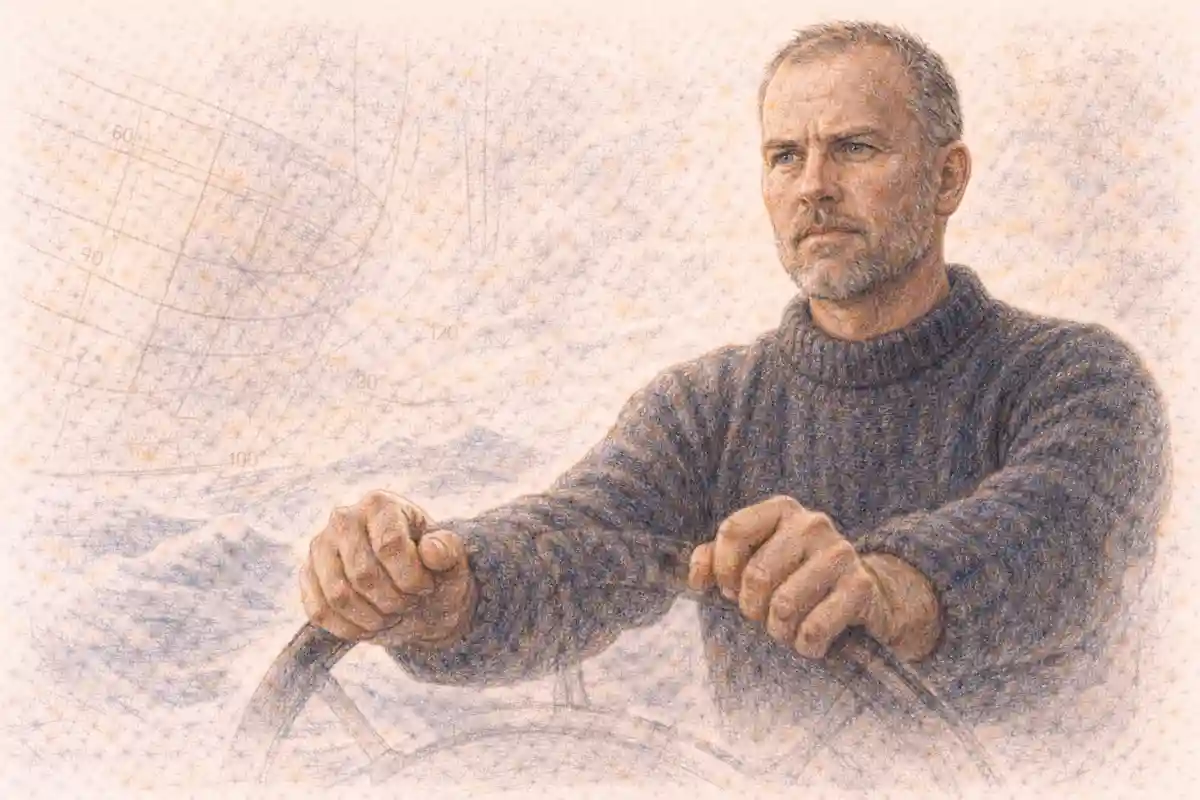
A man stands at a gas pump in a small California town, trying to convince himself that a quiet life can hold. Then a stranger drives into Bridgeport, recognizes him, and the past he buried walks back into the frame. That opening movement is the engine of Out of the Past (1947), Jacques Tourneur’s RKO production with Robert Mitchum as a private detective whose record catches up with him, and it is also the cleanest possible illustration of what the words “film noir” actually mean. The term was not coined in Hollywood. It was applied to American crime pictures by French critics after the Second World War, and the style it named had already been assembled out of German shadow, French fatalism, and American pulp before anyone gave it a label. To ask what film noir is, the most useful single film to stand in front of is this one, because it gathers every recurring marker of the style and lights them with the chiaroscuro that defines the look.
This article owns a deceptively simple question. People do not usually search for a plot summary of Out of the Past; they search for what film noir is, why it carries a French name, who coined the term, what defines the style, and whether noir is a genre at all. Those questions have a single best anchor, and the argument here is that the anchor is not a manifesto, a director’s statement, or a movement’s founding document. There is no founding document. Film noir is the one major body of cinema that was recognized only in retrospect, named by foreigners looking at someone else’s national output, and built from techniques that crossed at least two borders before they settled into an American idiom. The name for that condition, the organizing claim of this piece, is the named hybrid: noir is not a genre but a transnational style, German shadow plus French fatalism plus American crime, recognized and christened only in hindsight by critics who were not American.
The Style That Was Named in Hindsight
Begin with the word, because the word carries the whole strange history. “Film noir” is French for black film, and it was first applied to Hollywood pictures by the critic Nino Frank in 1946. Frank, an Italian-born writer working in Paris, published an article that grouped a handful of American crime dramas under the heading and argued that something new had appeared in them. He was almost certainly borrowing from the Serie noire, the French publishing imprint founded in 1945 that printed translated American hardboiled fiction under uniform black covers. A fellow critic, Jean-Pierre Chartier, wrote a parallel piece the same year. Neither man was describing a Hollywood category that Hollywood acknowledged. American studio professionals of the period did not call these films noir, did not think of them as a unified group, and frequently filed them under the loose commercial label of melodrama.
The films that prompted the naming reached French screens in a compressed burst. During the German occupation, American movies were banned in France, so the backlog of wartime Hollywood production arrived all at once in the summer of 1946. A French critic could sit through several years of American output in a few weeks and notice a tone that an American moviegoer, seeing one picture at a time across the same span, might never have isolated. The films that Frank and Chartier pointed to included John Huston’s The Maltese Falcon, Otto Preminger’s Laura, Edward Dmytryk’s Murder, My Sweet, Billy Wilder’s Double Indemnity, and Fritz Lang’s The Woman in the Window. The pattern they saw was darkness of mood as much as darkness of image: cynical protagonists, sexual motivation, moral ambiguity, and a pessimism that ran against the grain of the studio system’s official optimism.
Who actually coined the term film noir?
The French critic Nino Frank coined “film noir” in 1946, writing in Paris and almost certainly drawing the phrase from the Serie noire crime-fiction imprint. Jean-Pierre Chartier published a parallel article the same year. Neither described a category Hollywood recognized; the American industry did not adopt the label, and critics defined the group retrospectively.
The retrospective character matters more than it first appears. The term sat largely dormant for years before the critics Raymond Borde and Etienne Chaumeton gave it a fuller theoretical life in their 1955 study of American film noir, and it did not become standard critical and popular vocabulary until the 1970s, when a younger generation, including the writer and future filmmaker Paul Schrader, took it up and traced its sources. By the time the word was common currency, the classic cycle it described was effectively over. This is the first thing that separates noir from a conventional movement. The Italian neorealists wrote about neorealism while they were making it. The French New Wave announced itself in print and then shot its films. Noir was named by outsiders after the fact, and the people who made its defining works mostly did not know they were making noir. Out of the Past arrived in 1947, in the middle of the cycle and a year after Frank’s article, and its director and cinematographer were not consciously executing a named program. They were making an RKO crime picture with the visual and moral instincts the studio’s house style had already absorbed.
What Actually Defines a Film Noir
If there is no manifesto, the definition has to be built from the recurring markers, and the markers fall into three groups: visual, narrative, and thematic. None is individually unique to noir. What is distinctive is the combination, the consistency, and the mood that binds them.
The visual signature is low-key, high-contrast black-and-white photography, the technique called chiaroscuro after the painterly tradition of strong light against deep dark. Faces are half-lit; rooms are carved into pools of brightness and blocks of shadow; light arrives in hard slats through venetian blinds, in single overhead bulbs, in the glow of a cigarette. The frame is often unbalanced, shot from low or canted angles, with foreground objects looming and wet streets throwing back reflected light. This vocabulary did not originate in American crime film. It was imported, and the import is half the story of the style.
The narrative signature is structural rather than merely atmospheric. Noir favors the flashback and the voice-over, the protagonist narrating his own undoing from a point at which the outcome is already fixed. It favors convoluted plotting, double-crosses, investigations that turn back on the investigator. The chronology is frequently scrambled so that the audience experiences the past as a trap the present cannot escape. The form tells you the ending is sealed and then makes you watch the character walk toward it.
The thematic signature is fatalism and corruption. The noir protagonist is rarely a hero in the older sense. He is compromised, often a professional operating with a private code in a world that has none, and he is frequently doomed. Sexual desire is a motor and a danger; the femme fatale, the woman whose attraction draws the man toward ruin, is the recurring figure of that danger. The moral universe is gray. Institutions are corrupt or indifferent. The individual is small against forces, social and psychological and simply unlucky, that he cannot master.
What visual techniques define the film noir look?
The defining visual technique is low-key chiaroscuro lighting: high contrast between hard light and deep shadow, faces half-obscured, slatted light through blinds, canted angles, and reflective wet streets. The look descends from German Expressionist cinematography, carried into Hollywood by emigre directors and cameramen who had trained in that tradition before fleeing Europe.
These markers are why the style resists being filed as a simple genre. A Western is defined by setting and iconography you can photograph: the frontier, the horse, the gun, the saloon. A musical is defined by a formal element you can point to: characters sing. Noir has no fixed setting (it moves from city apartment to desert road to mountain town), no fixed plot (heist, investigation, wrong-man chase, doomed romance all qualify), and no single formal device. What holds it together is a sensibility expressed through a look. That is closer to a style or a mood than to a genre in the textbook sense, and the debate over which word fits has run among scholars for decades. The position defended later in this article is that noir is best understood as a transnational style, and Out of the Past is the film that makes the case most efficiently because it carries every marker at full strength.
Out of the Past as the Purest Distillation
Out of the Past earns its standing as the textbook example because it does not merely include the markers; it concentrates them. Tourneur directed from a screenplay by Daniel Mainwaring, writing under the name Geoffrey Homes and adapting his own novel Build My Gallows High, with uncredited revision work folded in. The photography is by Nicholas Musuraca, the Italian-born cinematographer who had helped fix the RKO look on the Val Lewton horror unit, where Tourneur made Cat People and I Walked with a Zombie. The two men had worked together before, and the partnership shows in a film that treats darkness not as a deficiency of light but as a positive substance, a thing the frame is made of.
Consider the structure first. The film opens in the bright, ordinary present: Jeff Bailey runs a gas station in a mountain town, courts a local woman, and seems to belong to the daylight world. Then a man from his old life appears, and Jeff drives through the night to face Whit Sterling, the racketeer played by Kirk Douglas, who once employed him. On that drive he narrates his past in flashback to the woman who loves him, and the film slides into the shadowed world that is its true home. The flashback is the noir narrative device working at full power: the present is a thin shell over a buried history, and the act of telling the story is the act of being pulled back into it. Jeff was hired to find Kathie Moffat, played by Jane Greer, the woman who shot Whit and ran with his money. He found her in Mexico, fell for her, tried to disappear with her, and was betrayed. The doomed structure is announced by the form before any single plot turn confirms it.
Consider then the figures. Mitchum’s Jeff is the noir protagonist in his purest form, a man with a code and no illusions, heavy-lidded and fatalistic, certain that his past will collect what it is owed. Greer’s Kathie is the femme fatale who is not a stock seductress but a genuinely unreadable threat, capable of warmth and of murder in the same scene, and the film never lets the audience be sure of her until it is too late. Douglas’s Whit is corruption with a smile, the powerful man for whom violence is administrative. Around them, Musuraca builds a world where light itself seems to take sides. In the famous scenes between Mitchum and Douglas, smoke from their cigarettes hangs visible in the air between them, lit so that the haze becomes a third presence in the room, a sublimated fencing match conducted in exhaled clouds.
Why is Out of the Past considered the definitive film noir?
It is considered definitive because it concentrates every marker of the style at full strength: the doomed antihero, the unreadable femme fatale, the flashback structure, the fatalistic plot, and Nicholas Musuraca’s chiaroscuro photography. No other single film gathers the visual, narrative, and thematic signatures of noir as completely, which is why teachers reach for it first.
The fatalism is built into the ending, which the film earns rather than imposes. Jeff cannot escape Kathie or his own history; the two are finally the same trap. The resolution is bleak in the manner the style requires, a closing of accounts rather than a rescue. What makes the bleakness land is that the film has been telling you from the first flashback that the outcome is fixed. The pleasure of Out of the Past, and the reason it teaches the style so well, is that it lets you watch a man who knows he is doomed move with grace toward the doom anyway. That combination of foreknowledge and helplessness is the emotional core of noir, and the structure delivers it without a single wasted scene.
Reading the Craft Scene by Scene
A definition built only from abstract markers stays abstract. The way to feel why Out of the Past teaches the style is to watch how specific sequences execute the principles, because the film keeps making the same argument in different registers, and each sequence shows a different facet of the craft.
Take the opening, before any flashback. The first images belong to daylight and to an ordinary America: a quiet mountain town, a fishing trip, a gas station, a deaf-mute boy who works for Jeff. Tourneur establishes a world of even light and open air precisely so that the descent into shadow will register as a fall. The arrival of Joe Stefanos, Whit’s man, is the moment the daylight cracks, and the film signals the danger less through dialogue than through the way the ordinary surfaces begin to feel exposed. Noir often works this way, by making safety feel provisional, and the contrast between the bright present and the dark past is built into the structure from the first reel.
The night drive that launches the flashback is the formal heart of the picture. Jeff drives Ann, the woman who loves him, through the dark toward the meeting that will destroy his peace, and as he drives he narrates his history. The choice to deliver the backstory as a confession spoken into the night, with the road unspooling and the past dissolving onto the screen, fuses the two halves of noir narrative, the voice-over and the flashback, into one gesture. The man is literally driving toward his fate while describing how he was first caught. The form tells the audience that the telling and the trap are the same act, and that recognition is the engine of the dread.
How does the flashback structure of Out of the Past work?
Jeff narrates his past in voice-over during a night drive toward the man who once employed him, and the film dissolves into that past as he speaks. The device fuses noir’s two signature narrative tools, voice-over and flashback, so the act of confession becomes the act of being pulled back into the trap, sealing the fatalistic outcome before the plot confirms it.
The Acapulco passages inside the flashback show Musuraca’s other register, because noir is not only darkness. When Jeff first sees Kathie walk out of the sunlight into a cantina, the cinematographer stages an entrance that uses brightness as a lure rather than shadow as a threat. The seduction is shot warm and open, which makes the later darkness colder by contrast. This is a subtle point about the style that the film teaches well: noir controls light as a moral instrument, and the move from the warm Mexican daylight of the courtship to the wet, slatted shadow of the betrayal traces Jeff’s fall in pure photography, without a line of dialogue announcing it.
The cabin sequence, where Kathie kills Jeff’s former partner, is a lesson in noir restraint. Tourneur consistently chooses to de-emphasize the dramatic peak rather than punch it. The killing happens with a withheld camera, the violence registered through reaction and sound rather than a lurid insert, which makes Kathie’s capacity for murder more chilling because it is matter-of-fact. The film treats her ability to kill as a quiet, almost administrative fact, and that refusal to sensationalize is itself a noir value. The style is fatalistic, not melodramatic; it watches catastrophe with a cold eye rather than a gasp.
The scenes between Mitchum and Douglas are where the famous smoke imagery lives, and they demonstrate how noir converts atmosphere into character. Musuraca lights the two men so that their cigarette smoke hangs visible in the air between them, a glowing screen of haze that turns a conversation into a duel. Neither man raises his voice; the menace is entirely in the light, the timing, and the sublimated aggression of the smoking. This is noir as a craft of implication, where the threat is carried by the image and the rhythm rather than spelled out, and it is one of the clearest demonstrations in the cycle of how the visual style does dramatic work that dialogue cannot.
The closing stretch gathers every thread into a single fatalistic motion. Once the flashback has caught up to the present, the film no longer has anywhere to hide its conclusion, and Tourneur lets the trap close with the same cool restraint he has used throughout, refusing to inflate the doom into melodrama. The resolution is a settling of accounts rather than a rescue, and its bleakness lands because the structure has promised it from the first reel. What lingers after the final image is not shock but recognition, the sense that the ending was always there, waiting at the end of the road Jeff was driving down while he told his story. A small grace note involving the deaf-mute boy who works at the gas station closes the film on a note of ambiguous mercy, a last gesture that lets one character keep a private truth, and even that small kindness is shadowed by everything that came before. The ending is the proof that noir’s fatalism is structural, not decorative: the film could not have ended any other way, and the inevitability is the meaning.
The Antihero at the Center
The noir protagonist deserves separate attention, because the figure is one of the style’s genuine innovations and Out of the Past offers the type in an almost ideal form. Classical Hollywood had heroes who were good and villains who were bad, with the moral lines clear. Noir put a different figure at the center: the compromised man who is neither, who operates by a private code in a world that has abandoned codes, and who is frequently doomed by the gap between his decency and his circumstances.
Robert Mitchum’s Jeff Bailey is this figure rendered with unusual economy. Mitchum’s screen presence, heavy-lidded, unhurried, ironic, is itself an argument about the character. He does not perform anxiety; he performs acceptance, the look of a man who has already calculated the odds and knows they are against him. That stillness is the opposite of the striving classical hero, and it carries the noir conviction that the outcome is fixed. When Jeff walks back into Whit’s orbit knowing it is a trap, Mitchum plays it without panic, because panic would imply a belief that the trap could be avoided. The performance embodies fatalism as a manner, a way of standing and speaking, and that is why it reads as definitive.
The code is the crucial nuance. The noir antihero is not amoral; he has a personal ethic that he holds onto precisely because the surrounding world offers none. Jeff lies, gambles, and falls for the wrong woman, but he keeps a private line he will not cross, and his tragedy is that the line is not enough to save him in a rigged game. This is what separates the figure from the simple criminal and from the simple hero. He is a man trying to be decent without illusions, which is harder and sadder than being either good or bad, and it is the moral texture that gives noir its weight. The audience roots for a man it knows is doomed, because his effort to stay himself in a corrupt world is recognizable and moving.
The femme fatale exists in relation to this figure and completes him. If the antihero is the man with a code trying to navigate corruption, the fatale is the force that turns his own desire against him, the point where his appetite becomes the lever of his fall. Kathie is not a generic temptress; she is specifically the thing Jeff cannot resist and cannot read, and the film keeps them locked in a mutual unreadability until the end. The relationship is the engine of the fatalism, because it makes the doom internal as well as external. Jeff is not only trapped by Whit and by his past; he is trapped by what he wants, and that is the deepest kind of noir trap, the one a man builds for himself out of his own longing.
The Visual Grammar Beyond the Lighting
Lighting is the most discussed element of the noir image, but the style is a full grammar of composition, and Out of the Past uses the whole vocabulary. Reducing noir to dark lighting misses how the frame itself is organized to express entrapment, instability, and concealment.
Consider framing and the use of obstruction. Noir loves to shoot characters through, behind, or beside objects that box them in: a doorway that narrows the figure, a banister whose verticals fall across a face like bars, a window whose frame divides the image. The visual message is confinement. The protagonist is caught inside the architecture of the shot before he is caught by the plot. Tourneur composes Jeff repeatedly within frames that enclose him, so that even in open scenes the geometry suggests a closing space. The audience reads the entrapment before it can name it, because the composition has already said it.
Consider depth and the placement of figures in space. Noir frequently stages action in deep compositions where a threat sits in the background or the foreground while the protagonist occupies the middle, so that danger and vulnerability share a single image without a cut. The technique keeps menace present in the frame rather than alternating it with the hero through editing, which sustains tension and implies that the threat is always already there. The style prefers the loaded single shot to the reassuring cut, because the loaded shot carries the noir conviction that the danger is environmental and inescapable rather than something the camera can look away from.
Consider reflective surfaces and the motif of the double. Mirrors, wet streets, glass, and polished metal recur across the cycle, and they are not only beautiful. The reflection doubles the character, suggests duplicity, and visualizes the gap between the face a person shows and the self underneath, which is the central problem of a style built on liars, double-crosses, and concealed pasts. When a noir frames a character against a mirror, it is making a quiet argument about the unreliability of surfaces. Musuraca’s love of reflected and refracted light, the gleam off a road, the haze of lit smoke, belongs to this grammar of surfaces that cannot be trusted.
How does composition create tension in film noir beyond lighting?
Noir composes for entrapment and instability: characters are framed behind bars, banisters, and doorways that box them in; threats are staged in deep focus so danger and vulnerability share one shot without a cut; and reflective surfaces double figures to suggest duplicity. The geometry of the frame expresses confinement and concealment before the plot confirms them.
Consider, finally, camera placement and the canted angle. Noir reaches for low angles that make figures loom and ceilings press down, and for the tilted frame that signals a world knocked off its axis. These choices descend from the Expressionist instinct to externalize psychological disturbance, but noir uses them sparingly enough that they read as unease rather than fantasy. The realist materials hold the stylization in check. The result is a frame that feels slightly wrong, slightly pressured, without tipping into the openly distorted spaces of 1920s German cinema. That balance, expressive geometry inside a realist surface, is one more way the style fuses its European inheritance with its American setting, and it is visible throughout Out of the Past, where the ordinary American spaces, a gas station, a cantina, a cabin, a city apartment, are composed so that something always seems to be pressing in from the edges of the image.
The National-Cinema Conditions That Made It
A style is not only a set of techniques; it is also the product of the conditions that let those techniques flourish. American film noir emerged from a specific convergence of industrial, literary, and historical pressures, and Out of the Past sits at the meeting point of all of them.
The industrial condition was the economics of the studio B-picture. RKO, which produced the film, was a major studio that specialized heavily in modestly budgeted features, and the noir style was perfectly suited to that economy. Low-key lighting is cheaper than high-key lighting; a scene carved out of shadow needs fewer fully dressed sets and fewer fully lit square feet than a bright, even composition. Night exteriors hide the limits of a back lot. The look that reads as artful menace was also, in studio terms, thrifty. Many of the classic noirs were B-films or A-films made with B-film discipline, and that discipline pushed filmmakers toward the expressive shorthand of shadow. Out of the Past was a well-cast picture with names that meant something at the box office, but it carried the visual economy of the form into a production that could afford location work in Mexico and the California mountains, blending the studio’s shadow craft with real exteriors.
The literary condition was American hardboiled crime fiction. The flat, cynical, first-person voice of writers such as Dashiell Hammett, Raymond Chandler, and James M. Cain gave noir its narration, its moral temperature, and many of its plots. The hardboiled detective and the doomed insurance man came from the page before they reached the screen, and the Serie noire that gave the style its eventual French name was an imprint of exactly this fiction in translation. Mainwaring’s source novel for Out of the Past sits squarely in that tradition, which is why the film’s dialogue carries the clipped, fatalistic music of the form. The hardboiled voice is the American half of the hybrid, the contribution that was native rather than imported.
The historical condition was the war and what came after. Noir’s first stirrings predate American entry into the Second World War, but the cycle deepened through the 1940s, and its bleakness is inseparable from the anxieties of the period: returning veterans, social dislocation, a postwar disillusionment that the official culture of victory did not acknowledge. The series The Best Years of Our Lives explored from the daylight side, noir explored from the shadow side, and the two together map the postwar mood. Out of the Past belongs to the moment when the cycle was at its richest, and its theme, a man who cannot outrun what he has done, reads naturally against a culture trying and failing to leave its wartime history behind.
The Hardboiled Voice: The American Ingredient
The European debt explains the look and the fatalism, but it can obscure what was genuinely American in the style, and the American ingredient is the voice. Before noir was a way of lighting a room, it was a way of talking, and that way of talking came from the hardboiled crime fiction that flourished in the United States from the Great Depression onward.
The three writers who matter most each gave the style a different gift. Dashiell Hammett, the former detective who wrote The Maltese Falcon and The Glass Key, supplied the lean, observed surface, prose that reported action and dialogue without entering a character’s head, which translated into the noir detective’s guarded, unsentimental front. Raymond Chandler, who wrote the Philip Marlowe novels, supplied the simile and the moral weariness, a first-person narrator who could turn a description of a hotel lobby into a comment on a corrupt world, and a private eye who kept a personal code in a city that had abandoned its own. James M. Cain, who wrote Double Indemnity and The Postman Always Rings Twice, supplied the doomed engine of desire, the ordinary man who lets a woman and his own appetite pull him into a crime that cannot end well. Between them, these writers built the voice noir would adopt: clipped, cynical, self-aware, and fatalistic.
That voice is why the flashback and the voice-over became structural staples. Hardboiled fiction is frequently first-person, and the screen adaptation kept the narrating voice, which is how so many noirs came to be stories a man tells about his own undoing. The narration is not decoration; it is the literary DNA of the style surfacing in the soundtrack. When Jeff Bailey narrates his past on the night drive, the cadence of his speech, the dry acceptance of doom, is the hardboiled voice made audible. Out of the Past adapts a novel by Daniel Mainwaring that sits inside this tradition, and the film’s dialogue carries the tradition’s music: the wisecrack that hides a wound, the understatement that signals defeat.
The French connection to this fiction is direct and is the reason the style got its name. The Serie noire imprint, founded in Paris in 1945, published exactly this American crime writing in translation under uniform black covers, and Nino Frank almost certainly took the phrase film noir from that imprint when he applied it to Hollywood pictures in 1946. The American voice traveled to France as fiction, acquired a French label, and then the label traveled back to describe the American films the fiction had helped shape. That loop, American writing to French publishing to French criticism to a name for American cinema, is the named hybrid operating in the realm of language as well as image.
The Existential Mood That Felt New
Audiences and critics in the 1940s registered noir as something genuinely new, and the novelty was not only visual. It was moral and philosophical. The classic Hollywood film offered a stable moral universe in which good was identifiable and usually triumphed. Noir offered a world in which the categories had blurred, institutions could not be trusted, and the individual was small against forces he could not control. That mood rhymed with the existential philosophy gaining ground in postwar Europe, the sense of a person thrown into a situation without guarantees, defined by choices made under pressure with no higher order to appeal to.
The noir protagonist embodies that condition. He is not a villain and not a conventional hero; he is a compromised man trying to act decently, or at least according to a private code, in a corrupt and indifferent world. His freedom is real but nearly useless, because the situation is rigged and the past is closing in. Jeff Bailey is a clean case study. He makes genuine choices, to take the job, to fall for Kathie, to try to leave, to come back, and every choice tightens the net. The film grants him agency and then shows that agency cannot save him, which is precisely the existential predicament rendered as crime drama. The fatalism is not the absence of choice; it is the futility of choice against a fixed outcome.
This is also why the femme fatale carries philosophical weight rather than mere titillation. She is the figure through whom desire becomes destiny, the point at which the protagonist’s own appetite becomes the instrument of his fall. Kathie is unreadable on purpose, because the film needs the audience to share Jeff’s inability to know whether his desire is leading him toward salvation or destruction. The unreadability is the existential uncertainty made flesh. When the film finally resolves who she is, the resolution is also the closing of the trap, and the two cannot be separated. That fusion of desire, knowledge, and doom is the deepest reason Out of the Past feels like more than a crime picture. It is a fatalist argument with a femme fatale at its center, and it felt new because the American screen had rarely been that cold about the limits of the will.
Is Noir a Genre, a Movement, or a Mood?
This is the live scholarly dispute, and any honest account of what film noir is has to engage it rather than glide past it. The case for each term is real.
The case for genre rests on family resemblance. Noir films share characters (the detective, the fatale, the small-time loser), settings (the nocturnal city), and a recurring plot machinery of crime and investigation. Audiences and video stores and streaming menus treat noir as a category they can browse, which is functionally how genres behave. If a genre is simply a group of films that share enough conventions to set audience expectations, noir qualifies.
The case against genre, and for style or movement, rests on the exceptions and the origins. The settings are not fixed; the plots are not fixed; the period is bounded in a way genres usually are not, since the classic cycle runs roughly from the early 1940s to the late 1950s and then gives way to neo-noir. Above all, the unifying element is a visual and tonal sensibility rather than a content category, and that sensibility was named retrospectively by critics rather than established as a production category by an industry. A genre is usually something filmmakers set out to make. Noir is something critics discovered had been made.
Is film noir a genre or a style?
The strongest position is that noir is a transnational style, not a genre. Its unifying element is a visual and tonal sensibility, chiaroscuro lighting and fatalistic mood, rather than a fixed setting or plot. It was named retrospectively by French critics, not built as a production category, and it spans crime stories of many kinds, which is closer to style than to genre.
The defended position here treats noir as a style with movement-like coherence, and the reason is precisely its transnational construction. A genre tends to grow inside one national tradition and stay there until it is exported. Noir was assembled from at least three traditions before it was named by a fourth observer, the French critic looking at American film. Calling it a genre flattens that history; calling it a style preserves it. The word “mood” captures the tonal truth but undersells the concrete technique. The most accurate compromise is that noir is a style, expressed through a specific craft of light and structure, that achieved enough consistency across a defined period to function like a movement, even though no one inside it organized it as one. Out of the Past is the proof object for that compromise because it is unmistakably noir on every axis while belonging to no narrower genre than crime, and it could not have been built without the European techniques that the next sections trace.
The Critics Who Built the Category
Because noir was named in hindsight, its definition is partly a history of criticism, and understanding the style means understanding the writers who assembled the category after the films existed. The story did not end with Nino Frank’s 1946 article. Frank and Jean-Pierre Chartier opened the conversation by noticing a pattern, but they did not yet have a theory of it. The first sustained attempt to map the territory came in 1955, when Raymond Borde and Etienne Chaumeton published a book-length panorama of American film noir. They treated it as a coherent object of study, catalogued its films, and argued for the qualities that bound them, and their work is the reason the term acquired intellectual weight rather than remaining a passing label.
The category then crossed back into English-language criticism over the following years and reached a wider readership in the 1970s, when a generation of American critics and filmmakers took it up. Among the most influential statements was an essay by Paul Schrader, written in 1972, that traced the style to a tangle of sources at home and abroad, German Expressionism, hardboiled fiction, French influence, and the hard postwar mood, and tried to periodize the cycle into phases. Schrader’s account is notable for an argument this article shares: that noir is defined more by tone and style than by the content categories that define a genre. He treated noir as a specific period and sensibility rather than a permanent kind of story, which is the position the films themselves support.
The critical history carries a lesson about the style’s nature. A genre that an industry produces deliberately does not need to be discovered; it is announced by its makers and marketed to its audience. Noir had to be discovered, argued into existence, and periodized by critics working after the fact, first in France and later in the English-speaking world. The very shape of its scholarship, foreign critics first, theory second, popular adoption last and decades late, is evidence for the transnational, retrospective character of the thing. Out of the Past was made in the middle of this process, before most of the theory existed, which is exactly why it is so useful as evidence: it is a pure specimen formed before the category that describes it had hardened, an organism that grew before anyone named the species.
There is a further consequence worth naming. Because the boundaries were drawn retrospectively, the edges of noir are genuinely contested. Some writers extend the term backward to proto-noirs of the 1930s and outward to films that share the mood without the crime plot; others restrict it tightly to a core of urban crime dramas in the classic period. This fuzziness is not a flaw in the definition but a feature of how the category was built. A style recognized after the fact will always have soft edges, because no production office ever set the rules. What gives the term its usefulness is its center, not its border, and the center is occupied by films that carry every marker at once. That is the practical reason Out of the Past anchors the definition: whatever the arguments about the edges, no one disputes that this film sits at the dead center of the style.
The German Shadow: Expressionism and Its Emigres
The visual half of noir came from Germany, and it came in person. German Expressionist cinema of the 1920s, the movement of The Cabinet of Dr. Caligari (1920) and Fritz Lang’s M (1931), built a vocabulary of distorted space, stark high-contrast lighting, looming shadow, and subjective camera that externalized psychological states. The Expressionists used darkness to render dread and instability, treating the image as a map of a disturbed mind rather than a window on a stable world.
That vocabulary crossed the Atlantic with the people who had made it. As the Nazis took power, a wave of German and Central European filmmakers emigrated to Hollywood, and a remarkable number of them became central to noir. Fritz Lang, already a master of fatalism and the criminal web in M and the Dr. Mabuse films, directed American pictures, including The Woman in the Window, one of the films Nino Frank pointed to when he coined the term. Robert Siodmak, who had cut his teeth in Berlin, became one of noir’s defining directors with The Killers and Criss Cross. Billy Wilder, a Berlin screenwriter before he was a Hollywood director, made Double Indemnity, the film whose venetian-blind shadows and confessional structure became a template; the analysis of how that screenplay builds its trap belongs to the dedicated study of Double Indemnity and the noir screenplay, and the structural lessons there run parallel to the flashback architecture of Out of the Past. Edgar G. Ulmer, who had worked as a set designer under F. W. Murnau, carried the Expressionist training into the lowest-budget end of the form with Detour.
The line into Out of the Past runs through this milieu even though Tourneur was French rather than German. The RKO house style that Musuraca helped build had absorbed the Expressionist lesson that shadow is expressive, that a face emerging from black carries more menace than a face evenly lit. When Musuraca lights Mitchum and Douglas so that the smoke between them glows and the rest of the room falls away, he is using a German inheritance in an American crime film, which is exactly the cross-border transfer the named-hybrid claim describes. The shadow is German; the cigarettes and the gas station are American. The image of noir is a graft.
To see how concrete the German inheritance is, look at the techniques themselves rather than the biographies. Expressionist cinema treated the set and the lighting as projections of a character’s inner state. A staircase could be warped, a shadow could be painted onto a wall, a corridor could narrow into a trap, and the effect was to make the external world a diagram of psychological disturbance. Noir kept the principle and dropped the overt stylization. Instead of painted shadows and warped sets, it used real lamps, real venetian blinds, and real night, but the goal was the same: to make the environment express the protagonist’s moral and emotional condition. The slatted light that falls across a noir face like the bars of a cell is the Expressionist instinct rendered in the realist materials of the American studio.
The emigre cinematographers carried this knowledge as craft, not theory. Cameramen trained in or influenced by the German tradition brought a mastery of high-contrast lighting and expressive composition that became the technical backbone of the cycle. The look could be executed because the people who knew how to execute it had arrived, and studios such as RKO built house styles around that expertise. Musuraca, Italian-born rather than German but formed in the same shadow-conscious craft culture, is part of this story. When he models a face out of darkness or throws a single hard light into a room, he is practicing a discipline that descends from the Expressionist understanding that light is meaning, not merely illumination.
The thematic side of the German debt matters too. Fritz Lang’s German films, especially M, were studies in fatalism and the criminal psyche, in the way a city becomes a web and an individual becomes prey. When Lang transplanted that sensibility into American pictures, he was not only importing a look but a worldview, the sense that forces larger than the individual are closing in. That worldview meshed perfectly with the American hardboiled fatalism and the postwar mood, which is why the German and the American halves of noir fused so seamlessly. They were already saying compatible things about the smallness of the individual; the Germans said it in shadow and the Americans said it in slang.
The French Fatalism: Poetic Realism and the Trapped Man
The thematic half of noir, the fatalism, has a French parent that predates the American cycle: poetic realism, the French film movement of the 1930s. Films such as Marcel Carne’s Le Jour se leve (1939) and Jean Renoir’s La Bete humaine (1938) built moody, atmospheric portraits of working-class characters trapped by fate and their own flaws, frequently in nocturnal urban settings, frequently ending in doom. Jean Gabin, the great star of the movement, specialized in the doomed everyman, the decent figure caught in a closing net. The look of these films, contrasting bands of darkness and light, the gleam off wet surfaces and metal, the menacing yet poetic atmosphere, anticipates the noir image, and some of it was achieved by emigre technicians moving in the opposite direction, German cameramen working in France.
The kinship is so close that the French critics who later named American noir were in part recognizing something they had already produced. When poetic realism portrayed a man boxed in by his past and his desire, with no exit but death, it laid down the fatalistic template that American noir would inherit and harden. The difference is one of texture. French poetic realism is mournful and romantic about its doom; its trapped men are objects of pity and lyricism. American noir is colder, more cynical, more interested in the mechanics of the double-cross and the corruption of institutions. The French film grieves for the trapped man; the American film watches him with a wry, unsentimental eye and lets him narrate his own demise.
Out of the Past sits exactly on this inheritance. Jeff Bailey is a poetic-realist hero in noir clothing: a man who tried to step out of the net, found love, and discovered that the net was never gone. The flashback that pulls him from the daylight town back into the shadowed past is precisely the structure of fatalism the French movement had developed, now executed with American hardboiled dialogue and a cynicism the French films lacked. The European craft variant of this same shadow style, filtered through postwar Vienna, is the subject of the study of The Third Man and its noir cinematography, where a British production and an American star inherit the same chiaroscuro and the same moral ambiguity from the same European sources. Read across those films, the pattern is consistent: the technique and the fatalism are European; the crime, the voice, and the wry cold eye are American.
It is worth being concrete about what poetic realism actually did, because the parallels to noir are structural and not vague. The movement’s films often built toward a fixed, doomed ending and then used flashback to explain how the trap was set, a structure that Le Jour se leve deploys with particular clarity: a man barricaded in a room, the police outside, the catastrophe already complete, the past returning in fragments to show how he arrived there. That architecture, an ending known from the start and a past unspooled to explain it, is the same architecture Out of the Past uses on its night drive. The French movement had worked out how to make fatalism a narrative shape, and noir inherited the shape.
The Gabin persona is the human core of the inheritance. The great star of poetic realism specialized in the decent working man with a flaw, caught in a situation that would not release him, doomed but sympathetic. That figure is the direct ancestor of the noir protagonist, the compromised man with a code who cannot escape his fate. The difference, again, is temperature. The French film treats its trapped man with lyricism and pity; the camera mourns him. The American film treats its trapped man with a dry, ironic distance; the camera watches him with something closer to a shrug. Jeff Bailey would be a tragic lyrical hero in a French film of the 1930s. In an American film of 1947 he is a cool customer narrating his own destruction with a half-smile, and that tonal shift, from lament to irony, is the Americanization of the European inheritance.
The visual kinship sealed the relationship. Poetic realism favored nocturnal, atmospheric images, wet streets, fog, light reflecting off metal and water, a menacing yet poetic darkness, and some of those images were achieved by emigre technicians moving between national industries, the same pool of European craft that would later feed Hollywood. The shadow style was already crossing borders within Europe before it reached America. By the time noir cohered, the look had passed through German studios and French ones and arrived in Hollywood as a shared European inheritance, which is one more reason the style cannot be assigned to a single national tradition. It was transnational at the level of the people holding the cameras.
The Opposite Path: Italian Neorealism
To see what noir is, it helps to see clearly what it is not, and the sharpest contrast among the postwar movements is Italian neorealism. At almost the same moment that American noir reached its richest phase, Italian filmmakers, including Roberto Rossellini with Rome, Open City (1945) and Vittorio De Sica with Bicycle Thieves (1948), were building a movement that pointed in the opposite aesthetic and moral direction.
Neorealism took to the streets in daylight, used nonprofessional actors and real locations, and aimed at social truth about ordinary people under economic and political pressure. Its light is the available light of actual streets, not the sculpted shadow of a studio stage. Its concern is the collective and the social, the conditions of postwar poverty and survival, rather than the doomed individual locked in a private moral maze. Where noir is nocturnal, stylized, fatalistic, and individual, neorealism is diurnal, documentary in impulse, hopeful or at least morally engaged, and social.
The contrast clarifies the named-hybrid claim. Both movements are postwar responses to dislocation, both born of the same global moment, yet they diverge completely in method and meaning. Neorealism is a national movement in the classic sense: organized in part by its makers, theorized as it happened, rooted in Italian conditions and Italian streets. Noir is the transnational style with no national home, assembled from German technique and French fatalism and American fiction, named by French critics, and expressed through a craft of shadow that neorealism explicitly rejected. Set side by side, neorealism is what a self-aware national movement looks like, and noir is what a retrospectively recognized transnational style looks like. Out of the Past, with its sculpted darkness and its solitary doomed man, stands at the farthest possible distance from the sunlit social conscience of Bicycle Thieves, and the distance is the point.
The comparison also clarifies a question about realism that often confuses discussions of noir. Both movements claimed a kind of truth, but they meant opposite things by it. Neorealism pursued documentary truth, the actual textures of poverty and the actual faces of nonactors, and it built its authority on fidelity to the surface of real life. Noir pursued psychological and moral truth, the inner darkness of desire, guilt, and doom, and it was willing to stylize the surface heavily, with sculpted shadow and heightened atmosphere, in order to reach it. One movement said the truth is in the streets as they are; the other said the truth is in the shadows of the mind, and the streets must be lit to reveal them. Both are serious artistic positions, and the fact that they emerged at the same postwar moment in different national contexts shows how a single historical pressure can produce opposite aesthetic answers.
There is one more instructive contrast in how the two movements were named and theorized. Neorealism was discussed by its makers and its national critics as it happened; it had spokesmen and something close to a program. Noir had neither until foreign critics built the category afterward. This difference in self-consciousness is not incidental. It reflects the deeper truth that neorealism was a deliberate national movement and noir was an unplanned transnational style that accumulated before anyone stood back far enough to see it whole. The Italian filmmakers knew what they were doing and said so; the noir filmmakers were following studio instincts and inherited European craft without a unifying name. To define noir is therefore always partly to reconstruct something its own makers did not articulate, which is exactly why a representative specimen like Out of the Past is more useful than any manifesto, because there is no manifesto to consult.
How the Style Crossed Borders Again
A style assembled across borders does not stay put, and the final piece of noir’s transnational story is the way it traveled outward after the classic cycle ended, which is itself evidence of how portable a style rather than a genre can be. The markers that Out of the Past concentrates proved detachable from their original time and place, and they reappeared in new contexts that adapted the sensibility to their own purposes.
The most immediate return was to France. The young critics who would become the French New Wave revered American crime cinema, and when they began directing they carried noir’s fatalism, its compromised antiheroes, and its love of the nocturnal city into their own films, paying open homage to the Hollywood pictures that the previous French generation had named. The style that French critics had labeled came back to France as a living influence on French filmmaking, completing a circuit that had run from German shadow through French fatalism to American crime to French naming and now to French practice. Few bodies of cinema have crossed the same borders so many times in so many directions.
The later return within the United States was neo-noir, the term for films made after the classic period that revive noir’s themes and visual language with updated content, color photography, and contemporary settings. Neo-noir is proof that the original style was a sensibility rather than a fixed genre, because a sensibility can be revived in new materials while a genre tends to evolve continuously rather than be deliberately resurrected. The fact that filmmakers consciously returned to noir, rather than simply continuing it, shows that the classic cycle was understood as a bounded style with a recognizable identity that could be quoted, honored, and reworked.
Beyond France and Hollywood, the noir sensibility seeped into thrillers, crime films, and science fiction around the world, wherever filmmakers wanted to render a corrupt environment, a doomed protagonist, and a morally gray universe through expressive shadow. Because the style was a graft to begin with, assembled from techniques that had already crossed borders, it carried no single national accent that would resist translation. It was, from birth, an international language of shadow and fatalism, which is why it became one of the most widely inherited sensibilities in the medium. Out of the Past stands at the center of that language, the clearest single statement of a grammar that the rest of world cinema would go on to borrow.
The Named Hybrid: What the Comparison Proves
Put the three European relations together and the structure of the style becomes legible. The German Expressionists supplied the shadow, the visual technique of dread carried to Hollywood by emigres. The French poetic realists supplied the fatalism, the doomed man trapped by his past, which the French critics would later recognize in American film because they had helped invent it. American hardboiled fiction supplied the voice, the cynicism, and the crime plots, the one native ingredient. The French critics supplied the name, applied in hindsight to films Hollywood did not know it had grouped. No single nation built film noir. It is the great transnational graft of twentieth-century cinema, and that is why it resists every attempt to file it as one country’s genre.
That argument is easiest to hold in the mind as a framework, so the findable artifact for this article is a map of the markers, their sources, and how Out of the Past carries each one.
| Marker of film noir | Where it came from | How Out of the Past carries it |
|---|---|---|
| Low-key chiaroscuro lighting | German Expressionism, via emigre directors and cameramen | Musuraca sculpts faces from shadow; smoke glows between Mitchum and Douglas |
| Doomed, fatalistic protagonist | French poetic realism, the trapped man of Carne and Renoir | Jeff Bailey knows his past will collect; the flashback seals the ending |
| Femme fatale | Hardboiled fiction and the older vamp tradition, hardened | Kathie Moffat is unreadable, capable of warmth and murder at once |
| Flashback and voice-over structure | Hardboiled first-person narration | Jeff narrates his past on the night drive back into it |
| Cynicism and institutional corruption | American crime fiction and postwar disillusionment | Whit Sterling treats violence as administration; no institution helps |
| The name “film noir” | French critics, Nino Frank in 1946, from the Serie noire imprint | Applied retrospectively; Tourneur and Musuraca never used the term |
The namable claim, the named hybrid, is the spine of that table. Noir is not a genre but a transnational style: German shadow plus French fatalism plus American crime, recognized and christened only in hindsight by foreign critics. Out of the Past is the proof object because it carries every row at full strength while belonging to no narrower genre than crime, and because its own making, a French-descended director and an Italian-born cinematographer building an American crime picture from a hardboiled novel, literally enacts the hybrid on the production sheet. The starting point of the cycle this film distills, the picture most often called the first true noir, is the subject of the study of The Maltese Falcon and its influence on the form, and reading the two together gives a clean before-and-after of how the style cohered.
Clearing the Common Confusions
Because noir was named after the fact and has soft edges, several persistent misconceptions cluster around it, and clearing them sharpens the definition that Out of the Past anchors. Each confusion mistakes one feature of the style for the whole.
The first confusion is that any dark or violent crime film is noir. It is not. A film can be a crime film without being noir, and a film can be noir without being primarily about crime. The defining element is the sensibility, the fatalistic mood and the chiaroscuro vision, not the presence of a gun or a corpse. A brightly lit, morally clear thriller with a triumphant hero is not noir no matter how much violence it contains, while a shadowed, doomed, morally gray drama may be noir even where the crime is incidental. Reducing the style to its crime content misses the point that noir is a way of seeing, not a category of plot.
The second confusion is that noir is simply German Expressionism in America. The German debt is real and large, but it is the visual half of the story, and treating it as the whole erases the French fatalism and the American hardboiled voice that are equally essential. Noir is not transplanted Expressionism; it is a fusion in which the Expressionist look meets a fatalism with French roots and a cynicism with American ones. The graft is the thing. To call noir German is as partial as to call it American, and the truth is that it is neither and both, a transnational compound that belongs fully to no single tradition.
The third confusion is that noir is a tightly bounded genre with firm rules. The category has a clear center and fuzzy edges, and the fuzziness is structural rather than a failure of definition. Because no production office ever set the rules, the boundaries were drawn by critics working backward, and reasonable critics disagree about which marginal films qualify. The useful move is to define the style by its center, the films that carry every marker at once, rather than by litigating its borders. This is precisely why a representative specimen does the defining work that no rulebook can: the center of the category is occupied by films like Out of the Past, and the meaning of the term lives there.
The fourth confusion is that noir requires a private detective. The detective is one recurring figure, fixed early by the hardboiled tradition, but the style accommodates many protagonists: the doomed insurance man, the drifter, the veteran, the small-time loser, the man with a buried past. Jeff Bailey is a former private investigator, but his story is not a detective case; it is a fatalistic romance and a reckoning with his own history. The protagonist of noir is defined by his moral position, compromised, coded, doomed, rather than by his profession, and insisting on the detective narrows the style to one of its variants.
The fifth confusion is that noir is purely a matter of style with no substance, a look without a worldview. The opposite is true. The look exists to carry a worldview, the conviction that institutions are corrupt, that desire is dangerous, that the individual is small against forces he cannot master, and that the past collects what it is owed. The shadow is not decoration; it is the argument made visible. Out of the Past is the clearest demonstration that the style and the substance are inseparable, because its fatalism is built entirely out of its craft, the flashback that seals the ending, the light that models the doom, the femme fatale who is unreadable on purpose. Strip the style and the worldview would have no body; the body is how the worldview is felt.
Why Out of the Past and Not Another Film
If the goal is to define film noir, several films could plausibly serve as the anchor, and it sharpens the argument to say why this one wins the role. The chief rivals are the films that opened or refined the cycle, and each has a strong claim on a particular axis.
The Maltese Falcon has the claim of priority. It is the picture most often called the first true noir, the film that fixed the hardboiled private eye as a wary professional navigating universal corruption, and the work that launched the cycle and made its leading archetype legible. Its strength is historical primacy, and that primacy is exactly why it owns the question of where noir began rather than what noir is; the dedicated study of The Maltese Falcon and its influence carries that part of the story. But priority is not the same as completeness. The Huston film is lighter on the fatalistic structure and the doomed romance than the fully developed cycle would become, because it is the beginning, and a beginning by definition does not yet contain everything the form will discover.
Double Indemnity has the claim of structural perfection. Its confessional flashback, its venetian-blind shadows, and its airtight screenplay make it perhaps the most precisely engineered noir of all, and its architecture became a template that later films, including Out of the Past, clearly absorbed; the structural breakdown belongs to the study of Double Indemnity and the noir screenplay. Its strength is the screenplay, which is why it owns the question of noir narrative construction. But its very perfection makes it slightly atypical, a peak rather than a center. It is the most polished example, not the most representative one, and to define a style you want the representative case, not the outlier of excellence.
The Third Man has the claim of visual fame, its tilted angles and its sewer chase among the most reproduced images in the cycle, and it carries the European craft of noir back to a literal European setting; that thread runs through the study of The Third Man and its noir cinematography. But it is a British production set in Vienna, a hybrid even by noir standards, and its singular visual signature makes it a brilliant variant rather than a baseline. It teaches what noir could become at its most stylized, not what noir is at its most typical.
Out of the Past wins the anchoring role on the axis that matters most for definition, which is representativeness. It is not the first, not the most influential, not the most structurally perfect, and not the most visually singular. It is the most complete and the most typical, the film in which every marker appears at full strength and in balance: the doomed antihero, the unreadable fatale, the flashback fused with voice-over, the institutional corruption, the chiaroscuro, and the fatalistic ending, with no single element so dominant that it distorts the picture of the whole. When the question is what the style is rather than where it started or how high it could climb, the representative specimen beats the record-holder, and Out of the Past is the representative specimen.
The Postwar Mood the Style Registered
A style this consistent does not appear by accident, and the deepest condition behind noir is the mood of the years that produced it. The cycle’s bleakness is inseparable from the disillusionment that followed the Second World War, even though its first stirrings predate American entry into the conflict. Victory did not erase the anxieties of returning soldiers, the dislocations of a society retooling from war to peace, the new fears of the atomic age, or the quieter unease about what the war had revealed of human capacity. The official culture celebrated; noir registered the shadow side of the same moment.
The film The Best Years of Our Lives approached the postwar adjustment from the daylight, treating the difficult homecoming of veterans with sympathy and social realism, and reading it against the noir cycle shows the two faces of one cultural moment. Where that film looks at the returning soldier and asks how he will rebuild, noir looks at the same society and sees corruption, betrayal, and a past that cannot be escaped. Both are true responses to 1946 and 1947; they simply face opposite directions, one toward repair and one toward reckoning. Out of the Past, with its theme of a man who cannot leave his history behind no matter how clean a new life he builds, reads naturally as a fable of a culture trying and failing to put its wartime past behind it.
The femme fatale carries a piece of this historical charge as well. During the war, women had entered the workforce and gained an independence that the postwar order sought to reverse, and the noir fatale, the independent, dangerous, sexually autonomous woman who threatens the male protagonist, can be read as one expression of the anxiety around that shift. This is interpretation rather than fact, and the films do not announce it, but the recurrence of the figure across the cycle at exactly this historical moment is hard to read as coincidence. Kathie Moffat is dangerous precisely because she is autonomous, unowned, and unreadable, and the film’s inability to control her until the final reckoning channels a broader unease that the period felt and rarely spoke aloud.
To call noir a cultural document is not to reduce it to its conditions. The style outlived the specific anxieties that fed it and traveled to other eras and other countries, which is why it became one of the most widely inherited sensibilities in cinema. But the original charge came from a real historical pressure, and Out of the Past carries that charge in its bones. The man at the gas station who thought he had escaped, and learns that escape was never possible, is a private story that also reads as the secret feeling of a triumphant nation that could not quite believe its own good news. That double reading, intimate and historical at once, is part of why the film keeps repaying study, and it is one more reason the picture sits so comfortably at the center of the style rather than at its edge.
Where Out of the Past Stands
The verdict on the film’s movement standing is direct: Out of the Past is the textbook film noir because it is the most complete single demonstration of the style, and the style is the most important thing about it. Other noirs do individual things more sharply. Double Indemnity builds a tighter screenplay; The Third Man achieves a more famous single visual coup; The Maltese Falcon fixed the private-eye archetype first. But no other film of the cycle gathers the full set of markers, visual, narrative, and thematic, with the even concentration that Out of the Past manages. It is not the first noir, not the most influential, and not the most experimental. It is the most representative, and representativeness is exactly the quality a teacher, a student, or a researcher needs from an anchor. When the question is what film noir is, this is the film to project on the wall, because everything the term means is present in it at once.
That standing also explains why the film keeps anchoring film-studies syllabi long after the cycle ended. It is legible without being simple, complete without being a checklist, and it carries its European inheritances visibly enough that a single screening can teach the transnational history the style embodies. The fatalism is not a footnote to the craft; the craft is how the fatalism is built, and the comparison to the European parents is not an afterthought but the explanation of where the craft and the fatalism came from. A reader who wants to keep building on that comparison, organizing the noir cycle, tracking the emigre directors across films, and assembling the European sources alongside the American ones, can save and annotate this analysis and build your own watchlist free on VaultBook and build a study guide and reference set on ReportMedic, turning a single viewing into a mapped study of the whole transnational style.
The lasting value of Out of the Past is that it makes an argument about cinema simply by existing. It shows that a national style need not be national in origin, that a movement can be recognized only after it is finished, and that the most American of forms can be a graft of European techniques named by European critics. The man at the gas pump who cannot outrun his past is also the style itself, a thing assembled out of borrowed parts that can never quite be separated from where it came from. That is what film noir is, and this is the film that proves it.
Frequently Asked Questions
Q: What is film noir?
Film noir is a style of American filmmaking, most active from the early 1940s to the late 1950s, defined by low-key chiaroscuro lighting, fatalistic and cynical mood, crime and investigation plots, doomed protagonists, and figures such as the femme fatale. It is not a fixed genre with a single setting or plot; it is a visual and tonal sensibility expressed through a craft of light and structure. The style was assembled from German Expressionist technique, French poetic-realist fatalism, and American hardboiled fiction, then named retrospectively by French critics who saw a backlog of Hollywood crime films after the war. Out of the Past is the most complete single example, because it carries every recurring marker, the shadow, the flashback, the fatale, and the doom, at full strength in one picture.
Q: Why is film noir called noir, and who coined the term?
The term is French and means black film. The critic Nino Frank, an Italian-born writer working in Paris, first applied it to Hollywood pictures in 1946, almost certainly borrowing from the Serie noire, a French imprint of translated American crime fiction founded in 1945. A second critic, Jean-Pierre Chartier, wrote a parallel article the same year. The label sat largely unused until Raymond Borde and Etienne Chaumeton gave it fuller theoretical life in a 1955 study, and it became standard vocabulary only in the 1970s. Crucially, American studios did not use the term; they often filed these films as melodramas. Noir is the rare body of cinema named by foreign observers after the fact, which is part of why it behaves like no ordinary genre.
Q: Why is Out of the Past called the definitive film noir?
Because it concentrates every marker of the style at full strength in a single film. Jacques Tourneur and cinematographer Nicholas Musuraca supply the low-key chiaroscuro that defines the look; Robert Mitchum’s Jeff Bailey is the doomed, fatalistic protagonist in pure form; Jane Greer’s Kathie Moffat is the unreadable femme fatale; and the flashback structure, the night drive into a buried past, delivers the fatalism by form before any plot turn confirms it. Other noirs do individual things more sharply, but none gathers the visual, narrative, and thematic signatures so evenly. That completeness, rather than originality or influence, is what makes the film the standard teaching anchor for the question of what noir is.
Q: What does Out of the Past say about fate and the inescapable past?
The film’s title is its thesis. Jeff Bailey has tried to step out of his old life, building a daylight existence as a small-town gas-station owner with a woman who loves him. The arrival of a stranger proves the escape was an illusion: the past was never gone, only deferred. The flashback structure makes the argument formally, since the present is a thin shell narrated over a history that pulls the narrator back in. Jeff cannot separate himself from Kathie or from what he did, and by the end the two are the same trap. The film insists that a buried history collects what it is owed, and the grace of the picture lies in watching a man who knows this move toward his fate anyway.
Q: How does Out of the Past show the German and French roots of noir?
The film enacts noir’s transnational origins on every level. The chiaroscuro lighting descends from German Expressionism, the 1920s movement of Caligari and M, carried to Hollywood by emigre filmmakers and absorbed into the RKO house style that Musuraca helped build. The fatalism, the doomed man trapped by his past, descends from French poetic realism, the 1930s movement of Marcel Carne and Jean Renoir, whose trapped everymen prefigured the noir protagonist. Out of the Past fuses these European inheritances with American hardboiled dialogue and crime plotting, and even its production embodies the graft: a French-descended director and an Italian-born cinematographer building an American crime picture from a hardboiled novel.
Q: How does the cinematography of Out of the Past define noir style?
Nicholas Musuraca treats darkness as a positive substance rather than an absence of light. He carves rooms into pools of brightness and blocks of shadow, half-lights faces so menace emerges from black, and uses single sources, lamps, bulbs, the glow of a cigarette, to model the frame. In the celebrated scenes between Mitchum and Douglas, he lights the cigarette smoke so it hangs visible between them, turning exhaled haze into a third presence in the room. This is the German Expressionist lesson that shadow is expressive, applied to an American crime film. The result is the textbook noir image, and it is why the film teaches the visual half of the style in a single screening.
Q: Is film noir a genre, a movement, or a style?
The most defensible answer is that noir is a transnational style with movement-like coherence, not a conventional genre. Genres are defined by fixed content, a setting or a plot device you can photograph, and they usually grow inside one national tradition. Noir has no fixed setting or plot; its unifying element is a visual and tonal sensibility, and it was assembled from German, French, and American sources before French critics named it in hindsight. The word genre flattens that cross-border history; the word style preserves it; the word mood captures the tone but undersells the concrete craft. Calling noir a style achieved across a bounded period, with the consistency of a movement no one organized, fits the evidence best.
Q: When was the classic film noir period?
The classic cycle is generally dated from the early 1940s to the late 1950s. Films from before that window are often called proto-noirs, and later films that revisit the style are called neo-noirs. The cycle’s first stirrings predate American entry into the Second World War, and it deepened through the 1940s as postwar disillusionment fed its cynicism and fatalism. By the time the term film noir became standard critical vocabulary in the 1970s, the classic period it described had effectively ended. Out of the Past, released in 1947, sits in the middle of the cycle at its richest moment, which is one reason it serves so well as the representative example rather than the first or the last word.
Q: Why did French critics name an American style?
Because of an accident of distribution. During the German occupation, American films were banned in France, so several years of Hollywood production arrived in a compressed burst in the summer of 1946. A French critic could watch the backlog in a few weeks and notice a consistent dark tone that an American moviegoer, seeing one film at a time, might never isolate. The French were also primed to recognize it: their own poetic realism had developed the fatalistic template, so the critics were partly seeing a reflection of something they had helped create. That outside vantage point, watching another nation’s films all at once with a relevant home tradition in mind, is exactly what made the pattern visible and the naming possible.
Q: What is a femme fatale in film noir?
The femme fatale is the recurring figure of sexual danger in noir, the woman whose attraction draws the male protagonist toward ruin. She is not simply a villain or a seductress; the most effective examples are genuinely unreadable, capable of warmth and betrayal in the same scene, so the audience cannot be sure of her until it is too late. Jane Greer’s Kathie Moffat in Out of the Past is a defining case: she shoots, she lies, she loves, and the film withholds final judgment about her until the trap has closed. The figure expresses noir’s broader theme that desire is a motor and a danger, and that the protagonist’s undoing is partly chosen.
Q: How does film noir differ from Italian neorealism?
They are opposite postwar paths. Noir is nocturnal, studio-stylized, fatalistic, and focused on the doomed individual in a private moral maze; its light is sculpted shadow. Italian neorealism, emerging at the same moment in films such as Rome, Open City and Bicycle Thieves, is diurnal, shot in real streets with available light and often nonprofessional actors, documentary in impulse, and concerned with the social conditions of ordinary people under postwar hardship. Neorealism is a national movement organized and theorized by its makers; noir is a transnational style recognized only in retrospect. Both respond to the same global dislocation, but they diverge completely in method and meaning, which is why setting them side by side clarifies what noir actually is.
Q: What is the relationship between hardboiled fiction and film noir?
Hardboiled crime fiction is the American half of noir’s hybrid. The flat, cynical, first-person voice of writers such as Dashiell Hammett, Raymond Chandler, and James M. Cain gave the style its narration, its moral temperature, and many of its plots, from the private investigation to the doomed insurance scheme. The detective with a private code and the small-time loser caught in a closing trap came from the page before they reached the screen. The very French imprint that gave noir its name, the Serie noire, published this fiction in translation. Out of the Past adapts a hardboiled novel by Daniel Mainwaring, which is why its dialogue carries the clipped, fatalistic music that marks the form’s American ingredient.
Q: Why was film noir so visually dark, and was budget a factor?
Two reasons combined: aesthetics and economics. Aesthetically, the low-key chiaroscuro descended from German Expressionism, where shadow expressed psychological dread, and noir used it to render moral and emotional darkness. Economically, low-key lighting was cheaper than bright, even illumination: a scene carved from shadow needs fewer fully dressed and fully lit sets, and night exteriors hide the limits of a back lot. Many classic noirs were B-films or made with B-film discipline, and that thrift pushed filmmakers toward the expressive shorthand of darkness. The look that reads as artful menace was also studio-efficient, which is one reason the style flourished at a studio like RKO that specialized in modestly budgeted features.
Q: Did Jacques Tourneur and Nicholas Musuraca know they were making a film noir?
Almost certainly not, in the sense the term carries now. Out of the Past was released in 1947, only a year after Nino Frank coined the phrase in a French article that American filmmakers had no reason to read, and the word did not become standard vocabulary until the 1970s. Tourneur and Musuraca were making an RKO crime picture using the visual and moral instincts their studio’s house style had already absorbed from European sources. This is the strange truth at the center of noir: the people who made its defining works were not executing a named program. The style was recognized and labeled after the fact, which is exactly why it behaves like no ordinary, self-conscious movement.
Q: What did film noir influence in later cinema?
The style proved remarkably portable. Its retrospective naming in the 1970s coincided with the rise of neo-noir, films that revisit noir’s themes and visual language with updated content, and it fed directly into movements abroad, including the French New Wave, whose directors revered American crime cinema. The figure of the compromised protagonist with a private code, the fatalistic structure, and the chiaroscuro image recur across decades of crime film, thriller, and science fiction. Because noir was a transnational graft to begin with, its later influence was equally borderless, traveling back to Europe and outward into world cinema. The cycle that Out of the Past distills became one of the most widely inherited sensibilities in the medium’s history.
Q: What is the difference between film noir and neo-noir?
Film noir refers to the classic Hollywood cycle, roughly the early 1940s to the late 1950s, shot in black and white and built on chiaroscuro lighting, fatalistic mood, and crime plots. Neo-noir refers to films made after that period that consciously revive noir’s themes and visual language in new materials, often in color, in contemporary settings, and with explicit awareness of the tradition they are quoting. The key distinction is self-consciousness: classic noir was made by filmmakers following studio instincts and inherited European craft without a unifying name, while neo-noir is made by filmmakers who know the category exists and choose to work inside it. That a later cinema could deliberately revive noir is itself evidence that the original was a recognizable style rather than a continuously evolving genre.
Q: Is Out of the Past based on a novel?
Yes. The film adapts Build My Gallows High, a hardboiled crime novel by Daniel Mainwaring, who wrote under the pen name Geoffrey Homes and also worked on the screenplay, with uncredited revisions folded in. The source places the film squarely in the American hardboiled tradition that supplied noir its voice, its clipped dialogue, and its fatalistic plotting, the native ingredient that fused with the imported European visual style. The novel’s first-person crime fiction lineage is audible in the film’s narration, the dry, self-aware confession Jeff delivers on the night drive. The adaptation matters to the definition of noir because it shows the literary half of the hybrid arriving directly from the page, the same fiction that the French Serie noire imprint published and that gave the style its eventual name.
Q: Why does film noir use voice-over narration so often?
The voice-over descends from the hardboiled crime fiction that supplied noir its plots and tone, which was frequently written in the first person. Adapting that fiction to the screen kept the narrating voice, which is why so many noirs are stories a man tells about his own undoing. The device does specific work: it establishes a fatalistic frame, since a narrator recounting past events implies the outcome is already settled, and it lets the audience inhabit the protagonist’s cynical, self-aware perspective. In Out of the Past, Jeff’s narration on the night drive fuses voice-over with flashback so that the act of telling becomes the act of being pulled back into the trap. The narration is not decoration; it is the literary DNA of the style surfacing on the soundtrack.