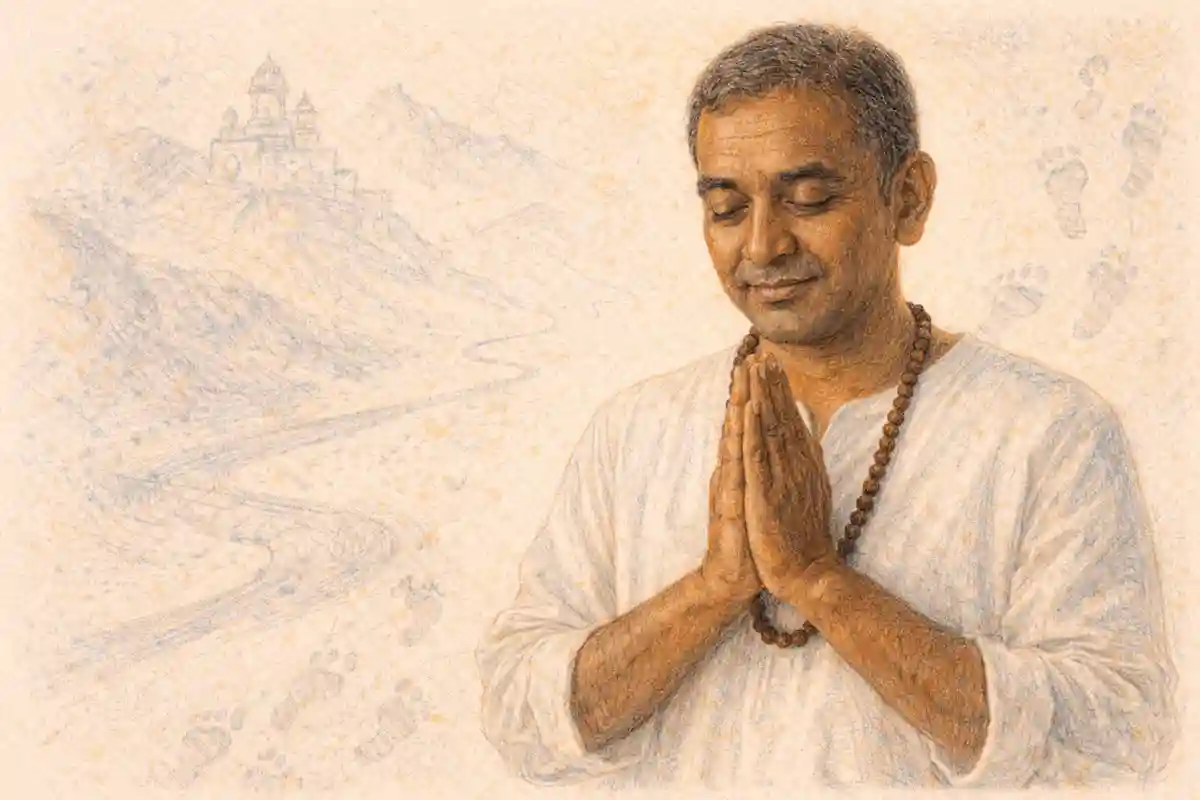
There is a moment near the end of The Alchemist that has puzzled readers since the novel’s publication in Portuguese in 1988 and its explosion into global consciousness through the 1990s. Santiago, the Andalusian shepherd boy who has crossed Spain and North Africa in pursuit of a treasure his dreams promised him, finally digs at the base of a sycamore tree near the pyramids of Egypt and finds nothing. Then a man beats him savagely, robs what little he has, and in a rage reveals that he too has been dreaming of a treasure – a treasure buried in a ruined church in Spain, the very church in which Santiago’s journey began, the very spot where he slept under a sycamore tree at the story’s opening.

The irony is so complete it is almost geometrical. The treasure was at the origin. The journey was the point. You had to leave to understand where to come back to.
This is one of the most satisfying and most contested endings in contemporary world literature. Satisfying because the symmetry is so elegant, because the spiritual logic clicks into place with the precision of a well-made lock. Contested because the logic, on examination, raises serious questions. If the treasure was always at the starting point, why did Santiago have to go at all? Is Coelho saying that the journey creates the person who can receive the treasure, even though the treasure was always there? Or is he saying something harder and stranger: that the Soul of the World is playing an elaborate game, sending people on journeys whose destination they could have reached by standing still, simply to teach them something that the journey itself imparts?
These questions do not have clean answers, and the novel’s enormous global readership – over 150 million copies sold, translated into 80 languages, one of the bestselling novels in history – suggests that the questions themselves, held without resolution, have given enormous numbers of people something they needed. The ending works not despite its paradox but because of it.
And yet. The paradox is also a pressure point. Every element of the ending is a choice. Santiago could have dug at the pyramids and found the treasure. He could have stayed in Tarifa and never gone at all. He could have married Fatima in Al-Fayoum and made a different life. He could have become a crystal merchant. He could have turned back at the first obstacle. Each of these alternatives produces a different novel with a different argument about what a human life is for.
This article explores seven alternative endings to The Alchemist with the full seriousness they deserve, not to improve on Coelho but to understand him. We examine what each alternative would do to the novel’s central argument about Personal Legends, the Soul of the World, omens, and the relationship between dreaming and doing. We draw on the biographical context of Coelho’s own unusual life, on the novel’s place in the tradition of spiritual quest literature, and on the responses of critics who have found the actual ending too convenient and of readers who have found it transformative. The alternative endings map the terrain of the actual ending’s claims. They show us what Coelho chose to insist upon and what he chose to risk.
Part One: Understanding the Ending Coelho Wrote
The Architecture of the Plot
The Alchemist is a novel of relentless forward motion, organized around a single question – will Santiago reach his Personal Legend? – that is answered only in the final pages, and answered in a way that reframes the question entirely.
Santiago begins as a shepherd in Andalusia, Spain, who has been having a recurring dream about a treasure near the Egyptian pyramids. He consults a Romani woman who interprets dreams, then encounters a mysterious old man who claims to be the King of Salem – Melchizedek, as readers familiar with the Hebrew Bible recognize immediately – and who teaches him about Personal Legends, the Soul of the World, and omens. The King of Salem takes a tenth of Santiago’s sheep in exchange for the teaching and gives him two stones, Urim and Thummim, that can answer yes or no questions.
Santiago sells his remaining sheep, crosses to Africa, loses all his money to a thief in Tangier, rebuilds himself by working for a crystal merchant for nearly a year, then joins a caravan crossing the Sahara toward Egypt. On the caravan he meets an Englishman studying alchemy, then falls in love with Fatima at an oasis, then encounters the Alchemist himself – a two-hundred-year-old master of transmutation who agrees to guide Santiago across the desert’s most dangerous territory.
The journey with the Alchemist is the novel’s spiritual climax. He teaches Santiago to speak the Language of the World, to listen to his heart, to understand that “when you want something, all the universe conspires in helping you to achieve it.” He demonstrates the Masterwork of alchemy by transmuting lead into gold before a tribal chieftain. He accompanies Santiago to within an hour of the pyramids and leaves him to complete the journey alone.
Santiago reaches the pyramids, begins to dig, finds nothing, is beaten and robbed by a thief who inadvertently reveals the treasure’s true location, then returns to Spain and finds the treasure exactly where the thief described – beneath the roots of the sycamore tree in the abandoned church where he slept when the dream first came to him.
The novel ends with Santiago speaking to the wind, which carries his words toward the desert and toward Fatima. He tells her he is coming.
What the Ending Argues
The ending is a thesis statement about the nature of spiritual seeking, and it makes several specific claims simultaneously.
First, it claims that the journey is necessary even when the destination is already present. Santiago could not have found the treasure without leaving, because the man who could find the treasure – the man who understands the Soul of the World, who can speak the Language of the World, who has been transformed by love and loss and danger and the company of the Alchemist – did not exist until the journey created him.
Second, it claims that omens and dreams and the universe’s conspiring are real and operative, not merely metaphorical. The dream was genuine prophecy. The King of Salem was a genuine supernatural intervention. The Alchemist was a genuine guide. The universe does, in the novel’s argument, literally arrange itself to help those who pursue their Personal Legends. This is not merely an encouraging figure of speech; it is the novel’s metaphysical commitment.
Third, it claims that love – specifically the love of Fatima – is not a distraction from the Personal Legend but a confirmation of it. Santiago’s decision to leave Fatima, made against his own desire, is what allows him to complete the journey. His promise to return is what completes the circle.
Fourth, it claims that the treasure of the Personal Legend is always material as well as spiritual. Santiago does not return to Spain with wisdom alone. He returns with an actual chest of gold coins, emeralds, and jewelry. The material treasure is present alongside the spiritual transformation; Coelho does not dematerialize the reward into pure abstraction.
Fifth, it claims that the beginner’s luck of the very first steps toward a Personal Legend – Santiago’s initial crossing to Africa, facilitated by his skill as a shepherd and the favorable circumstances he encounters – is real, not coincidental. The universe does not merely allow the journey; it actively enables it at the beginning, before withdrawing its most obvious support and requiring the seeker to find inner resources.
What the Ending Risks
The ending risks what every ending organized around poetic justice risks: the charge of being too neat. Critics of The Alchemist have consistently identified the ending’s symmetry as its most vulnerable feature. If the treasure was always at the starting point, and if the journey was necessary to prepare the person to find it, then the novel is essentially saying that doing what you most deeply want to do will always lead to the discovery that you had what you needed all along. This is consoling. It is also, in the secular world’s framework, not obviously true.
The ending also risks the charge of tautology. “When you really want something, the universe conspires to help you get it.” But we know, from ordinary life, that people who really want things often do not get them. People who pursue their deepest desires with total commitment are frequently destroyed by the pursuit. The novel’s response to this objection is embedded in the concept of the Personal Legend: only desires that are genuinely aligned with the Soul of the World qualify. Desires that conflict with the Soul of the World are not Personal Legends, and the universe is not obligated to conspire in their favor.
This response is internally consistent but unfalsifiable. If someone pursues what they believe is their Personal Legend and fails, the novel’s framework can explain the failure as evidence that what they pursued was not truly their Legend. This protects the theory at the cost of making it untestable – which is, critics have observed, the characteristic move of a certain kind of inspirational literature.
These vulnerabilities are the pressure points from which the alternative endings most naturally emerge.
Part Two: Seven Alternative Endings
Alternative Ending One: Santiago Finds the Treasure at the Pyramids
The most tonally dissonant alternative is the one in which the dream was literally accurate: the treasure is buried near the pyramids, exactly where Santiago dreamed it would be. He digs in the right place, finds the chest, and returns to Spain wealthy and transformed by the journey.
This alternative eliminates the novel’s central irony entirely. There is no symmetrical return to the origin. There is no encounter with a thief who reveals that the real location was always behind Santiago. There is just a young man who had a dream, pursued it across a continent, and found exactly what he was looking for where he was told to look.
On the surface, this seems like a more direct confirmation of the novel’s central thesis: the universe conspires to help you achieve your Personal Legend. If the universe arranges things so that Santiago reaches the pyramids and finds the treasure there, it has done precisely what it promised. The dream was true. The omens were accurate. The Alchemist’s guidance was effective. The reward is present.
But the loss is enormous, and it is thematic rather than merely structural. The version of the novel where the treasure is at the pyramids is a novel about a man who got what he wanted. It is not a novel about a man who discovered that the self who could want correctly had to be built by the journey. The transformation that Coelho actually values – the spiritual deepening, the opening to the Language of the World, the discovery that the treasure of transformation is inseparable from the material treasure – is present in both versions, but it carries a different meaning.
In the version where the treasure is at the pyramids, the journey was the means and the treasure was the end. In the actual novel, the journey was the end and the treasure was the confirmation. This distinction is the entire argument of the book. Coelho needed the treasure to be at the beginning not to mock the journey but to reveal that the journey had been misunderstood throughout – by Santiago, by the reader, and by every person who has ever pursued a dream purely for what they imagined would be at the destination.
The alternative ending where the treasure is found at the pyramids produces a more conventional adventure story. It is satisfying in the way that a well-executed quest narrative is satisfying. But it is not mysterious. It does not require the reader to reconsider anything. It confirms what the reader expected.
The actual ending requires the reader to reconsider everything, which is why it is more powerful and why it is also more vulnerable to the charge of being a trick. Whether the trick is valid depends on whether the journey’s transformative effect on Santiago is sufficient to justify the elaborate deception. Coelho believes it is. He has organized the entire novel to make this case. The alternative ending where the treasure is at the pyramids simply agrees with the reader’s initial expectation and sends them home satisfied. The actual ending argues with the reader and challenges them to find satisfaction in a different place.
Alternative Ending Two: Santiago Stays with Fatima
At the oasis of Al-Fayoum, Santiago falls in love with Fatima, a desert woman from a tribe of the Sahara. Their love is immediate and total. Santiago tells her about his Personal Legend, and Fatima – in one of the novel’s most spiritually charged exchanges – tells him that she has been waiting for him all her life, that the desert has taught her to wait, and that he should continue his journey. If it is truly his Personal Legend, she will wait. If he stays for her, he will grow to resent her.
Santiago leaves. He does not stay. This is the novel’s most psychologically difficult moment, because the reader has been taught by every other story they have encountered that when a young man meets the woman of his life in the middle of a journey, he stays for her. The journey can wait. Love is the destination.
Coelho reverses this convention. Fatima herself reverses it. She tells Santiago that love never keeps a man from his Personal Legend. If it claims to, it is not love. It is something else.
The alternative ending in which Santiago stays with Fatima is the ending in which this reversal does not occur – in which the conventional logic prevails and love is allowed to supersede the Personal Legend.
This alternative is not merely sentimental. It raises a genuine philosophical question that the novel sidesteps: what if love is the Personal Legend? What if the thing Santiago was born to do was not to find a material treasure at a sycamore tree in Spain, but to love this particular woman in this particular desert? The novel never seriously entertains this possibility. It treats Fatima as a waypoint – the Soul of the World’s most beautiful confirmation that Santiago is on the right path, but not the path itself.
The Santiago who stays would build a life in Al-Fayoum. He would learn the desert’s ways. He and Fatima would have children who would know the constellations by the age of five. He would become a respected figure in the oasis community, a man who tells stories of his journey to Spain and across North Africa to a child who cannot imagine a land where the ground is green. He would never find the material treasure. He would have, instead, a life.
This alternative is compelling because it does not require us to believe that Santiago’s choice was wrong. The novel’s framework – the Soul of the World, the Personal Legend, the universe’s conspiracy – allows for the possibility that a Personal Legend can be completed in ways that are not always the most obviously dramatic. If Santiago’s deepest self genuinely chose Fatima, genuinely found in her the thing that his journey was building toward, then staying would be completing the Legend rather than abandoning it.
The novel resists this reading because it is committed to the idea that the Personal Legend is specific and demanding, that it requires a particular destination and a particular kind of courage, and that love that keeps you from your Legend is a form of spiritual failure. But the alternative ending where Santiago stays does not require us to accept this framework. It simply imagines a man who made a different choice and carried that choice fully, without resentment and without regret.
The most honest version of this alternative is not the sentimental one where everything works out beautifully. It is the one where Santiago, years later, sitting outside his tent at night and watching the stars, feels something unresolved – not regret exactly, but the persistent sense that there is something he did not do, something the desert is still waiting for him to complete. The love is real. Fatima is real. The children are real. And the sycamore tree in Spain is still standing over an unexcavated treasure, and the Santiago who stayed will never be the Santiago who digs it up.
Whether this is a tragedy or a fulfillment depends on whether Coelho’s framework of the Personal Legend is right. The alternative ending where Santiago stays is the ending that most forcefully puts that framework to the test.
Alternative Ending Three: The Crystal Merchant’s Path
Before reaching Al-Fayoum and the Alchemist and the pyramids, Santiago spends eleven months working for a crystal merchant in Tangier. This interlude is one of the novel’s richest sections. The merchant is a Muslim who has always wanted to make the pilgrimage to Mecca – it is his most sacred obligation and his most deeply held dream – but he has never gone. He is afraid that if he goes, he will have nothing left to live for. The dream of Mecca is what keeps him going. If he achieves it, what then?
This is Coelho’s most direct statement of the novel’s central danger: the person who refuses the Personal Legend is not simply someone who has made a practical calculation. He is someone who has decided that the dream is more valuable unrealized than realized, because an unrealized dream is always perfect and an achieved dream is always mixed with the ordinariness of the achieved.
Santiago is transformed by his time with the merchant. He takes the merchant’s crystal business from near-failure to conspicuous success by suggesting innovations – a display case in the doorway, mint tea for customers, a model of the Kaaba made of crystal for pilgrims. He makes enough money to return to Spain and buy a larger flock than he sold. He could go home. He chooses, instead, to continue toward Egypt.
The alternative ending in which Santiago makes the crystal merchant’s choice is the one most deeply embedded in the novel’s own cautionary logic. He takes his saved money, returns to Spain, buys his sheep, and lives a comfortable shepherd’s life. He is not unhappy. He is not destroyed. He is simply a man who turned back.
What makes this alternative interesting is that it is available at every point in Santiago’s journey, not just at the crystal merchant’s shop. He could turn back after the thief steals his money in Tangier. He could turn back when the tribal warfare across the Sahara makes the journey lethal. He could turn back when the Alchemist warns him that the journey to the pyramids may cost him his life. He could turn back when he is beaten by the thieves at the pyramids and left with nothing in a foreign country.
The crystal merchant represents the composite of all these turning-back moments. He is what Santiago would become at any of those points: a man who did not quite do the thing he most deeply wanted to do, who organized his life instead around the distance between where he is and where he wanted to be, who keeps the dream alive precisely by not testing it against reality.
Coelho is clear that this is a kind of death – that the crystal merchant, for all his warmth and wisdom, has made the worst possible mistake, because a life organized around an unrealized dream is a life of permanent incompleteness. But the alternative ending where Santiago makes the same choice allows us to ask: is Coelho right? Is the merchant’s life genuinely worse than Santiago’s? The merchant has his faith, his routines, his customers, his mint tea, his comfortable relationship with the familiar. Santiago has his transformation, his treasure, his Fatima, and the knowledge that he listened to his heart. Are these genuinely incommensurable? Is one clearly better?
The novel does not want to ask this question honestly because it is committed to the answer. But the alternative ending that follows the crystal merchant’s path forces the question and declines to answer it.
Alternative Ending Four: The Alchemist Does Not Appear
The figure of the Alchemist is one of the most deliberately mysterious in the novel. He appears at Al-Fayoum, identifies Santiago immediately as someone who is seeking his Personal Legend, and offers to guide him across the Sahara’s most dangerous territory to within an hour of the pyramids. He is two hundred years old, having achieved the Philosopher’s Stone and the Elixir of Life. He is, in the novel’s symbolic vocabulary, what Santiago will eventually become if he fully commits to the Soul of the World: a human being who has so completely aligned himself with the universe’s language that he can transmute matter and extend his own life indefinitely.
The Alchemist is also, structurally, a gift the novel gives Santiago at the moment when the journey has become too dangerous to complete alone. Without the Alchemist’s guidance and his ability to negotiate with tribal leaders and his demonstration of the Masterwork before the chieftain who would otherwise have executed Santiago, the journey does not reach the pyramids. Santiago’s own resources, without the Alchemist, are insufficient.
The alternative ending in which the Alchemist does not appear is therefore the alternative in which the journey is genuinely blocked – not by Santiago’s failure of nerve or insufficient desire, but by external circumstances that cannot be overcome by personal determination alone.
This alternative takes seriously a challenge to the novel’s central claim that is never fully addressed in the text: what about the Personal Legends that are genuinely blocked not by the seeker’s inadequacy but by historical forces, structural circumstances, or simple bad luck? Santiago is trying to cross the Sahara during a period of active tribal warfare. Without the Alchemist’s intercession, he would be captured and likely killed, not because his desire was insufficient but because a war was in his way.
In the alternative where the Alchemist does not appear, Santiago turns back at the edges of the tribal conflict zone. He is not a coward – the conflict zone is genuinely lethal, and turning back is the rational decision. He returns to Al-Fayoum. He marries Fatima. He becomes the shepherd of the oasis. He grows old having never reached the pyramids, not because he lacked the will but because the world did not cooperate.
The novel’s framework handles this possibility through the concept of the Soul of the World’s conspiracy: if Santiago were truly following his Personal Legend, the universe would provide the guide at the right moment, and the Alchemist’s appearance is that provision. The alternative ending where the Alchemist does not appear is therefore, within the novel’s framework, either an ending in which Santiago was not truly following his Personal Legend (which conflicts with everything the novel has established) or an ending in which the universe failed to keep its promise.
This second possibility is the one the novel cannot entertain, because the entire edifice of the Soul of the World and the Personal Legend and the universe’s conspiracy collapses if the universe sometimes fails to conspire. The framework is only coherent if the assistance is guaranteed. The alternative ending where the Alchemist does not appear reveals this guaranteed quality as the framework’s most questionable feature.
In the real world, guides do not always appear when needed. The people most committed to their deepest desires are sometimes stopped not by their own failures but by history, by circumstance, by the simple absence of the help that would have made the difference. The novel’s framework calls these people’s desires something other than Personal Legends, after the fact. The alternative ending refuses this after-the-fact reclassification and imagines what it looks like when a genuinely committed seeker is genuinely stopped.
Alternative Ending Five: Santiago Returns to Find Fatima Gone
The ending as Coelho wrote it closes with Santiago speaking to the wind and promising Fatima that he is coming. The implication is clear: she is waiting, she has been waiting, and the reunion is imminent. The love that Santiago left at Al-Fayoum is preserved, as Fatima promised it would be, as a desert woman who has learned to wait promises.
But the journey from the pyramids back to Spain and then presumably back to Al-Fayoum is not instantaneous. Santiago left Al-Fayoum and was gone for what the novel implies is a significant period of time. He crossed the desert with the Alchemist. He was beaten at the pyramids and left without resources in Egypt. He had to find his way back to Spain, a journey that in the novel’s historical period would have taken weeks at minimum. He found the treasure. He would then need to arrange a return to Africa.
All of this takes time. And Fatima, for all her desert patience and her promise to wait, is a human being in a community with its own pressures and its own expectations. Desert women do not wait indefinitely for men who have left for foreign countries with uncertain prospects of return.
The alternative ending in which Santiago returns to Al-Fayoum to find Fatima gone – married to a chieftain’s son, moved to a different oasis, simply not there – is the ending that tests the novel’s romantic logic most severely. The Personal Legend was completed. The treasure was found. The transformation occurred. And the love that was supposed to be preserved by the desert’s patient logic did not survive the time the journey required.
This alternative is not cruel for its own sake. It is a genuine examination of a tension the novel identifies but does not resolve: the tension between the time that a Personal Legend requires and the real-world consequences of that time for the relationships that are supposed to wait.
Santiago returns to find Fatima gone. He is rich, transformed, complete in his Personal Legend – and he is alone. The universe conspired to help him achieve his dream. It did not prevent his dream from costing him the thing he loved most.
This alternative asks whether the completeness of the Personal Legend is sufficient consolation for what it costs. The novel assumes the answer is yes – that the transformation and the treasure and the fulfilled purpose are worth any price. The alternative ending where Fatima is gone tests this assumption by making the price explicit rather than conveniently waived.
The most honest version of this alternative does not end with Santiago in grief. It ends with him in a complicated state that the novel’s vocabulary of the Personal Legend is not equipped to describe – a state in which something was gained and something was lost, in which both things are real, in which the gain does not cancel the loss and the loss does not cancel the gain. He is not the crystal merchant, who kept his dream alive by not pursuing it. He is not the Santiago of the actual novel, who returns to a waiting Fatima and a completed circle. He is a third thing, which is perhaps closer to what most actual human lives look like: partial, mixed, genuinely achieved and genuinely costly.
Alternative Ending Six: The Treasure Buys Nothing
In the actual ending, Santiago finds the treasure and the ending closes before we see what he does with it. He speaks to the wind. He thinks of Fatima. The novel ends. The material question – what does he actually do with a chest of gold, emeralds, and jewelry – is not addressed.
This is a deliberate choice. Coelho is not writing a novel about wealth management. He is writing a novel about the pursuit of the dream, and the dream is complete when the treasure is found. What comes after is, in the novel’s logic, the territory of ordinary life, which the novel has no obligation to inhabit.
The alternative ending in which the treasure buys nothing takes this unaddressed question and fills it in, not with contentment and ease, but with a different kind of problem. Santiago returns to Spain with a chest of significant material wealth in a world that has not changed to accommodate him. He is an Andalusian shepherd with no formal education, no family property, no social position beyond what his father’s name might confer. He has a chest of treasure. He does not necessarily have the social infrastructure to deploy it.
In the Spain of the novel’s historical period – roughly the early nineteenth century, given the presence of trade routes and caravan culture, though Coelho is deliberately vague – a young man appearing from North Africa with unexplained wealth would attract specific kinds of attention, not all of it welcome. Questions would be asked. The treasure might need to be converted, explained, legitimized.
This alternative is less interested in the practical logistics than in the philosophical question they illuminate. The novel ends before the treasure becomes ordinary – before the gold is spent, the novelty fades, the transformation of the journey settles into the steady-state of a changed but nonetheless daily life. The ending freezes Santiago at his moment of maximum spiritual velocity. The alternative ending that shows what happens after asks: does the velocity carry? Does the transformation persist when the journey is over and the ordinariness of life resumes?
The crystal merchant’s fear – that achieving the dream leaves nothing to live for – is addressed in the novel only by the assertion that a completed Personal Legend opens the way to a new one. Santiago has found his treasure, but the Soul of the World does not stop at completed tasks. The alternative ending that follows Santiago into the life after the finding discovers whether the post-legend life is as the novel promises: a beginning rather than a conclusion.
The most revealing version of this alternative is the one in which the treasure is material enough to change Santiago’s external circumstances dramatically but not enough to substitute for the internal changes that the journey produced. He is wealthy. He is also alone in his understanding of what wealth means. The people around him – his father, his former village, the practical world – see the gold. They do not see the Alchemist. They do not hear the Language of the World. They do not know about Fatima or the oasis or the Sahara or the Soul of the World’s conspiracy. They see a young man who went away a shepherd and came back with a chest of treasure. They have their own explanations.
Santiago, in this alternative, discovers that the journey’s completion is visible only to him. The transformation is real and total and entirely private. The treasure is visible and entirely public. The gap between these two things is where the rest of his life must be lived.
Alternative Ending Seven: The Dream Was Wrong
This is the darkest and most philosophically rigorous alternative, and it goes to the root of the novel’s entire structure. What if the recurring dream about the treasure near the pyramids was simply a dream – not a communication from the Soul of the World, not a genuine prophecy, not an omen to be followed, but the product of a young man’s mind processing his desires and anxieties in the language of symbol and narrative that the sleeping brain uses?
The novel never seriously entertains this possibility. It dismisses it through the mechanism of the King of Salem, who confirms for Santiago that his dream is a real communication from the Soul of the World and that he should pursue it. The supernatural guarantees the dream’s authority. The Romani woman, the Alchemist, Urim and Thummim, the wind that speaks, the hawk’s flight, the desert’s voice: all of these confirm, repeatedly, that the universe is speaking to Santiago and that his dream is its primary communication.
But imagine a version of the novel in which these confirmations are not present, or in which they are present but Santiago, in this alternative, does not experience them as supernatural. He has the dream. He meets an old man who is simply an old man, not the King of Salem. He makes his own choice to cross to Africa. The thief who steals his money in Tangier is simply a thief, not a test. The crystal merchant is simply a merchant, not a lesson. The desert is simply the desert. Fatima is a woman, extraordinary and specific and real, but not a confirmation of anything cosmic.
In this alternative, Santiago crosses a continent in pursuit of a dream, the dream turns out to be – as most dream-literalism turns out to be – metaphorically true but literally false. There is no treasure at the pyramids. There is no treasure at the sycamore tree in Spain. There are simply the experiences he accumulated along the way: the learning, the loving, the surviving, the changing.
The alternative ending in which the dream was wrong is not an ending in which Santiago is destroyed. He is returned to Spain a different person than he left it. He has loved Fatima. He has crossed the Sahara. He has been beaten by thieves and rebuilt himself and learned what the desert teaches. He is, by any measure, more than he was. He has no treasure. He has himself, remade.
This alternative is the most honest test of what the novel is actually arguing, because it separates the transformative power of the journey from the metaphysical framework the novel wraps around it. If the journey produces real transformation independent of whether the universe was actively conspiring in it, then the spiritual framework of the Personal Legend is not strictly necessary to make the novel’s core point. The core point – that pursuing what you most deeply desire will transform you, and that the transformation is worth the cost – stands without the Soul of the World’s guarantee.
The alternative ending where the dream was wrong is also the ending most consistent with how the world actually works for most people. Most people who pursue their deepest desires do not find a literal treasure at the end. They find a changed self, a set of experiences, a set of losses and gains that do not add up to a clean conclusion. They find, if they are lucky, that the pursuit was worth it regardless of the material outcome. This is a smaller and more honest version of the novel’s claim, and it is actually more demanding than the novel’s version, because it does not promise the universe’s assistance. It simply says: go anyway.
Part Three: What the Alternatives Reveal About the Original
The Guarantee and Its Cost
Having examined seven alternative endings, the pattern they reveal is clear: the actual ending of The Alchemist is organized around a guarantee that the alternatives collectively expose and question. The guarantee is this: if you genuinely pursue your Personal Legend, you will achieve it. The universe will conspire to help you. The treasure is real and it will be found.
This guarantee is the novel’s most commercially successful feature and its most philosophically contested one. The alternative endings where the guarantee fails – where the Alchemist does not appear, where Fatima does not wait, where the dream was wrong – are more realistic and less comforting. They are also, in a sense, more respectful of the reader’s intelligence.
The novel’s enormous readership demonstrates that the guarantee, however philosophically vulnerable, meets a genuine human need. People who are told that the universe conspires to help those who pursue their true desires are given something that secular modernity typically does not provide: a sense that the cosmos has intentions, that their deepest wishes are not simply private noise but signals in a larger conversation, that the effort of pursuing what they most want is cosmically sanctioned.
The cost of the guarantee is the unfalsifiability we noted earlier. If you pursue your Personal Legend and fail, the novel’s framework can explain the failure as evidence that what you pursued was not truly your Legend. This protects the theory, but it also removes its most important test. A theory that cannot be falsified is not an explanation; it is a comfort.
The alternative endings that allow the guarantee to fail are the ones that restore the possibility of genuine testing. In a world where Santiago can pursue his deepest desire and be genuinely stopped, the pursuit becomes genuinely courageous rather than cosmically insured. The courage to pursue is more admirable when failure is possible than when success is guaranteed.
The Alchemy of the Self
The Alchemist of the novel’s title is not primarily the two-hundred-year-old adept who guides Santiago across the desert. He is Santiago himself – or rather, Santiago is in the process of becoming an Alchemist of his own soul throughout the novel, transmuting the base metal of his ordinary shepherd’s life into the gold of a completed Personal Legend.
This is the novel’s genuine alchemical claim, and it is independent of the metaphysical framework. Whether or not the universe conspires, whether or not Personal Legends are cosmically guaranteed, whether or not the Soul of the World is a real and operative force, the process of self-transformation through committed pursuit of a deeply held desire is real and documented and available. People do become different through sustained effort toward meaningful goals. The neuroscience of habit formation, the psychology of resilience, the philosophy of virtue: all of these confirm, from secular frameworks, something like Coelho’s core claim.
The alternative endings reveal that this genuine alchemy does not require the novel’s supernatural apparatus. Santiago can become a different and better person through his journey whether or not the universe was arranging the journey on his behalf. The transformation is real. The guarantee of its material reward is what the supernatural apparatus is for.
Coelho included the guarantee because he was writing a novel of hope, not a novel of challenge. He wanted readers to feel that the pursuit of their Personal Legends was supported rather than merely admirable. The alternative endings that remove the guarantee are novels of challenge: they ask readers to pursue their deepest desires in a world that does not promise to help. This is a harder ask. It is also, perhaps, a more honest one.
Omens and the Selective Attention Problem
One of the novel’s most distinctive techniques is its treatment of omens. Santiago is taught to read omens – signs from the universe about which direction to take – and he becomes increasingly skilled at this reading throughout the novel. The flight of hawks over the desert tells him about an imminent attack. The behavior of sand tells him things. The wind speaks. The Alchemist confirms that these readings are accurate.
The selective attention problem is this: omens, as the novel uses them, are meaningful only in retrospect. When Santiago sees the hawks and interprets their flight as a warning of attack, and the attack occurs, the omen was real. But if no attack had occurred, the omen would have been reinterpreted as a warning that Santiago’s vigilance prevented the attack, or as a sign about something else entirely. Omens, as the novel presents them, cannot be wrong – they can only be misread.
The alternative endings where the omens are wrong – where the Alchemist is not present to confirm the reading, where the dream does not lead to the treasure, where the universe’s messages are the signals of a shepherd’s own desires rather than communications from the Soul of the World – are the endings that restore the omens’ genuine meaning by making them fallible. An omen that could be wrong is more meaningful when it is right. An omen that cannot be wrong is simply a story we tell ourselves about events that would have occurred regardless.
The novel’s treatment of omens is, in the secular reading, a sophisticated account of how motivated perception works: once you are committed to a direction, evidence for that direction becomes visible and evidence against it becomes invisible or reinterpretable. This is not a spiritual failure; it is a human cognitive pattern. The alternative ending where the dream was wrong is the ending that names this pattern honestly and asks whether the pattern can still lead somewhere worth going.
The Question of Other Personal Legends
One of the alternative endings we did not explore, but that the alternatives collectively imply, is the question of everyone else’s Personal Legend. Santiago’s story is told from his perspective, but the world through which he moves contains other people with their own deepest desires and their own journeys.
The tribal warriors who threaten his life in the desert have their own version of the story, in which Santiago is an obstacle or an irrelevance. Fatima has her own story. The crystal merchant has his – and his story, as we noted, is a cautionary tale precisely because his desire is real but unfulfilled. The thief who beats Santiago at the pyramids has his. The Englishman studying alchemy has his, and the novel dispatches him before we learn whether he achieves his goal.
The novel is not designed to hold multiple perspectives simultaneously. It is a fable, and fables follow single protagonists through singular journeys. But the alternatives collectively raise the question: what does the Soul of the World do when Santiago’s Personal Legend conflicts with someone else’s? When the tribal war that threatens Santiago’s life is itself the Personal Legend of a warrior chief? When the thief who beats Santiago at the pyramids is pursuing his own survival, his own version of the only life he has?
The novel’s framework handles these conflicts implicitly through the concept of alignment: those who are aligned with the Soul of the World will find that even apparent obstacles serve the larger pattern. But the alternative endings that take seriously the stories of the people Santiago moves among reveal a world in which the Soul of the World is managing an enormous number of trajectories simultaneously, and the management requires that some of them fail in order for others to succeed.
Santiago’s success required, among other things, a thief who would beat him and unknowingly reveal the treasure’s location. This thief is, structurally, the most important character in the novel’s final movement. Without his violence and his inadvertent revelation, Santiago would have returned to Spain without the information he needed. The universe, in the novel’s framework, conspired to use this thief to complete Santiago’s legend – which means, in some sense, that the universe conspired to make this thief a thief, which raises questions about his Personal Legend that the novel has no interest in addressing.
The alternative endings that follow secondary characters – Fatima, the crystal merchant, the Englishman, the thief at the pyramids – all eventually arrive at this question: is the universe’s conspiracy available to everyone, or is it available to Santiago specifically because he is the protagonist? And if it is available to everyone, what happens when two Personal Legends require incompatible things?
Part Four: The Biographical Context
Coelho’s Own Journey
Paulo Coelho’s life is a version of his novel, told in a different register. He was born in Rio de Janeiro in 1947 and showed early signs of a literary vocation that his parents responded to by having him committed three times to a psychiatric institution between the ages of seventeen and twenty. They believed he was mentally ill. He believed he was a writer.
He was released each time and continued his unconventional life: involvement with the counterculture, theater, songwriting, political activism during Brazil’s military dictatorship, arrest and torture by the regime. He spent years not writing, years in the music industry, years traveling. He did not publish his first major work until he was thirty-nine.
The turning point, by Coelho’s own account, was a journey he made in 1986 along the Camino de Santiago, the medieval Christian pilgrimage route across northern Spain. The journey transformed him. He returned and wrote a book about it, The Pilgrimage. He then wrote The Alchemist, which drew on the same pilgrimage’s spiritual insights but translated them into the language of secular fable.
The parallels with Santiago the shepherd are obvious and clearly intentional. Coelho, like his character, spent years pursuing something he could not clearly name before a journey transformed his understanding. Coelho, like his character, found that the treasure he was looking for had a specific and unexpected form. The novel is, in this biographical reading, Coelho’s account of his own experience of the Personal Legend’s logic, translated into a universally accessible narrative.
This biographical context matters for the alternative endings because it reveals what Coelho had personally at stake in the novel’s claims. He was not writing a philosophical treatise about the conditions under which dreams are achievable. He was writing about something that happened to him – or that he understood to have happened to him – and he was writing it in the form most likely to transmit the experience to others.
The alternative endings that cast doubt on the universe’s conspiracy are, in this biographical reading, also alternative versions of Coelho’s own life: the version in which the psychiatric commitments were not the Soul of the World testing him but simply the consequences of having an unusual temperament in an unsympathetic family; the version in which the years of failed projects and near-misses were not preparation for the eventual breakthrough but simply years of failed projects and near-misses; the version in which the Camino de Santiago was a beautiful walk that produced a good book, rather than the transformative encounter with the Soul of the World that Coelho believed it to be.
Coelho himself is the evidence for his novel’s claims, which is why the novel is so personally charged and why it has reached so many people who have had comparable experiences of feeling that the universe was arranging things on their behalf. He is also, precisely because he is his own evidence, unable to falsify his own experience. The alternative versions of his life exist; he cannot inhabit them. He can only write from where he landed.
The Tradition of the Spiritual Quest
The Alchemist belongs to a long tradition of spiritual quest literature that includes Bunyan’s The Pilgrim’s Progress, Voltaire’s Candide (which it partly inverts), Hesse’s Siddhartha, Castaneda’s The Teachings of Don Juan, and countless mythological hero journeys from Odysseus to Gilgamesh. In all of these narratives, a seeker leaves a familiar world, passes through ordeals, receives wisdom from supernatural or exceptional teachers, and returns transformed.
The specific feature that distinguishes The Alchemist from most of this tradition is its insistence on the material reward. In most spiritual quest narratives, the seeker returns with wisdom, enlightenment, or peace – the transformation is purely internal, and the world remains as it was. In The Alchemist, Santiago returns with gold. The spiritual transformation and the material reward are inseparable.
This insistence on the material is philosophically significant and commercially shrewd. It addresses the objection that spiritual seeking is impractical, that the Personal Legend and the Soul of the World are fine for monks and mystics but irrelevant to people who need to pay rent. Coelho’s Santiago pursues his soul’s desire and finds, literally, gold. The message is clear: the soul’s desire and material success are aligned, not opposed.
The alternative endings that separate these two – the ending where Santiago is transformed but not enriched, the ending where the treasure is found but means nothing, the ending where the universe does not conspire and the journey produces only its own internal rewards – all move toward the more traditional spiritual quest model in which the material and the spiritual are not guaranteed to converge. These alternatives are more consistent with the experience of most spiritual seekers and with most of the tradition The Alchemist draws from.
Coelho’s insistence on the convergence is his most distinctive and most contested intervention in the tradition. The alternative endings reveal it as an intervention rather than a necessity – something Coelho chose to claim rather than something the tradition requires.
Part Five: The Adaptations and Their Readings
The Long Road to Film
The Alchemist was optioned for film adaptation almost immediately after its international breakthrough, and yet as of this writing it has not been produced as a major theatrical film. This is not for lack of interest; it is a direct consequence of the difficulty of translating the novel’s internal spiritual logic into cinematic form.
The novel’s most important events are internal. Santiago’s conversations with his heart, his reading of omens, his understanding of the Language of the World, his transformation through the journey: all of these are processes happening inside a character who speaks relatively little and whose external circumstances are not especially dramatic by cinematic standards. A man walks across North Africa, works in a shop, falls in love, crosses a desert, gets beaten, digs in the ground. The visual content is manageable. The meaning is not.
Every serious attempt to develop the screenplay has confronted the same problem: the ending that works on the page depends on an ironic symmetry that cinema typically finds difficult to render without either over-explaining it (which destroys the irony) or under-explaining it (which leaves audiences confused). The revelation that the treasure was always at the origin requires the audience to have held the origin clearly in mind throughout the journey. Novels can rely on readers to carry this information because readers control the pace of reading. Cinema cannot.
Several of the alternative endings we have explored would be easier to film than the actual ending. The ending where the treasure is at the pyramids gives the film a clear and visually satisfying climactic discovery. The ending where Santiago stays with Fatima gives the film a romantic resolution that is cinematically conventional and emotionally accessible. The ending where the Alchemist does not appear gives the film a realistic drama about a young man blocked by circumstances – not a spiritual fable, but a human story.
These observations reinforce the conclusion that the actual ending is specifically literary – that it achieves its effect through the specific properties of narrative prose, through the reader’s willingness to sit with an irony and feel it resolve across a moment of re-reading. The difficulty of filming the actual ending is indirect evidence that the ending is doing something that cannot be replicated in other media, which is a mark of genuine literary distinctiveness.
The Theatrical Tradition
Stage adaptations of The Alchemist have been more numerous and more consistently successful than film attempts, partly because theater has a long tradition of externalizing interior states through physical metaphor and direct address.
The most successful theatrical productions have tended to emphasize the journey’s sensory dimensions – the heat of the Sahara, the quality of the desert light, the sound of the caravan – as the embodiment of the spiritual transformation, rather than trying to explain the transformation through dialogue. This approach is consistent with the Fox’s teaching in The Little Prince: the essential things cannot be said, only felt. Good theatrical productions create the conditions for the audience to feel the transformation rather than explaining why it occurred.
The ending in theatrical productions has almost universally preserved the actual ending’s ironic symmetry, because directors have found that audiences receive it with something like recognition – a sense that they had known all along that the treasure was at the origin, even though they did not consciously know. This collective experience of recognition is what Coelho was aiming for and what the alternative endings, in different ways, forfeit.
Part Six: The Ending We Live
The Reader’s Personal Legend
The Alchemist is one of those books whose readership has generated a secondary literature of personal testimony. Readers consistently describe the book as arriving at a specific moment in their lives when its message was precisely what they needed to hear. The book has been credited with decisions to change careers, leave relationships, begin journeys, and pursue long-deferred desires. It has been given at graduation ceremonies, cited in therapy sessions, carried on expeditions, and left in hotels for the next guest.
This testimonial tradition is itself a kind of alternative ending – the ending that each reader writes by doing something with the book’s argument. The reader who reads The Alchemist and goes back to graduate school in something they love is living one version of the alternative. The reader who reads it and stays in their job but stops resenting it is living another. The reader who reads it and does nothing but feel briefly inspired before returning to ordinary life is living the crystal merchant’s version.
Coelho was aware of this when he wrote the novel – aware that a book about Personal Legends would, if it succeeded, prompt readers to ask about their own. The ending he chose is the ending that opens most widely into this reader-participation. Santiago finds the treasure, speaks to the wind, promises Fatima he is coming. The story is complete. The reader’s story is not. The space between the end of the novel and the beginning of the reader’s response is where the book’s actual work is done.
The alternative endings that close more completely – the ending where the journey was a hallucination, the ending where the dream was wrong, the ending where the treasure buys nothing – leave less space for this reader-participation. They are more artistically honest, in some respects, but they are less generative. They close the story rather than handing it forward.
Coelho chose an ending that hands the story forward, and eighty million readers have confirmed that the choice was correct for what he was trying to do. The alternatives tell us what he chose not to do. They tell us, by their different closures, what the actual ending’s openness costs and what it provides.
What the Alternatives Give Back
Having explored seven alternative endings in depth, we can now say clearly what the alternatives collectively provide that admiration of the actual ending cannot.
The alternatives prove that the ending is not inevitable. Every element of it was chosen from multiple possibilities. The choice to have the treasure at the origin rather than the destination was a deliberate artistic and philosophical decision, not the only logical conclusion of the premise. The choice to have Fatima wait was a romantic decision, not a narrative requirement. The choice to have the Alchemist appear when needed was a metaphysical commitment, not a plot necessity.
These choices are ideologically loaded in specific ways. The actual ending believes: that genuine desire is cosmically sanctioned, that the universe actively conspires in the pursuit of true purposes, that love and purpose are aligned rather than opposed, that material and spiritual reward converge for the truly committed, and that the destination of a journey is always, in some sense, the origin recognized.
The alternative endings each contradict one or more of these beliefs, and each contradiction makes the original claim more visible. We see most clearly what someone is claiming when we understand what they chose not to claim. Coelho chose to claim a great deal – more than most spiritual quest literature claims, more than most secular literature claims. The alternatives show us the magnitude of what he chose.
Part Seven: The Language of the Ending
How Fable Protects Its Claims
The Alchemist is written in the register of fable, and fable is a form with specific immunities that realist fiction does not have. In a realist novel, when the protagonist is guided by a two-hundred-year-old alchemist across the Sahara and the universe conspires to fulfill his dream, these elements invite scrutiny against the standards of probability. In a fable, they do not. Fables operate within their own internal logic, and the reader’s contract with a fable is different: you agree to accept the form’s conventions in exchange for access to what the form uniquely provides, which is the concentrated articulation of a truth that realist probability cannot contain.
The seven alternative endings we have explored all, in some degree, violate this contract. They apply the standards of realist probability to a fable – asking what would realistically happen if the Alchemist did not appear, if Fatima did not wait, if the dream was simply a dream. This is not an unfair thing to do; it is what serious literary analysis requires. But it is worth acknowledging that the fable’s resistance to these alternatives is partly built into the form.
A fable is not trying to describe the probability distribution of outcomes for people who pursue their desires. It is trying to articulate a truth about desire and purpose and the relationship between effort and meaning. The truth it articulates may be false when applied as a prediction. It may be true as a description of what desire feels like from the inside – the sense of being called, of the universe arranging itself, of obstacles being tests rather than stops, of love confirming rather than conflicting with purpose.
The alternative endings that take the fable’s claims literally and find them wanting are doing something real and necessary. The alternative endings that take the fable’s claims as descriptions of interior experience rather than exterior prediction find them more defensible. Both responses are appropriate, depending on what you ask the fable to do.
Coelho was writing for readers who needed what the fable could provide. He was not writing for critics who needed what realist probability requires. The alternative endings we have explored serve both audiences: they satisfy the critic’s need to test the claims, and they reveal, through the testing, why the fable’s mode is necessary to make the claims at all.
The Ending as a Mirror
The Alchemist’s ending has been described by many readers as a mirror – a surface that reflects back whatever the reader brings to it. Readers who are at a point of decision in their lives see the ending as permission. Readers who have already made their journeys and arrived somewhere unexpected see the ending as recognition. Readers who are in the middle of something difficult see the ending as promise. Readers who have tried and failed see the ending as either consolation or accusation, depending on how they hold the novel’s framework.
This mirror quality is not an accident. Coelho engineered it by keeping Santiago’s specific circumstances general enough that almost any reader can project their own circumstances onto them. Santiago wants something and pursues it across obstacles and transforms in the pursuit and finds the thing in an unexpected form. This structure is universal enough to contain almost any specific human version.
The alternative endings are what you see in the mirror when you bring a different set of circumstances. The ending where Santiago stays with Fatima reflects the reader who chose love over ambition and is still wondering. The ending where the Alchemist does not appear reflects the reader whose guide did not come. The ending where the dream was wrong reflects the reader whose dream turned out to be something other than what they imagined. Each alternative is the novel’s mirror showing a different face.
This mirror quality is why the novel continues to be relevant to such different readers in such different circumstances. It is not specific enough to exclude anyone from recognition, and not vague enough to offer no content at all. It occupies the specific territory between the particular and the universal that all lasting fables occupy.
The Symmetry That Cannot Be Earned Without the Journey
There is one more thing the alternative endings reveal, and it is perhaps the most important thing for understanding why the actual ending is constructed the way it is. The symmetry of the actual ending – treasure at the origin, journey required to know where the origin was – is only satisfying to the reader who has made the journey through the novel. A reader who skips to the last chapter and reads that the treasure was at the starting point does not feel the recognition. They feel the information. The information is nothing. The recognition is everything.
The ending’s satisfying quality is produced by the journey to it, not by the information it contains. This is the fable demonstrating its own thesis inside the reading experience. The reader who has read all of The Alchemist before reaching the ending is in Santiago’s position: they have journeyed to a discovery that they could have reached by a shorter route, except that the shorter route would have produced the information without the meaning.
The alternative endings all produce the information without meaning. They tell you what happened. The actual ending shows you what the journey produced. These are not the same experience, and the difference between them is not reducible to the plot.
This is why the ending works so consistently across so many readers in so many languages and so many decades. It is not telling them something they could not have known. It is confirming something they now understand because of where they have been. The treasure was always at the origin. The journey was always about becoming the person who could recognize it. The universe conspired to arrange exactly this experience of recognition.
The alternatives could have been the novel. They were not. The choice that was made – to send Santiago all the way to Egypt and back, to guarantee the universe’s assistance and Fatima’s fidelity and the Alchemist’s guidance and the thief’s inadvertent revelation – was the choice to write a book that teaches through recognition rather than instruction.
The alternatives teach through information. The actual ending teaches through experience. And experience, as the fox would confirm, is the only thing that truly changes what you see.
Part Eight: The Paths Not Taken and the Path That Was
What Each Alternative Costs Santiago
Across seven alternative endings, we have seen what different choices would have produced for Santiago, for the novel’s argument, and for its readers. It is worth pausing to inventory what each alternative specifically costs the character himself, because the cost is not the same in each case and the differences are instructive.
The Santiago who finds the treasure at the pyramids loses the discovery that the journey was the treasure – he gains the material reward without the ironic confirmation that the material and the spiritual are aligned in unexpected ways. He is richer but not deeper.
The Santiago who stays with Fatima loses his Personal Legend in its specific realized form, gains a specific love in a specific place, and lives with the question of what he did not do. Whether this is a net loss depends on whether you believe Fatima is more or less than the sycamore tree’s treasure. The novel believes it is less. The alternative believes the question deserves to stay open.
The Santiago who makes the crystal merchant’s choice loses the transformation entirely – not the potential for transformation, but the specific transformation that the journey produces. He remains the Santiago who could have gone. He is not destroyed. He is diminished by exactly the dimension that the journey would have added.
The Santiago who is not guided by the Alchemist loses his ability to complete what he began – not through his own failure, but through the world’s failure to provide what he needed. This is the loss that the novel’s framework cannot accommodate and that realist probability requires us to take seriously.
The Santiago who returns to find Fatima gone loses the proof that love and purpose are aligned. He has his purpose completed and his love incomplete. He lives in a different arrangement of gain and loss than the novel’s promise, and this arrangement – mixed, real, partial – is the one most consistent with actual human experience.
The Santiago whose treasure buys nothing loses the confirmation that the Personal Legend’s fulfillment is materially real, that the spiritual and the material are genuinely unified. He has the spiritual transformation; he lacks the visible sign of it. He must live with the transformation as a private fact in a world that values public evidence.
The Santiago whose dream was wrong loses the framework of cosmic sanction – the reassurance that his desires are aligned with something larger than himself. He retains the changes the journey produced, but they are produced by his own commitment rather than the universe’s conspiracy. Whether this is a smaller or a larger thing depends on whether you need the universe’s sanction to value what you have become.
Each loss is real. Each alternative is a genuine life, not a failure of imagination. And across all seven alternatives, Santiago remains someone who did something, who left, who moved through the world in pursuit of something that mattered to him. The alternative Santiago is never nothing. He is always a person who attempted, which is already more than what the novel calls the crystal merchant’s version: the person who kept the dream alive by not testing it, who organized an entire life around the distance between where he stood and where he believed he should be.
The One Alternative Coelho Could Not Write
There is an eighth alternative that none of the seven we have explored exactly captures, and it is the one Coelho was constitutionally unable to write: the alternative in which the pursuit of the Personal Legend leads to total destruction.
This is not the alternative where Santiago fails to find the treasure. Failure, in the novel’s framework, is always retrievable – a setback, a test, an occasion for deeper commitment. It is the alternative where Santiago’s pursuit of his dream leads not to transformation and treasure but to complete annihilation: death, madness, the destruction of everyone around him.
History offers many examples of people who pursued their deepest desires with total commitment and were destroyed by the pursuit. The framework of the Personal Legend cannot accommodate these examples except by classifying the desires in question as not truly aligned with the Soul of the World. But the people living those destructions did not experience them that way. They experienced them as the sincere pursuit of what they most deeply believed was their purpose.
Coelho could not write this alternative because it would contradict his deepest belief, which is that the universe is ultimately organized toward the fulfillment of genuine purpose rather than toward its destruction. This belief is not provable. It is not disprovable. It is a faith commitment about the nature of reality, and it is the foundation on which every page of The Alchemist rests.
The alternative endings we have explored all stay within the territory of the possible and the partial. They imagine Santiago achieving less than the novel promises, or achieving it differently, or at a different cost. They do not imagine him destroyed by the attempt. Even the most pessimistic alternative – the one where the dream was wrong – leaves Santiago alive, changed, and carrying the experience of the journey as a permanent part of himself.
The actual novel is, in the end, a novel of faith. Not religious faith in a specific doctrinal sense, but faith in the sense that William James meant when he argued that beliefs about the universe that make the universe livable are worth holding even in the absence of proof. The belief that the universe conspires in the favor of genuine purpose makes purpose feel genuinely purposeful. It makes the journey worth taking even before the destination is certain. It makes love a confirmation rather than a complication. It makes the obstacles navigable because they are tests rather than walls.
The alternative endings are the world that exists when this faith is absent or unconfirmed. They are the territory of doubt, of partial achievement, of the mixed and genuine human life in which some things work out and others do not, and the Personal Legend is not guaranteed to be among the things that do.
Both territories are real. Coelho chose to write from the territory of faith. The alternatives show us the territory of doubt. And between them – held together, neither canceling the other – is the whole of what it means to pursue something that matters and not yet know how it ends.
Conclusion: The Legend That Writes Back
The ending of The Alchemist is an argument in the form of a story. It argues that your deepest desire knows something you do not yet know about where it leads. It argues that the universe’s assistance, however invisible, is real and operative. It argues that love confirms rather than contradicts purpose. It argues that the treasure is at the origin – not because the journey was wasted, but because the journey was the only way to understand what the origin contained.
These are large claims. They are offered in the form of a shepherd boy’s adventure, which makes them more digestible but not less large. The seven alternative endings we have explored are, each of them, the form these claims take when one or more of them is doubted: the ending where the journey’s destination is found at the destination and not the origin; the ending where love displaces purpose; the ending where purpose is genuinely blocked by circumstance; the ending where love does not wait; the ending where material reward is absent; the ending where the dream was simply a dream.
Each alternative is a valid story. Some of them are, in certain respects, more realistic stories, more consistent with the actual distribution of outcomes among people who pursue their deepest desires with full commitment. They are the stories of people who did everything Coelho’s framework asks and did not arrive at the ending Coelho promised.
The Alchemist does not tell those stories. It tells the story of a successful Personal Legend, because it is a book about why Personal Legends are worth pursuing, and a book organized around a successful example is more convincing than a book organized around a failed one.
The alternatives reveal the cost of this choice. They show us the people who were not Santiago – or who were Santiago up until the moment the universe stopped conspiring. They show us the crystal merchants of the world, the shepherds who stayed with Fatima, the travelers who turned back at the desert’s edge. They do not appear in the novel because the novel is not about them. But they exist in the margins of every page, pressing at the edges of the argument, representing the cases that the Soul of the World’s conspiracy, if real, chose not to facilitate.
What Coelho offered his readers was not a statistical claim about the outcomes of Personal Legend pursuit. It was an invitation. An invitation to understand their deepest desires as cosmically sanctioned rather than cosmically irrelevant. An invitation to read the coincidences of their lives as omens rather than noise. An invitation to see the universe as something that listens.
The alternatives show us what the invitation would look like if the universe did not listen. They show us a world in which the journey is still worth taking, the desire is still worth following, the transformation is still real – but the treasure is not guaranteed, the guide does not always appear, and love does not always wait.
Santiago found his treasure. The alternatives show us what it would have meant if he had not. And between the actual ending and its alternatives, in the space where both are held simultaneously, is the question that makes The Alchemist worth returning to: do you believe the universe is listening?
The novel asks you to say yes. The alternatives remind you what it costs to say no. And both – the yes and the no, the actual ending and all its shadows – are versions of the same ongoing conversation between a human being and the world, which may or may not be listening, which may or may not be conspiring, which receives your journey regardless and gives back exactly what you have been willing to find.
This article is part of Insight Crunch’s ongoing series on classic literature, narrative craft, and the choices that make great books great. We explore not only what enduring works contain, but what they might have contained – and what the difference between those two things tells us about art, desire, and the stories we tell ourselves about our lives.