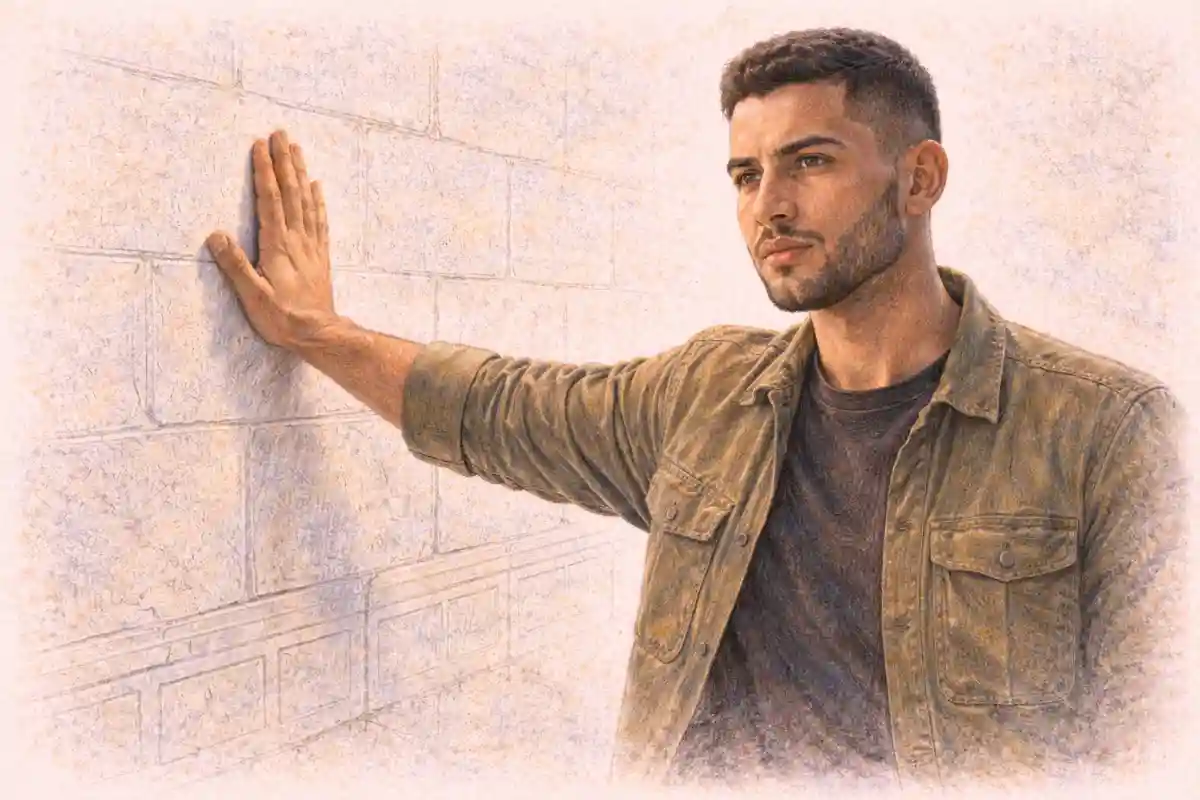
There is a moment early in Dhurandhar when Hamza Ali Mazari enters a room full of men who would kill him without hesitation if they knew who he really was, and Ranveer Singh does something remarkable with his eyes. They do not widen with fear. They do not narrow with calculation. They simply absorb, taking in the geometry of the space, the positions of the bodies, the exits, the weapons, the hierarchies visible in who sits where and who stands, and they do all of this in the time it takes to cross a threshold and offer a greeting. It is a look that communicates an entire psychology in two seconds, and it is the foundation upon which one of the most complex and compelling characters in Bollywood history is built. Hamza Ali Mazari, the undercover RAW agent who infiltrates Karachi’s criminal underworld in Aditya Dhar’s Dhurandhar duology, is not merely a well-written role performed by a talented actor. He is a sustained act of psychological excavation that unfolds across seven hours of screen time, revealing layer after layer of a man who has been required to erase himself in order to serve his country, and who must ultimately decide whether the person he was before the erasure still exists or has been permanently consumed by the fiction that replaced him.

What makes Hamza extraordinary as a character, and what separates him from every previous spy protagonist in Hindi cinema, is the depth of the psychological cost that the narrative is willing to explore. Previous Bollywood spy heroes have operated as fantasy figures, men who adopt glamorous disguises, seduce beautiful women, execute acrobatic fight sequences, and return to their true selves at the end of the mission without a scratch on their psyches. Hamza Ali Mazari is the antithesis of this fantasy. He is a man for whom the mission is not an adventure but an annihilation, a systematic destruction of everything that made him who he was, undertaken in the name of a country that will deny his existence if the mission fails. The duology tracks this destruction with unflinching honesty across both installments, and the result is a character study of extraordinary depth embedded within a commercial action thriller. For the broader cinematic context, see our complete analysis of Dhurandhar Part 1 and our complete analysis of The Revenge.
Hamza’s Role in the Dhurandhar Franchise
Hamza Ali Mazari is the gravitational center around which the entire Dhurandhar duology orbits. Every other character, every subplot, every action sequence, and every thematic exploration ultimately connects back to the question of who this man is, what he is willing to sacrifice, and whether the sacrifices he has made can ever be justified by their outcomes. In structural terms, Hamza functions simultaneously as protagonist, audience surrogate, dramatic engine, and thematic embodiment. He is the character through whose eyes the audience experiences the world of the film, the character whose choices drive the narrative forward, and the character whose internal contradictions give the franchise its psychological depth.
In the first installment, Hamza serves primarily as an infiltrator. His dramatic function is to navigate the treacherous ecosystem of Karachi’s Lyari underworld without being detected, and the tension of the film derives largely from the gap between what the audience knows about him and what the characters around him believe. This dramatic irony is the engine of the first film’s suspense, and Hamza’s ability to maintain his cover under increasingly dangerous circumstances is the mechanism through which that suspense is sustained.
In the second installment, Hamza’s role shifts fundamentally. He is no longer merely an infiltrator; he is an operator, a man who has moved from concealing his capabilities to deploying them openly. The power dynamics invert: where the first film showed Hamza as vulnerable and exposed within a hostile environment, the sequel shows him as increasingly dominant and aggressive, filling the power vacuum left by Rehman Dakait’s death and transforming himself into the feared Sher-e-Baloch. This transformation changes Hamza’s dramatic function from prey to predator, and the shift carries both narrative excitement and thematic risk, because a character who becomes too powerful loses the vulnerability that makes audiences care about his survival.
The genius of the franchise’s handling of Hamza is that it never allows the character to become invulnerable. Even as his operational power grows in the sequel, his psychological vulnerability deepens. The more he succeeds in his mission, the further he travels from the person he once was, and the more uncertain it becomes whether success and survival are the same thing. By the duology’s conclusion, Hamza has achieved everything his mission required, but the film refuses to present this achievement as unambiguous victory, instead framing it as a reckoning with costs that no strategic calculus can fully account for.
Hamza also functions as the franchise’s narrative bridge between its various worlds. He is the character who moves between the streets of Lyari and the offices of Indian intelligence, between the world of organized crime and the world of state policy, between the personal and the political. Every other character in the franchise is anchored to a single world: Rehman Dakait to the underworld, Ajay Sanyal to the intelligence service, Major Iqbal to the military establishment, Yalina to the civilian population of Lyari. Only Hamza moves between all of these worlds, and his movement is what makes the franchise’s cross-cutting narrative structure possible. Without a character who inhabits multiple worlds simultaneously, the film’s disparate storylines would fragment into disconnected threads. Hamza’s presence in each world is the connective tissue that holds the narrative together, and his reactions to each environment provide the emotional throughline that gives the structure coherence.
The character also serves a crucial function as the franchise’s moral compass, though that compass is deliberately uncalibrated. Hamza is not a figure of moral clarity; he is a figure of moral confusion, a man who commits acts of both heroism and brutality, who serves both justice and vengeance, who protects the innocent and endangers them in equal measure. But it is precisely this moral confusion that makes him useful as a compass, because it forces the audience to navigate the franchise’s moral landscape without a reliable guide. In a genre that typically provides clear moral distinctions between heroes and villains, Hamza occupies a space of sustained moral ambiguity that refuses to resolve into comfortable certainty. The audience cannot simply root for him or condemn him; they must engage with the specifics of each situation and each choice, evaluating his actions not against a fixed moral standard but against the impossible circumstances in which those actions are performed. This engagement is the franchise’s greatest achievement, and it is enabled entirely by the character at its center. You can compare the franchise’s box office trajectory against other Indian blockbusters to understand the commercial impact of this character-driven approach to genre filmmaking.
First Appearance and Characterization
Hamza’s introduction in the first film is a masterclass in economical characterization. He arrives in Lyari as a mystery, a figure whose past is unknown and whose capabilities are unclear. The film withholds exposition about his true identity, allowing the audience to experience him initially as the people around him do: as a stranger whose motivations are opaque and whose skills are revealed only gradually, through action rather than explanation.
The first thing the audience notices about Hamza is what he does not do. He does not announce himself. He does not seek attention. He does not posture or perform dominance displays. In a world populated by men who communicate through volume, aggression, and spatial dominance, Hamza communicates through stillness, observation, and strategic restraint. This negative characterization, defining a character by what they withhold rather than what they express, is one of the most sophisticated character introduction strategies in recent Bollywood cinema, and it immediately signals to the audience that this is a different kind of protagonist, one whose power lies not in what he shows but in what he conceals.
The physical characterization reinforces this impression. Ranveer Singh plays Hamza with a body that is always prepared for action but never displays its readiness. His posture is deliberately unimposing. His movements are efficient, neither rushed nor languid, calibrated to attract minimal attention while maintaining maximum situational awareness. He positions himself in spaces with tactical awareness, gravitating toward walls and exits, keeping sight lines open, ensuring that he is never cornered and never the center of attention. These physical choices communicate, before a single line of backstory is delivered, that this is a man who has been trained to survive in hostile environments and who has internalized that training so deeply that it has become indistinguishable from instinct.
The vocal characterization is equally precise. Hamza speaks with an accent and in a dialect that are not his own, maintaining a linguistic cover that is as essential to his survival as any physical disguise. Singh sustains this vocal identity with impressive consistency across both films, and the film uses the rare moments when his natural voice threatens to surface as some of its most tension-laden scenes. The audience understands that language is not merely a communication tool for Hamza; it is a survival mechanism, and every word he speaks in his adopted tongue is a performance that could fail at any moment with fatal consequences.
The emotional register of the introduction is carefully calibrated to establish the character’s fundamental loneliness without making it explicit. Hamza is surrounded by people but connected to none of them. He engages in conversation, shares meals, participates in social rituals, and builds relationships that are, from his perspective, entirely instrumental. The warmth that others extend to him is genuine; the warmth he returns is calculated. This asymmetry, visible to the audience but invisible to the characters around him, establishes the central dramatic irony that drives the first installment and creates a persistent undercurrent of guilt and moral unease that enriches every interaction.
The costuming in Hamza’s introduction deserves attention as a characterization tool. His clothing is carefully chosen to communicate a specific social position: respectable enough to suggest ambition, modest enough to suggest a man of the streets, and nondescript enough to avoid drawing attention. As Hamza rises through the organization, his wardrobe subtly evolves, reflecting his increasing status and the persona he is constructing for the benefit of those around him. But the costuming never becomes flamboyant or attention-seeking, even at the height of his power. This restraint in wardrobe mirrors the restraint in performance and serves as a constant visual reminder that the man wearing these clothes is not dressing for self-expression but for survival.
The film also establishes Hamza’s relationship to violence in his introductory sequences with careful precision. The first time the audience sees Hamza engage in physical combat, the violence is quick, efficient, and dispassionate. He does not relish it. He does not prolong it. He does not perform it for the benefit of onlookers. He uses exactly the force required to achieve his immediate objective and no more, then returns to his baseline state of controlled observation. This approach to violence tells the audience everything they need to know about the character’s training and temperament: he is capable of extreme lethality but does not define himself through it, and his restraint in the use of force is as informative as his competence in its application. The contrast between this controlled, purposeful violence and the expressive, performative violence of the criminals around him establishes a visual and behavioral distinction that underscores Hamza’s fundamental otherness within the environment he has infiltrated.
The introduction also establishes the specific quality of Hamza’s intelligence through his observation of power dynamics. He watches how people interact, who defers to whom, where the fault lines of loyalty and ambition lie within the organization. The film communicates this through point-of-view shots that show Hamza’s gaze tracking across rooms, registering details that other characters miss, building a mental map of the human terrain that is as essential to his survival as any physical map of the streets. This emphasis on intelligence as the character’s primary asset, rather than physical prowess or combat skill, is another departure from genre convention and helps establish the franchise’s commitment to psychological realism from its earliest scenes.
Psychology and Motivations
Understanding Hamza Ali Mazari requires understanding that the character is not a single person but a palimpsest, a surface identity written over an erased original. The man who operates in Karachi as Hamza is simultaneously the RAW operative carrying out a mission, the condemned prisoner who accepted the mission as an alternative to execution, and the young man from Pathankot whose family was destroyed by violence. These layers do not coexist peacefully; they are in constant tension, and the character’s psychology is defined by the effort required to manage, suppress, and compartmentalize the contradictions between them.
The deepest layer, revealed fully only in the origin story that opens the second film, is Jaskirat Singh Rangi: a young army aspirant from Pathankot whose life was shattered when a local politician ordered the murder of his father, the assault and killing of his elder sister Harleen, and the abduction of his younger sister Jasleen. Jaskirat’s response, rescuing Jasleen and killing the politician along with eleven others, was an act of primal vengeance that landed him on death row. This is the wound from which everything else flows. Every subsequent choice Hamza makes, every risk he takes, every act of violence he commits, is rooted in this original trauma. The intelligence service did not create Hamza from nothing; it channeled the rage and grief of a broken young man into a form useful to the state.
The psychological implications of this recruitment are profound and troubling. Ajay Sanyal identified in Jaskirat a combination of qualities that made him an ideal candidate for deep-cover work: the capacity for extreme violence, the ability to suppress his own identity, the willingness to sacrifice everything for a cause, and, crucially, the absence of alternatives. Jaskirat did not choose the mission because he was patriotic; he chose it because the alternative was death, and because the mission offered, however distantly, the possibility that his sacrifice might prevent other families from suffering what his had suffered. This motivation, a blend of self-preservation, revenge, and a genuine if deeply wounded desire to protect the innocent, gives Hamza’s psychology a complexity that is rare in action cinema.
The middle layer, Hamza’s identity as a trained intelligence operative, introduces its own psychological dynamics. The training that transformed Jaskirat into Hamza was not merely physical or tactical; it was psychological. He was taught to suppress his natural reactions, to override his instincts, to calculate when ordinary people feel, and to perform emotions that he does not experience while concealing those that he does. This training is both his greatest asset and his greatest burden. It keeps him alive in situations where untrained individuals would be exposed and killed, but it also erodes his capacity for authentic emotional experience. Over the course of the duology, the audience watches Hamza’s emotional range narrow as the training and the circumstances demand ever more complete suppression of his inner life. The question the films ultimately pose is whether a person who has been trained to feel nothing can ever learn to feel again, and the ambiguity of the answer is one of the franchise’s most powerful dramatic achievements.
The cognitive science of what Hamza does daily is worth examining because it illuminates the scale of his psychological achievement and the inevitability of its psychological cost. Sustained deception of the kind Hamza practices requires what psychologists call cognitive load management, the simultaneous processing of multiple information streams, including real-time threat assessment, linguistic monitoring (maintaining accent, vocabulary, and cultural references consistent with the cover identity), emotional regulation (suppressing authentic responses while generating appropriate performed ones), strategic calculation (evaluating how each interaction advances or endangers the mission), and memory management (maintaining the consistency of fabricated personal history across hundreds of interactions). Performing any one of these tasks under stress is demanding; performing all of them simultaneously, continuously, for years, without a single lapse that could result in death, exceeds the designed capacity of the human cognitive system.
The films acknowledge this cognitive burden through subtle performance details that become more pronounced as the duology progresses. Hamza’s moments of solitude, rare and carefully rationed by the narrative, reveal a man whose mental resources are depleted to the point of near-collapse. The micro-expressions that flicker across his face when he is alone, too quickly for conscious control, suggest a mind that is processing a backlog of suppressed emotions, filing away the experiences of the day into the psychological compartments that keep the cover identity intact. These moments are among the most psychologically authentic in the franchise, depicting not heroic stoicism but the grinding, unsexy reality of a cognitive system operating at its absolute limit.
The phenomenon of cover identity absorption, in which an undercover operative begins to genuinely identify with the persona they have created, is treated with particular nuance. The films resist the simplistic reading that Hamza “becomes” the criminal he is pretending to be. Instead, they depict a more psychologically complex process in which the boundaries between authentic and performed identity become permeable. Hamza does not lose himself in his cover; he discovers aspects of himself within it. The aggression, the willingness to dominate, the capacity for violence, the ability to command loyalty through force of personality: these are not qualities that the cover identity invented. They are qualities that existed within Jaskirat and that the cover identity gave permission to express. The disturbing implication is that the cover identity does not suppress the true self; it reveals parts of the true self that civilized life normally keeps hidden.
The surface layer, Hamza Ali Mazari the Karachi criminal, is the persona that the world of the film sees, and it is here that the character’s psychology becomes most interesting from a dramatic standpoint. Hamza has constructed an identity that is convincing enough to fool some of the most paranoid and perceptive people on earth, and maintaining this construction requires a level of sustained creative performance that would exhaust any ordinary person. He must anticipate questions, construct plausible backstories, respond to unexpected situations with the reflexes of the character he is playing rather than the person he actually is, and do all of this while simultaneously processing intelligence, managing his communication with his handlers, and navigating the lethal politics of the underworld. The cognitive and emotional load of this sustained performance is enormous, and the films track its effects on Hamza’s psychology with admirable fidelity.
The most psychologically compelling aspect of Hamza’s character is the blurring of boundaries between his layers. As the first film progresses, Hamza begins to form genuine connections with the people around him, connections that are not part of his mission profile and that create vulnerabilities he cannot afford. His relationship with Yalina Jamali is the most significant of these, but even his interactions with supporting characters like Jameel Jamali develop a warmth that exceeds operational necessity. The film suggests that sustained human contact, even within a fiction, generates genuine emotional bonds that cannot be entirely controlled or suppressed. Hamza’s tragedy is that the connections he forms are both real and built on lies, and that the relationships that give his existence in Karachi some measure of human warmth are the same relationships that his mission will ultimately require him to betray.
The evolution of Hamza’s psychology across the two films follows a recognizable trajectory from dissociation to fragmentation to, in the sequel’s climax, a violent reintegration. In the first film, Hamza operates in a state of controlled dissociation, maintaining the separation between his true self and his cover identity through disciplined compartmentalization. By the end of the first film and into the second, this compartmentalization begins to fail. The trauma of the events he has witnessed and participated in, combined with the emotional strain of his relationships and the physical toll of sustained danger, erodes the walls between his identities. The origin story in the second film, which reveals Jaskirat’s history to the audience, also functions as a narrative externalization of the character’s internal breakdown: the buried past is surfacing, and the persona that was built to contain it can no longer hold.
The sequel’s climax represents a violent reintegration of these fragmented selves. When Hamza deploys the Khanda in the final confrontation, he is not merely choosing a weapon; he is choosing an identity, asserting the Sikh heritage that was suppressed for years and reclaiming the cultural and spiritual self that the mission required him to abandon. This moment of reintegration is simultaneously liberating and devastating, because it acknowledges that the self being reclaimed has been fundamentally altered by the experience of its suppression. The Jaskirat who emerges from the mission is not the Jaskirat who entered it; he is something new, forged in the furnace of an experience that no human psychology is designed to withstand.
Character Arc Across the Duology
The arc of Hamza Ali Mazari across the two films is one of the most carefully constructed character trajectories in recent Indian cinema. It moves through distinct phases, each with its own dramatic logic and emotional register, and each building on the accumulated weight of everything that preceded it.
The first phase, covering the early chapters of the first film, is the phase of establishment. Hamza arrives in Lyari and begins the process of embedding himself within the criminal ecosystem. His behavior in this phase is characterized by caution, observation, and strategic self-presentation. He reveals just enough capability to make himself useful without revealing so much that he attracts dangerous attention. He calibrates his interactions with each character individually, adjusting his presentation based on what he reads in them. This phase establishes Hamza as a supremely competent operative and introduces the fundamental tension of his existence: every step deeper into his cover is a step further from his true self.
What makes this establishment phase so compelling from a dramatic standpoint is the granularity with which the film depicts the mechanics of trust-building within a paranoid organization. Hamza cannot simply arrive and announce his capabilities. He must be tested, watched, assessed by multiple individuals with different criteria and different levels of paranoia. The organization’s hierarchy has its own immune system, designed to identify and eliminate foreign bodies, and Hamza must pass through each checkpoint without triggering an alarm. The film devotes significant screen time to showing these tests, from minor demonstrations of loyalty to moments of crisis where Hamza’s response under pressure either confirms or undermines his cover. Each test passed carries the character deeper into the organization and further from safety, creating a narrative momentum that builds incrementally rather than through dramatic leaps.
The second phase, covering the middle and later chapters of the first film, is the phase of integration. Hamza becomes a trusted member of Rehman Dakait’s organization, and the lines between operational performance and genuine belonging begin to blur. He develops relationships that serve his mission but also satisfy deeper emotional needs. He participates in the life of the community with an engagement that exceeds strict operational requirements. The dramatic tension in this phase derives not from the risk of exposure but from the risk of absorption, the possibility that Hamza is becoming the person he is pretending to be, and that the mission may be compromised not by failure but by success.
The integration phase is psychologically the most interesting portion of the character’s arc because it reveals the paradox at the heart of deep-cover work. Success requires authenticity: the operative must become genuinely embedded in the social fabric of the target environment, forming relationships that are real enough to withstand scrutiny. But authenticity, by definition, means that the operative is no longer merely performing; they are experiencing, investing, and attaching. Hamza’s growing connection to the people around him, his comfort in Rehman’s inner circle, his ease in Lyari’s streets, his developing bond with Yalina, are all signs that his cover is working perfectly. They are also signs that the operative is being consumed by the operation, that the means of the mission are becoming indistinguishable from its ends. This paradox, which the film explores with considerable sophistication, is what elevates Hamza’s arc from a genre exercise to a genuine psychological portrait.
The third phase, spanning the transition between the two films, is the phase of crisis. The events that conclude the first installment, culminating in Rehman Dakait’s death and the post-credits revelation that sets up the sequel, push Hamza into territory that his training and his mission parameters did not anticipate. The power vacuum created by Rehman’s death presents both an opportunity and a danger: Hamza can fill the void and gain unprecedented access to the intelligence and infrastructure he was sent to infiltrate, but doing so requires him to become, not merely pretend to be, a crime lord. This is the point where the mission begins to consume the operative, and the distinction between cover and identity starts to collapse.
The crisis phase is characterized by a psychological state that might best be described as operational vertigo. The rules that governed Hamza’s behavior in the first film, the strict compartmentalization, the careful calibration of risk, the subordination of personal impulse to strategic calculation, begin to fail as the circumstances exceed the parameters they were designed to manage. The death of Rehman removes the authority structure within which Hamza had learned to operate, and the sudden absence of that structure forces him to improvise in ways that reveal aspects of his personality that the disciplined cover identity had kept hidden. The aggression, the ambition, the willingness to seize power rather than merely observe it: these are qualities that emerge not from the Hamza cover but from the Jaskirat underneath, and their emergence signals that the boundary between the two identities is becoming dangerously permeable. This crisis also carries an emotional dimension that compounds its operational implications. Hamza’s relationship with Rehman, however instrumentally motivated, had provided a framework of social belonging that the cover identity needed. With Rehman gone, Hamza is, in a sense, orphaned for the second time, and the emotional resonance of this loss, even the loss of a man he was ultimately betraying, reveals the depth to which the cover identity had become psychologically real.
The fourth phase, covering the early sections of the second film, is the phase of revelation. The origin story that opens The Revenge recontextualizes everything the audience has seen, revealing the personal tragedy that drove Jaskirat into the intelligence service and providing the emotional infrastructure that supports the rest of the duology. In narrative terms, this phase is a retrospective expansion, showing the audience the foundation beneath the building they have already been exploring. In character terms, it is a deepening, revealing the wounds that Hamza’s controlled exterior has been concealing and giving the audience a new lens through which to reinterpret every scene they have witnessed.
The revelation phase is structurally daring because it asks the audience to revise their understanding of a character they have already spent three and a half hours with. The Hamza of the first film, viewed without the knowledge of Jaskirat’s backstory, reads as a supremely competent operative whose emotional life is subordinate to his professional function. The same Hamza, viewed through the lens of the origin story, reads as a traumatized young man whose competence is a survival mechanism built on the rubble of a destroyed life. This retroactive transformation is one of the franchise’s most powerful storytelling techniques, and it demonstrates an understanding of character construction that operates not just within scenes but across the entire seven-hour span of the duology. Every moment of restraint in the first film is revealed as a moment of suppressed grief. Every act of violence is revealed as an echo of the original violence that broke Jaskirat. Every moment of connection with Yalina or the supporting characters is revealed as the reaching out of a man starving for the human warmth that his mission has placed forever beyond his authentic reach. The revelation phase does not change what happened; it changes what it means, and that change ripples backward through the entire first film in a way that rewards and demands rewatching.
The fifth phase, covering the main body of the sequel, is the phase of domination. Hamza, now operating as Sher-e-Baloch, pursues a systematic campaign of destruction against the networks he was sent to infiltrate. His behavior in this phase is aggressive, decisive, and increasingly unrestrained. The cautious infiltrator of the first film has been replaced by a predator who has spent years learning the terrain and is now ready to hunt. The dramatic tension in this phase comes from the awareness that dominance is not the same as control, and that Hamza’s increasingly aggressive operations are drawing the attention of Major Iqbal and S.P. Choudhary Aslam, who are closing in on his true identity.
The domination phase is psychologically the most volatile section of Hamza’s arc. Having spent years suppressing his capabilities and his identity, the shift to active aggression releases accumulated energies that the operative cannot fully control. The franchise depicts this through a subtle but progressive erosion of Hamza’s tactical discipline. His operations become bolder but also riskier. His violence becomes more personal, driven by emotion rather than pure strategic calculation. His interactions with allies and adversaries alike take on an edge that was absent from the first film’s more controlled exchanges. The film suggests that the transition from concealment to domination does not merely change Hamza’s operational posture; it changes his psychology, awakening capacities for aggression and assertion that the years of suppression had contained but not eliminated. The complete analysis of every major action sequence traces how this psychological shift manifests in the choreography and staging of the sequel’s combat scenes.
The sixth and final phase is the phase of reckoning. The climax of the sequel brings together every thread of Hamza’s character, forcing the protagonist to confront his enemies, acknowledge his losses, and decide who he is after the mission that defined his existence reaches its conclusion. The film handles this phase with a maturity that is rare in commercial cinema, refusing to provide a neat resolution and instead presenting the audience with a man who has accomplished everything he was asked to accomplish and who must now live with the consequences. The ending of the duology is not a celebration of victory but a meditation on cost, and Hamza’s final scenes are among the most emotionally devastating in the franchise.
What makes the reckoning phase so powerful is its refusal to offer catharsis as a substitute for complexity. The genre demands that the climax provide emotional release, that the audience be allowed to feel the satisfaction of the villain’s defeat and the hero’s survival. The franchise provides these satisfactions, but it complicates them by showing what survival looks like for a man whose identity has been fragmented by years of undercover work. The final image of Hamza is not an image of triumph but of exhausted bewilderment, a man standing in the aftermath of an accomplishment that has cost him everything he valued, uncertain whether the person who emerges from the rubble is the person he was meant to become or the person who was made by forces he could not control. This ambiguity is the franchise’s final and most significant gift to its audience: not an answer but a question, not resolution but the raw material for continued reflection.
Key Relationships
Hamza and Rehman Dakait
The relationship between Hamza and Rehman Dakait is the dramatic spine of the first installment and one of the most compelling antagonist-protagonist dynamics in recent Bollywood cinema. What makes it exceptional is the genuine quality of the connection that forms between them, despite the fact that the entire relationship is, from Hamza’s perspective, a strategic deception. Rehman is drawn to Hamza’s intelligence, his composure under pressure, and his demonstrated willingness to commit violence when the situation demands it. These are qualities that Rehman values because they mirror his own, and the bond that forms between them has the quality of a mentorship or even a warped paternal relationship.
For Hamza, the relationship with Rehman presents the mission’s most acute moral challenge. Rehman is a violent criminal who has caused immense suffering, but he is also a human being of genuine intelligence and even charm, and the film is honest about the fact that Hamza’s engagement with him is not entirely performative. There are moments of shared laughter, mutual respect, and even something approaching affection that suggest that Hamza, despite himself, has found in Rehman a connection that satisfies emotional needs his mission does not account for. The betrayal that Hamza’s mission ultimately requires is therefore not merely strategic but personal, and the film does not minimize its weight.
The psychological dynamics of the Hamza-Rehman relationship are further complicated by the power differential that shapes their interaction. Rehman, as the established authority in Lyari, holds the power of life and death over everyone in his orbit, including Hamza. This asymmetry means that Hamza’s deference to Rehman is not entirely a performance; it is a survival response to a genuinely threatening figure. But as Hamza’s value to the organization grows, the power dynamic subtly shifts, and the film tracks this shift with precision. Rehman begins to consult Hamza, to seek his counsel, to rely on his judgment in ways that elevate the operative from subordinate to something closer to an equal. This elevation is strategically advantageous for the mission but psychologically dangerous for the operative, because it deepens the genuine bond between them and makes the eventual betrayal more personally costly.
The face-off scenes between the two characters are the dramatic pinnacle of the first installment, and they function on multiple levels simultaneously. On the surface, they are conversations between a crime lord and his trusted associate. Beneath the surface, they are encounters between a predator and a predator, each reading the other, each calculating the other’s reliability, each aware at some level that the relationship contains elements that neither can fully control. The audience, armed with knowledge that Rehman lacks, watches these scenes in a state of sustained tension, aware that a single wrong word, a single misread signal, could collapse the fiction and end Hamza’s life. For the full exploration of this dynamic, see our Rehman Dakait character analysis.
Hamza and Yalina Jamali
The relationship with Yalina is the emotional heart of the franchise. Yalina represents the possibility of genuine human connection within the nightmare of Hamza’s undercover existence, and her growing suspicion of his true identity creates a dramatic tension that no action sequence can match. The relationship develops with a naturalism that defies the conventions of Bollywood romance; it is built not on dramatic declarations or musical montages but on proximity, shared experience, and the quiet accumulation of trust between two people living in dangerous circumstances.
What makes the relationship devastating is its fundamental asymmetry. Yalina’s feelings for Hamza are based on her understanding of who he is, which is a fiction. Hamza’s feelings for Yalina, to whatever extent they are genuine, exist within a framework of deception that she cannot see and he cannot acknowledge. The relationship therefore operates in a space of tragic irony: the closer they become, the more painful the eventual revelation of his true identity will be, and both the audience and Hamza know this even as the connection deepens.
The relationship also functions as a test of Hamza’s psychological compartmentalization. Operational doctrine would dictate that he maintain emotional distance from all contacts within his cover environment, treating every relationship as purely instrumental. But the film shows, with quiet honesty, that this doctrine fails in the face of sustained human contact. Hamza cannot help but respond to Yalina’s warmth, her curiosity, her courage in navigating a world that is as dangerous for her as it is for him. The moments of genuine tenderness between them are among the franchise’s most affecting, precisely because the audience understands the lie that underlies them and the devastation that will follow when the lie is revealed.
In the sequel, the relationship reaches its crisis point, and the film handles the emotional fallout with a care that honors both characters. Yalina’s discovery of the truth does not produce a simple reaction of anger or grief but a complex mixture of emotions that Sara Arjun plays with remarkable nuance: the betrayal of trust, the recognition that the connection she valued was founded on deception, but also, perhaps, an understanding that the man she knew as Hamza was not entirely a fiction, that something real existed between them even within the framework of the lie. The full analysis of Yalina’s character explores her side of this dynamic in depth.
Hamza and Ajay Sanyal
The handler-operative relationship between Hamza and Sanyal is the franchise’s most morally complex bond. Sanyal recruited Jaskirat from death row, offered him a purpose when his life had been stripped of meaning, and deployed him into circumstances that would test the limits of human endurance. The relationship contains elements of manipulation, dependency, genuine care, and institutional callousness that resist simple categorization. Sanyal cares about Hamza’s survival, but he also needs Hamza to accomplish strategic objectives that may conflict with that survival. Hamza depends on Sanyal for extraction, intelligence support, and the protection of his sister, but he also understands that Sanyal would sacrifice him if the mission required it.
The communication between them, conducted through encrypted channels at enormous personal risk, functions as a lifeline that connects Hamza to his true identity. Each contact with Sanyal is a moment when the mask can briefly slip, when Hamza can be Jaskirat for a few seconds before the demands of his cover identity reassert themselves. These moments are among the franchise’s most intimate and emotionally charged sequences, and they reveal a bond between handler and operative that transcends professional obligation.
The evolution of this relationship across the two films tracks a shift from dependency to something approaching partnership. In the first film, Hamza depends on Sanyal completely: for intelligence, for extraction plans, for the protection of his sister, for the strategic direction that gives his sacrifice meaning. By the sequel, the dynamic has shifted. Hamza has accumulated enough operational knowledge and local power to function with increasing autonomy, and the communications with Sanyal become less about receiving instructions and more about sharing assessments between two professionals who understand the situation from complementary perspectives. This evolution is subtle, communicated through changes in tone and register rather than explicit dialogue, but it adds an important dimension to both characters. Sanyal’s recognition that his creation has outgrown him, that the weapon he forged has developed its own strategic intelligence, is a moment of both professional pride and personal unease. For the complete analysis of the handler’s moral burden, see our Ajay Sanyal character analysis.
Hamza and Major Iqbal
The relationship between Hamza and Major Iqbal is defined by absence rather than presence in the first film and by direct confrontation in the sequel. Iqbal represents the institutional dimension of the threat facing Hamza, the systematic, analytical, and resource-rich apparatus of military intelligence that is far more dangerous than any individual adversary. Where Rehman Dakait was a street-level predator whose danger was physical and immediate, Iqbal is a bureaucratic predator whose danger is procedural and patient. He does not need to catch Hamza in a lie; he only needs to identify a pattern, an anomaly in the data, a discrepancy in the cover story, and the machinery of the state will do the rest.
In the sequel, the dynamic between Hamza and Iqbal becomes direct and personal. As Iqbal narrows his investigation and his suspicion crystallizes into certainty, the confrontation between them becomes the narrative’s central axis of tension. The contrast between these two characters is itself dramatically productive: Hamza operates through deception, improvisation, and personal relationships; Iqbal operates through analysis, documentation, and institutional resources. The clash between these approaches, between the individual and the system, between human intelligence and bureaucratic intelligence, gives the sequel a structural tension that complements the physical action. There is a quality to Iqbal’s pursuit that is both admirable and terrifying: the patient, methodical accumulation of evidence, the willingness to wait for the anomaly that will confirm his hypothesis, the institutional confidence that time and resources are on his side. Hamza can outfight any individual opponent, but he cannot outfight a system, and Iqbal’s genius lies in his understanding that the system, properly directed, is more lethal than any weapon. The complete Major Iqbal analysis examines what makes this antagonist so effective as a counterweight to Hamza’s resourcefulness.
Hamza and His Family
The relationship with his family, particularly his sister Jasleen, is the emotional bedrock upon which the entire character is built. It is the relationship that was destroyed, the relationship that justified the mission, and the relationship that represents the possibility of return, of a life beyond the undercover existence. The film handles this relationship with restraint, communicating its importance more through absence than presence, more through what Hamza cannot do for his sister than through what he can. Jasleen is the reminder that the mission has a human cost that extends beyond the operative himself, and her existence offscreen functions as a gravitational pull that keeps Hamza tethered, however tenuously, to the identity he has been required to abandon.
The elder sister Harleen, whose death is the franchise’s original wound, functions differently in Hamza’s psychology. She exists only in memory, and her absence is an absolute one that cannot be addressed by any operational success. Jasleen can be protected, at a distance, through institutional mechanisms; Harleen is beyond protection, beyond justice, beyond anything except the grief that her loss has permanently installed in her brother’s psyche. The film’s treatment of this dual sibling relationship, one sister alive but unreachable, the other dead but omnipresent in memory, creates a psychological architecture that supports the entire weight of the character’s emotional life. Every act of violence Hamza commits, every risk he takes, every sacrifice he makes carries the invisible weight of both sisters: the one he is trying to honor through action and the one he is trying to protect through endurance.
Hamza as a Symbol
Hamza Ali Mazari functions symbolically on multiple levels that extend beyond his literal role within the plot. At the most immediate level, he symbolizes the human cost of national security, the flesh-and-blood price that is paid, usually invisibly, by the individuals who carry out the operations that keep nations safe. The film uses Hamza’s suffering, his isolation, his psychological deterioration, and his moral compromise to argue that the security enjoyed by ordinary citizens is purchased through sacrifices that most people will never know about and that the individuals who make those sacrifices are rarely adequately recognized or compensated.
At a deeper level, Hamza symbolizes the impossibility of maintaining an authentic self in a world that demands performance. The character’s predicament, forced to play a role so convincingly that the performance threatens to consume the performer, resonates beyond the specific context of espionage. It speaks to anyone who has felt the pressure to present a version of themselves that differs from who they actually are: immigrants navigating between cultural identities, professionals maintaining corporate personae that differ from their private selves, individuals performing gender, class, or social expectations that conflict with their inner experience. Hamza’s struggle is a heightened, dramatized version of a universal human challenge, and this universality is a significant reason for the character’s resonance with audiences.
This metaphorical dimension is particularly potent for the Indian diaspora audiences who have driven the franchise’s extraordinary overseas collections. For viewers who navigate daily between the cultural expectations of their heritage and the demands of their adopted countries, who code-switch between languages, who maintain separate versions of themselves for different social contexts, Hamza’s predicament carries a recognition that transcends the specifics of espionage fiction. The exhaustion of sustained performance, the fear of being exposed as an outsider, the gradual uncertainty about which version of oneself is the real one: these are experiences that resonate with particular force for communities that live between cultures. The franchise may not have intended this metaphorical reading, but the response from overseas audiences suggests that it is operative nonetheless, and it helps explain why the character has achieved a cultural penetration that extends beyond the typical action-thriller audience.
The character also resonates as a meditation on what contemporary society asks of its young men. Jaskirat was an army aspirant, a young man who had internalized the narrative that service to the nation represents the highest form of masculine achievement. When personal tragedy intervened, the state harnessed his willingness to serve and transformed it into something far more extreme than the military career he had envisioned. The franchise uses Hamza to explore the gap between the idealized narrative of national service and the brutal reality of what that service actually demands, suggesting that the young men who volunteer to serve are rarely told the full cost of what they are signing up for, and that the institutions that benefit from their sacrifice are not always honest about the terms of the exchange.
Hamza also symbolizes the instrumentalization of grief by the state. His recruitment from death row, his deployment as a weapon forged from personal trauma, and his expendability in the eyes of the institution that employs him all point to a critique of how nation-states harness individual pain for collective purposes. The film does not condemn this process outright, acknowledging that the threats Hamza is deployed against are genuine and that the operations he conducts serve legitimate security interests. But it insists on keeping the human cost visible, refusing to allow the institutional narrative of patriotic duty to obscure the individual reality of psychological destruction.
The instrumentalization theme extends beyond the intelligence service to encompass the criminal organizations that Hamza infiltrates. Rehman Dakait instrumentalizes Hamza’s skills for his own purposes, valuing him as a tool while believing the tool is freely offered. Major Iqbal instrumentalizes the investigation of Hamza for his professional ambitions. Even Yalina, unknowingly, instrumentalizes her relationship with Hamza by investing it with emotional significance that the cover identity cannot authentically reciprocate. The film argues that instrumentalization, the treatment of human beings as means rather than ends, is not a pathology unique to the intelligence service but a pervasive feature of the worlds the franchise depicts, from the corridors of government to the streets of Lyari. Hamza, as the character who is most thoroughly instrumentalized by the most powerful institutions, becomes the embodiment of this critique.
Within the broader landscape of themes and symbolism in the duology, Hamza stands as the living embodiment of the franchise’s central argument: that the line between protector and predator is thinner than any ideology acknowledges, and that the men and women who walk that line pay a price that no amount of institutional gratitude can repay.
At his most universal, Hamza symbolizes the fundamental human tension between the self we present to the world and the self we conceal. In an age of curated social media identities, professional personae, and the constant performance of versions of ourselves calibrated for different audiences, Hamza’s predicament resonates as an extreme version of an experience that many people navigate in less dramatic forms every day. The franchise takes this everyday experience and amplifies it to the point of existential crisis, using the heightened context of espionage to illuminate the psychological costs that attend any sustained gap between who we are and who we pretend to be. This is perhaps the deepest reason for the character’s resonance: not the specific details of his mission or his trauma, but the universal recognition that the performance of identity, in whatever form, always exacts a price, and that the question of who we really are beneath our performances is one that every human being must eventually confront.
The Performance
Ranveer Singh’s portrayal of Hamza Ali Mazari deserves analysis not merely as an acting achievement but as a structural element of the franchise’s success. The performance is the mechanism through which the audience accesses the character’s psychology, and its quality determines whether the thematic ambitions of the script are realized on screen or remain inert on the page.
The most striking aspect of Singh’s approach is its commitment to subtraction. This is an actor renowned for performances of maximum expressiveness, for characters who fill every frame with kinetic energy and uncontainable emotion. In Hamza, Singh reverses his entire methodology. He empties himself. He reduces his expressive range to the absolute minimum required for each moment, trusting that the audience will read the vast emotional landscape beneath the controlled surface precisely because the surface is so carefully maintained. This is the most difficult kind of screen acting, because it requires the performer to communicate enormous internal complexity through the tiniest external signals: a shift in the quality of his gaze, a micro-tension in the muscles of his jaw, a fractional change in his breathing rhythm that suggests suppressed emotion fighting to surface.
The physical transformation Singh undergoes for the role is not limited to appearance. He changes the way he moves, the way he occupies space, the way he holds objects and interacts with the physical environment around him. Hamza moves with a particular quality of attention that suggests a man who has mapped every room before he enters it, who knows the location of every potential threat and every potential exit, and who is prepared to transition from stillness to lethal action in less time than it takes to draw a breath. This physical characterization is maintained with remarkable consistency across both films, creating a bodily vocabulary that is as specific and detailed as any dialogue.
The accent work deserves particular recognition. Maintaining a consistent and credible non-native vocal identity across two films, each exceeding three hours in length, under the stress of physically demanding action sequences and emotionally intense dramatic scenes, is a technical achievement of considerable difficulty. Singh’s vocal characterization of Hamza creates a complete linguistic identity that extends beyond mere accent to encompass speech patterns, vocabulary choices, rhythmic cadences, and even the quality of silence between words. The moments when Jaskirat’s Punjabi identity threatens to surface through the Hamza mask are among the franchise’s most quietly electrifying, and they work only because Singh has established the cover voice so thoroughly that any deviation from it registers immediately as a crack in the façade.
The performance in the origin story sequence of the second film deserves separate attention because it requires a register entirely different from anything else in the franchise. The young Jaskirat of the origin story is open, vulnerable, emotionally transparent, everything that the Hamza persona is not. Singh plays this version of the character with a rawness that is genuinely startling after the sustained restraint of the first film. The scenes of Jaskirat’s discovery of his family’s destruction and his subsequent rampage are performed with a ferocity that seems to exceed the boundaries of performance, as though Singh is not merely acting grief and rage but channeling something personal and uncontrolled. The transition from this open, wounded young man to the sealed, controlled operative that the audience met in the first film is one of the most powerful dramatic arcs in recent Bollywood filmmaking, and Singh navigates it with an assurance that suggests deep, sustained engagement with the character’s psychology.
The prison scenes that bridge the origin story and the Karachi timeline require yet another register. Jaskirat in prison, facing execution, stripped of everything he valued, forced to contemplate a death sentence that he arguably earned through an act of justice that the legal system classified as murder, is a man at zero. Singh plays this emotional nadir without melodrama, without the histrionics that the situation could easily invite. Instead, he retreats into a stillness that is qualitatively different from Hamza’s controlled composure. The stillness of the prison scenes is the stillness of a man who has given up, whose internal resources have been exhausted, and whose acceptance of his death sentence is not stoic but defeated. When Sanyal appears with his offer, Singh communicates the shift from defeat to dark, desperate hope through nothing more than a change in the quality of his eye contact: the dead gaze that was fixed on the middle distance reorients, focuses, and acquires a predatory intensity that the audience will come to recognize as the fundamental characteristic of the operative Jaskirat is about to become.
Singh’s management of the physical demands of the role across both films is itself an achievement worth recognizing. The action sequences require extraordinary physical fitness and the willingness to submit to punishing choreography. But the physical performance extends far beyond the fight scenes. Singh’s body tells the story of the character’s journey as clearly as any dialogue. In the early sequences of the first film, Hamza moves with the careful economy of a man who does not want to be noticed. As his status in the organization grows, his movement acquires more confidence, more territorial claim, more spatial authority. In the sequel, following the transformation into Sher-e-Baloch, Singh moves with an almost predatory expansiveness, a man who has stopped hiding and started hunting. By the film’s climax, the physical performance has undergone yet another shift: the movements are desperate, fueled by adrenaline and grief, stripped of the tactical precision that characterized the earlier sequences. The arc of the body mirrors the arc of the psyche, and Singh maintains this physical through-line with the commitment of an actor who understands that screen performance is a full-body instrument.
The voice work across the duology represents one of the most technically demanding aspects of the performance. Singh maintains a consistent Urdu-inflected vocal identity for the Hamza persona that must sound natural in extended dialogue scenes, under the stress of physical exertion, in moments of whispered intimacy, and in moments of shouted confrontation. The accent never breaks, the vocabulary choices remain consistent, and the rhythmic patterns of speech remain authentic to the character’s adopted identity throughout. When the Punjabi voice of Jaskirat surfaces in the sequel, through prayer, through involuntary exclamation, through the linguistic cracks that appear under extreme emotional pressure, the contrast with the established Hamza voice is electrifying precisely because the Hamza voice has been so thoroughly established. These moments would not work if the cover voice felt like a performance; they work because it has come to feel like the character’s natural voice, making the eruption of the buried voice feel like a seismic event.
The emotional climax of the franchise, in which Hamza/Jaskirat confronts the aftermath of the completed mission, is widely regarded as the peak of Singh’s career, and it is not difficult to understand why. In these final scenes, every layer of the character’s psychology is visible simultaneously. The relief of survival, the grief of what was lost, the exhaustion of a body and mind pushed beyond endurance, the confusion of a man who no longer knows which of his selves is real; all of these compete for expression on Singh’s face, and his ability to hold them all in suspension, to let the audience see the complexity without resolving it into a single readable emotion, is acting of the highest order. For a full career retrospective that traces the development of Singh’s craft from his earliest work through this performance, see our article on why Dhurandhar is Ranveer Singh’s career best.
Common Misreadings
The most prevalent misreading of Hamza Ali Mazari is the simplest one: that he is a patriotic hero who sacrifices himself for his country. While this reading captures one dimension of the character, it flattens a figure of extraordinary complexity into a motivational poster. Hamza does not serve his country out of patriotism; he serves it because the alternative was execution, because the intelligence service offered the only framework through which his grief and rage could be channeled into something other than self-destruction, and because the mission, for all its horrors, provides a purpose that his shattered life would otherwise lack. Reducing Hamza to patriotic hero status ignores the coercion at the heart of his recruitment, the moral compromises required by his mission, and the ambiguity of his ultimate psychological state.
A related misreading positions Hamza as an action hero who happens to be more serious than his predecessors. This reading acknowledges the character’s depth but still places him within a generic framework that underestimates the franchise’s ambitions. Hamza is not a spy thriller protagonist who has been given additional psychological shading; he is a psychological study that happens to operate within the spy thriller genre. The distinction matters because it determines how the audience engages with the character’s violent acts. If Hamza is an action hero, his violence is entertainment. If he is a psychological subject, his violence is evidence, data points in a case study of what happens to a human being who is required to commit acts of destruction as a condition of his survival. The franchise invites the second reading and rewards it with insights that the first reading cannot access.
Another common misreading concerns the relationship between Hamza and Jaskirat. Some viewers treat the cover identity and the true identity as entirely separate characters, speaking of “Hamza” when discussing the Karachi sequences and “Jaskirat” when discussing the origin story, as though the two are discrete entities that happen to share a body. The franchise’s argument is precisely the opposite: Hamza and Jaskirat are not separate identities but layers of a single, fractured self, and the drama of the character lies in the interaction between these layers, the way each one warps, constrains, and occasionally erupts through the other. Treating them as separate characters misses the central psychological insight of the franchise, which is that identity is not singular but stratified, and that the self is not a fixed point but a dynamic system that responds to circumstances, pressures, and the relentless demands of performance.
A fourth misreading positions the character as a simple revenge figure whose mission is motivated entirely by the desire to avenge his family. While personal vengeance is undeniably a component of Hamza’s motivation, the franchise complicates this reading significantly. The revenge Hamza pursues is not directed at a specific individual or even a specific organization; it is directed at the conditions that produced his family’s suffering, conditions that the film connects to broader systems of corruption, violence, and institutional failure. The mission Hamza undertakes is not a targeted assassination of the man who killed his father; it is a systemic assault on networks of terror and organized crime that represent the infrastructure of the violence that destroyed his family. This distinction is important because it transforms the character from a simple avenger into something more complex: an agent of structural change whose personal motivations align with, but are not identical to, the institutional objectives of the operation he serves.
A fifth misreading, more common in critical discussions than among general audiences, treats Hamza primarily as a propaganda vehicle, a character designed to validate a particular political worldview by embodying its idealized version of patriotic sacrifice. While the franchise’s political dimensions are real and worth engaging with, as our article on every major Dhurandhar controversy discusses in detail, reducing Hamza to a propaganda function ignores the genuine psychological complexity of the character and the sophistication of Singh’s performance. A purely propagandistic character would not be given the moral ambiguity, the visible psychological damage, or the ambiguous resolution that the franchise provides. The fact that the character can be read as both a critique of state power and a celebration of it, depending on which elements the viewer emphasizes, is evidence of complexity rather than simplicity.
The most useful approach to the character avoids all of these reductive readings and instead engages with Hamza as what the franchise clearly intends him to be: a human being of contradictory impulses placed in an impossible situation, whose responses to that situation are sometimes heroic, sometimes morally questionable, sometimes strategically brilliant, and sometimes emotionally devastating. The character resists single-adjective descriptions because he is not a single-adjective character, and any reading that reduces him to one dimension is sacrificing the richness that makes him worth analyzing in the first place.
Why Hamza Resonates
Hamza Ali Mazari resonates with audiences for reasons that extend beyond the quality of the writing and the brilliance of the performance, though both are essential. He resonates because he embodies a set of anxieties and aspirations that are deeply relevant to contemporary experience, particularly for audiences in India and the Indian diaspora.
At the most fundamental level, Hamza resonates because his situation, living as one person while being another, navigating between worlds that demand different versions of the self, performing competence and belonging in an environment where one is perpetually an outsider, mirrors experiences that are familiar to millions of people. The specific circumstances are extreme, but the underlying emotional reality, the loneliness of living behind a mask, the fear of being discovered, the exhaustion of sustained performance, the uncertainty about which version of oneself is real, connects to universal human experiences of displacement, assimilation, and the gap between public and private identity.
The character also resonates because he represents a version of heroism that is more credible and therefore more inspiring than the invulnerable supermen who typically populate action cinema. Hamza is not superhuman. He is hurt, frightened, exhausted, morally compromised, and uncertain about the value of his own sacrifice. His heroism consists not in the absence of these vulnerabilities but in his ability to function despite them, to continue performing his mission even as the personal cost of that performance escalates beyond anything he anticipated. This is a version of heroism that audiences can recognize in their own lives, not the heroism of extraordinary abilities but the heroism of ordinary people enduring extraordinary pressures through sheer willpower and the refusal to abandon their commitments.
Hamza resonates because his story poses questions that the audience cannot easily answer. Is the mission worth the cost? Is the state justified in demanding this sacrifice? Can a person who has been unmade in this way ever be remade? Is vengeance a legitimate response to trauma, or does it merely perpetuate the cycle of violence? The franchise does not answer these questions definitively, and the ambiguity is itself a source of engagement, inviting the audience to grapple with moral complexities that the film presents but does not resolve.
The character also resonates through the specificity of his cultural identity. Jaskirat Singh Rangi is a Sikh man from Punjab, and the franchise treats this identity with both respect and dramatic utility. His Sikh heritage is not incidental or decorative; it is the identity that must be completely suppressed in order for the Muslim cover of Hamza Ali Mazari to function in the environment of Karachi. The religious and cultural dimension of this suppression adds layers of meaning that a less culturally specific character would lack. For Sikh audiences in particular, the image of a young Sikh man forced to hide his faith, remove the outward markers of his identity, and live as someone culturally and religiously different carries a historical and emotional weight that connects to the community’s broader experiences of identity, displacement, and the preservation of self under hostile circumstances. The climactic moment when Jaskirat reclaims his heritage through the ceremonial blade is not merely a dramatic choice; it is a cultural one, and its impact on audiences who share that heritage has been visibly powerful.
The franchise’s treatment of Hamza as a character who generates debate rather than consensus is itself a mark of his complexity and resonance. Viewers disagree about whether he is a hero or a victim, whether his violence is justified or excessive, whether his mission was worth its cost or represented an unconscionable exploitation of a vulnerable person. These disagreements are productive, not because they will be resolved but because they force audiences to engage with moral questions that commercial cinema typically avoids. The character succeeds, in other words, not despite the discomfort he provokes but because of it.
Finally, Hamza resonates because Ranveer Singh’s performance gives the audience permission to feel the character’s pain. In a genre that typically insulates its audiences from the emotional consequences of the violence they are witnessing, Singh’s performance refuses that insulation. He makes the audience feel the isolation, the moral weight, and the psychological damage that the character endures, and this emotional transparency creates a bond between character and audience that transcends the specific details of the plot. The audience does not merely watch Hamza; they experience him, and that experience, sustained across seven hours of screen time, creates a connection of unusual depth and durability.
The way the character has been discussed, debated, and analyzed in the weeks and months since the franchise’s release suggests that Hamza Ali Mazari has achieved something that very few fictional characters in any medium accomplish: he has become a reference point, a shorthand for a particular kind of experience and a particular set of moral questions that will continue to resonate long after the box office records are forgotten.
The character’s cultural afterlife, the way audiences have continued to engage with him through fan discussions, social media analysis, academic commentary, and creative reinterpretation, speaks to the depth of identification the franchise has generated. Audiences do not merely remember Hamza; they inhabit him, returning to specific scenes and specific moments to extract new layers of meaning. The entry scene that opens the first film has been dissected in hundreds of fan analyses. The origin story in the sequel has generated extended discussions about the ethics of intelligence recruitment. The climactic use of the Khanda has sparked conversations about cultural identity, religious symbolism, and the representation of Sikh characters in mainstream Bollywood cinema. This sustained engagement is the ultimate measure of the character’s success: not the immediate reaction in the theater but the ongoing conversation that the character continues to fuel.
The franchise has also inspired a secondary discourse about the nature of screen heroism in Indian cinema. Critics and audiences who might not otherwise engage with questions of character construction, psychological realism, and the ethics of representation have found in Hamza a figure who demands that kind of engagement. The character has, in this sense, raised the standards of the conversation around Bollywood protagonists, demonstrating that audiences are not satisfied with one-dimensional heroes and that the industry underestimates its audience’s appetite for complexity at its commercial peril.
You can track the full box office journey to see the commercial impact, but the cultural impact of this character will be measured not in crore but in the conversations he continues to inspire. For the complete franchise context, see our comprehensive Dhurandhar franchise guide and our exploration of how Dhurandhar changed Bollywood forever.
Frequently Asked Questions
Q: Who is Hamza Ali Mazari in Dhurandhar?
Hamza Ali Mazari is the cover identity used by an undercover Indian intelligence agent who infiltrates the criminal underworld of Karachi’s Lyari district as part of a covert counter-terrorism operation. The character’s real name is Jaskirat Singh Rangi, a young man from Pathankot who was recruited by RAW from death row after killing the politician responsible for destroying his family. Hamza is played by Ranveer Singh across both installments of the Dhurandhar duology, and the role is widely considered the finest performance of Singh’s career.
Q: What is Hamza Ali Mazari’s real name and backstory?
Hamza’s real identity is Jaskirat Singh Rangi, revealed in full during the origin story that opens the second installment. Jaskirat was a twenty-one-year-old army aspirant from Pathankot whose family was attacked by a local politician while he was away for military training. His father was murdered, his elder sister Harleen was killed, and his younger sister Jasleen was abducted. Jaskirat rescued Jasleen and killed the politician along with eleven others, for which he was sentenced to death. RAW officer Ajay Sanyal recruited him from prison, offering commutation of his sentence in exchange for his service as a deep-cover operative.
Q: What makes Ranveer Singh’s performance as Hamza so praised?
Singh’s performance is praised for its radical departure from his established screen persona. Known for explosive, high-energy performances, Singh delivers a role defined by restraint, suppression, and interiority. He communicates enormous psychological complexity through minimal external expression, using micro-gestures, controlled physicality, and vocal precision to convey a character living under constant threat of exposure. The performance maintains consistency across two films totaling over seven hours of screen time, including credible accent work, physical transformation, and a range that spans from the raw vulnerability of the origin story to the controlled lethality of the Karachi sequences.
Q: What is Hamza’s relationship with Rehman Dakait?
Hamza infiltrates the criminal organization run by Rehman Dakait, played by Akshaye Khanna, and builds a relationship that combines strategic manipulation with genuine human connection. Rehman is drawn to Hamza’s intelligence and composure, and the bond that forms between them has qualities of mentorship and mutual respect that complicate the eventual betrayal that Hamza’s mission requires. The face-off scenes between them in the first installment are among the franchise’s dramatic highlights, functioning as psychological chess matches sustained through performance rather than exposition.
Q: What is the meaning of Sher-e-Baloch in the film?
Sher-e-Baloch, meaning Lion of the Baloch, is the alias that Hamza adopts in the sequel as he fills the power vacuum left by Rehman Dakait’s death. The title represents his transformation from a covert infiltrator operating in the shadows to a dominant figure operating openly within the Lyari power structure. The alias carries symbolic weight, as it associates Hamza with the local Baloch identity and establishes him as a territorial power in his own right, deepening his cover while simultaneously expanding his operational capabilities.
Q: How does Hamza’s character change between Part 1 and Part 2?
In Part 1, Hamza operates primarily as an infiltrator whose survival depends on concealment, restraint, and the ability to avoid suspicion. In Part 2, he transitions to an operator and aggressor who fills the power vacuum in Lyari and pursues an active campaign of destruction against the networks he was sent to infiltrate. This shift from defensive to offensive posture changes his behavior, his risk profile, and his relationship to violence, while the origin story revelation adds emotional depth that retroactively enriches every aspect of his character in the first film.
Q: What does the Khanda symbolize in the climax?
The Khanda, a ceremonial blade with deep significance in Sikh tradition, appears during the climactic confrontation as both a weapon and an identity marker. After years of suppressing his Sikh heritage to maintain his Muslim cover identity in Karachi, Jaskirat’s use of the Khanda represents a reclamation of the cultural and spiritual identity that the mission required him to abandon. The moment transforms a physical fight into an act of psychological and cultural reassertion.
Q: Is Hamza based on a real person?
The character is fictional, though he draws loose inspiration from real intelligence operatives and the broader dynamics of covert counter-terrorism work. Rumors that the character was based on a specific Indian military officer were denied by director Aditya Dhar, and the family of the officer in question sought legal intervention before the first film’s release. The character’s psychology and circumstances are original creations that combine elements from multiple real-world scenarios into a fictional composite.
Q: What is Hamza’s relationship with Yalina Jamali?
Yalina Jamali, played by Sara Arjun, is Hamza’s closest personal connection within Lyari. Their relationship develops with a naturalism that defies genre conventions, built on proximity and shared experience rather than dramatic declarations. The relationship is complicated by its fundamental asymmetry: Yalina’s feelings are based on who she believes Hamza to be, which is a fiction. Her growing suspicion of his true identity creates escalating tension across both films and provides some of the franchise’s most emotionally devastating dramatic material.
Q: How does Hamza compare to other Bollywood spy characters?
Hamza Ali Mazari represents a fundamental departure from previous Bollywood spy protagonists. Where characters in other franchise spy films typically operate as wish-fulfillment figures who adopt glamorous disguises and execute stylish action without psychological consequence, Hamza is defined by the psychological cost of his undercover existence. He does not enjoy his mission; he endures it. His violence is not graceful; it is ugly and consequential. His cover identity is not a costume; it is a cage. This grounding in psychological realism distinguishes the character from every predecessor in the genre.
Q: What drives Hamza’s motivation throughout the films?
Hamza’s motivation is layered and evolves across the duology. At the deepest level, he is driven by the personal trauma of his family’s destruction, a wound that the intelligence service channels into operational purpose. At the institutional level, he is motivated by the mission itself and the genuine security threats he has been deployed to counter. At the survival level, he is motivated by the simple imperative to stay alive in an environment that will kill him instantly if his cover fails. These motivations sometimes align and sometimes conflict, and the tension between them is a primary source of the character’s dramatic richness.
Q: Does Hamza survive at the end of the duology?
The duology concludes with the completion of the mission, and the film’s handling of Hamza’s fate is deliberately ambiguous in its emotional register. While the character physically survives the events of both films, the franchise does not present survival as equivalent to wholeness. The final scenes depict a man who has accomplished his mission at an enormous psychological cost, and the question of whether the person who survives is still recognizably the person who began the journey is left for the audience to determine.
Q: Why is Hamza considered Bollywood’s greatest spy character?
The claim rests on several factors: the depth of the psychological portrayal across seven hours of screen time, the quality of Ranveer Singh’s performance, the specificity of the character’s construction (his backstory, his cover identity, his relationships, his internal contradictions), the thematic ambition of the franchise in exploring the cost of undercover work, and the commercial and cultural impact that the character has achieved. No previous Bollywood spy character has been explored with comparable depth, performed with comparable commitment, or resonated with audiences on a comparable scale.
Q: What is Operation Dhurandhar and what is Hamza’s role in it?
Operation Dhurandhar is the covert counter-terrorism initiative that serves as the narrative framework for both films. The operation involves embedding an undercover agent deep within the criminal and political power structures of Karachi to gather intelligence, disrupt terror networks, and dismantle the nexus between organized crime and state-sponsored terrorism. Hamza is the primary operative of this mission, the individual on whom its success or failure depends. His role requires him to maintain a false identity for an extended period while navigating extreme danger, building instrumental relationships, and executing strategic objectives that escalate significantly in the second installment.
Q: How does Hamza handle the revelation of his identity to those around him?
The revelation of Hamza’s true identity to various characters is one of the sequel’s most dramatically rich threads. The impact of the revelation differs depending on the character receiving it. For Yalina, it represents a devastating personal betrayal. For the criminal associates, it represents a lethal operational failure. For Major Iqbal and Choudhary Aslam, it represents the confirmation of a suspicion that validates their investigative efforts. The film handles each reaction with specificity, and Hamza’s response to each revelation, mixing relief at the end of deception with grief at the loss of relationships built on that deception, provides some of the sequel’s most nuanced dramatic material.
Q: What makes Hamza’s entry scene in the first film so effective?
Hamza’s introduction is effective because it characterizes him through negation rather than assertion. In a world of loud, aggressive, spatially dominant men, Hamza enters quietly, observes carefully, and reveals nothing about himself beyond what is strategically necessary. His body language communicates tactical awareness without overt display, his speech is calibrated and controlled, and his emotional register is opaque. This approach immediately distinguishes him from genre convention and signals to the audience that the character they are watching operates by different rules than the world around him.
Q: How do the two films together create a complete portrait of the character?
The duology is structurally designed so that each installment reveals a different dimension of the character, and the complete portrait only emerges from the interaction between the two. The first film shows who Hamza is operationally: his skills, his strategies, his relationships, his tactical intelligence. The second film shows who Hamza is emotionally: his history, his wounds, his motivations, his capacity for both violence and vulnerability. Neither film alone contains the complete character; the first is the exterior, the second is the interior, and the full portrait requires both. This structural decision is one of the franchise’s most sophisticated achievements, and it ensures that audiences who experience both films gain an understanding of the character that is qualitatively different from what either film provides on its own.
Q: How does Hamza navigate the cultural and religious differences between his real and cover identities?
One of the most psychologically demanding aspects of Hamza’s undercover existence is the requirement to live as a Muslim man in Karachi while his true identity is that of a Sikh from Punjab. This involves not merely adopting surface-level cultural markers but internalizing an entirely different set of religious practices, cultural references, dietary habits, social expectations, and interpersonal norms. The film treats this cultural code-switching with considerable specificity, showing the daily effort required to maintain the fiction: the prayers that must be performed convincingly, the cultural knowledge that must be demonstrated without hesitation, the absence of any visible connection to Sikh tradition or Punjabi culture. The suppression of religious and cultural identity adds a dimension of sacrifice that goes beyond the physical dangers of the mission, representing an erasure of the spiritual and cultural self that is, in some ways, more fundamental than the tactical challenges of the operation.
Q: What is the significance of Hamza’s moments of solitude in the films?
The rare scenes in which Hamza is truly alone are among the franchise’s most psychologically revealing. These moments, typically brief and positioned between scenes of social performance and operational activity, show the character without his mask. They reveal the toll of sustained deception: the micro-expressions of grief, exhaustion, and disorientation that surface when the requirement to perform is temporarily suspended. Singh plays these moments with a rawness that contrasts starkly with the controlled composure of the social scenes, creating a visual and emotional rhythm that communicates the character’s inner life through structural juxtaposition. The solitary moments also serve a narrative function, providing the audience with confirmation that the person beneath the cover identity still exists, however diminished, and maintaining the emotional connection that sustains investment across the franchise’s extended runtime.
Q: How does the franchise use action sequences to develop Hamza’s character?
The action sequences in both films are not merely spectacle but character development delivered through physical performance. The way Hamza fights evolves across the duology in ways that reflect his psychological state. In the early sequences of the first film, his combat is efficient, controlled, and defensive, reflecting a man whose priority is survival and whose training emphasizes threat neutralization over dominance. As his confidence and operational authority grow, his fighting style becomes more aggressive and more personal, reflecting the shift from prey to predator. In the sequel’s climactic sequences, the fighting becomes desperate and emotionally driven, reflecting a man who has been pushed beyond the limits of professional composure and is operating on primal instinct and accumulated rage. The choreography, in other words, is not separate from the character work; it is an extension of it, and the detailed ranking of every major action sequence in both films examines how each fight contributes to the character’s arc.
Q: What psychological defense mechanisms does Hamza employ throughout the films?
The franchise depicts a range of psychological defense mechanisms that Hamza uses to manage the cognitive and emotional burden of his undercover existence. Compartmentalization is the primary mechanism, allowing him to separate his operational self from his emotional self and to engage in violence, deception, and relationship manipulation without those activities contaminating his core identity. Dissociation surfaces in moments of extreme stress, where Hamza appears to detach from immediate reality and operate on a level of pure tactical calculation that bypasses emotional processing. Intellectualization allows him to frame the moral compromises of his mission in strategic rather than personal terms, treating acts of betrayal as operational necessities rather than moral failures. And displacement redirects the grief and rage generated by his family’s destruction into the operational aggression that the mission requires, channeling personal emotions into professional performance. The gradual failure of these defense mechanisms across the duology, as the accumulated weight of experience overwhelms the cognitive structures designed to contain it, is one of the franchise’s most psychologically authentic narrative threads.
Q: How does Hamza Ali Mazari compare to real-world undercover intelligence operatives?
While Hamza is a fictional character, his portrayal reflects several psychological realities documented in accounts of real-world deep-cover operatives. The erosion of personal identity through sustained role-playing, the formation of genuine emotional bonds within target organizations, the difficulty of reintegrating into normal life after extended undercover assignments, and the psychological toll of compartmentalized existence are all documented phenomena in intelligence literature. The franchise takes these documented realities and amplifies them for dramatic effect, but the psychological foundation is more grounded than audiences might expect. Where the character departs most significantly from real-world precedent is in the scale and duration of his mission and in the extreme personal backstory that motivated his recruitment, both of which are heightened for narrative purposes but serve the franchise’s thematic ambitions.
Q: What would Hamza’s life look like after the events of the duology?
The franchise deliberately leaves this question unanswered, and the ambiguity is itself a thematic statement. The psychological literature on operatives returning from extended deep-cover assignments suggests a range of outcomes, from successful reintegration to sustained identity confusion, post-traumatic stress, and difficulty forming authentic relationships. The franchise’s ending gestures toward the complexity of this transition without prescribing a specific outcome. The man who emerges from the mission carries the accumulated weight of years of deception, violence, and emotional suppression, alongside the unresolved grief of his family’s destruction and the uncertain status of his relationship with every person he encountered during the mission. Whether Jaskirat can rebuild a life from these fragments, or whether the fragments are all that remains, is a question the franchise wisely and deliberately trusts its audience to contemplate on their own terms rather than providing a convenient or sentimental resolution that would betray the complexity of the character’s journey.